
When plastics and rubber are the right choice for durable parts
Author
Date Published
Reading Time
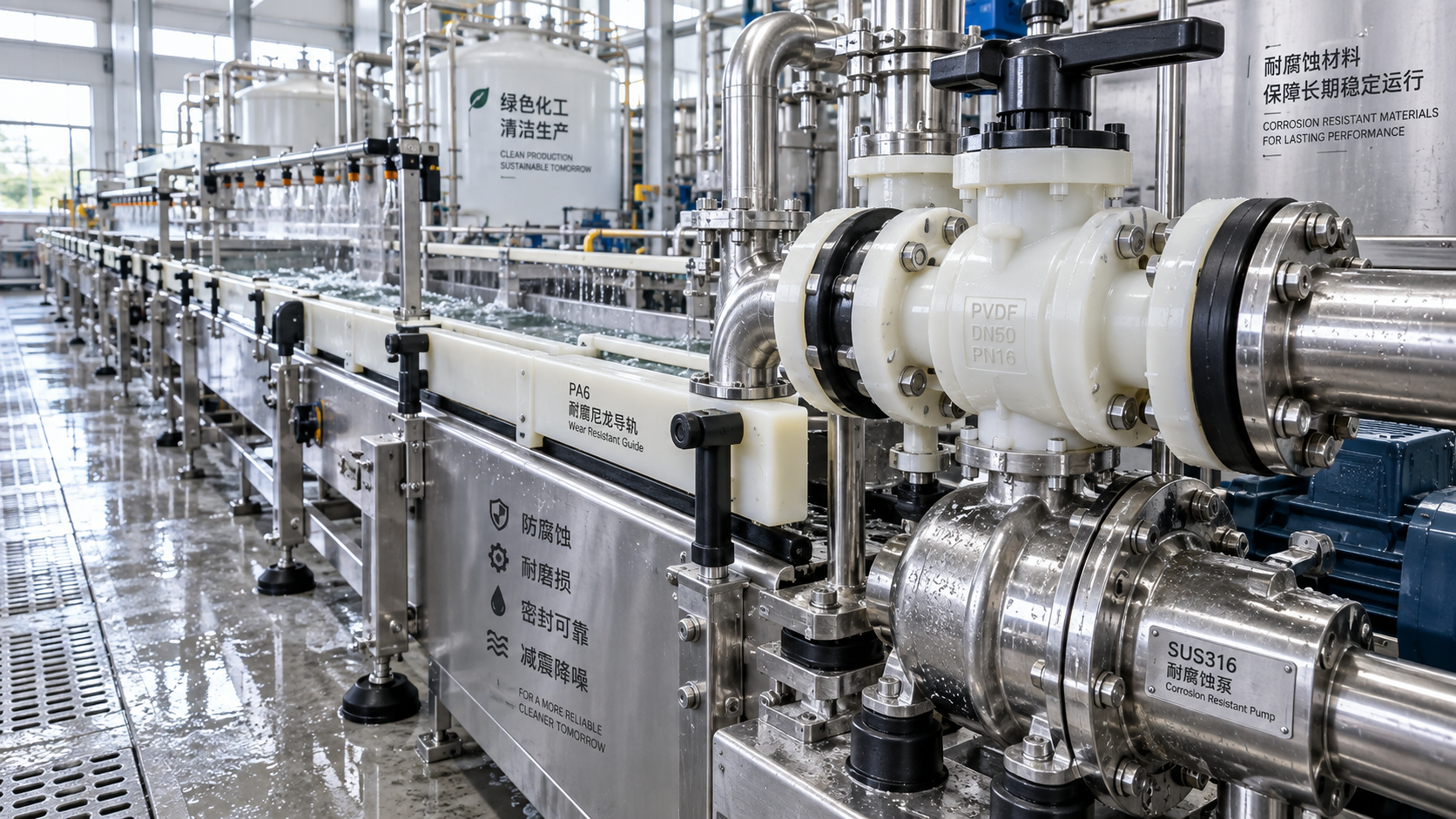
A durable part does not always need to be metal. In a pump room, processing line, outdoor enclosure, conveyor system, or electrical assembly, the failure risk may come less from load-bearing stress than from corrosion, repeated movement, vibration, moisture, chemical contact, or electrical exposure. In those conditions, plastics and rubber can be the right choice because they solve the failure mechanism directly rather than simply offering the highest possible strength.
The deciding question is not whether a plastic or elastomer is “strong enough” in general. It is whether the material can retain the required shape, function, and safety margin throughout its service life. Plastics are often appropriate for rigid, lightweight, corrosion-resistant components; rubber is usually selected where sealing, flexibility, damping, traction, or impact absorption is essential. They become poor choices when sustained loads, elevated temperatures, sharp abrasion, fire exposure, or dimensional precision exceed their practical limits.
Start with the condition that would make the part fail
A material selection can go wrong when the team begins with a familiar material name rather than the actual operating condition. A metal bracket may appear more substantial than a molded polymer bracket, for example, but it can introduce corrosion points, require protective finishing, add installation weight, or create unwanted electrical conductivity. Conversely, replacing a metal component with plastic solely to reduce weight can lead to creep, cracking, or distortion if the part remains under load for years.
Before comparing grades, define the failure mode that matters most. The same component may face several conditions at once, but one or two usually control the decision:
- Corrosion or chemical attack: Water treatment, marine equipment, cleaning processes, fertilizer handling, and chemical transfer systems often damage unprotected metals faster than expected.
- Repeated deflection: Seals, gaskets, flexible guards, rollers, bump stops, and cable protection parts need recovery after movement rather than high rigidity.
- Constant mechanical load: Structural supports, threaded joints, clamped covers, and mounted housings may deform gradually even when the initial load appears acceptable.
- Temperature cycling: A component can fit correctly at installation but loosen, harden, soften, or crack after repeated hot-cold changes.
- Electrical exposure: Insulation, arc resistance, static control, and conductivity requirements can eliminate otherwise suitable options.
- Surface wear: Sliding contact, particle abrasion, belt contact, and impact all demand a closer look at hardness, friction, and wear behavior.
These questions turn a broad material conversation into a practical selection exercise. A rigid cover exposed to washdown water is not evaluated in the same way as a flexible hose seal exposed to oil, even if both are described as “durable parts.”
Where plastics make a durable alternative
Engineering plastics are most useful when a part needs to be rigid but does not need to carry primary structural loads comparable to steel or cast metal. Their main advantages are corrosion resistance, low density, electrical insulation, design flexibility, and the ability to mold complex forms without multiple machining operations. They are commonly considered for housings, guards, liners, wear pads, bushings, valve components, electrical insulators, fluid-handling fittings, covers, spacers, and conveyor-related parts.
Not all plastics behave alike. A general-purpose polymer that works in a dry indoor enclosure may fail quickly in a heated chemical environment. The selection should therefore focus on the property that governs the application.
One frequent mistake is treating tensile strength as the complete answer. A plastic may show adequate strength in a short test but still be unsuitable for a bolted assembly under sustained load. This is because creep—slow deformation under constant stress—can reduce clamp force, alter alignment, or cause a contact surface to deform over time. Parts carrying static loads need a creep assessment at the expected operating temperature, not merely at room temperature.
Thermal expansion deserves the same attention. Plastics generally expand and contract more than metals. A long plastic panel fixed rigidly at multiple points can bow, buckle, or crack during temperature changes. Slots, floating mounts, compliant fasteners, and allowance for movement may be more important than increasing wall thickness.
Rubber is the better answer when controlled flexibility matters
Rubber and other elastomeric materials are selected for a different reason: they can deform repeatedly and recover while maintaining contact, absorbing energy, or isolating movement. This makes them suitable for gaskets, O-rings, diaphragms, vibration mounts, flexible couplings, hoses, wheel treads, protective boots, cable glands, seals, and impact pads.
The phrase “rubber part” is too broad for purchasing or design approval. The chemical family changes the result significantly. Natural rubber may offer useful resilience and abrasion behavior but is not a universal choice for oils or weathering. Nitrile rubber is often considered where petroleum oils are present. EPDM is frequently used where water, steam, weather exposure, or certain chemicals are relevant. Silicone can retain flexibility across a broad temperature range, while fluorinated elastomers are considered for more demanding chemical and temperature environments. Each choice still requires confirmation against the actual fluid, concentration, temperature, pressure, and exposure duration.
In sealing applications, hardness is only one part of the decision. A hard gasket may resist extrusion but fail to conform to uneven flange surfaces. A softer material may seal readily but become difficult to retain under pressure or may be damaged during installation. Seal geometry, groove design, compression range, pressure direction, surface finish, and assembly method can matter as much as the elastomer itself.
Do not confuse chemical resistance with service compatibility
A material data sheet may indicate resistance to a certain substance, but that does not automatically confirm suitability in the field. The result can change with concentration, temperature, immersion time, pressure, cycling, and the presence of mixed chemicals. Cleaning agents create a similar problem: a seal may tolerate the process fluid but swell or crack after repeated cleaning exposure.
Ask for compatibility confirmation using the exact media involved. “Oil resistant” is not enough when the system contains additives, solvents, fuels, high temperatures, or intermittent dry running. “Water resistant” does not answer whether hot water, steam, chlorinated water, or abrasive slurry will be present. This level of detail prevents a durable-looking part from becoming the shortest-lived item in the assembly.
Use a service profile before selecting a grade
Material names should come after the service profile, not before it. A concise profile gives design, procurement, and suppliers a common basis for comparison. It should describe what the component does, what it touches, and how it is installed.
- Define the function. Is the part supporting, separating, sealing, guiding, insulating, cushioning, or protecting? A guide rail and a load-bearing support may look similar in an assembly drawing but have very different requirements.
- Identify all contact conditions. Include process media, cleaning chemicals, airborne contaminants, UV exposure, dust, moisture, oils, and neighboring materials. Galvanic corrosion may be avoided with plastics, but trapped moisture or incompatible fasteners can still create system-level issues.
- Set the mechanical duty. Record static load, impact, vibration, movement frequency, sliding speed, contact pressure, and expected installation forces. Repeated low-level flexing can be more damaging than one occasional high load.
- Map the temperature range. Consider normal operation, startup, shutdown, cleaning cycles, outdoor seasonal conditions, and heat from adjacent equipment. A material that survives an average temperature may fail at short-duration peaks.
- State dimensional requirements. Include allowable clearance, mating-part tolerance, flatness, thread engagement, and whether the part must stay sealed after temperature changes or aging.
- Review fabrication and replacement needs. A custom-molded part may be suitable for repeat demand, while machined stock shapes or standard seals may offer more practical maintenance support for low-volume repairs.
This exercise also reveals when a mixed-material design is more reliable than forcing one material to perform every function. A metal insert can carry concentrated fastener loads while a polymer body provides corrosion resistance and reduced weight. A rubber seal can protect a rigid plastic or metal housing from fluid ingress. The interfaces between materials then need attention: differential expansion, adhesive compatibility, insert retention, and assembly sequence should be reviewed early.
Warning signs that plastics or rubber are being used beyond their limits
Material problems often show visible symptoms before a complete failure. In plastics, look for whitening at flex points, surface crazing, cracking around inserts, permanent bowing, loosened fasteners, abrasion grooves, or discoloration near heat sources. Rubber components may harden, soften, swell, become sticky, crack at bends, flatten permanently, or lose sealing force.
These symptoms should not automatically be blamed on poor material quality. A crack near a screw boss may indicate excessive torque, a sharp corner, insufficient wall thickness, or a metal insert that expands differently during temperature changes. A swollen seal may indicate fluid incompatibility, but it can also result from an incorrect cleaning product or a process temperature outside the original assumption.
For critical parts, review the failed geometry and the operating history together. Determine whether the damage is localized, whether it occurs after a particular cycle, and whether mating parts have changed. Replacing the same grade without correcting a design or operating condition can repeat the failure.
Cost decisions should include installation and maintenance exposure
The lowest unit price is rarely the full cost of a material decision. Plastics and rubber can reduce machining, coating, lifting, and handling requirements. They may simplify installation because the part is lighter, electrically insulating, or less likely to corrode in place. A well-selected polymer liner can be easier to replace than a corroded metal surface; a correctly specified gasket can prevent repeated disassembly caused by leakage.
At the same time, an inexpensive grade can create costly service work when it cannot tolerate the real conditions. The useful comparison is between complete options: part cost, fabrication route, expected inspection needs, downtime risk, replacement accessibility, and the consequences of failure. A low-cost wear strip may be acceptable where replacement is quick and safe. The same approach is unsuitable for a seal inside equipment that requires extended shutdown to access.
Information to request before releasing the part
Procurement documentation should make the required performance visible rather than relying on a generic description such as “plastic component” or “rubber gasket.” Specify the material family and grade where known, dimensions and tolerances, hardness for elastomeric parts where relevant, color or UV requirements if applicable, media and temperature conditions, expected operating pressure, and any restrictions on fillers, reinforcements, or recycled content.
For molded or fabricated parts, request confirmation of the manufacturing method and identify any features that need special control, such as thin sections, inserts, threads, sealing lips, weld lines, or critical flat surfaces. For replacement components, verify that the drawing revision, mating dimensions, and installation orientation are clear. These details are more useful than a broad claim that a material is “industrial grade.”
Questions that often affect the final decision
Can plastic replace metal in a load-bearing part?
Sometimes, but only when load type, duration, temperature, deflection limits, fastener design, and creep behavior have been assessed. It is more realistic to replace metal in covers, housings, guides, corrosion-exposed fittings, and secondary supports than in highly loaded structural members without redesign.
Is harder rubber always more durable?
No. Higher hardness can improve resistance to deformation or extrusion, but it can reduce conformity, flexibility, and low-temperature performance. The correct hardness depends on the sealing surface, compression range, pressure, and movement of the assembly.
When should a material specialist review the choice?
Additional review is warranted where the part is safety-related, pressure-retaining, exposed to aggressive chemicals, used at elevated temperatures, or difficult to replace after installation. Those conditions leave less room for selection based only on general material descriptions.
- Last One:No more articles
- Next Article:How recyclable thermoplastic elastomer affects sealing performanceOct 06, 2026
Technical Specifications
- When plastics and rubber are the right choice for durable partsAuthor :Polymers & Rubber Editorial Team
- How recyclable thermoplastic elastomer affects sealing performanceAuthor :Polymers & Rubber Editorial Team
- When does industrial equipment downtime justify replacing a machine?Author :Industrial Machinery Editorial Team
Expert Insights

Chief Security Architect
Dr. Thorne specializes in the intersection of structural engineering and digital resilience. He has advised three G7 governments on industrial infrastructure security.
Core Sector // 01
Security & Safety