
How to compare fire-resistant building materials for wall insulation
Author
Date Published
Reading Time
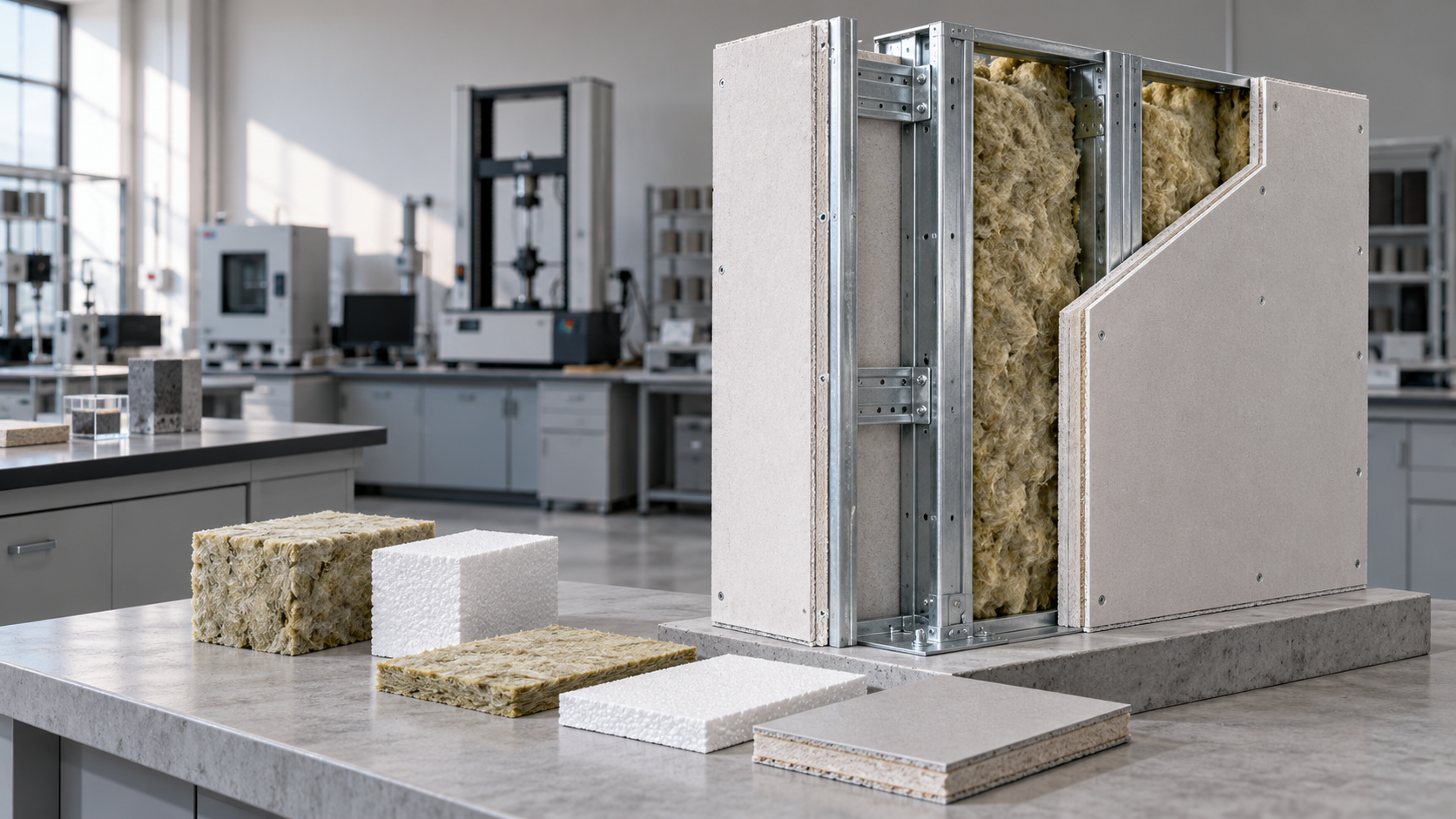
The most important distinction when comparing fire-resistant building materials for wall insulation is whether the evidence describes the insulation product or the complete wall. A material may have a favorable reaction-to-fire classification without establishing that a wall containing it will achieve a specified fire-resistance period. Conversely, a combustible insulation product may be permitted within a particular tested assembly, subject to the applicable code and the limits of that assembly’s approval.
A defensible selection therefore starts with the required wall construction and compliance route, not a supplier’s headline fire rating. Only after confirming that a proposed insulation is acceptable in that construction should thermal performance, moisture behavior, installation constraints, and installed cost determine the preferred option.
Establish what the wall must demonstrate
“Fire-resistant” is an imprecise product description. Before comparing quotations or technical data sheets, define the wall’s location, function, and required fire performance. An internal compartment wall, a loadbearing external wall, and insulation behind a ventilated rainscreen present different evaluation problems.
Record whether the wall must provide a fire-resistance period, restrict external fire spread, use materials meeting a prescribed combustibility classification, or satisfy several requirements simultaneously. Building height, occupancy, construction type, and jurisdiction can change the applicable route. A successful test does not override a separate restriction on the materials permitted in that location.
The distinction between three types of evidence is particularly important:
Under the European classification system, EN 13501-1 addresses reaction to fire, while EN 13501-2 covers fire-resistance classification using relevant test evidence. An A1 or A2 classification is not interchangeable with an EI 60 classification. The former concerns reaction to fire; the latter concerns integrity and insulation for a classified period. Loadbearing elements may also require an R criterion.
In North American specifications, ASTM E84 surface-burning results are not equivalent to an ASTM E119 or UL 263 fire-resistance rating. An ASTM E84 “Class A” designation does not establish noncombustibility. NFPA 285 addresses exterior wall assembly fire propagation where required by the applicable code. These test methods answer different questions and should occupy separate fields in a comparison schedule.
Compare material families without treating them as approvals
Material chemistry provides a useful screening tool, but it cannot replace product-specific evidence. Facings, binders, density, thickness, and manufacturing formulation can affect performance. A classification for an unfaced product should not automatically be assigned to a foil-faced or laminated version.
Where a specification explicitly requires noncombustible insulation, options supported by the required noncombustibility evidence become the practical starting point. Where combustible insulation is allowed through an approved assembly route, the comparison remains open—but only among products supported for the proposed construction.
A higher melting temperature is not a substitute for wall fire-resistance evidence. Wall failure can be governed by board joints, fasteners, frame deformation, loss of protective linings, or heat transfer before the insulation core reaches its melting temperature.
Read the tested construction before accepting the rating
The useful question is not simply whether a product has been tested, but whether the proposed wall falls within the evidence’s permitted scope. Obtain the relevant classification, listing, or assessment and the supporting construction details. A certificate cover page or a laboratory logo is insufficient.
Compare the proposed design against the documented configuration, including:
- Insulation identity, thickness, density range, facing, and orientation.
- Stud material, stud dimensions, spacing, and wall height limits.
- Sheathing and lining types, layer counts, thicknesses, and joint arrangements.
- Fastener type, spacing, embedment, and attachment method.
- Cladding, cavity depth, membranes, cavity barriers, and opening details.
- Fire-exposure direction and loadbearing conditions, where relevant.
Changing a named insulation to another product with the same thermal conductivity does not establish equivalent fire performance. Neither does increasing insulation thickness necessarily preserve the rating. Changes can alter cavity geometry, heat transfer, combustible content, and the interaction between layers.
Some changes are permitted through a test method’s field of application, an extended application, a listed design option, or an accepted technical assessment. Their validity depends on the governing approval route. A supplier’s general statement that a substitution is “equivalent” should not be treated as authorization.
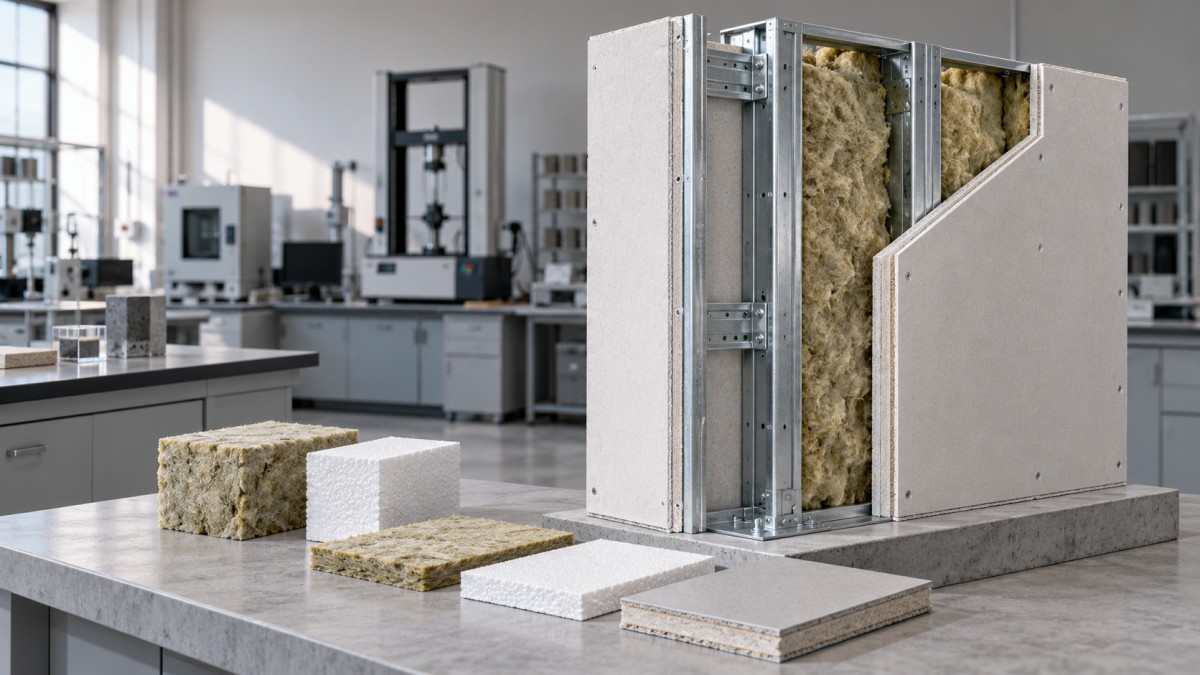
For exterior walls, pay particular attention to window openings, cavity barriers, and transitions between systems. These details influence fire entry and propagation. Passing an assembly test such as NFPA 285—or a BS 8414 test assessed under the relevant acceptance framework—does not make every façade containing the same insulation compliant. Results from different national systems are not automatically interchangeable.
Normalize thermal performance at wall level
Once fire compliance is established, compare insulation at the required whole-wall thermal performance rather than equal board thickness. A product with lower thermal conductivity may achieve the target within a thinner build-up, but that advantage can be reduced by metal framing, brackets, fasteners, gaps, and discontinuities.
For a homogeneous insulation layer, thermal resistance is calculated as thickness divided by thermal conductivity: R = t/λ. Using illustrative values, a 100 mm layer at 0.036 W/(m·K) provides approximately 2.78 m²·K/W, while a layer at 0.022 W/(m·K) needs about 61 mm to provide the same nominal resistance. These are calculation examples, not product performance claims.
The wall U-value requires an appropriate calculation that includes framing and relevant thermal bridges. Continuous exterior insulation and insulation placed between metal studs cannot be compared reliably using the insulation R-value alone.
Use declared or design thermal conductivity values on a consistent basis. Check the reference temperature, aging treatment where applicable, and any corrections required for service conditions. Comparing an initial foam conductivity with another product’s declared long-term value can create a misleading thickness advantage.
Thickness also affects fire compliance. A thermally optimized redesign may require a different insulation thickness, bracket arrangement, or cavity depth from the approved wall. Recheck the evidence rather than treating the thermal calculation as an independent decision.
Moisture and installation can overturn the apparent preference
Water absorption, water-vapor resistance, and airtightness are different properties. A hydrophobic fibrous product is not a waterproof layer. A low-permeability board does not guarantee an airtight installation. A foil facing may strongly resist vapor diffusion while still allowing air leakage through unsealed joints.
Evaluate the complete wall’s wetting and drying paths. Climate, indoor humidity, air-conditioning conditions, rain exposure, and the position of vapor-resistant layers influence condensation risk. Adding low-permeability insulation to an existing wall can change its drying capacity; choosing vapor-open insulation does not by itself resolve air leakage or rain penetration.
Where the build-up creates a significant moisture concern, use a suitable hygrothermal assessment rather than selecting by a single vapor-resistance value. Include construction moisture and the condition of existing substrates in refurbishment work.
Installation tolerances should also influence selection. Flexible batts depend on accurate cutting and retention to avoid gaps or slumping. Rigid boards require close-fitting joints, appropriate support, and detailing around irregular substrates. Excessive compression changes thickness and can invalidate declared performance assumptions. Spray-applied products require control of application conditions, installed thickness, and other parameters specified by the manufacturer and approval.
The practical choice is the compliant system whose critical installation conditions can be achieved and inspected on the project—not merely the material with the strongest isolated laboratory result.
Make document quality part of the acceptance decision
Require documentation for the exact product being supplied, including its trade name, manufacturer, production identification, facing, and declared specification. For imported products, similar branding or appearance is not proof that the supplied version matches the tested one.
A useful evidence package contains the applicable declaration or certification, relevant classification or listing, construction details, installation instructions, and traceability information. Confirm that the issuing organization and certification status can be checked. Where full reports are restricted, obtain sufficient authenticated detail to establish scope and limitations.
Keep smoke claims equally disciplined. An EN 13501-1 smoke classification and an ASTM E84 smoke-developed index arise from different methods; they are not directly interchangeable and do not constitute a comprehensive assessment of combustion-gas toxicity.
Treat missing evidence as an unresolved approval issue, not a minor scoring disadvantage. A product with excellent thermal performance and an incomplete compliance record should remain conditional until the gap is closed.
Compare the cost of compliant walls, not insulation alone
The meaningful cost comparison includes insulation, protective boards, subframing, cavity barriers, fixings, membranes, labor, waste, inspection, and any assessment required for deviations. A lower insulation price may be offset by additional protective construction. A thinner board may reduce reveal or bracket dimensions, but only where those changes remain within the approved design.
Separate acceptance criteria from preferences in the final comparison. Required fire classifications, assembly approval, and moisture suitability are pass-or-fail conditions. Among options that pass, compare whole-wall thermal performance, build-up depth, installation reliability, and installed cost.
Record the selected product together with the approved wall reference, permitted variations, required installation controls, and substitution procedure. That record makes the specification defensible: it links the material delivered to the construction assessed, rather than relying on an undefined claim that the insulation is “fire resistant.”
Facing technical bottlenecks in manufacturing or looking for more efficient industrial solutions? Leave your details below and let the engineering experts at GIi solve them for you.
“We respect your privacy. Your information is strictly confidential.”
Technical Specifications
- How to verify the consistency of PVC resin from a supplier in EuropeAuthor :Polymers & Rubber Editorial Team
- How to choose polyethylene grades in Saudi Arabia for film productionAuthor :Polymers & Rubber Editorial Team
- US Finds Imported Robots a Security Threat, Defers Tariffs for 180 DaysAuthor :Industrial Machinery Editorial Team
Expert Insights

Chief Security Architect
Dr. Thorne specializes in the intersection of structural engineering and digital resilience. He has advised three G7 governments on industrial infrastructure security.
Core Sector // 01
Security & Safety