How to evaluate a TPE material supplier for batch consistency
Author
Date Published
Reading Time
How to evaluate a TPE material supplier for batch consistency
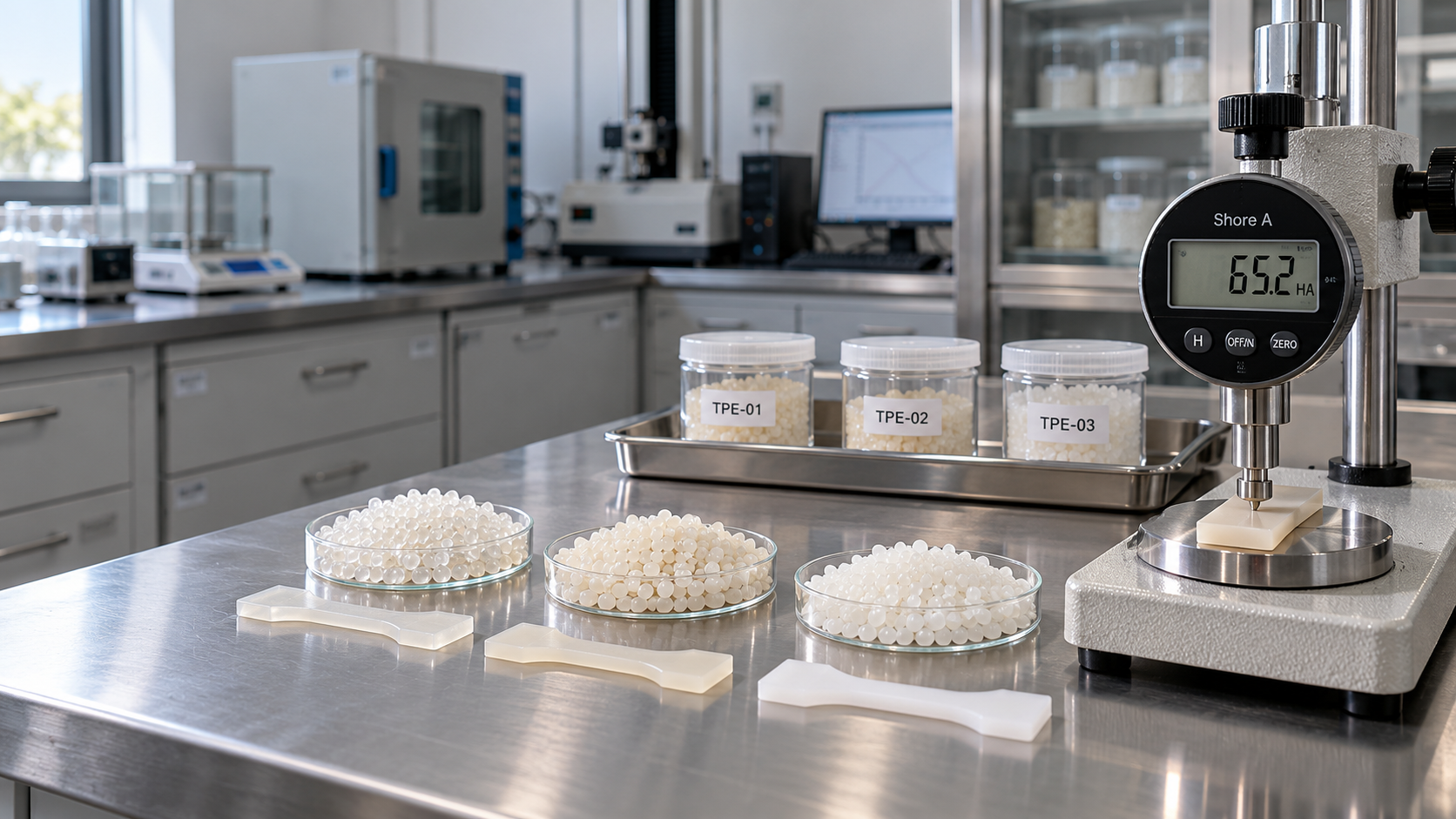
A sample that performs well does not guarantee consistent results across production batches. For procurement teams, choosing a TPE material supplier means checking whether routine shipments can meet agreed specifications for hardness, flow, color, and application-critical properties. Inconsistent material can mean processing adjustments, rejected parts, and delayed deliveries—costs that a low purchase price may not offset.
The useful question is not simply, “Can you make this grade?” It is, “What evidence shows that you can keep making it, and what happens when something changes?” That shifts the evaluation from sample approval to production control.
Define consistency around the part, not just the datasheet
TPE covers several material families, including styrenic compounds, thermoplastic vulcanizates, and thermoplastic polyurethane. They do not share one universal acceptance specification. A compound suitable for a soft-touch grip may be unsuitable for a seal, even when the nominal hardness matches.
Start with the failures your application cannot tolerate. A seal may depend on compression set and resistance to its service environment. An overmolded handle needs reliable adhesion to the specified substrate. Thin-wall molding may expose flow differences that a simple test plaque does not reveal. Visible consumer parts can pass mechanical checks but still fail because of gloss, color, or surface defects.
Translate those risks into a purchasing specification. Separate properties needed for every-lot release from those checked during qualification or periodic verification. Testing everything on every shipment can add cost without improving control; testing only hardness can leave the actual failure mechanism unmonitored.
Methods such as ASTM D2240 or ISO 48-4 for hardness, and ASTM D1238 or ISO 1133-1 for melt flow, can provide a common reference where applicable. Naming a standard alone is not enough: the agreed conditions and applicable procedure must accompany it. Do not assume results from different methods are interchangeable.
Ask for production history, not another perfect sample
A development sample demonstrates feasibility. It may have been produced on a pilot line, adjusted carefully, or selected from a favorable run. None of that makes it dishonest, but it limits what the sample proves.
Request results from multiple independently produced commercial lots of the proposed grade. Where confidentiality prevents disclosure of customer information, anonymized lot data should still allow you to examine dates, test conditions, and variation. Ask whether the material came from the same site and production route intended for your orders.
Look beyond pass or fail. Results repeatedly close to a specification limit leave less room for measurement differences or normal production movement. A gradual trend can deserve investigation even while every lot remains compliant. Conversely, identical reported values are not automatic proof of poor practice; rounding or reporting resolution may explain them. Ask for the underlying records before drawing conclusions.
Capability indices can support this review, but only when the process is stable and the measurement system and dataset are suitable. A capability number without its sampling basis, time period, and specification limits is weak purchasing evidence.
Read the certificate of analysis as a release record
A technical datasheet usually describes typical properties. A certificate of analysis, or CoA, should identify what supports release of the supplied lot. Procurement teams should establish whether listed values are actual lot measurements, calculated results, or typical figures copied from a product specification.
A useful CoA connects the exact grade and lot number with agreed limits, units, methods, and results for the release tests. Not every application property needs testing on every batch, but the distinction between lot-tested and periodically verified properties should be explicit.
Ask how samples represent the batch. A single grab sample may miss variation during a long compounding run. The appropriate sampling plan depends on the process, batch definition, and risk; there is no universal sample count that makes every TPE shipment reliable.
Also agree what happens when your incoming result differs from the supplier’s. Compare specimen preparation, conditioning, instrument calibration, and test settings before declaring the material defective. For disputed results, retained samples and a pre-agreed independent laboratory can prevent an argument from consuming the delivery window.
Follow one bag backward through the factory
During an audit, select a finished-material lot and ask the supplier to trace it backward. The record should connect finished bags to production records, relevant raw-material lots, formulation revision, processing information, and quality-release status. Then trace forward: which shipments received material from that production lot?
This exercise is more revealing than a presentation about traceability software. It shows whether the system works across warehouse, production, laboratory, and dispatch records.
Ask what “batch” actually means. It might refer to a mixer charge, an extrusion run, or a blended release lot. If several production runs are combined, the supplier should explain how they preserve traceability and demonstrate uniformity. Approved blending is not inherently unacceptable; undocumented blending is a different matter.
The factory controls worth examining include raw-material identification, weighing verification, feeder checks, line clearance, and segregation of nonconforming material. Where rework, regrind, or recycled feedstock is permitted, its use needs defined limits and traceable records. A “virgin material” requirement should be stated clearly rather than assumed.
Find out what can change without your approval
A compound can retain its grade name while a polymer source, oil, filler, pigment, or manufacturing location changes. Some changes may have little effect on your application. Others may alter odor, adhesion, appearance, or processing behavior without pushing routine release properties outside their limits.
Request a written change-notification agreement covering relevant raw-material substitutions, formulation changes, production-site transfers, and major process changes. Define which changes require notification, which require approval, and what validation evidence is expected. The notice period should give your team enough time to test and manage stock, not merely inform you after dispatch.
Do not confuse management-system certification with product consistency. ISO 9001 certification can support confidence in documented processes when its scope covers the relevant operation, but it does not prove that a particular lot meets your specification. Likewise, regulatory declarations address their stated requirements; they do not replace performance testing. Verify document scope, grade identity, and applicability to the destination market and end use.
Qualify several lots under controlled production conditions
A practical qualification should include material from separate production lots, not several bags from one run. Agree the number and scale according to application risk, available history, and the cost of failure. Higher-consequence parts justify more extensive validation than a noncritical decorative component.
Use your intended equipment, tooling, substrate, and preparation procedure. Establish a documented processing baseline, then record any adjustments needed for each lot. Otherwise, operators may compensate for material variation and unintentionally hide it from the qualification report.
For an overmolded part, for example, compare adhesion using a defined test and conditioning procedure, not just a hand pull immediately after molding. For visible components, compare surfaces under agreed lighting after the relevant conditioning period. Include aging or service exposure where the application requires it.
Separate supplier variation from handling problems. Moisture-sensitive materials such as many TPU grades may need controlled drying, while other TPE compounds have different requirements. Follow grade-specific guidance and record storage, bag condition, and preparation. Transit-damaged packaging or poor warehouse control can undermine an otherwise consistent compound.
Compare cost per accepted part—and the response when things go wrong
The cheapest delivered kilogram is not necessarily the cheapest usable material. Compare quotations alongside actual yield, purge consumption, inspection effort, processing stability, and disruption risk. Include freight and duties where relevant, but avoid inventing a precise failure cost when you lack operating data. Use your trial results and clearly stated assumptions instead.
For distributors and importers, establish who owns the formulation, issues the CoA, retains samples, and investigates complaints. Commercial responsiveness is useful, but the seller also needs dependable access to the actual manufacturer’s technical records and decision-makers.
Before approval, ask how a suspect shipment is contained, how replacement material is authorized, and how affected lots are identified. Agree responsibilities for investigation and disputed-material handling in writing. A supplier promising immediate answers to every technical complaint may be less credible than one offering a clear containment step followed by evidence-based analysis.
Approve the TPE material supplier when the evidence connects: application-specific limits, representative production history, traceable release records, successful multi-lot trials, and enforceable change controls. If a key link is missing, keep the approval conditional and define what must be demonstrated before routine purchasing begins.
Facing technical bottlenecks in manufacturing or looking for more efficient industrial solutions? Leave your details below and let the engineering experts at GIi solve them for you.
“We respect your privacy. Your information is strictly confidential.”
Technical Specifications
- How to verify the consistency of PVC resin from a supplier in EuropeAuthor :Polymers & Rubber Editorial Team
- How to choose polyethylene grades in Saudi Arabia for film productionAuthor :Polymers & Rubber Editorial Team
- US Finds Imported Robots a Security Threat, Defers Tariffs for 180 DaysAuthor :Industrial Machinery Editorial Team
Expert Insights

Chief Security Architect
Dr. Thorne specializes in the intersection of structural engineering and digital resilience. He has advised three G7 governments on industrial infrastructure security.
Core Sector // 01
Security & Safety
- How to verify the consistency of PVC resin from a supplier in EuropeAuthor :Polymers & Rubber Editorial Team

- How to choose polyethylene grades in Saudi Arabia for film productionAuthor :Polymers & Rubber Editorial Team

- When is a recyclable thermoplastic elastomer suitable for seals?Author :Polymers & Rubber Editorial Team

- How to choose the right hardness for thermoplastic elastomersAuthor :Polymers & Rubber Editorial Team

- BASF, Chery and Coordinate Showcase EMB Brake-by-Wire System for Series ProductionAuthor :Polymers & Rubber Editorial Team

- India’s Bottle-Grade PET Resin Market Holds Steady on Festive DemandAuthor :Polymers & Rubber Editorial Team

- How to evaluate a TPE material supplier for batch consistencyAuthor :Polymers & Rubber Editorial Team

- Which appliance resins withstand repeated hot-water exposure?Author :Polymers & Rubber Editorial Team