How to assess an injection molding machine supplier's local support
Author
Date Published
Reading Time
How to assess an injection molding machine supplier's local support
A competitive machine price can lose its appeal when a breakdown leaves production waiting for service or spare parts. For procurement teams, assessing an injection molding machines supplier means verifying what local support actually delivers—not simply accepting a promise of nearby coverage. Technician availability, parts inventory, response commitments, and experience with the equipment being purchased all deserve scrutiny before the purchase agreement is signed.
The useful question is not “Do you have local service?” It is “What happens when this particular machine stops during our production shift?” A supplier that can answer with named responsibilities, documented resources, and realistic limitations is easier to assess than one offering broad assurances.
Find out who will actually arrive at your factory
“Local support” can mean a manufacturer-owned service branch, an authorized distributor, an independent contractor, or a salesperson who calls the overseas factory. None of these arrangements is automatically unsuitable. The problem is buying under one assumption and discovering a different arrangement after installation.
Ask for the legal entity responsible for service, its operating address, and the technicians assigned to your area. Establish whether those technicians are employees or subcontractors, which machine brands they cover, and who authorizes warranty work. A distributor may diagnose a fault locally but still require factory approval before replacing an expensive component.
Headcount alone tells you little. A small team near your plant may offer better coverage than a larger team spread across several countries. Ask how technicians are allocated when commissioning work overlaps with breakdown calls, and who provides cover during leave or simultaneous failures. An organization chart without a backup arrangement is not much protection.
Check competence against the exact machine configuration
Experience with hydraulic molding machines does not automatically establish competence with all-electric models, unfamiliar servo drives, or a different controller generation. Even within one manufacturer's range, troubleshooting procedures and required software can differ.
Give the supplier your proposed configuration and ask who has serviced that combination: machine series, controller, clamping system, injection unit, drives, and automation interfaces. Request relevant training records or a description of comparable installed equipment. Evidence should relate to the proposed machine, not merely to the brand.
A technical discussion is revealing. Ask how the team would distinguish a machine fault from a process, mold, material, or utility issue when shot weight becomes unstable. A credible response should consider evidence such as actual versus set values, material preparation, temperature behavior, and injection-system condition—not jump straight to replacing a component.
Also define the boundary of responsibility. If a robot handshake prevents automatic operation, who coordinates the machine supplier and robot integrator? Buyers can lose considerable time when each service team declares its own equipment healthy and leaves the interface problem unresolved.
Separate a quick reply from a production recovery commitment
A promise of “24-hour response” is ambiguous. It could mean an automated acknowledgment, a call from an engineer, or attendance at the plant. These are different services, and none necessarily means production will restart within that period.
Ask suppliers to distinguish the milestones below in their proposals. The timing should reflect your location, operating hours, and production risk rather than a generic sales commitment.
Use a clearly identified hypothetical breakdown to test the process before ordering. Describe a stopped machine, provide sample alarm information, and ask the supplier to explain the contact route and escalation steps. Do not disguise the exercise as a real emergency. The purpose is to expose handoff gaps, not to divert working technicians.
Inspect spare-parts readiness, not just warehouse size
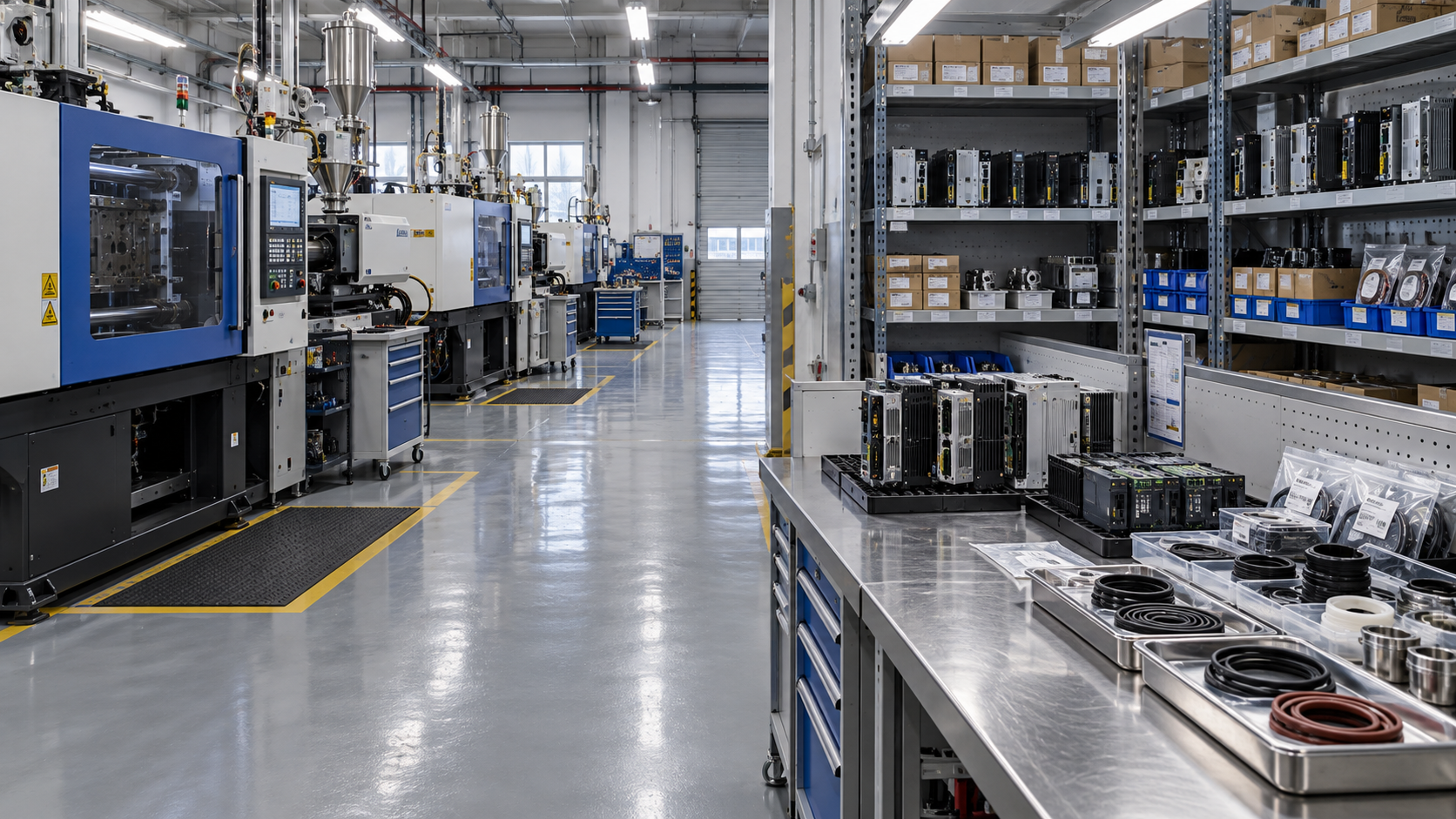
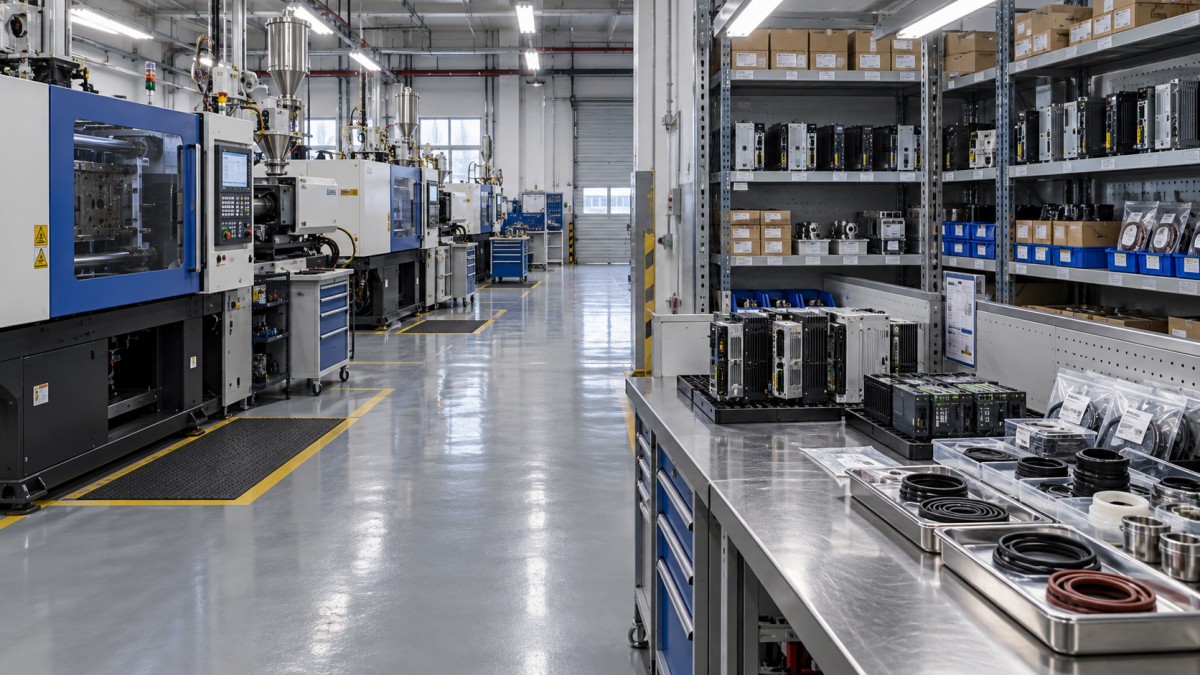
A warehouse visit is useful only if you check parts relevant to your machine. Shelves of seals and heater bands do not prove that the supplier can recover a failure involving a controller module, servo drive, position transducer, or model-specific valve.
Request a proposed critical-spares list tied to the machine specification. For each item, establish whether it is physically stocked locally, held at a regional hub, or ordered from the factory. Ask whether inventory is available for your purchase or already reserved for another customer. Stock reports are a snapshot, so discuss replenishment arrangements as well.
Compatibility matters as much as availability. An apparently identical electronic module may need the correct firmware, parameter file, license, or commissioning procedure. Ask whether the local technician can install and configure it, and whether current machine backups will be retained securely.
For imported parts, separate factory availability from arrival at your plant. Export processing, customs clearance, courier schedules, and the identity of the importer can all affect delivery. “In stock at headquarters” is not a local recovery plan. Trade and logistics news can flag disruption risks, but the supplier should explain the actual supply route for your order.
There is a purchasing trade-off here. Keeping every expensive component on-site may be unjustified. A practical arrangement combines selected plant-held consumables and critical spares with verified regional stock for costlier items. Base that choice on production criticality, machine redundancy, and confirmed replacement lead times—not a standard spare-parts package alone.
Treat commissioning as part of support, not a separate sales promise
Support quality becomes visible before the first breakdown. Ask who checks site readiness, supervises installation, establishes machine backups, and trains each operating shift. Clarify responsibility for power supply, cooling water, compressed air, lifting equipment, and connections to auxiliary machinery.
Acceptance should distinguish machine functionality from application performance. A supplier may demonstrate machine operation without proving that your mold, resin, and auxiliaries can sustain the required production conditions. If an application trial is part of the purchase, document the materials, tooling, utilities, measurements, and acceptance criteria in advance.
Training should leave the plant with usable knowledge: alarm interpretation, preventive maintenance tasks, backup procedures, and clear escalation instructions. Confirm which tasks operators and maintenance staff are authorized to perform. Remote guidance must not become a reason to bypass guarding, interlocks, or site isolation procedures.
Use customer references to investigate difficult service events
Ask to speak with customers using a similar machine generation within the same service territory. A reference elsewhere may validate the equipment but say little about your local support team. Where possible, speak with a maintenance manager or production engineer rather than relying solely on a purchasing reference.
The most useful question is not whether the customer likes the supplier. Ask them to describe a difficult service event: how diagnosis started, whether the first visit had the right tools, where replacement parts came from, and who maintained communication. Respect confidentiality; you do not need production volumes or commercially sensitive details to understand the service process.
Listen for repeated workarounds. A machine eventually repaired after several visits is a different proposition from one restored through a coordinated visit with the correct part. Equally, one delayed repair does not establish poor service. Consider the cause, the supplier's communication, and whether corrective action followed.
Put the service arrangement into the commercial comparison
Machine quotations rarely make support costs directly comparable. Request labor rates, travel charges, minimum callout fees, overtime terms, remote-support charges, and any subscription requirements. Check when warranty coverage starts and whether it includes diagnosis, labor, travel, freight, and replacement parts. Warranty duration alone does not answer these questions.
For connected diagnostics, involve your IT team before purchase. Confirm remote-access approval, authentication, access logging, and whether support remains available without a permanent internet connection. Also ask about controller support life, replacement-part availability, and the process for communicating obsolescence. A new machine should not arrive with an unexplained dependency on unsupported software.
Compare offers using your own downtime exposure. Consider affected contribution margin, restart scrap, overtime, and external production costs where applicable, while avoiding double-counting. There is no universal hourly downtime figure. A lower purchase price may remain the right choice for a plant with spare capacity; it may be much less attractive for a single-machine production bottleneck.
Before issuing the purchase order, attach the agreed support scope to the contract. Name the responsible service entity, define response milestones, record stock commitments, and document escalation and warranty exclusions. If distribution arrangements change, establish who remains responsible for support.
The strongest supplier is not necessarily the one promising the fastest recovery in every situation. It is the one that can show how recovery will work for your machine, at your plant, with the people and parts actually available—and is willing to put those commitments in writing.
Facing technical bottlenecks in manufacturing or looking for more efficient industrial solutions? Leave your details below and let the engineering experts at GIi solve them for you.
“We respect your privacy. Your information is strictly confidential.”
Technical Specifications
- How to verify the consistency of PVC resin from a supplier in EuropeAuthor :Polymers & Rubber Editorial Team
- How to choose polyethylene grades in Saudi Arabia for film productionAuthor :Polymers & Rubber Editorial Team
- US Finds Imported Robots a Security Threat, Defers Tariffs for 180 DaysAuthor :Industrial Machinery Editorial Team
Expert Insights

Chief Security Architect
Dr. Thorne specializes in the intersection of structural engineering and digital resilience. He has advised three G7 governments on industrial infrastructure security.
Core Sector // 01
Security & Safety
- How to assess an injection molding machine supplier's local supportAuthor :Industrial Machinery Editorial Team

- How to assess an injection molding manufacturer’s quality controlAuthor :Industrial Machinery Editorial Team

- Injection Molding Defects and How to Prevent ThemAuthor :Industrial Machinery Editorial Team