
Which plumbing materials are best suited to hard-water systems?
Author
Date Published
Reading Time
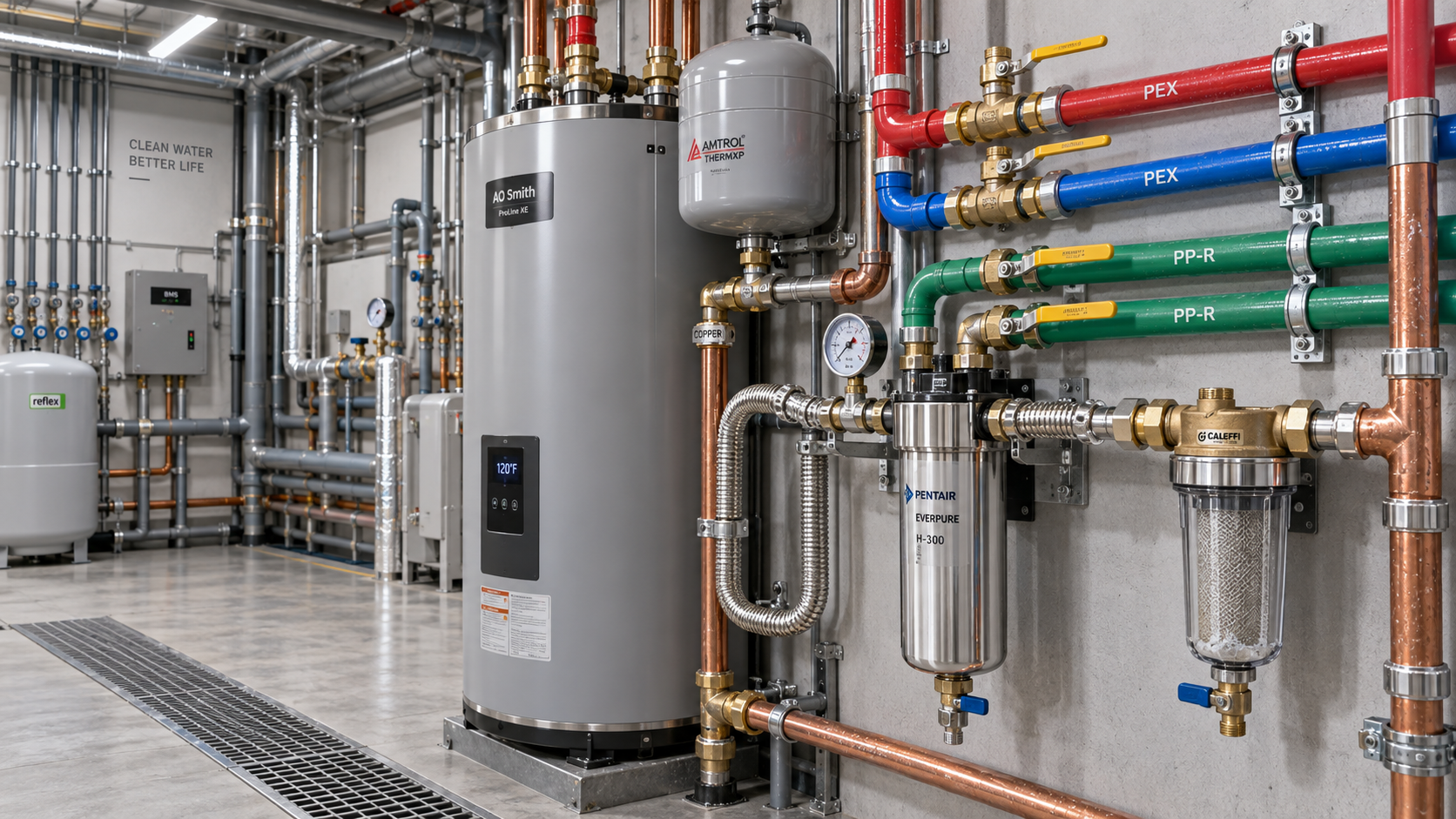
Hard water rarely causes an immediate plumbing failure. Instead, it leaves a slow, visible trail: white deposits around faucets, reduced shower pressure, noisy water heaters, sticking valve cartridges, and fittings that become difficult to service after only a few years. For technical evaluators, the question is not simply which pipe “survives” hard water. The more useful question is which plumbing materials will maintain flow, seal reliably, tolerate operating temperatures, and remain practical to inspect or replace over the expected life of the system.
Water hardness is primarily caused by dissolved calcium and magnesium salts. These minerals are not inherently corrosive in the same way as strongly acidic water, but they can precipitate as scale when water is heated, pressure changes, or evaporation occurs. The resulting deposits affect every part of a plumbing network differently. A smooth plastic pipe may remain largely unaffected internally, while a brass valve body, heater element, aerator, or narrow passageway can collect scale quickly.
That distinction matters when selecting materials for residential buildings, hotels, commercial kitchens, healthcare facilities, light industrial plants, and distribution projects in hard-water regions. Pipe material is only one part of the decision. Fittings, valves, heat exchangers, flexible connectors, joining methods, and maintenance access often determine whether a system performs well in real use.
Short answer: the strongest material choices depend on where they are used
For most cold- and hot-water distribution systems, PEX, CPVC, polypropylene random copolymer (PP-R), and properly specified copper are commonly viable choices in hard-water environments. Stainless steel can be highly durable in selected commercial or industrial applications, but it must be matched to the actual water chemistry. Brass remains widely used for valves and fittings, although alloy selection is important. Galvanized steel is generally the least attractive option for new hard-water plumbing systems because scale and corrosion can combine to reduce its internal diameter over time.
There is no universal winner. PEX may be the best practical choice for a complex residential retrofit; PP-R may suit a building with a welded thermoplastic distribution strategy; copper may still be preferred where fire performance, local code practice, or mechanical robustness matters; and stainless steel may justify its cost in demanding service areas. A technically sound specification begins with the service conditions rather than a material preference.
Why hard water changes the selection process
Scale is most aggressive where water is hot, stagnant, turbulent, or forced through small openings. That is why a system can have relatively clean main pipes but frequent problems at mixing valves, water heater connections, showerheads, solenoid valves, flow meters, and appliance supply lines.
Hardness should also be evaluated alongside pH, alkalinity, chloride concentration, dissolved oxygen, disinfectant residuals, temperature, and conductivity. A water supply described simply as “hard” may still have chemistry that creates a separate corrosion risk. For example, copper and stainless steel may perform very differently in water containing elevated chlorides, while certain brass alloys may require attention to dezincification resistance. A hardness test alone is not a complete material compatibility assessment.
Technical teams should avoid assuming that scale is always protective. In some conditions, mineral deposits can form unevenly and create localized environments beneath the deposit. They can also trap debris, interfere with moving parts, and make it harder to detect early leakage or corrosion. The system’s practical reliability depends on how deposits interact with its geometry and components.
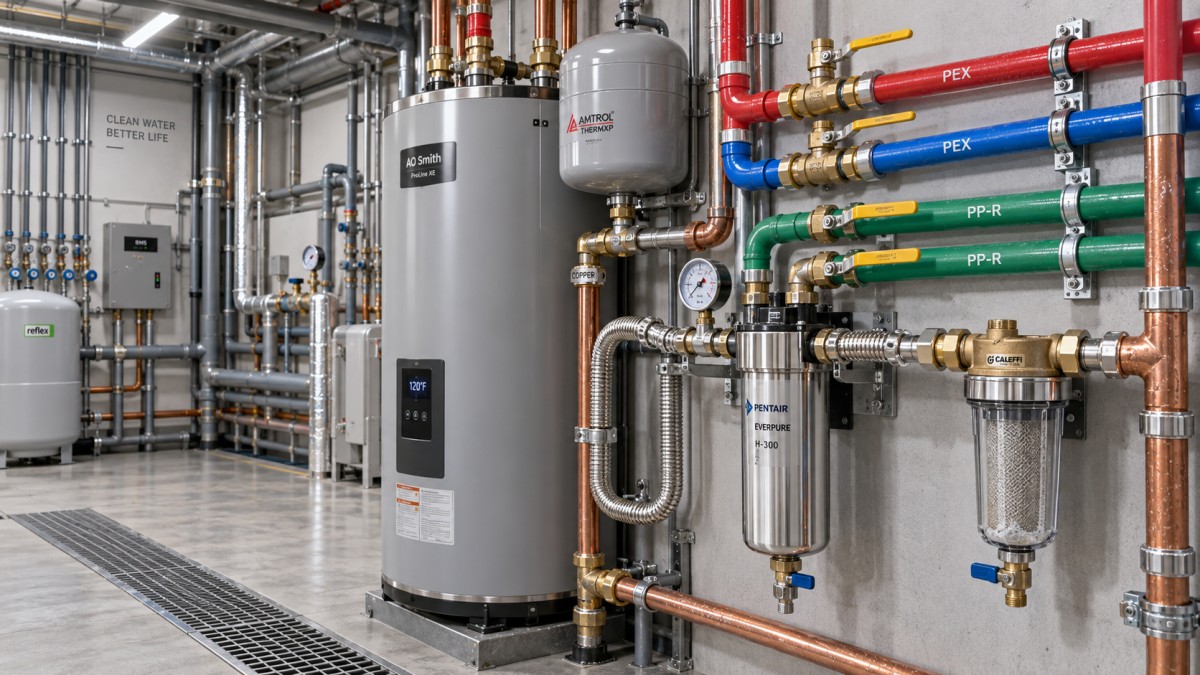
How common plumbing materials compare in hard-water systems
PEX: a practical option where flexibility and low scaling tendency matter
Cross-linked polyethylene (PEX) is widely selected for potable-water distribution because its smooth internal surface is less likely to accumulate mineral scale than rougher metallic piping. It does not corrode electrochemically, and its flexible form reduces the number of fittings required in many layouts. Fewer joints can mean fewer localized restrictions and fewer potential service points.
PEX is particularly attractive in residential construction, multifamily projects, and retrofit work with complex routing. However, it is not a cure for hard-water problems downstream. Faucets, valves, heaters, and appliances will still see mineral deposits. Specifiers must also confirm the pipe’s temperature and pressure rating, local code acceptance, UV exposure limitations, and compatibility with the intended disinfectant regime. Plastic piping should not be treated as interchangeable across all hot-water applications.
The fitting system deserves as much attention as the tube. Some connection styles introduce a smaller internal passage than the pipe itself, which can become more noticeable in high-demand or scale-prone installations. For hard-water service, a manifold layout or a system designed with accessible isolation valves may provide more long-term value than choosing a marginally different tubing grade.
CPVC: durable for hot water, but installation discipline is essential
Chlorinated polyvinyl chloride (CPVC) has long been used in domestic hot- and cold-water systems. Its corrosion resistance and relatively smooth bore make it a sensible choice where mineral scale is a concern. It is generally more suitable for hot-water service than standard PVC, provided the design stays within the manufacturer’s pressure-temperature limits.
Its limitations are mostly mechanical and installation-related. CPVC can be more vulnerable to impact damage than metal systems, requires correct support spacing, and depends on proper solvent-cement joining procedures. In tightly packed service shafts or exposed commercial areas, its physical protection and accessibility should be considered carefully. Compatibility with insulation materials, sealants, and cleaning products should also be checked rather than assumed.
PP-R: strong performance for planned building systems
PP-R is frequently used in large residential, hospitality, institutional, and commercial water installations. It offers good resistance to internal corrosion and mineral scaling, and heat-fused joints create a continuous connection without threaded metal interfaces inside the waterway. That can be an advantage where a project seeks a long-lived, low-leakage distribution system.
The trade-off is that PP-R installation depends on trained fusion practice, correct heating tools, appropriate alignment, and good site quality control. Thermal expansion is also a design issue, especially on long hot-water runs. A technically capable contractor can manage these requirements well; a poorly controlled installation can negate the material’s strengths. For buyers comparing global suppliers, consistency of pipe dimensions, fusion parameters, and documented system compatibility is worth reviewing.
Copper: proven, but water chemistry must support it
Copper remains a respected plumbing material due to its temperature capability, mechanical strength, established installation base, and broad code acceptance. In many hard-water areas, copper systems operate successfully for decades. Moderate mineral deposits may form, especially in hot-water sections, but copper itself does not suffer the same rust-and-scale cycle associated with galvanized steel.
Still, copper should not be selected solely on the assumption that it is “premium.” Its performance depends heavily on water chemistry and installation details. Low-pH water, excessive velocity, poor grounding practices, flux residue, and aggressive water conditions can contribute to corrosion or pitting. Hardness may coexist with unfavorable chloride levels or other parameters that need laboratory confirmation. Where water is highly variable or treatment is uncertain, plastic alternatives may offer a less chemistry-sensitive choice for distribution lines.
Stainless steel: durable in the right chemistry, not automatically immune
Stainless steel piping and corrugated stainless components can provide excellent mechanical durability and a clean internal surface. It is often considered for exposed installations, premium buildings, specialized commercial systems, and certain industrial applications. Yet stainless steel is not universally resistant to every water supply. Chloride concentration, temperature, crevices, stagnant zones, and fabrication quality can influence the risk of localized corrosion.
For this reason, stainless steel selection should be grade-specific rather than generic. The appropriate grade, welding practice, passivation approach, and fitting compatibility should be evaluated against a current water analysis. In many ordinary potable-water projects, its higher initial cost is difficult to justify when PEX, PP-R, CPVC, or copper meets the performance requirement. In demanding applications, however, the lifecycle case may be stronger.
Brass and bronze: focus on valves, fittings, and alloy quality
Brass is not usually the main pipe material in modern distribution systems, but it remains central to valves, threaded fittings, manifolds, meter connections, backflow components, and fixture bodies. Hard water can deposit scale on internal brass surfaces, especially in small or throttled passages. The larger concern is whether the alloy is appropriate for the local chemistry and potable-water regulations.
Where water conditions create a dezincification risk, evaluators should consider dezincification-resistant brass or suitable bronze alternatives. Material documentation should identify the alloy and intended potable-water application rather than relying on a broad “brass fitting” description. This is particularly relevant in international sourcing, where nominally similar fittings may use different alloys and manufacturing controls.
Galvanized steel: usually a legacy material, not a new-build recommendation
Galvanized steel pipe has a well-known weakness in hard-water systems. Its zinc coating can deteriorate, while mineral scale and corrosion products build on the interior surface. Over time, the effective bore shrinks, pressure drops become more noticeable, and discolored water or debris may appear. The issue is especially pronounced in older hot-water lines.
For renovation planning, galvanized piping should be treated as a condition-assessment item. A building may appear functional at the fixtures while hidden restrictions are already severe. Replacement decisions should consider pipe age, flow testing, visible corrosion, water quality, and the consequences of a failure in occupied areas.
The real weak points are often not the pipes
A hard-water specification that only names pipe material is incomplete. Many service calls arise from components with fine channels or moving mechanisms. Thermostatic mixing valves, pressure-reducing valves, solenoid valves, cartridge faucets, recirculation pumps, water heater relief valves, and appliance connections all need attention.
For these components, look for accessible strainers, removable cartridges, service unions where appropriate, isolation valves, and manufacturer guidance on water hardness. Avoid unnecessary dead legs and undersized branches. Keep serviceable equipment reachable; placing a scale-prone valve behind finished walls without access can turn a minor maintenance task into an expensive repair.
Hot-water design deserves special scrutiny. Higher temperatures accelerate precipitation, so recirculation loops, storage tanks, heat exchangers, and point-of-use heaters may experience scale long before the cold-water network does. Material selection should therefore be coordinated with temperature control, flushing provisions, inspection ports, and water-treatment strategy.
A decision framework for technical evaluators
Before approving plumbing materials, collect a recent water analysis from the actual supply source or from the expected operating location. At minimum, review total hardness, pH, alkalinity, chlorides, iron, manganese, total dissolved solids, and disinfectant information where available. If the source may change seasonally or between municipal and well water, account for that variability.
Then define the service profile: cold water only, domestic hot water, recirculation, process water, outdoor exposure, concealed runs, or high-purity applications. Temperature and flow velocity can shift the preferred material as much as hardness does. A material that is acceptable in a cold-water branch may be unsuitable near a high-temperature heater outlet.
Next, assess installation capability. PP-R needs controlled fusion work; copper requires workmanship that avoids damaging residues and poor joints; CPVC requires correct preparation and cure time; PEX depends on an approved fitting system and installation method. The best material on paper can underperform when contractors lack experience with its joining process.
Finally, compare lifecycle cost rather than purchase price alone. Include expected maintenance, access requirements, replacement of scale-sensitive components, downtime, and local availability of compatible fittings. For many projects, selecting a non-corroding distribution pipe while budgeting for periodic maintenance of heater and valve components is the most balanced approach.
Water treatment can change the outcome, but it does not eliminate material selection
Ion-exchange softeners, template-assisted conditioning, filtration, and other treatment approaches may reduce the operational burden of hard water. They can protect heating equipment and improve fixture performance, but they should not be used as an excuse to specify unsuitable materials. Treatment equipment requires maintenance, bypass planning, and performance monitoring. A failed or neglected softener can quickly return the system to full hardness exposure.
In projects where treatment is planned, it is useful to distinguish between treated hot water, untreated cold water, irrigation branches, fire-protection systems, and process connections. Not every branch needs the same water quality, and not every material should be exposed to every stream without review.
Practical recommendation
For many hard-water potable-water systems, PEX, CPVC, and PP-R offer strong resistance to corrosion and relatively low scale adhesion in distribution piping. Copper remains a valid choice when water chemistry, workmanship, and local standards support it. Stainless steel should be selected through a chemistry-specific review, not as a blanket upgrade. Brass and bronze components should be specified by suitable alloy and serviceability, while galvanized steel is generally best avoided for new installations.
The most reliable specification combines compatible plumbing materials with realistic water analysis, controlled hot-water temperatures, accessible valves and filters, and a maintenance plan for scale-prone equipment. Hard water will still leave its mark. The goal is to ensure that it leaves deposits on parts that can be cleaned or replaced—not inside a system that becomes progressively harder to operate, diagnose, and trust.
Technical Specifications
- How to choose ceramic tiles for bathroom floors with better slip resistanceAuthor :Construction Materials Editorial Team
- Which plumbing materials are best suited to hard-water systems?Author :Construction Materials Editorial Team
- When are porcelain wall tiles the right choice for shower walls?Author :Construction Materials Editorial Team
Expert Insights

Chief Security Architect
Dr. Thorne specializes in the intersection of structural engineering and digital resilience. He has advised three G7 governments on industrial infrastructure security.
Core Sector // 01
Security & Safety