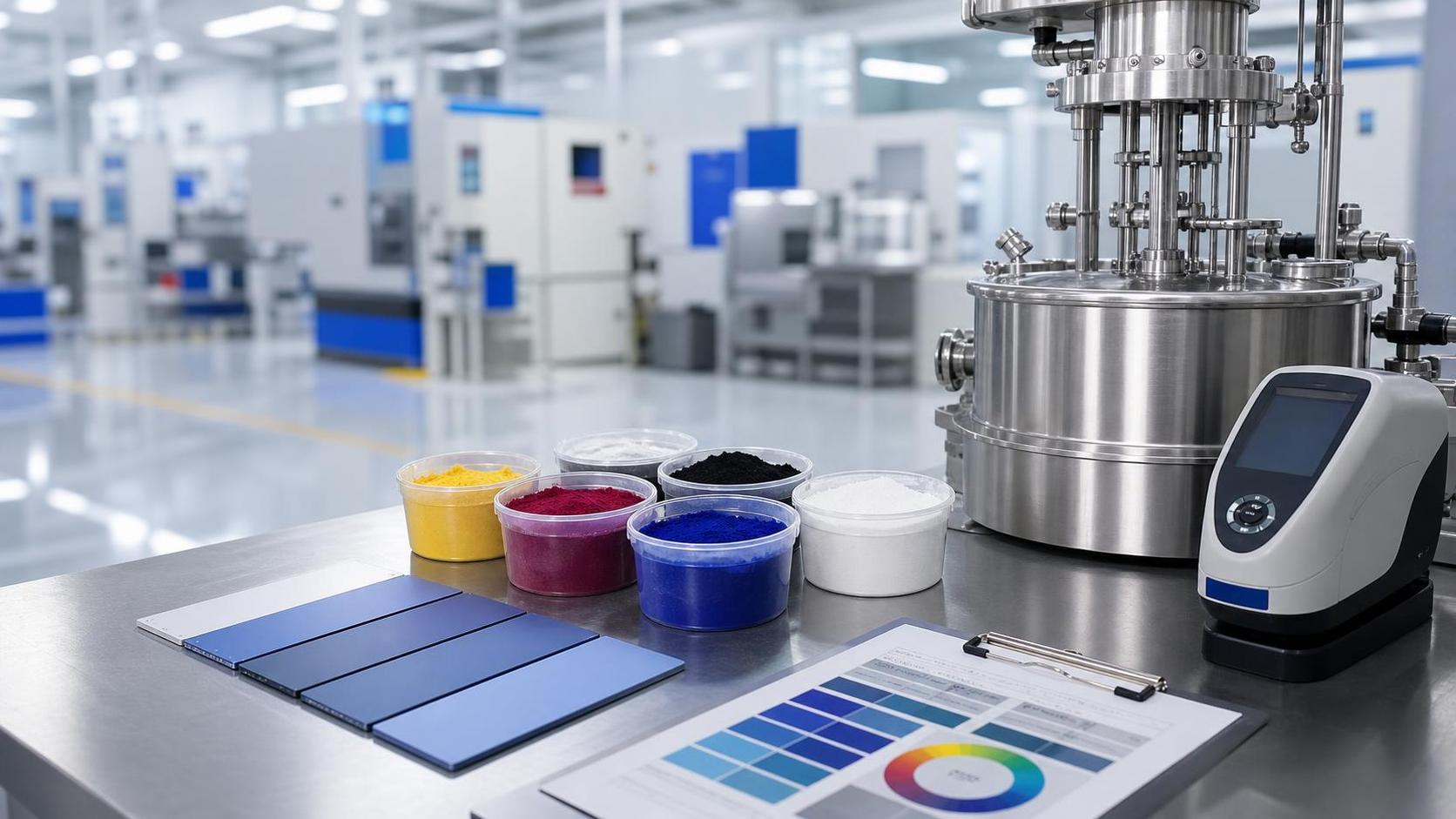
How to select pigments for coatings that resist UV color fading
Author
Date Published
Reading Time
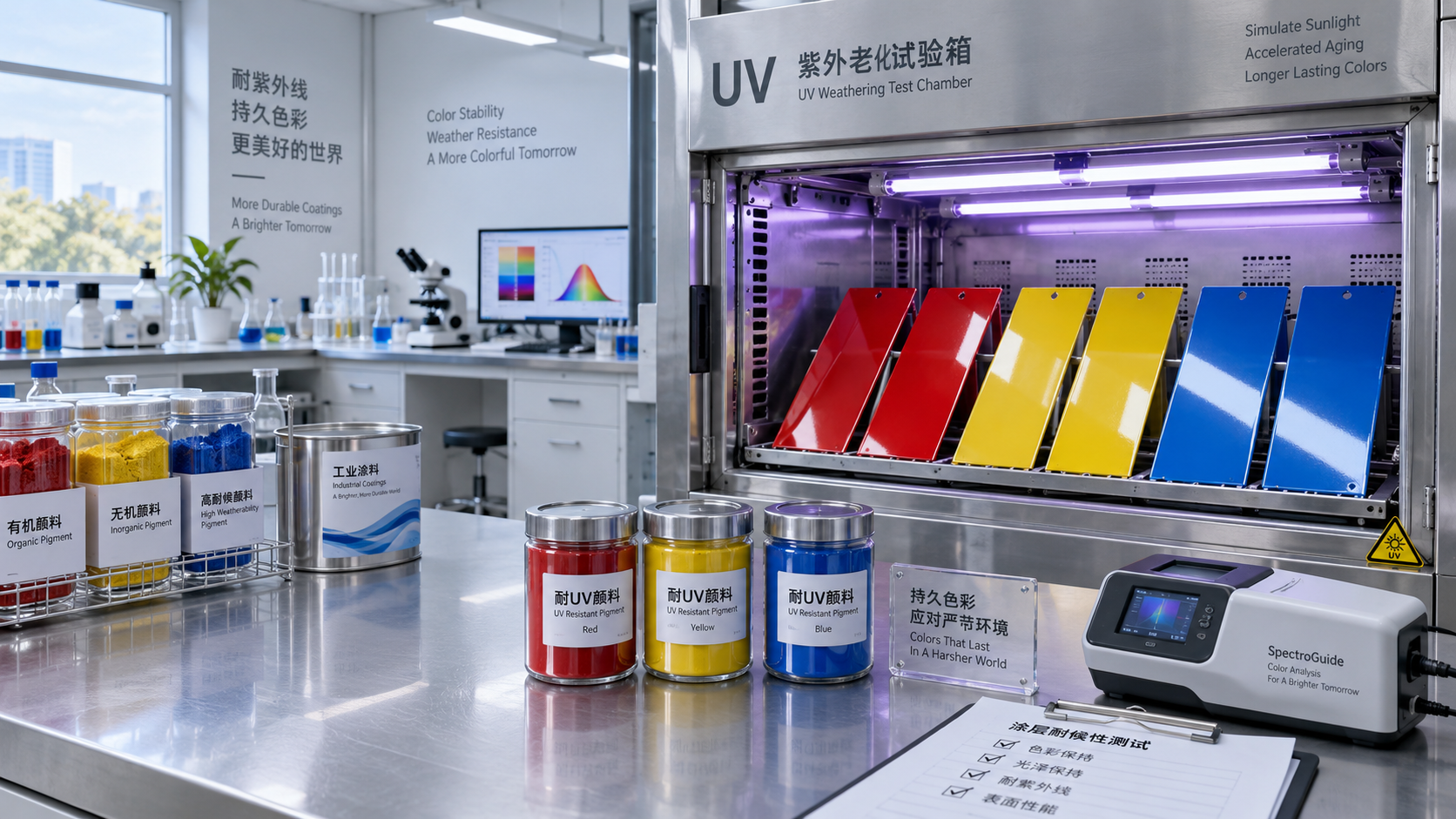
A coating can pass a short laboratory exposure and still lose visual uniformity outdoors if the pigment, resin, dispersant package, and film design do not degrade at the same rate. For UV-exposed applications, the correct question is not simply “Which pigment has the highest lightfastness?” It is whether the complete color system can retain hue, chroma, gloss, and surface integrity in its intended exposure environment.
That distinction matters because visible fading has several causes. A pigment may chemically fade; the binder may yellow or erode; the surface may chalk and expose less-saturated particles; or poor dispersion may create weak points that accelerate local color change. Selecting pigments for coatings therefore requires a system-level evaluation, beginning with the actual failure mode that must be prevented.
Separate pigment fading from coating weathering
“UV color fading” is often used as a catch-all term, but technical evaluation should distinguish among several mechanisms:
- Color fade: loss of chroma or shift in hue caused by pigment photodegradation, chemical reaction, or interaction with the surrounding resin.
- Binder degradation: chain scission, oxidation, yellowing, or erosion of the resin matrix. The original pigment may remain stable while the coating appears faded because the film has changed.
- Chalking: degradation of the organic binder at the surface, leaving loosely bound pigment and filler particles. Chalking reduces gloss and can make the color look lighter, duller, or uneven.
- Gloss loss: surface roughening changes reflected light and can make a color appear less deep even where instrumental color change is limited.
- Staining or migration: some pigment or colorant systems can move, bleed, or react with adjacent materials, especially under heat and moisture.
A pigment selected only on the basis of a supplier lightfastness rating can therefore give a misleading result. Lightfastness usually refers to a pigment’s resistance to light-induced color change under defined conditions. Weatherability is broader: it includes ultraviolet radiation, visible light, heat, moisture, condensation, rain, pollutants, and the behavior of the surrounding coating film.
For exterior architectural metal, agricultural machinery, transport equipment, outdoor plastic substrates, and protective industrial finishes, weatherability is normally the more relevant performance concept. Indoor installations behind glass present a different exposure profile, as glass filters part of the UV spectrum but does not eliminate light and heat-related color change.
Start with the exposure severity, not the color card
Color selection often begins with shade matching, but pigment screening should begin with service conditions. A deep red coating on a vertical façade, for example, faces different stress than the same shade on a dark horizontal rooftop component. Orientation, latitude, altitude, local climate, moisture retention, operating temperature, and maintenance practice all change the practical exposure level.
Questions that materially affect pigment selection include:
- Will the coating be used outdoors continuously, intermittently, or only during transport and storage?
- Is the surface horizontal, near-horizontal, or vertical?
- Will the coating experience high substrate temperatures, such as on metal roofing, machinery housings, or dark automotive parts?
- Does the environment include high humidity, repeated condensation, salt, industrial pollutants, agricultural chemicals, or cleaning agents?
- Is visual color retention more important than gloss retention, or must both remain within tight limits?
- Will the coating be repaired or overcoated during service?
These conditions determine how conservative the pigment choice needs to be. A color that is acceptable for a short-life decorative finish may be unsuitable for a high-durability fluoropolymer, polyurethane, silicone-modified polyester, or architectural powder coating system intended to retain appearance for extended outdoor use.
Exposure severity also changes the value of accelerated testing. Fluorescent UV and condensation equipment can be useful for comparing formulations and identifying weak resin systems, but it does not reproduce the full solar spectrum. Xenon-arc exposure is generally more relevant where broad-spectrum light exposure and color change are central concerns. Neither method should be treated as a universal conversion into a fixed number of outdoor years. Correlation depends on the formulation, substrate, geometry, climate, and property being measured.
Read pigment classes as starting points, not final decisions
Inorganic pigments are often favored where maximum weather resistance is required. Iron oxides, chromium oxide green, mixed-metal oxide pigments, ultramarine in appropriate systems, and certain complex inorganic colored pigments can offer strong resistance to light and heat. Their limitations are usually color space and tinting strength: bright clean reds, yellows, oranges, and blues may be difficult to achieve without organic pigments.
Organic pigments provide the high chroma and clean shades required for many modern coating palettes, but their outdoor durability varies substantially by chemistry, particle form, concentration, and coating environment. Broad labels such as “organic red” or “yellow organic pigment” are not sufficient for technical selection.
Several organic pigment families are commonly considered for demanding exterior colors:
- Quinacridones are used for durable red, magenta, and violet shades, particularly where clean chromatic colors are needed.
- Diketopyrrolopyrrole (DPP) pigments can provide high-performance red to orange-red shades with strong color strength and good weathering potential in suitable formulations.
- Perylenes are used in durable red, maroon, and black-shade applications.
- Phthalocyanine blues and greens are important for high-strength blue and green systems and are generally valued for good exterior stability, although dispersion and flocculation control remain important.
- Isoindolinone and benzimidazolone pigments are frequently evaluated for durable yellow, orange, and red-yellow spaces.
These categories should not be interpreted as blanket approvals. Commercial pigment grades within the same chemical family can differ in crystal modification, surface treatment, particle-size distribution, transparency, rheological behavior, and performance in a particular resin. A grade optimized for printing ink, for instance, may not offer the same dispersibility or weathering behavior in a high-solids coating.
Classical azo pigments cover a wide performance range. Some are entirely suitable for limited outdoor service, while others may show unacceptable fade, hue shift, or chemical sensitivity in severe exposure. The decision cannot be made from the word “azo” alone; it requires grade-specific technical data and testing in the intended coating system.
High lightfastness does not remove formulation risk
The pigment is only one photoactive component in the coating. The resin must resist UV-driven oxidation and hydrolysis, and it must retain sufficient cohesion to hold pigment particles at the surface. If the binder degrades before the pigment changes, the coating may still lose color depth through erosion and chalking.
This interaction is especially important with titanium dioxide. Rutile titanium dioxide is widely used for opacity and brightness, but its surface treatment and photocatalytic behavior can influence coating durability. Untreated or poorly matched TiO2 can contribute to degradation in some organic binder systems by promoting photo-oxidative reactions. The choice of TiO2 grade, its treatment, pigment volume concentration, and the overall stabilizer package should be assessed alongside the colored pigment.
At high pigment volume concentration, there may be insufficient binder to fully protect and bind the pigment-filler network. The resulting porous surface can absorb moisture, lose gloss, and chalk more quickly. Conversely, low pigment loading does not automatically improve durability; transparent organic pigments may need enough concentration to achieve adequate hiding or color development, while excessive loading can complicate dispersion and increase flocculation risk.
For transparent or semi-transparent shades, substrate color and primer selection are part of color-retention design. A stable transparent red topcoat over an unstable primer may appear to shift because the underlying layer changes. Multi-coat systems should therefore be exposed and evaluated as complete assemblies rather than as isolated drawdowns.
Dispersion quality can determine whether the pigment performs as specified
A durable pigment chemistry cannot compensate for poor dispersion. Agglomerates reduce color development, create shade variation, alter gloss, and may concentrate stresses or defects in the dry film. In high-chroma shades, even modest flocculation can produce visible differences between batches or between application methods.
Dispersion evaluation should go beyond fineness-of-grind readings. A grind gauge can indicate coarse particles, but it does not fully reveal soft flocculation or coloristic instability. Useful checks include drawdown comparison at different film thicknesses, tint-strength consistency, rub-up behavior where relevant, viscosity stability, storage stability, gloss, and color measurement after application and cure.
Dispersant chemistry must match both pigment surface and resin system. A dispersant that gives excellent initial color strength in a solventborne acrylic may not stabilize the same pigment in a waterborne polyurethane dispersion or powder coating. Changes in solvent blend, neutralization level, let-down sequence, curing conditions, or additive package can alter pigment orientation and flocculation behavior.
For metallic and pearlescent coatings, the problem becomes more complex. UV durability of the colored pigment remains important, but visual appearance is also governed by flake orientation, clearcoat protection, film build, and surface smoothness. Color measurement at a single angle may not capture the appearance changes that matter in service.
Use performance data with the right questions
Supplier documents often list lightfastness, weather fastness, heat resistance, solvent resistance, and migration resistance. These are useful screening indicators, but the test basis must be understood before comparing grades.
A lightfastness rating may be generated in a specific medium, at a specified dilution, or under a defined exposure source. A pigment can appear more durable at full shade than in a white tint, or the reverse can occur depending on its concentration and interactions with titanium dioxide. Testing should therefore include the intended masstone and relevant reductions, especially where pastel shades are commercially important.
Color change should be evaluated instrumentally as well as visually. CIELAB measurements can quantify total color difference, commonly expressed as ΔE, but a single ΔE value does not explain the direction of change. Separate review of lightness, red-green, and yellow-blue shifts can reveal whether the coating is bleaching, yellowing, reddening, or becoming bluer. Visual panels remain necessary because gloss loss, mottling, and chalking can affect acceptance even when numerical color change appears modest.
Useful test methods may include xenon-arc or fluorescent UV exposure under applicable parts of ISO 16474 or ASTM G155 and ASTM G154, respectively. Color differences can be calculated using methods such as ASTM D2244. Gloss retention and chalking should be measured or rated separately using suitable methods, including ASTM D523 for specular gloss and ASTM D4214 for evaluating the degree of chalking. The governing specification should define exposure cycle, panel orientation, exposure duration, acceptable color difference, gloss retention, and visual defect criteria.
Comparing results across laboratories requires caution. Differences in panel preparation, film thickness, cure schedule, exposure cycle, calibration practice, and measurement geometry can materially affect reported outcomes. A test report is most useful when it identifies the full coating formulation or at least the resin family, pigment concentration, substrate, dry-film thickness, curing process, and exposure conditions.
Do not use a single pigment rating for every shade
Color formulation changes the exposure behavior of a pigment. A red pigment at full shade receives and filters light differently from the same pigment used at a low concentration in a white tint. Mixtures can also introduce unexpected effects: one component may fade faster, shifting the balance of the blend even if the total color change seems moderate at first.
Blended shades deserve particular scrutiny in bright oranges, greens, browns, and neutral grays. An orange made from a durable yellow and a less durable red can shift toward yellow with exposure. A gray created with a blue organic pigment and carbon black may develop a visible hue change if one component loses strength. In these formulations, evaluating each pigment independently is not enough; the final blend must be tested.
Carbon black itself is generally highly lightfast, but black coatings can reach high surface temperatures in sunlight. The selection issue may therefore be resin thermal stability, substrate expansion, and clearcoat durability rather than pigment fading. Dark colors also make gloss loss and surface defects more visible.
Set acceptance criteria before requesting samples
Sampling often fails because the approval target is not defined until after panels are exposed. A more reliable approach is to establish the performance requirement before formulation work begins. This should identify the intended service environment, target service life category or project specification, approved resin family, substrate and pretreatment, film thickness range, gloss level, and acceptable appearance change.
The pigment request should then include the information needed to assess both performance and manufacturing control:
- chemical identity or Colour Index designation where available;
- recommended coating applications and disclosed limitations;
- lightfastness and weathering data with test conditions;
- heat stability at relevant processing temperatures;
- chemical resistance information relevant to the intended environment;
- particle form, surface treatment, and dispersion guidance;
- batch-to-batch color tolerances and quality-control documentation;
- regulatory information relevant to the markets and applications involved.
For long-life outdoor coatings, approval should not rely solely on a pigment supplier’s drawdown. The final resin, dispersant, TiO2, fillers, UV absorbers, hindered amine light stabilizers, crosslinker, solvent or water phase, and curing process can all affect the result. Stabilizer packages can extend coating durability, but they do not make an inherently unsuitable pigment suitable for severe UV service.
The practical selection rule
The most reliable pigments for coatings that resist UV color fading are not simply those with the strongest headline ratings. They are the grades whose light stability, weathering behavior, dispersion response, heat resistance, and chemical compatibility have been demonstrated in the actual coating architecture and target shade.
Where exterior color retention is critical, use pigment chemistry as the first filter, then confirm the choice through complete-formulation exposure testing in both full shade and relevant tints. Evaluate color, gloss, chalking, and surface condition together. That process is slower than selecting from a shade card, but it is the difference between a pigment that looks durable in a data sheet and a coating system that remains visually credible in service.
Technical Specifications
- How supply disruptions in the manufacturing supply chain affect lead timesAuthor :Global Industrial Core Editorial Team
- How to select pigments for coatings that resist UV color fadingAuthor :Chemical Industry Editorial Team
- When plastics and rubber are the right choice for durable partsAuthor :Polymers & Rubber Editorial Team
Expert Insights

Chief Security Architect
Dr. Thorne specializes in the intersection of structural engineering and digital resilience. He has advised three G7 governments on industrial infrastructure security.