
How to compare the embodied carbon of sustainable building materials
Author
Date Published
Reading Time
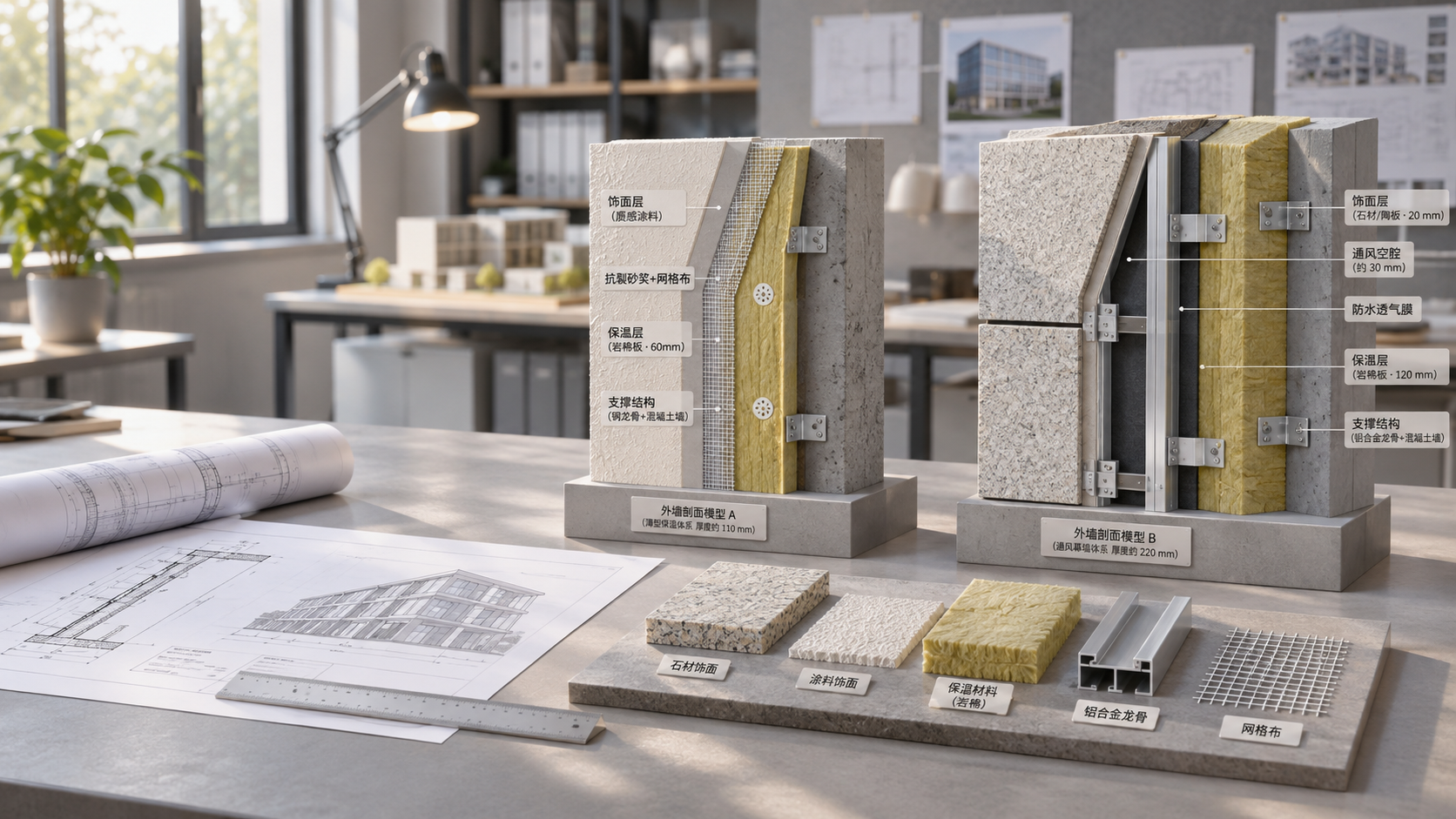
A credible embodied carbon comparison starts with the same building function, not the same quantity of material. A tonne of insulation, concrete or timber tells an assessor little on its own: each option must be assessed at the quantity and specification needed to deliver the required performance over the study period.
Environmental product declarations (EPDs) can provide the underlying data, but two headline figures are comparable only when their scope, units and assumptions align. The best choice for one project may change when structural capacity, fire protection, replacement cycles or delivery distance are included. Start by defining the application, then calculate each complete option on a consistent basis.
Set the comparison around the building function
Define what the material or assembly must do before collecting carbon figures. For a structural floor, that could include the area supported, design loads, span, fire resistance, acoustic performance and required service life. For insulation, it could be the area of envelope achieving a specified thermal performance, with the necessary moisture and fire provisions.
This definition becomes the functional unit: the common reference against which alternatives are assessed. A comparison of one square metre of wall assembly over a stated study period is generally more useful for design selection than a comparison of one kilogram of each constituent. The wall options may need different thicknesses, fixings, membranes or finishes to meet the same requirements.
Where an EPD reports emissions per kilogram or cubic metre, convert the figure using the actual quantity required by the design. Include associated components when they differ between options or are necessary to make an option perform. A lower-carbon insulation product, for example, may need a different thickness or supporting system; omitting those quantities can reverse the apparent result.
Keep the specification realistic. If one option requires additional fire protection or a larger structural support, include it. If a requirement is still undecided, state the assumption and test whether changing it affects the ranking.
Read the EPD beyond the headline number
An EPD is a standardized declaration of environmental impacts based on life-cycle assessment rules. It is valuable because it documents the product, declared unit, boundaries and assumptions behind the results. It does not, by itself, establish that a product is low carbon or that it is directly comparable with another declaration.
Begin with the product description and declared unit. Check that the declaration covers the product, composition and manufacturing location being considered. An industry-average EPD can be useful during early design, but it may not represent a specific factory or product. A product-specific declaration can offer a closer match, provided it applies to the proposed supply.
Then check the following before placing figures side by side:
- Life-cycle stages: identify which stages are reported and which are outside the scope. A product-stage result cannot be compared directly with a result that also includes transport, replacement or disposal.
- Declared unit: confirm whether the result is per kilogram, cubic metre, square metre or another unit, and whether any stated thickness, density or performance applies.
- Data quality and applicability: review the manufacturing geography, data period, validity and whether the declaration represents a specific product or an average.
- Calculation rules: check the applicable standards and product category rules. Declarations developed under different rules or versions may need careful review before comparison.
- Impact indicator: compare like with like. Pay attention to how fossil, biogenic and land-use-related greenhouse gas impacts are reported and whether a total is provided on the same basis.
Do not treat a missing module as zero emissions. A stage may be unreported, excluded under the declaration rules or genuinely insignificant; those are different situations. If the missing information matters to the decision, request additional data or use a documented project assumption rather than silently filling the gap.
Choose the life-cycle boundary deliberately
For building products, EPDs commonly organize results into modules. Product-stage modules A1–A3 cover raw material supply, transport to manufacturing and manufacturing. Later modules can address delivery to site and construction, use and replacement, and end-of-life processes. Module D may report potential benefits or loads beyond the product system boundary.
A1–A3 is a useful starting point when evaluating material production, especially early in design. It is not necessarily a complete procurement comparison. A product with a lower factory-gate result may travel farther, create more site waste or need replacement during the assessment period. Conversely, a product with a higher initial result may require fewer replacements. Neither outcome should be assumed without quantities and scenarios.
For a construction-stage comparison, add delivery and installation where the data are available and relevant. Delivery calculations need the actual transport mode, distance and quantity, including packaging and waste where applicable. For the use stage, establish a common building study period and use service-life assumptions appropriate to the application. A product's declared reference service life is not automatically the life it will achieve under every installation and exposure condition.
At end of life, compare scenarios consistently. Demolition, transport, processing and disposal assumptions can materially affect results. Avoid crediting one option for an optimistic recycling route while assigning another to disposal without a project-specific reason.
Keep Module D results separate from the impacts within the selected building life-cycle boundary. They represent modeled consequences beyond that boundary and depend on assumptions about future recovery and substitution. Adding them indiscriminately to A1–A3, or using them to offset present emissions without explaining the method, can make alternatives appear more comparable than they are.
Calculate complete options, then test the ranking
Once the functional unit and boundary are fixed, create a bill of quantities for each compliant design. Multiply each material quantity by its corresponding impact factor, then add the relevant transport, installation, replacement and end-of-life contributions. Record the source and assumption for every significant input.
A simplified insulation comparison shows why this matters. Suppose two products have EPD results per kilogram, but one needs a thicker layer to meet the same thermal requirement. The assessor must convert both to the mass needed per square metre of compliant assembly, add any differing components and apply the same study period. The product with the lower emissions per kilogram may still produce the higher assembly result.
Use a comparison table that exposes the drivers, rather than presenting only one total:
Totals that are close should not be treated as a precise ranking without examining uncertainty. Test the inputs most likely to change the result: material quantities, transport distance, replacement frequency, manufacturing data and end-of-life scenario. Change one assumption at a time where possible, then consider a reasonable combination of changes. If the preferred option switches under plausible assumptions, report that sensitivity alongside the result.
Biogenic carbon requires particular care when comparing timber or other bio-based products with alternatives. Carbon stored in a product and emissions associated with its eventual treatment may appear in different modules. Follow a consistent accounting method across the full boundary, and do not interpret temporary storage as an unconditional permanent removal. The EPD's indicator definitions and end-of-life assumptions should remain visible in the comparison.
Turn the assessment into a procurement decision
Use the early calculation to identify which inputs would most improve the decision. For a high-volume material, a product- and plant-specific EPD may be more valuable than refining a minor component. Where transport is influential, ask for the likely manufacturing and dispatch location as well as the delivery mode. Where replacements dominate, examine the evidence supporting service life and maintenance assumptions.
Procurement documents can then specify the performance and evidence needed to preserve the assessment: the applicable product configuration, an appropriate EPD, the declared unit and the life-cycle modules required for evaluation. Allow for equivalent evidence where the procurement rules require it, but assess submissions against the same functional and boundary rules.
Finally, update the model when the selected product, quantities or supply route change. A comparison based on an average declaration is a design-stage estimate; the decision record should show whether later product-specific information confirms the ranking. The most defensible selection is the one that meets the project requirements and retains its carbon advantage under assumptions the project can support.
Facing technical bottlenecks in manufacturing or looking for more efficient industrial solutions? Leave your details below and let the engineering experts at GIi solve them for you.
“We respect your privacy. Your information is strictly confidential.”
Technical Specifications
- German Chemical Industry Business Climate Index Falls to -5.9 in OctoberAuthor :Chemical Industry Editorial Team
- ACC Reports 4% Rise in US Plastic Resin Production Through September 2026Author :Polymers & Rubber Editorial Team
- How to compare the embodied carbon of sustainable building materialsAuthor :Metals & Fabrication Editorial Team
Expert Insights

Chief Security Architect
Dr. Thorne specializes in the intersection of structural engineering and digital resilience. He has advised three G7 governments on industrial infrastructure security.
Core Sector // 01
Security & Safety
- How to compare the embodied carbon of sustainable building materialsAuthor :Metals & Fabrication Editorial Team

- Metal Fabrication Methods for Custom Parts ComparedAuthor :Metals & Fabrication Editorial Team

