
Can nestable plastic pallets be used safely in warehouse racking?
Author
Date Published
Reading Time

Nestable plastic pallets are suitable for warehouse racking only when the exact pallet design has a documented rack-load rating for the intended support arrangement and operating conditions. A high static or dynamic load rating does not establish that suitability. Without supporting evidence, a nestable pallet should not be placed across open rack beams with a loaded, unsupported span.
Many nestable designs use tapered feet that fit inside another pallet when empty. This saves return-storage space, but it does not establish a continuous structural path between rack supports. The selection decision rests on where the rack contacts the pallet, how the goods distribute their weight, and how the plastic behaves throughout storage.
Start with the support arrangement
On a level floor, a pallet transfers weight through its feet or runners directly into the surface beneath it. Across rack beams, sections of the pallet must bridge gaps. Bending then becomes a primary concern, alongside local crushing, twisting, and loss of bearing at the supports.
A common nestable pallet has separate feet rather than continuous bottom runners. If those feet do not align with the rack supports, the load path changes substantially. A foot hanging inside an open bay provides no direct support; a beam contacting a thin deck section can create a concentrated reaction that the pallet was not designed to carry.
Even the phrase “supported on two beams” leaves important details unresolved. The pallet orientation, clear unsupported span, beam contact width, and position of the feet all affect performance. A rating established with the long edges supported cannot automatically be applied with the short edges supported.
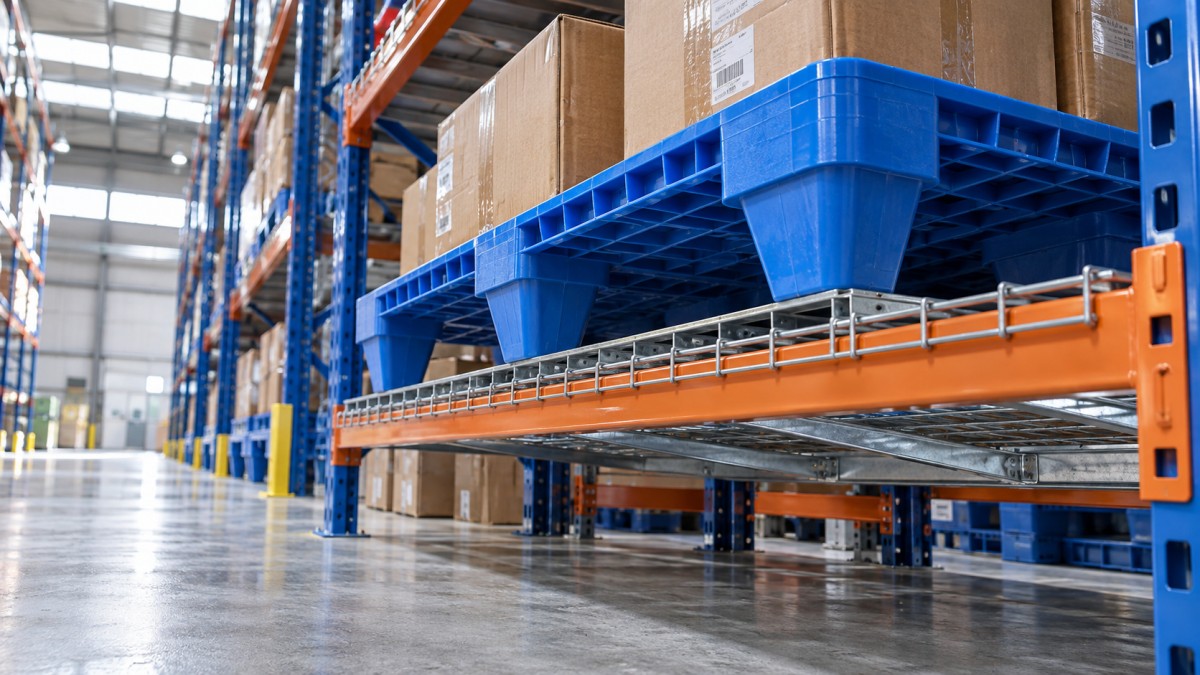
A useful support drawing shows the pallet underside, beam contact areas, unsupported distances, and load direction together. Overall pallet dimensions alone are insufficient: two rack bays accepting the same pallet footprint can impose different bending conditions.
Read the load rating as a set of conditions
Static, dynamic, and rack-load ratings describe different support conditions. Static capacity generally concerns a stationary pallet supported as specified, often on a floor. Dynamic capacity concerns a pallet during handling under stated conditions. Neither demonstrates performance over an unsupported rack span.
A stated rack-load capacity is more relevant, but the number still needs its test conditions. Confirm the support spacing, orientation, load pattern, temperature, loading duration, and acceptance criteria. Establish whether the figure represents a working load, a test load, or a failure load. A short test ending without breakage does not establish acceptable deflection over an extended storage period.
Also resolve what the quoted mass includes. Product mass, packaging, attached equipment, and pallet self-weight contribute to the forces acting on the rack. A supplier’s definition of payload should be explicit so that the proposed loading can be compared with the rating consistently.
Missing rack data should remain an unresolved qualification issue. Dividing a static rating by an assumed safety factor does not produce a defensible rack rating, because the support geometry and failure mechanism have changed.
The goods determine how the deck is loaded
A uniformly distributed load spreads force over a defined area. Actual goods often impose a different pattern. A rigid container with small feet, a drum resting on a narrow rim, or machinery mounted on blocks can concentrate weight over a few deck ribs. The total mass may remain below the published rating while local stresses exceed the conditions represented by that rating.
Cartons introduce another variable. A tightly arranged layer distributes contact differently from a partial layer with large gaps. Packaging compression, moisture damage, or settlement can shift the load during storage. Stretch wrap helps retain the unit load, but it should not be credited with structural reinforcement unless that contribution has been validated.
Uneven placement also matters. Goods concentrated toward one edge increase twisting and unequal support reactions. Tall loads with an offset center of gravity create additional stability concerns during placement and retrieval, even when the pallet performs adequately under a centered laboratory load.
A qualification load should therefore reproduce the actual contact pattern, including gaps, overhang, and concentrated bearing points. Testing with a rigid plate that spreads force evenly can conceal deck weaknesses that appear beneath the intended goods. Conversely, packaging stiffness should receive credit only when its contribution remains reliable throughout storage.
Plastic creep changes the storage assessment
Plastic deforms under sustained stress. Part of that deformation develops over time, so a pallet that looks acceptable immediately after loading can sag further while it remains in the rack. This time-dependent behavior, known as creep, makes storage duration a material part of the rating.
Temperature affects stiffness and creep behavior. Evidence obtained under moderate indoor conditions does not automatically cover warmer storage areas or goods loaded while still hot. Cold environments introduce different concerns, including impact performance during handling. The relevant temperature is the pallet’s operating temperature, which can differ from the surrounding air temperature.
Resin type alone does not settle the question. Wall thickness, rib layout, molding quality, reinforcement, and material formulation all influence performance. Recycled content is not, by itself, a reason to accept or reject a pallet; consistency and evidence for the specified formulation are more useful criteria.
Deflection limits also need a practical basis. Excessive sag can reduce clearance, interfere with retrieval, alter support engagement, or destabilize goods before the pallet breaks. Qualification should address both strength and usable geometry, including residual deformation after unloading.
Additional support requires its own assessment
Rack decking can make some nestable pallets usable where direct beam support is unsuitable. However, adding a surface beneath the pallet does not automatically create full, uniform support. Wire mesh has openings, and its capacity depends on the deck design, reinforcing channels, beam engagement, and load pattern.
A decking rating based on a uniformly distributed load does not necessarily cover the concentrated reactions beneath individual pallet feet. A foot positioned between reinforcing channels can load the mesh differently from one positioned directly above a channel. Narrow feet also require attention to opening size and the possibility of tilting or slipping into a gap.
Intermediate bars offer a different approach. Their locations should correspond to structurally suitable areas beneath the pallet, and their connections must transfer the resulting loads into the rack. An added bar beneath an unsupported thin panel can cause local damage even while reducing overall span.
Some nestable designs accept runners or reinforcement accessories. Those additions change the assembly being evaluated. Approval must identify the accessory, attachment method, orientation, and rated configuration; a capacity assigned to the reinforced version cannot be transferred to the bare pallet.
Where the required rack arrangement cannot be supported by documentation or practical modification, a purpose-designed rackable pallet is the clearer selection. Its suitability still requires confirmation against the actual rack and load.
Evidence that makes a selection defensible
A useful technical submission connects the quoted capacity to an identifiable pallet and a reproducible test arrangement. A catalog statement such as “heavy duty” contributes little without that connection. The following information resolves the main uncertainties:
- Exact configuration: model identification, dimensions, mass, material specification, reinforcement, and any fitted runners. A visually similar variant is not sufficient evidence.
- A support diagram showing orientation, clear span, bearing widths, and intermediate supports, accompanied by the load distribution used during evaluation.
- Time and temperature conditions. The report should explain loading duration, measured deflection, recovery after unloading, and the basis for the stated working capacity.
- For existing pallets, the acceptable service condition and rejection criteria, including damage to feet, ribs, deck surfaces, and accessory connections.
A reference to a test method is useful only when the reported conditions match the application closely enough. The distinction between a pallet strength test and an assessment of maximum working load should be clear. Any reliance on packaging stiffness or a particular unit-load arrangement also needs to be stated.
When available evidence leaves a gap, a controlled qualification trial can address it. The trial should use representative pallets and goods, the intended support geometry, relevant temperature exposure, and a loading duration justified against the storage cycle. Accelerated testing requires a sound technical basis before its results are extrapolated to longer periods.
Acceptance criteria should be defined before loading begins. They can include maximum deflection, retained bearing on supports, absence of cracking or local collapse, acceptable permanent deformation, and successful retrieval. A trial in which the pallet simply remains intact provides a weak basis for approval.
Keep the approved configuration intact during service
Approval applies to a defined combination of pallet, load, and rack support. Changing beam spacing, removing decking, substituting a similar-looking pallet, or increasing storage duration can invalidate the original assessment. A different carton pattern can also matter if the qualification depended on load distribution.
Placement tolerances deserve explicit limits. A pallet positioned too far forward, rotated, or left with a foot outside its intended bearing area can experience conditions absent from the qualification test. Support drawings and placement references should make the acceptable position clear.
Damage affects the same load paths that establish rack capacity. Cracked feet, split ribs, distorted decks, and loose reinforcement require assessment against defined rejection criteria. Permanent sag is particularly relevant because it indicates that the pallet no longer has its original geometry; appearance alone cannot establish its remaining capacity.
The final specification should record the approved pallet configuration, maximum payload, load pattern, support arrangement, temperature range, and storage duration. If an operating change falls outside those conditions, the rack-use decision needs to be reopened before the revised arrangement enters service.
Technical Specifications
- At what production volume does metal stamping become cost-effective?Author :Metals & Fabrication Editorial Team
- Can nestable plastic pallets be used safely in warehouse racking?Author :Polymers & Rubber Editorial Team
- How to test melt flow consistency in batches of recycled plasticsAuthor :Polymers & Rubber Editorial Team
Expert Insights

Chief Security Architect
Dr. Thorne specializes in the intersection of structural engineering and digital resilience. He has advised three G7 governments on industrial infrastructure security.
Core Sector // 01
Security & Safety