At what production volume does metal stamping become cost-effective?
Author
Date Published
Reading Time
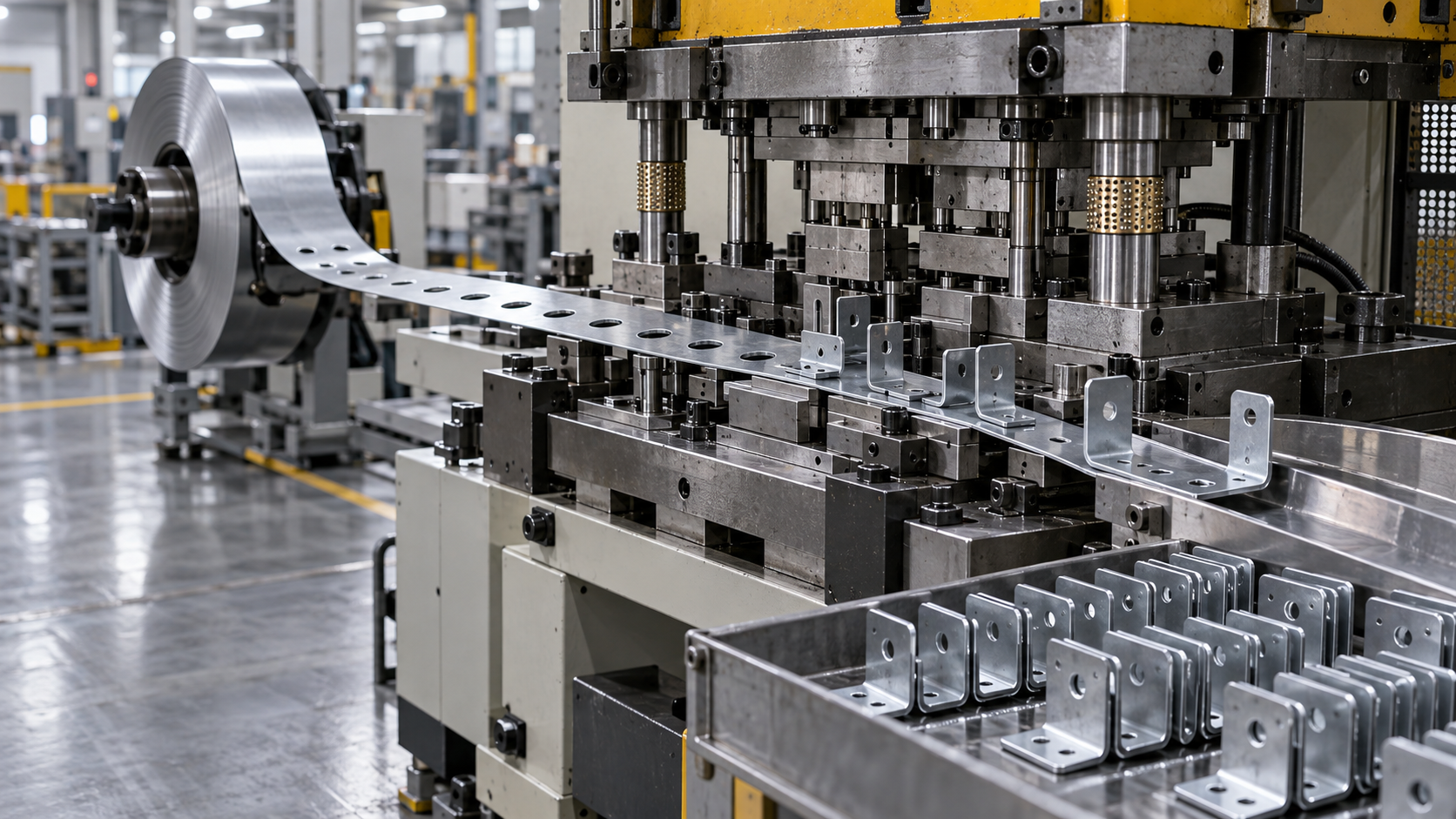
Metal stamping becomes cost-effective when the savings on each accepted part recover the additional tooling and setup investment within a credible production commitment. There is no universal order quantity that establishes this point. A simple blank made with a basic die has a different cost structure from a formed component requiring a progressive die, several development trials, and secondary machining.
The most useful threshold is the break-even volume calculated from comparable supplier quotations. That calculation must cover the same finished part, inspection requirements, delivery schedule, and tooling responsibilities. A low stamping price is meaningful only when the resulting savings repay the costs required to achieve it.
Calculate the volume that repays the tooling investment
For an initial comparison, express the total cost of each manufacturing route as a fixed amount plus a cost per accepted part:
Total cost = fixed costs + (accepted quantity × variable cost per accepted part)
If stamping requires a higher initial investment but has a lower variable cost, the simplified break-even calculation is:
Break-even quantity = (stamping fixed costs − alternative fixed costs) ÷ (alternative variable cost − stamping variable cost)
Fixed costs include the expenses needed to launch the specific production program: tooling, fixtures, programming, development trials, and initial qualification where applicable. Variable costs include material, conversion, required secondary operations, and other expenses that increase with output. Use the same scope for both processes.
The denominator must be positive. If stamping does not offer a lower variable cost, increasing volume alone will not recover its higher fixed investment under this model. A different die concept, material layout, production route, or part design would be needed to change the result.
Use accepted parts as the quantity basis. If a quotation already includes normal production scrap and inspection losses in its unit price, do not add those allowances again. If it excludes them, translate the quoted production cost into the cost of usable output before comparing alternatives.
This calculation assumes reasonably stable unit costs. Where quotations contain quantity breaks, tooling replacement charges, or different setup frequencies, compare total costs at each relevant quantity instead of extending one unit price across the entire program.
The stamping process changes the answer
“Metal stamping” covers production routes with very different investment requirements. A quotation based on a simple blanking die should not be compared with a progressive-die quotation as though tooling scope were identical.
A progressive die offers little financial advantage if an expensive downstream operation remains unchanged and dominates the finished-part cost. Conversely, a die that combines piercing and forming while removing repeated handling can create savings beyond the press cycle itself.
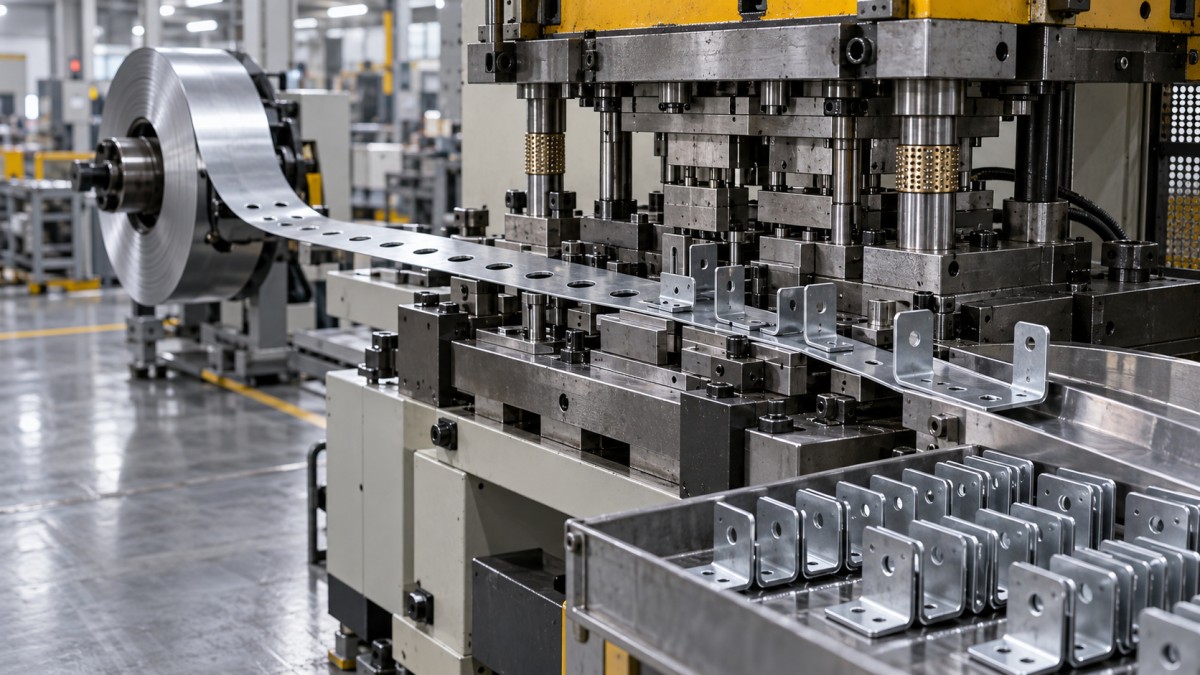
The relevant comparison therefore follows the part through every required operation. Press speed alone does not establish the economic threshold.
Compare equivalent finished parts
Laser cutting is a useful reference for flat sheet components because it avoids a dedicated cutting die and accommodates geometry changes through programming. Its economics change with cutting length, piercing count, thickness, nesting efficiency, and any subsequent forming or edge finishing. A flat blank cut by laser is not equivalent to a stamped part delivered fully formed and deburred.
For a bent bracket, compare laser cutting plus bending, handling, inspection, and finishing against the complete stamping route. If both methods still require tapping or coating, include those operations in both totals. Where these costs are identical, they do not change the simplified break-even quantity, although they remain part of the purchasing budget.
CNC machining deserves a different comparison. A component machined from solid stock may contain pockets, thick sections, or features that sheet metal cannot reproduce directly. Moving to stamping could require a redesign, additional hardware, or an assembly. Any resulting joining and qualification costs belong in the conversion analysis.
For flat profiles and holes, turret punching with existing standard tools also deserves consideration. It can occupy a useful position between flexible laser processing and dedicated dies. The economic question is whether the proposed stamping investment beats the strongest feasible alternative for the actual geometry.
Material and tolerances can move the threshold
Material utilization can outweigh an attractive press rate. A progressive strip needs carrier material and sufficient spacing to move reliably through the die. A laser nest can arrange parts differently across a sheet. The relative material cost depends on the geometry, strip layout, stock format, and restrictions on rotating the part.
Compare purchased material per accepted component and account for recoverable scrap value consistently. Scrap credit reduces net material cost, but it does not recover the full purchase price or the processing effort already spent on that material.
Grain direction creates a practical constraint. A nesting layout that saves sheet area may be unsuitable if it places a critical bend in an unfavorable orientation. Coil width, thickness tolerance, temper, surface condition, and protective film also affect the available process window. A material substitution that improves forming must still satisfy the drawing and functional requirements.
Tolerance requirements influence both tooling expense and recurring cost. Hole position, flatness, bend angle, and burr direction need separate consideration. A stamped feature that requires shaving, restriking, leveling, or machining after pressing carries a different cost from one accepted directly from the die.
Inspect the relationship between features as well as their individual tolerances. A hole formed before bending may move relative to a final assembly datum. If the drawing requires that relationship to be tightly controlled, the proposed process must explain how it will achieve it. Otherwise, a low quoted price can rest on an incomplete manufacturing route.
Use repeat demand that can realistically be produced
The quantity used to justify tooling should belong to a stable part revision over a defined commercial period. Forecast demand, committed releases, and optional future business do not offer the same confidence of cost recovery.
A repeat component with predictable releases supports a different decision from a new design awaiting field validation. If a revision changes a formed feature or station layout, modifying the die could consume savings expected from later orders. Design maturity therefore changes the useful volume available to repay the tool.
Annual demand also hides batch economics. The same yearly quantity released in frequent small batches can require more die changes, startup scrap, first-piece inspection, and administration than a consolidated production run. If the quotation assumes a minimum manufacturing batch, distinguish that batch from the shipment quantity.
Producing larger batches and shipping them gradually introduces storage, inventory financing, and obsolescence exposure. These costs should be assigned to whichever route creates them. A lower unit price achieved through excess inventory is not automatically a lower total program cost.
Timing matters when tooling is paid upfront and savings arrive over several years. A discounted cash-flow comparison is more informative than a simple quantity calculation when the recovery period is long. At minimum, establish when cumulative savings repay the initial payment and whether that date falls within the supported demand horizon.
Read the quotation for costs that change with volume
A usable quotation separates the assumptions that determine the break-even point. The following details deserve explicit treatment because each can change the result:
- Tooling scope and acceptance: identify whether the price covers production-intent tooling, development trials, sample submission, and corrections needed to meet the agreed drawing. A tool price without an acceptance basis leaves the launch cost uncertain.
- Batch size. The unit price should state the production quantity and release pattern on which it depends, including setup charges that recur with each run.
- Material basis: establish whether material is included, supplied separately, or adjusted through an agreed pricing mechanism. Comparisons made on different material assumptions distort the apparent conversion savings.
- Maintenance and tool life: clarify responsibility for sharpening, replacement inserts, wear components, and major refurbishment. A production horizon extending beyond the quoted tooling allowance needs the corresponding future expense.
- Ownership and transfer terms. Ownership alone does not establish that a die can move economically to another facility. Press compatibility, technical records, storage arrangements, and transfer charges influence its usable value.
Also establish whether tooling is paid separately or recovered through the piece price. If an amortization surcharge is already included, adding the full tooling invoice to the same cost model double-counts the investment. Conversely, a unit price that falls after an agreed quantity requires a staged calculation.
Finished-part packaging and delivery terms should match across quotations. Thin stamped parts that scratch, deform, or interlock during shipment may need separators or controlled packing. Those requirements belong in the delivered cost when they differ between proposed routes.
Make the conversion decision at the point of commitment
Calculate the result under the quoted production assumptions, then test the uncertainties capable of reversing it. Useful variations include lower released demand, a delayed production launch, additional finishing, and a tooling modification. There is little value in adding many scenarios that leave the decision unchanged.
If stamping becomes economical only after every optimistic forecast is fulfilled, the investment has little room for disruption. A stronger case recovers tooling within supported demand and retains a cost advantage after realistic setup, maintenance, and quality expenses are included.
An initial laser-cut or machined batch can resolve fit and design questions before dedicated tooling is commissioned. Those early parts carry their own cost, but they can also prevent investment in an unstable revision. Once that spending has occurred, treat it as a sunk cost when deciding whether to convert the remaining production; retain it separately when reporting the total program budget.
The practical threshold is reached when the remaining accepted quantity provides enough verified savings to recover the remaining incremental investment within the required timeframe. That is the volume at which metal stamping has a defensible economic case for the specific part.
- Last One:No more articles
- Next Article:Can nestable plastic pallets be used safely in warehouse racking?Oct 19, 2026
Technical Specifications
- At what production volume does metal stamping become cost-effective?Author :Metals & Fabrication Editorial Team
- Can nestable plastic pallets be used safely in warehouse racking?Author :Polymers & Rubber Editorial Team
- How to test melt flow consistency in batches of recycled plasticsAuthor :Polymers & Rubber Editorial Team
Expert Insights

Chief Security Architect
Dr. Thorne specializes in the intersection of structural engineering and digital resilience. He has advised three G7 governments on industrial infrastructure security.