How to test melt flow consistency in batches of recycled plastics
Author
Date Published
Reading Time
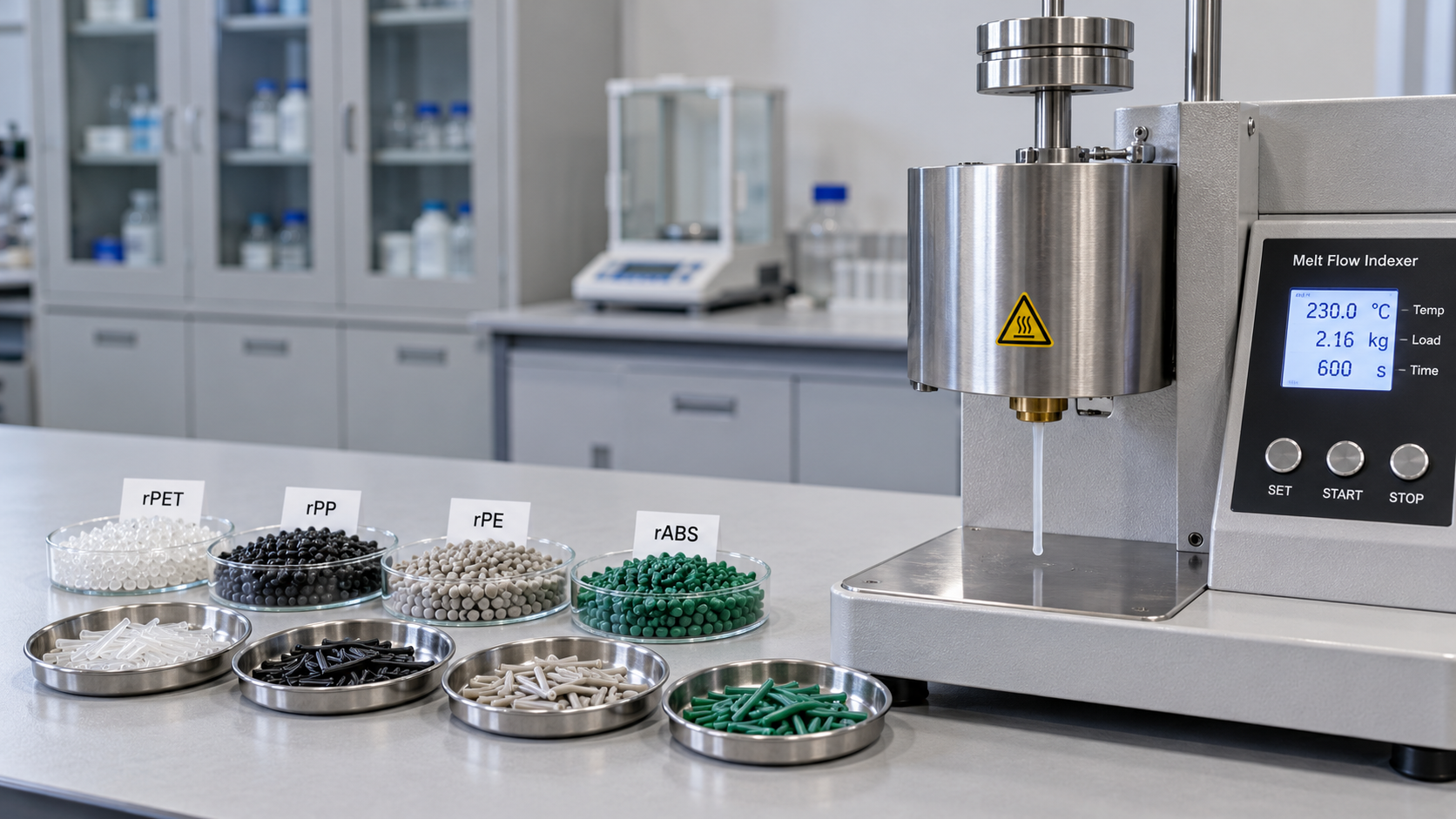
To test melt flow consistency in batches of recycled plastics, compare representative samples under the same temperature, load, conditioning, and timing conditions. Measure variation within each batch as well as differences between batches. A single acceptable melt flow rate can conceal uneven blending, contamination, or material degradation elsewhere in the shipment.
The useful result is more than an average. It is evidence that the material behaves consistently enough for its intended process, with a sampling plan and test method capable of detecting meaningful changes. ASTM D1238 and the ISO 1133 series provide standardized methods, but reliable batch decisions also depend on how material reaches the instrument and how results are interpreted.
Define exactly what the melt flow result represents
Melt mass-flow rate, usually abbreviated MFR and often called melt flow index or MFI, measures the mass of molten material extruded through a specified die under prescribed conditions. Results are expressed in grams per 10 minutes. Melt volume-flow rate, or MVR, measures the extruded volume and is expressed in cubic centimeters per 10 minutes.
Both describe flow under a particular test condition. Neither provides a complete viscosity curve or directly predicts behavior across all injection molding, extrusion, or blow molding conditions.
For comparable materials tested identically, higher MFR generally indicates easier flow under the test conditions. However, recycled feedstock can contain different polymer grades, fillers, additives, and degradation products. A change in MFR does not identify which component changed.
Keep MFR and MVR separate in specifications. Converting between them requires an appropriate melt density at the test temperature; room-temperature pellet density is not a suitable substitute. Changes in filler content or composition can also affect the relationship between mass flow and volume flow.
Agree on the test method before comparing suppliers or batches
Use ASTM D1238 or the applicable part of ISO 1133 as the basis for a documented laboratory procedure. ISO 1133-1 covers the standard method, while ISO 1133-2 addresses materials sensitive to their time-temperature history and/or moisture. Method selection should reflect the polymer and its sensitivity during testing.
These standards should not be treated as interchangeable labels. Results reported under different procedures may not be directly comparable, even when both laboratories describe them as “melt index.” Record the standard edition and procedure used, together with the actual test conditions.
A workable purchasing specification should identify:
- The polymer family, grade designation, and material form being evaluated.
- The test standard, procedure, temperature, and applied load.
- Conditioning or drying requirements and handling after conditioning.
- The sampling approach and number of independent determinations.
- Acceptance limits, reporting requirements, and treatment of disputed results.
Temperature and load must suit the material and agreed specification. A condition used for one polymer should not be transferred to another simply because the instrument is already configured that way. Supplier certificates become useful for comparison only when their test conditions match the receiving laboratory’s requirements.
Sample the batch so that uneven material remains visible
Recycled plastics may vary between bags, bulk containers, or sections of a production run. Scooping pellets from the top of one accessible bag creates a convenient sample, but it provides weak evidence about the whole batch.
Begin with a clear lot definition. A shipment can contain multiple production lots, and a supplier lot may include material made across changing feedstock conditions. Preserve those distinctions until there is a justified reason to combine them.
Take increments from locations or production intervals that represent the lot. For continuous production, sampling across the run can reveal drift. For packaged material, distribute sampling across containers and accessible positions using suitable sampling equipment. Record where each increment came from.
A composite sample can estimate average behavior, but mixing all increments together may hide pockets of unusually high or low flow. Where segregation or uneven blending is a concern, retain location-specific samples and test them separately. A useful plan may include a composite for overall characterization and individual samples for evaluating uniformity.
Reduce laboratory samples with a method that limits segregation. Flakes, fines, and pellets of different sizes or densities can separate during pouring and handling. Selective scooping can therefore change the composition of the test portion.
Keep retained material linked to the shipment, production lot, sampling position, and collection date. This traceability allows an unusual result to be investigated without relying entirely on a newly collected sample that may represent a different part of the batch.
Control moisture and thermal history before testing
Conditioning is part of the measurement. Moisture can cause bubbles and unstable extrusion; in moisture-sensitive polymers, it can also promote hydrolysis during heating. The resulting flow change may reflect degradation inside the test barrel rather than the material’s intended processing condition.
Use a defined drying procedure where required by the material specification and selected method. Record drying temperature, duration, and relevant dryer conditions. Where residual moisture materially affects interpretation, measure it with a suitable method instead of assuming that a fixed drying time always achieves the same result.
Protect dried samples during transfer and storage. Material that absorbs moisture again before testing no longer has the same conditioning history. Keep the time between conditioning and testing controlled where it affects results.
Drying itself must also be appropriate. Excessive heat or prolonged exposure can alter some materials. The objective is reproducible preparation suitable for the polymer, rather than applying the strongest available drying cycle.
For flakes or regrind, avoid adding an undocumented melt-processing step merely to make testing easier. Pelletizing before measurement introduces additional heat and shear that can change flow. If pre-processing is necessary, define it as part of the method and apply it consistently.
Separate repeatability from actual batch variation
Several cuts from a single barrel charge provide information about that determination, but they are not independent samples of the batch. To evaluate consistency, distinguish variation during one determination, variation between fresh charges of the same laboratory sample, and variation between independently collected batch samples.
Set the number of samples and repeat determinations according to lot heterogeneity, process sensitivity, and demonstrated measurement precision. Increase sampling when qualifying a new source, investigating a change, or evaluating a poorly mixed stream. A stable supply with an established history may support a less intensive routine plan.
During testing, control the variables most likely to create artificial differences:
- Instrument condition: verify temperature control, timing, load, and dimensional checks through the laboratory’s maintenance and calibration program.
- Die and barrel cleanliness: remove residues that could restrict flow or contaminate the next charge.
- Charging and preheating: follow the selected procedure for charging, packing, preheat time, and measurement position.
- Measurement technique: use suitable cutting intervals and balance performance for MFR, or verified displacement measurement for MVR.
- Elapsed heating time: maintain the prescribed timing, particularly for materials that change rapidly while molten.
Watch the extrudate as well as the reported number. Bubbles, intermittent flow, visible particles, or a progressive change during measurement can reveal a problem that an average obscures. Record these observations and assess validity against the method’s requirements.
A stable in-house control material can help detect instrument or operator drift. It supports ongoing measurement control but does not replace calibration or establish that the recycled material itself is uniform.
Use the average and the spread to judge consistency
Calculate a mean for the independent determinations, then examine their spread. The range is easy to understand but depends strongly on how many results were collected. Standard deviation gives a more useful measure of dispersion when enough representative observations are available.
The coefficient of variation expresses standard deviation relative to the mean:
CV (%) = standard deviation ÷ mean × 100
CV can help compare relative variability across grades with different flow levels. It becomes less useful when the mean is very low or measurement resolution dominates the result. Never use it to combine data obtained at different temperatures, loads, or conditioning states.
Review individual results alongside the batch average. Two batches can have similar means while one contains a much wider spread. That wider spread may cause unstable processing even though the certificate’s headline value meets the purchasing specification.
These patterns guide investigation; they do not prove a particular cause. For example, chain scission can increase flow in some polymers, while branching, crosslinking, or contamination can produce different behavior. MFR alone cannot distinguish them reliably.
Build acceptance limits around the material and process
There is no universal acceptable melt flow variation for all recycled plastics. Limits should reflect the polymer, intended conversion process, product requirements, and measurement capability.
Start with material that has demonstrated acceptable processing and product performance. Use its test history to establish a practical flow window and an acceptable level of within-batch variation. Confirm that the laboratory can reliably distinguish meaningful material changes from ordinary test scatter.
Separate product acceptance limits from statistical control limits. Acceptance limits define suitability for use. Control limits describe the behavior of a stable process and help detect changes. A result can remain inside the purchasing specification while signaling an unusual shift that deserves investigation.
Where release decisions are sensitive to results near a boundary, define a decision rule that accounts for measurement uncertainty. Agree on retesting in advance: which retained samples will be tested, how many determinations will be made, and how the results will be evaluated. Repeatedly testing until a passing value appears undermines the release decision.
Use an abnormal result to direct the investigation
When a batch fails or shows an unexplained shift, hold it under the established disposition procedure and check measurement validity first. Review sample identity, conditioning records, test settings, instrument status, and raw results. Then examine retained samples from different parts of the lot to determine whether the issue is localized or widespread.
Select additional tests according to the suspected cause. Moisture measurement can clarify conditioning problems; thermal analysis can support polymer identification; ash testing can investigate inorganic content. Contamination assessment, rheological testing, or application trials may be needed when MFR does not explain processing behavior.
Matching melt flow values do not establish equivalent impact strength, odor, chemical composition, or suitability for food contact and other regulated uses. Heat unknown recycled feedstock under appropriate laboratory ventilation, with controls for hot surfaces, molten polymer, and potential decomposition products.
The batch record should preserve individual results, sampling locations, preparation history, test conditions, observed abnormalities, and the disposition decision. That record makes the next shipment easier to assess and gives supplier discussions a concrete basis: where variation occurred, whether the measurement was reliable, and which material change needs attention.
- Last One:No more articles
- Next Article:When does a cast resin transformer need high-altitude derating?Oct 18, 2026
Technical Specifications
- How to test melt flow consistency in batches of recycled plasticsAuthor :Polymers & Rubber Editorial Team
- When does a cast resin transformer need high-altitude derating?Author :Electrical Components Editorial Team
- How to verify Global Industrial Insights sourcing informationAuthor :Industrial Machinery Editorial Team
Expert Insights

Chief Security Architect
Dr. Thorne specializes in the intersection of structural engineering and digital resilience. He has advised three G7 governments on industrial infrastructure security.
Core Sector // 01
Security & Safety
- How to test melt flow consistency in batches of recycled plasticsAuthor :Polymers & Rubber Editorial Team

- Which thermoplastic elastomers stay flexible at low temperatures?Author :Polymers & Rubber Editorial Team

- Which Shore hardness suits soft touch TPE for handheld grips?Author :Polymers & Rubber Editorial Team

- Should Buyers Lock In Polypropylene Prices for Six Months?Author :Polymers & Rubber Editorial Team

- Why Do Polypropylene Prices Differ by Region?Author :Polymers & Rubber Editorial Team

- What Drives Polypropylene Price Changes in Packaging and Injection Molding?Author :Polymers & Rubber Editorial Team

- How to Evaluate a Polyethylene Manufacturer for Long-Term Supply ReliabilityAuthor :Polymers & Rubber Editorial Team

- Polypropylene Material Properties: Where PP Works Well and Where It Does NotAuthor :Polymers & Rubber Editorial Team