When are low modulus silicone sealants needed for moving joints?
Author
Date Published
Reading Time

A low modulus silicone sealant is needed when a joint must move repeatedly while the adjoining materials, coatings, or bond lines cannot safely tolerate high tensile or compressive stress. The key reason is not simply that the sealant is “more elastic.” A low modulus formulation develops less stress at a given extension, so it is less likely to pull away from weak substrates, overstress thin panels, distort flexible glazing components, or concentrate force at the edge of a joint.
This distinction matters in exterior building envelopes, rainscreen systems, glazing interfaces, metal cladding, precast concrete, and long expansion joints. A sealant can have an acceptable movement classification yet still be unsuitable if its force at service extension is too high for the substrates or the joint geometry. Movement capability and modulus must therefore be evaluated together, not treated as interchangeable properties.
Movement alone does not define the need for low modulus
Sealant joints move because materials expand and contract at different rates, structural elements deflect under load, panels respond to wind and temperature, and concrete undergoes shrinkage and creep. A joint between aluminium and masonry, for example, is exposed to both thermal mismatch and the limited tensile capacity of the masonry surface. A stiff sealant may remain intact internally but transfer sufficient stress to cause adhesive failure, cohesive tearing near the bond line, or damage to a surface coating.
Low modulus silicone sealants are designed to reduce this transferred stress. When stretched to the same percentage of their original joint width, they generally require less force than medium- or high-modulus alternatives. That makes them particularly relevant where one or both substrates are relatively compliant, weak in tension, thin, highly finished, or exposed to cyclic deformation.
The need is strongest where the joint is not merely expected to move once during construction but must accommodate repeated seasonal and service-related movement over its working life. A sealant that survives a short-term laboratory extension is not automatically suitable for a façade joint subjected to thousands of temperature cycles, wet-dry exposure, ultraviolet radiation, wind-induced panel movement, and occasional building deflection.
Applications where low stress at the bond line is critical
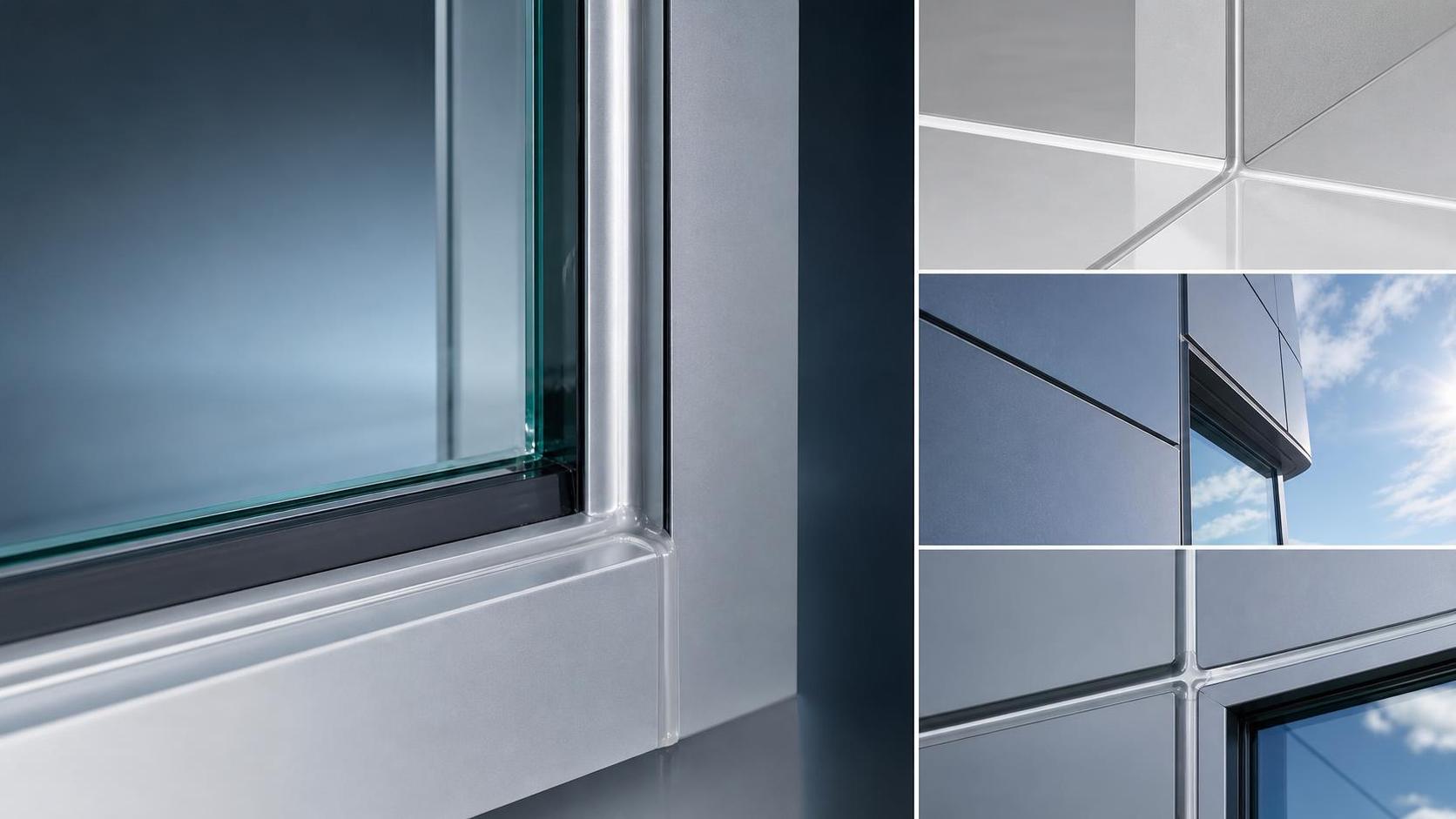
Perimeter joints around windows, curtain walls, and façade openings often require low modulus sealants because aluminium framing, glass, concrete, masonry, insulation systems, and coated panels may all be present within one elevation. These materials do not move uniformly. The sealant must bridge the gap while limiting stress on the less robust substrate, particularly porous concrete, render, stone, or factory-coated metal.
Rainscreen cladding and metal composite panel joints are another common application. Long metal panels can undergo substantial thermal movement, especially on dark finishes and sun-exposed elevations. If the panel is restrained by a relatively stiff sealant, stress can be transferred to panel edges, coatings, fasteners, or narrow adhesion areas. Low modulus silicone can better accommodate movement where the joint design permits appropriate extension and compression.
Glazing and weatherseal joints may need low modulus behavior when glass, aluminium, gaskets, spacers, and coated surfaces interact. In weathersealing, the objective is usually to maintain an external air- and water-resistant seal while accommodating movement between framing and infill components. The correct silicone must also be compatible with adjacent glazing materials; low modulus alone does not establish suitability for structural glazing or insulating glass edge-seal contact.
Precast concrete and curtain-wall interface joints can benefit from low modulus sealants where panel movement, concrete shrinkage, and frame deflection act together. Concrete frequently presents a substrate challenge because its surface condition can vary significantly. A low-modulus product may reduce bond stress, but it cannot compensate for weak laitance, residual curing compounds, moisture-related contamination, or an incorrectly selected primer.
Expansion joints in external walls and roof-adjacent details are candidates when movement is substantial and the sealant is exposed to weathering. These joints require a coordinated design involving joint width, depth, backing material, movement direction, and expected service environment. Selecting a low modulus silicone without confirming those variables can simply move the failure mechanism from the sealant to the substrate, backing rod, or adjacent construction.

Situations that indicate a low modulus formulation is justified
A practical assessment starts with the forces acting on the joint rather than a generic preference for “flexible” sealants. Low modulus silicone is normally justified when one or more of the following conditions applies:
- The joint connects dissimilar materials with meaningfully different thermal expansion behavior, such as aluminium to concrete, glass to metal, or metal cladding to masonry.
- The substrate has limited tensile strength, a friable surface, or a finish that may be vulnerable to high peel and shear stress.
- Wide façade panels, long glazing runs, or exposed metal elements are expected to generate cyclic thermal movement.
- The joint is exposed to outdoor weathering and must retain flexibility after ultraviolet exposure, moisture, and temperature cycling.
- The assembly includes thin sheet materials, flexible panels, or coated components where a higher-stress sealant could contribute to distortion, edge lifting, or coating damage.
- The joint width has been designed for movement, but the available adhesion area remains limited and must not be overloaded.
Conversely, a low modulus product is not automatically the best choice for every moving joint. Certain flooring joints, high-abrasion areas, fuel-exposed environments, immersed conditions, fire-rated penetrations, or joints requiring controlled hardness may demand a different chemistry or performance profile. Silicone also has limitations in areas intended for later painting, because many conventional silicone sealants are not paintable. The requirement should be defined by the assembly, not by the label on the cartridge.
Joint design determines whether the sealant can perform
Many apparent sealant failures originate in joint geometry rather than the sealant formulation. Even a well-selected low modulus silicone can fail prematurely if it is installed too deeply, bonded on three sides, or placed in a joint that is too narrow for the expected movement.
The sealant should normally adhere to the two opposing joint faces and remain free to deform across its depth. A correctly sized closed-cell polyethylene backer rod is widely used to control depth and prevent three-sided adhesion. Where joint conditions require an alternative bond-breaker, it must be compatible with the sealant and the intended movement. Three-sided adhesion restricts the sealant’s ability to elongate and concentrates stress where failure is most likely to begin.
Width and depth should be set from the anticipated total movement and the product’s declared movement capability, with allowance for construction tolerances and installation temperature. A joint installed at one extreme of its expected temperature range begins service already biased toward compression or extension. If the joint is filled when very narrow, later contraction may demand more extension than the design calculation assumed. If filled when unusually wide, compression may become the limiting condition.
Movement ratings must be read carefully. Under ASTM C920, sealants are classified by movement capability, such as Class 25 or Class 50, which refer to extension and compression performance under defined test conditions. ISO 11600 uses a different classification system, including movement classes and modulus designations. These standards are useful comparison tools, but they do not replace project-specific joint calculations or substrate testing. A Class 50 product does not guarantee that every field joint can safely move 50% in every direction under every exposure condition.
Substrate compatibility can outweigh nominal performance
Silicone adhesion depends on the chemistry and condition of the actual surface, not merely the base material named in a specification. “Aluminium,” for example, may mean mill-finished metal, anodized aluminium, powder-coated aluminium, fluoropolymer-coated aluminium, or a surface carrying fabrication residues. Each may require a different preparation method, primer, or compatibility confirmation.
Porous mineral surfaces create a separate set of issues. Concrete, brick, natural stone, cement render, and fibre-cement can contain moisture, dust, alkaline residues, sealers, water repellents, or weak surface layers. Low modulus silicone reduces stress but does not solve inadequate surface cohesion. If the substrate itself fails under pull testing, changing to a softer sealant is not a complete corrective action.
Compatibility with adjacent materials deserves equal attention. Plasticized PVC, bituminous membranes, EPDM, butyl products, insulating glass components, certain tapes, and some coatings can cause staining, migration, adhesion loss, or chemical interaction. Silicone sealants are also not interchangeable across glazing applications. A weatherseal product, a structural silicone, and a neutral-cure construction sealant may share a broad chemistry category while serving very different functions and having different approval requirements.
Where a project involves sensitive stone, coated panels, or glazing systems, representative adhesion and compatibility testing should be part of the evaluation. The test assembly should reflect actual substrates, surface treatments, cleaning methods, primers, and expected joint dimensions. Testing a clean laboratory coupon while the project uses weathered, coated, or site-cut materials gives limited assurance.
Cure conditions affect the result before movement begins
Most one-component silicone sealants cure through moisture exposure. Skin formation and cure rate are influenced by temperature, relative humidity, joint depth, ventilation, and the ability of moisture to reach the sealant. A deep joint or cold, dry environment can slow through-cure significantly. Movement, cleaning, water exposure, or mechanical loading before adequate cure may compromise the seal.
Installation conditions should therefore be checked against the manufacturer’s published application limits. Surface temperature, condensation risk, frost, rain, standing water, and visible contamination all matter. A dry-looking joint can still have condensation on a cold substrate when ambient humidity is high. This is particularly relevant on metal framing, glass, and early-morning installation work.
Sealant application also needs to wet the substrate fully. Tooling is not just a cosmetic operation: it presses material against the joint faces, removes voids, and forms the intended sealant profile. Poor tooling can leave discontinuities at the bond line that become water paths or stress concentrators under cyclic movement.
Low modulus is not a substitute for structural assessment
Where joint movement results from building drift, major slab-edge deflection, curtain-wall anchorage movement, or seismic displacement, the issue exceeds ordinary weatherseal selection. The expected displacement vector, joint opening range, frame rotation, and system-specific load path must be considered. A low modulus silicone may be one element of the solution, but it cannot make an undersized joint or unsuitable façade detail reliable.
The same caution applies to structural glazing. Structural silicone applications require system-specific design, adhesion verification, and compliance with the applicable project requirements. A low modulus weatherseal should not be assumed to provide structural load transfer merely because it bonds well to glass and aluminium.
A more reliable evaluation sequence
The most useful starting question is: what movement must this joint accommodate, and which component is least able to accept stress? That directs the review toward the real failure risk.
Define the joint substrates and finishes; estimate thermal, moisture-related, and structural movement; establish the installation width and likely service extremes; then compare sealants by both movement classification and stress behavior. Confirm whether the product is intended for the exposure, substrate combination, and adjacent materials involved. Review the need for primer, determine the correct backing material, and verify cure conditions before installation.
Low modulus silicone sealants are needed when flexibility must be paired with low force transfer. They are particularly valuable in exterior joints involving differential movement and vulnerable bond surfaces, but their benefit depends on a joint that is correctly dimensioned, prepared, and tested for the actual assembly. The right decision is not “use the softest sealant available.” It is to select a sealant whose movement capacity, modulus, adhesion profile, and environmental resistance match the mechanics of the joint it is expected to protect.
- Last One:No more articles
- Next Article:Which flooring materials hold up best in high-traffic commercial spaces?Sep 20, 2026
Technical Specifications
- When are low modulus silicone sealants needed for moving joints?Author :Chemical Industry Editorial Team
- Which flooring materials hold up best in high-traffic commercial spaces?Author :Construction Materials Editorial Team
- What to verify before selecting a transformer manufacturer in the USAAuthor :Electrical Components Editorial Team
Expert Insights

Chief Security Architect
Dr. Thorne specializes in the intersection of structural engineering and digital resilience. He has advised three G7 governments on industrial infrastructure security.