What to verify before selecting a transformer manufacturer in the USA
Author
Date Published
Reading Time
What to Verify Before Selecting a Transformer Manufacturer in the USA
Selecting a transformer manufacturer USA buyers can rely on is not simply a matter of comparing quotation totals, stated lead times, and nameplate ratings. A transformer may appear straightforward on a purchase order, yet it sits at the center of electrical reliability, safety compliance, installation planning, and long-term maintenance cost. A unit that is technically acceptable on paper can still become an expensive problem if its impedance does not match the system study, its enclosure is unsuitable for the site, its documentation is incomplete, or the supplier cannot support a failure investigation after delivery.
For procurement teams, especially those buying for industrial facilities, commercial construction, utility-related work, data infrastructure, renewable projects, or distribution networks, the real question is broader: can this manufacturer repeatedly deliver a transformer that fits the application, meets the applicable requirements, and arrives with manageable commercial risk? The checks below help separate a credible manufacturing partner from a supplier whose offer is mainly built around a low initial price.
Start with the application, not the catalog rating
The first verification should be whether the manufacturer understands the duty of the transformer being requested. “Dry-type transformer,” “pad-mounted unit,” or “medium-voltage transformer” is rarely enough specification detail for a dependable procurement decision. Voltage, kVA or MVA rating, frequency, phase arrangement, winding connections, insulation class, cooling method, impedance, tap arrangement, basic impulse insulation level where relevant, and enclosure requirements can all affect design, cost, and project suitability.
Ask the supplier to identify the assumptions behind its quotation. This is particularly important when a bid package contains incomplete drawings or when an equipment schedule has been copied forward from an earlier project. A manufacturer should be able to flag missing information rather than quietly price a generic configuration. For example, harmonic loading from variable-frequency drives, rectifiers, UPS systems, or other nonlinear loads may require additional engineering review. Ambient temperature, altitude, seismic considerations, indoor versus outdoor placement, and expected load profile can also change the appropriate design.
A low-cost offer based on an unstated assumption is not necessarily a bargain. It may create a change order, redesign delay, or site modification once the transformer reaches the installation stage.
Confirm standards, listings, and the exact scope of compliance
Compliance language deserves close reading. A buyer may see references to UL, ANSI, IEEE, NEMA, CSA, IEC, DOE efficiency requirements, or local utility specifications. These references do not all mean the same thing, and not every standard applies to every transformer type or installation. The relevant requirement may depend on the product design, voltage class, end use, jurisdiction, and customer specification.
Rather than accepting a broad statement such as “built to applicable standards,” request a compliance matrix. It should show which standards are being claimed, which tests or construction features support those claims, and whether the finished product carries a required third-party listing or only uses listed components. If a project requires a Nationally Recognized Testing Laboratory listing, verify that the offered configuration—not merely a similar catalog family—falls within the listing scope.
For overseas buyers sourcing equipment for the U.S. market, this distinction is especially important. Local electrical inspectors, owners, insurers, utilities, and engineering firms may each impose separate expectations. A transformer accepted in another market is not automatically acceptable for a U.S. installation. The manufacturer should be willing to review project-specific requirements before production begins.
Look beyond the factory address: verify actual manufacturing capability
“Made in the USA” and “U.S.-based supplier” can describe very different operating models. Some companies design, wind, assemble, test, and service transformers from domestic facilities. Others may import major assemblies, outsource selected fabrication, or operate primarily as distributors. None of these models is automatically unsuitable, but procurement teams need transparency because the model affects lead time, repair options, spare parts, origin requirements, and exposure to logistics disruption.
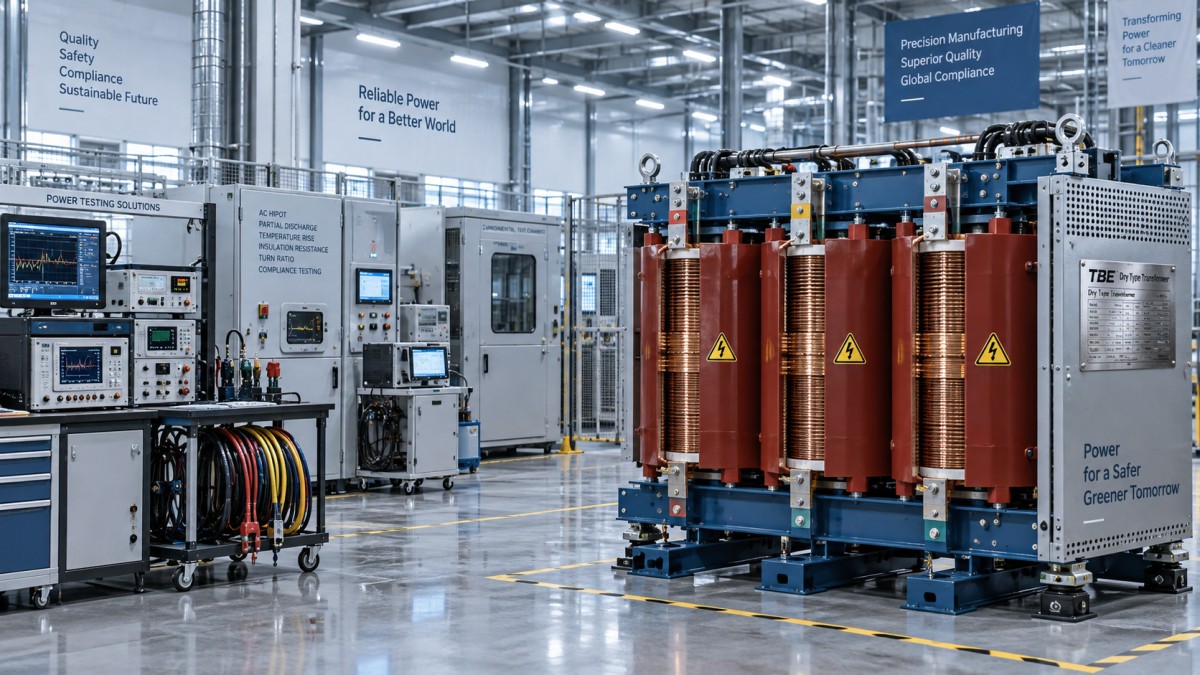
A useful due-diligence discussion covers the manufacturer’s engineering, winding, core processing, tank fabrication where applicable, assembly, test, and final inspection capabilities. Ask which steps occur in-house and which are subcontracted. If custom units are involved, determine who owns the design responsibility and who approves deviations. A manufacturer that cannot clearly explain its production flow may also struggle to explain responsibility when a nonconformance appears.
Capacity should be assessed in practical terms. Published annual capacity is less useful than the current production schedule for the relevant product line, the availability of critical materials, and the manufacturer’s ability to handle the physical size and test requirements of the proposed unit. Large power transformers, medium-voltage designs, and engineered specialty units may face different constraints than standard low-voltage dry-type products.
Treat testing as evidence, not a checkbox
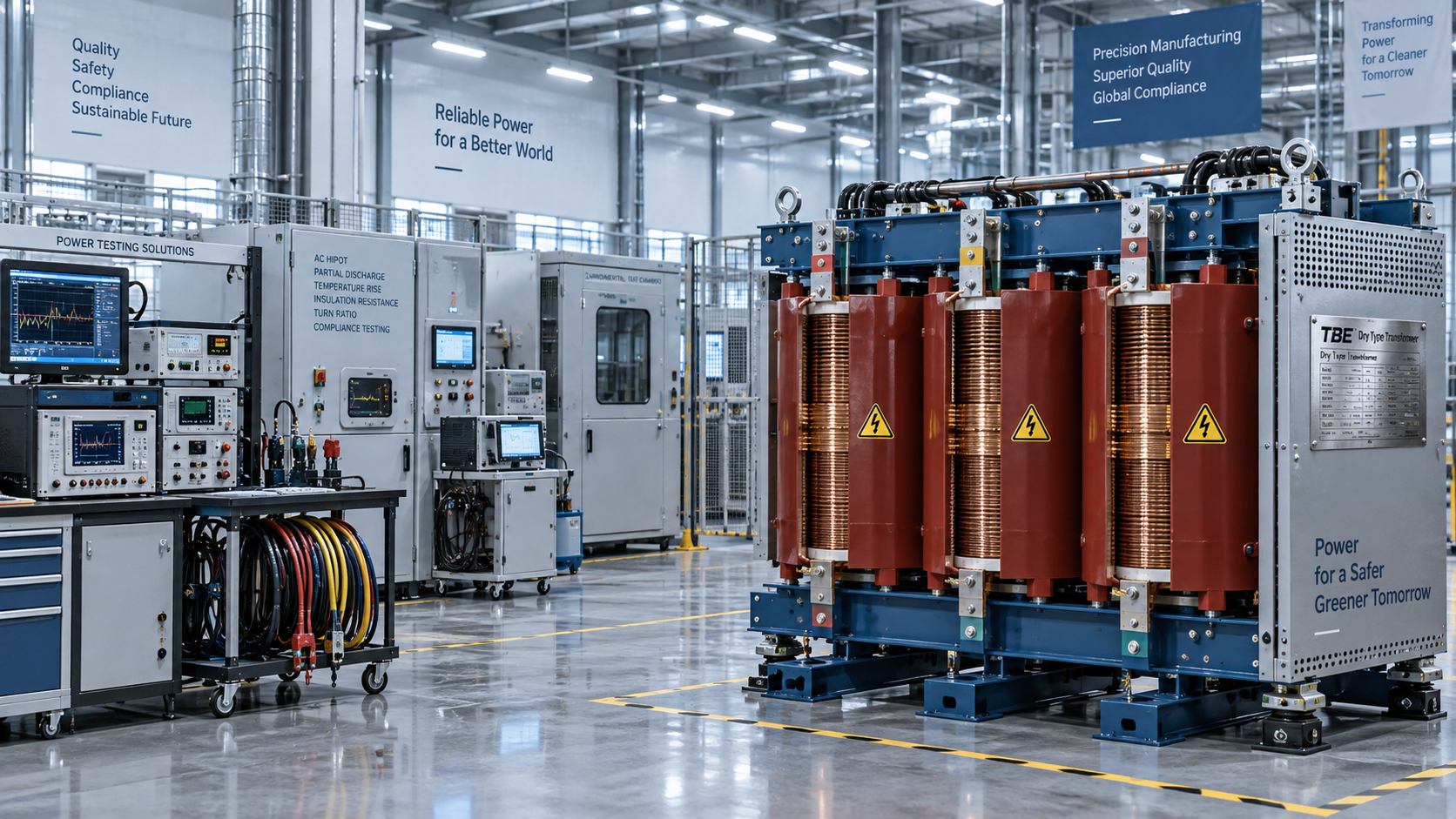
Testing is one of the clearest windows into a manufacturer’s discipline. The buyer should ask what routine tests are performed before shipment, what documentation will be supplied, and whether witness testing is available when the project justifies it. The answer should align with the transformer category and governing specification. Routine electrical tests may include verification of ratio, polarity or phase relation, winding resistance, insulation resistance, impedance, and dielectric performance, among other checks appropriate to the design.
Do not assume that a factory test report from one product is interchangeable with another. The report should identify the unit, serial number, applicable test basis, measured results, and any deviations or retests. Clarify whether the documentation is issued before shipment and whether it can be reviewed before final payment or release. For high-consequence equipment, an agreed inspection and test plan can prevent disputes about what was expected.
Testing also has a commercial dimension. A supplier that prices an unusually low unit but excludes requested documentation, witness arrangements, special tests, or packaging verification may shift significant risk back to the buyer. Those exclusions should be visible in the bid comparison.
Compare total acquisition cost, not only the transformer price
The lowest purchase price can be misleading because transformers carry costs well beyond the invoice. Freight, crating, domestic delivery, rigging, storage, insurance, accessories, field assembly, commissioning support, and warranty handling all deserve consideration. A large unit may require route planning, special lifting provisions, or delivery coordination that is not obvious in an initial quotation.
Energy losses are another part of the calculation. Core loss and load loss can influence operating cost over the transformer’s service life, but the financial relevance depends on loading conditions, operating hours, electricity cost, and the owner’s evaluation method. Procurement should ask for loss values and avoid comparing them without confirming that the ratings and test basis are equivalent. A unit with a higher initial price may be commercially reasonable in a continuously loaded installation, while the same premium may be harder to justify for intermittent duty.
Examine the supply chain behind the promised lead time
Transformer lead times are shaped by more than factory labor. Electrical steel, copper or aluminum conductors, insulating materials, bushings, tap changers, enclosures, protection components, and specialized test capacity can all affect the schedule. Market conditions can shift quickly, so buyers should be wary of a firm delivery promise that is not tied to a defined technical release date and commercial milestone.
Ask when the manufacturing clock starts, what approvals are required, what information the customer must provide, and how schedule changes are communicated. It is also reasonable to ask whether key materials are already allocated or still subject to supplier confirmation. This is not about demanding confidential sourcing details; it is about identifying schedule dependencies before they turn into missed construction dates.
For importers and distributors, country-of-origin declarations, tariff exposure, and port-to-site logistics may also matter. These points should be confirmed through the actual transaction documents and current trade requirements rather than assumed from a company’s U.S. sales presence.
Evaluate engineering communication and document control
A transformer manufacturer’s technical responsiveness often becomes visible before the order is placed. Good signs include clear clarification questions, controlled drawings, documented exceptions, and an ability to explain why a requested feature affects price or lead time. Weak signs include copied specifications, vague promises of “full compliance,” or frequent revisions without a clear revision history.
Before award, establish the required submittal package. Depending on the project, it may include outline drawings, connection diagrams, nameplate data, weights, foundation or mounting information, shipping dimensions, installation instructions, test reports, and operation or maintenance guidance. Contractors need these documents early enough to coordinate electrical rooms, cable routing, lifting clearances, and protective devices. A late drawing can delay a project even when the transformer itself is on schedule.
Do not leave warranty and field support until the end
Warranty language should answer practical questions: When does coverage begin? What is covered? What evidence is required for a claim? Who pays for removal, inspection, freight, reinstallation, or emergency replacement? Is field service provided directly, through approved partners, or not at all? The contract may not eliminate every outage risk, but it should make responsibilities understandable.
Support capability matters more for critical installations and custom equipment. Confirm whether the manufacturer can provide commissioning guidance, troubleshooting support, replacement components, or engineering review if the transformer behaves unexpectedly in service. A domestic phone number is not proof of technical depth; the relevant question is whether qualified people can access the design records and help resolve the issue.
Build a comparison that exposes risk
The strongest supplier comparison is usually not a one-line price table. It is a controlled review of technical compliance, exclusions, tests, documentation, lead-time assumptions, commercial terms, and service responsibilities. This approach makes it easier to explain a selection internally, particularly when the lowest bid is not the lowest-risk choice.
Industry news, standards updates, logistics developments, price movements, and supplier references can provide useful context during this process, but they should not replace project-specific verification. Buyers researching a transformer manufacturer USA market option should use current information to identify questions, then obtain written answers tied to the exact unit being purchased.
Before issuing a purchase order, reconcile the final approved drawing, technical schedule, compliance requirements, test documentation, delivery basis, and warranty terms. That final alignment is less glamorous than negotiating the last percentage point off the price, but it is often where avoidable transformer procurement problems are prevented.
- Last One:No more articles
- Next Article:How to choose a cutting machine for stone based on slab thicknessSep 19, 2026
Technical Specifications
- What to verify before selecting a transformer manufacturer in the USAAuthor :Electrical Components Editorial Team
- How to choose a cutting machine for stone based on slab thicknessAuthor :Construction Materials Editorial Team
- When are porcelain tiles for outdoor spaces at risk of cracking?Author :Construction Materials Editorial Team
Expert Insights

Chief Security Architect
Dr. Thorne specializes in the intersection of structural engineering and digital resilience. He has advised three G7 governments on industrial infrastructure security.
Core Sector // 01
Security & Safety
- What to verify before selecting a transformer manufacturer in the USAAuthor :Electrical Components Editorial Team

- How to size solar transformer capacity for peak generationAuthor :Electrical Components Editorial Team

- Which solar transformer specifications must match inverter output?Author :Electrical Components Editorial Team

- How do you size a transformer for solar power projects?Author :Electrical Components Editorial Team

- How Transformers Affect Power Stability in Industrial FacilitiesAuthor :Electrical Components Editorial Team

- Dry-Type vs Oil-Filled Transformers: Which Fits Your Project?Author :Electrical Components Editorial Team