Which flooring materials hold up best in high-traffic commercial spaces?
Author
Date Published
Reading Time
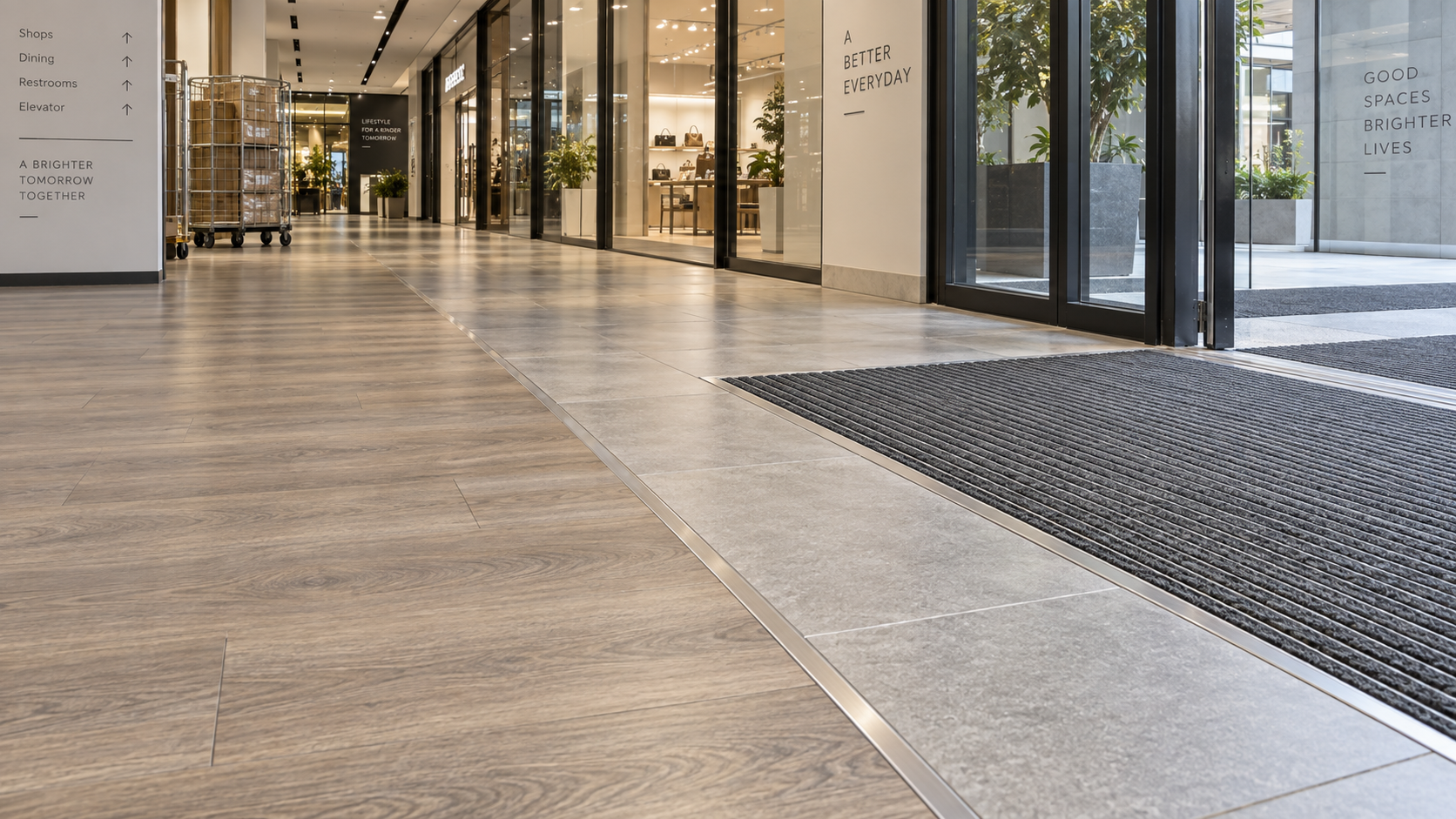
For sustained commercial traffic, the strongest overall choices are porcelain tile, high-quality luxury vinyl tile or plank, homogeneous sheet vinyl, polished or sealed concrete, quarry tile, and properly specified rubber flooring. None is universally best. The right material changes with rolling loads, moisture, cleaning chemistry, acoustic needs, subfloor condition, and the cost of taking an area out of service for repairs.
A surface that survives foot traffic can still fail under shopping carts, hospital beds, pallet jacks, grit at entrances, wet cleaning, or repeated point loads from shelving. The most reliable specifications evaluate the complete floor assembly: wear surface, adhesive or setting bed, joints, transitions, moisture control, and cleaning method. Selecting by a sample board or a single wear-layer figure often produces a floor that looks appropriate at handover but ages poorly in service.
Start with the type of traffic, not the material label
Traffic intensity has several forms. Shoe traffic abrades finishes and carries in grit. Wheeled traffic concentrates force at small contact points and places stress on seams and edges. Static loads can leave dents or crack brittle materials where the substrate is uneven. Wet operations add slip and staining concerns, while frequent disinfection may attack coatings, adhesives, or poorly welded seams.
Entrance zones deserve separate treatment from the rest of the floor. Fine sand and hard debris act like abrasive media under shoes and wheels. Even a highly durable finish will show premature wear if dirt is allowed to travel from an entrance across a long circulation route. Recessed or surface-applied entrance matting, sized for the actual approach path, reduces wear on every flooring material behind it. It should be designed with drainage, cleaning access, and transition heights in mind rather than treated as a decorative accessory.
Also distinguish between a visible wear problem and an assembly problem. Dulling in a lobby may be caused by soil retention or aggressive cleaning pads rather than insufficient surface hardness. Open vinyl seams near a service corridor may reflect substrate moisture, inadequate adhesive coverage, or rolling loads crossing the seam at a weak angle. Replacing the same finish without correcting the underlying condition repeats the failure.
Materials that perform best under heavy use
Porcelain tile for abrasive, wet, and public-facing areas
Porcelain tile is among the most durable flooring materials for concourses, retail entrances, corridors, public washrooms, food-service front areas, and transport facilities. Its dense fired body resists scratching, water absorption, many stains, and routine cleaning. Through-body or full-body porcelain is especially useful where chips are possible, because minor edge damage is less visually obvious than on a glazed product with a contrasting body.
Tile performance depends heavily on installation quality. Large-format units can create lippage when the substrate is not flat, and raised edges receive repeated impacts from carts and cleaning equipment. A rigid tile surface also transfers movement from the slab or underlayment into grout joints and tile edges. Movement joints, correct substrate preparation, compatible setting materials, and a joint layout that avoids narrow perimeter cuts matter as much as tile selection.
Slip resistance must be evaluated in its intended condition. A very smooth polished porcelain surface can be suitable for dry, controlled interiors but is a poor choice where rainwater, food residue, or tracked-in moisture is routine. Textured finishes improve grip but retain more soil and may require more deliberate cleaning. In areas where hygiene and cleaning speed are important, a moderate texture with appropriately sized grout joints is often easier to maintain than either a mirror-polished tile or an aggressively rough surface.
Luxury vinyl tile and plank for adaptable interiors
Commercial-grade LVT and LVP perform well in offices, retail floors, hotel circulation, education spaces, and many healthcare support areas. They offer a broad visual range, lower noise underfoot than tile or concrete, and easier local replacement when damage occurs. The material is particularly useful when renovation schedules require installation over a prepared existing floor and the project needs a resilient finish rather than a hard surface.
The word “commercial” alone is not enough to judge resilience. Compare the construction, wear layer, protective coating, backing stability, indentation resistance, and permitted rolling-load use. A thick-looking plank with a decorative embossed surface may not withstand concentrated loads as well as a denser, purpose-designed tile. Dark or highly textured visual patterns can also hide early wear, which is useful in busy spaces but should not substitute for the underlying performance requirement.
Subfloor moisture is a frequent source of failure. Vinyl products and pressure-sensitive adhesives can be affected by excessive moisture vapor emissions or high alkalinity in a concrete slab. Patch compounds, primers, adhesive, and flooring must be evaluated as a compatible system. When a moisture-control treatment is required, omitting it to protect the initial budget can lead to bubbles, curling edges, adhesive displacement, and costly access restrictions later.
Plank direction should be coordinated with wheeled paths. Repeated traffic that strikes short ends or long edges can expose joints over time, especially where the substrate has local irregularities. Tile formats, seam orientation, and transition locations should be considered alongside the movement of carts, beds, trolleys, and cleaning machines.
Homogeneous sheet vinyl where seamless hygiene matters
Homogeneous sheet vinyl is a strong option for clinical areas, laboratories, schools, back-of-house corridors, and other interiors that need a cleanable, resilient surface with few dirt-catching joints. Its consistent composition through the thickness means that minor surface wear does not reveal a separate printed layer. Heat-welded seams and coved skirtings can create a more continuous finish around walls, equipment zones, and wet-cleaned rooms.
This material is not immune to damage. Dragging sharp metal furniture, using unsuitable cleaners, or allowing heavy point loads without load-spreading protection can gouge or permanently indent the surface. Seam welding needs careful workmanship: weak fusion, overheated material, inadequate trimming, or contamination in the joint can leave a seam that opens under cleaning and rolling traffic. The quality of the welded joint should be inspected before the space becomes occupied, when correction is still manageable.
Sheet products also demand a very smooth substrate. Small ridges, trowel marks, and uneven patches can telegraph through the finish, becoming visible and vulnerable to wear. This is why a lower material price does not automatically produce a lower installed cost. Substrate preparation can be a substantial part of a durable sheet-vinyl installation.
Concrete for industrial movement and simple maintenance
Polished, densified, or coated concrete is practical in warehouses, logistics areas, large-format retail, workshops, parking-adjacent interiors, and utility corridors. When the existing slab is structurally sound and properly finished, concrete avoids the seam and edge issues associated with modular resilient products. It tolerates heavy rolling equipment well and can be maintained with mechanical sweeping and suitable wet cleaning.
Concrete should not be specified simply as “polished” or “sealed.” The desired appearance affects durability and maintenance. A highly reflective polish may show tire marks, spills, and surface scratches more readily than a lower-sheen finish. Film-forming coatings can offer color, chemical resistance, or dust control, but their service life depends on traffic, surface preparation, cure conditions, and cleaning methods. A coating that works in a pedestrian showroom can wear rapidly in a loading zone with hard wheels and abrasive debris.
Cracks, joints, and slab movement remain part of the design. Filling joints flush may improve cleanability and wheel movement, but the filler must suit the expected joint movement and traffic. Rigid fills in moving joints can break down; flexible fills may be damaged by aggressive wheeled loads. Drainage, surface profile, and slip characteristics deserve close attention anywhere water, oils, or process liquids are present.
Quarry tile for demanding wet-service environments
Quarry tile remains one of the most robust choices for commercial kitchens, food preparation rooms, dishwashing areas, and service zones exposed to water, grease, and repeated washdown. Its textured surface and durable fired body can provide dependable footing and abrasion resistance. It is better suited to these conditions than many decorative ceramic finishes.
The trade-off is cleaning effort. Texture and grout joints collect soils, so the floor needs cleaning procedures capable of reaching the surface profile without degrading grout or causing residue buildup. A layout with appropriate falls to drains, compatible waterproofing, and coved wall transitions is often more important than a nominal tile thickness. Water trapped beneath tile because of poor drainage or failed waterproofing creates a different problem from surface staining and cannot be solved with stronger cleaning chemicals.
Rubber flooring for comfort, noise control, and repeated footfall
Rubber flooring is effective in airports, education facilities, fitness spaces, healthcare circulation, and transit interiors where long periods of standing, acoustics, and slip resistance matter alongside durability. Dense commercial rubber resists scuffing well and absorbs impact better than hard tile. It can reduce noise from foot traffic and dropped objects, which is valuable in busy interior environments.
Its limits should be assessed early. Some rubber products can stain or react when exposed to oils, asphaltic materials, certain chemicals, or migration from unsuitable backing and adhesives. Color selection influences visible scuffing, and textured surfaces require cleaning tools that remove soil without leaving detergent film. Near exterior doors, rubber may still need protective matting because fine grit can abrade and discolor the surface over time.
A comparison that avoids common shortcuts
Specify the assembly around the floor
Durability is often lost at interfaces rather than in the center of the field. Door thresholds, elevator entrances, floor drains, expansion joints, changes in substrate, and transitions to carpet or adjacent tile should be drawn and coordinated before installation. A resilient finish can tear at a poorly supported metal transition; a tile edge can chip where a wheeled load repeatedly crosses an abrupt height change.
Request samples that represent the actual finish, not only the color. For textured products, assess cleanability after soil exposure. For resilient products, test the visual effect of castor wheels and proposed cleaning equipment on a mock-up where feasible. For hard surfaces, review expected joint width, grout color, edge profile, and the way natural or artificial light reveals lippage and surface variation.
Maintenance assumptions belong in the selection stage. A surface requiring periodic refinishing may remain economical where access is easy and overnight work is available, yet become disruptive in a continuously occupied facility. Conversely, a material with higher installation complexity can be preferable when it reduces recurring closure time. Cleaning chemicals, pad types, machine weight, water use, and drying time should align with the selected surface.
The longest-lasting result usually comes from matching a material to a specific failure mode: porcelain or quarry tile where abrasion and moisture dominate; dense resilient vinyl where cleanability and replaceable modules are valuable; concrete where wheeled loads govern; and rubber where pedestrian comfort and acoustic control carry more weight. That match must extend through the substrate, joints, transitions, and maintenance regime, because the visible flooring is only one part of the system carrying the traffic.
Technical Specifications
- When are low modulus silicone sealants needed for moving joints?Author :Chemical Industry Editorial Team
- Which flooring materials hold up best in high-traffic commercial spaces?Author :Construction Materials Editorial Team
- What to verify before selecting a transformer manufacturer in the USAAuthor :Electrical Components Editorial Team
Expert Insights

Chief Security Architect
Dr. Thorne specializes in the intersection of structural engineering and digital resilience. He has advised three G7 governments on industrial infrastructure security.
Core Sector // 01
Security & Safety
- Which flooring materials hold up best in high-traffic commercial spaces?Author :Construction Materials Editorial Team

- Laminate Flooring vs Wood Flooring: Which Option Fits Rental Renovations?Author :Construction Materials Editorial Team

- How to Choose Laminate Flooring Wear Ratings for High-Traffic Commercial AreasAuthor :Construction Materials Editorial Team

- Engineered Wood Flooring vs Solid Wood Flooring: Pros, Limits, and Best UsesAuthor :Construction Materials Editorial Team

- How to Check Moisture Conditions Before Installing Wood FlooringAuthor :Construction Materials Editorial Team