Choosing roofing materials for commercial buildings in hot climates
Author
Date Published
Reading Time
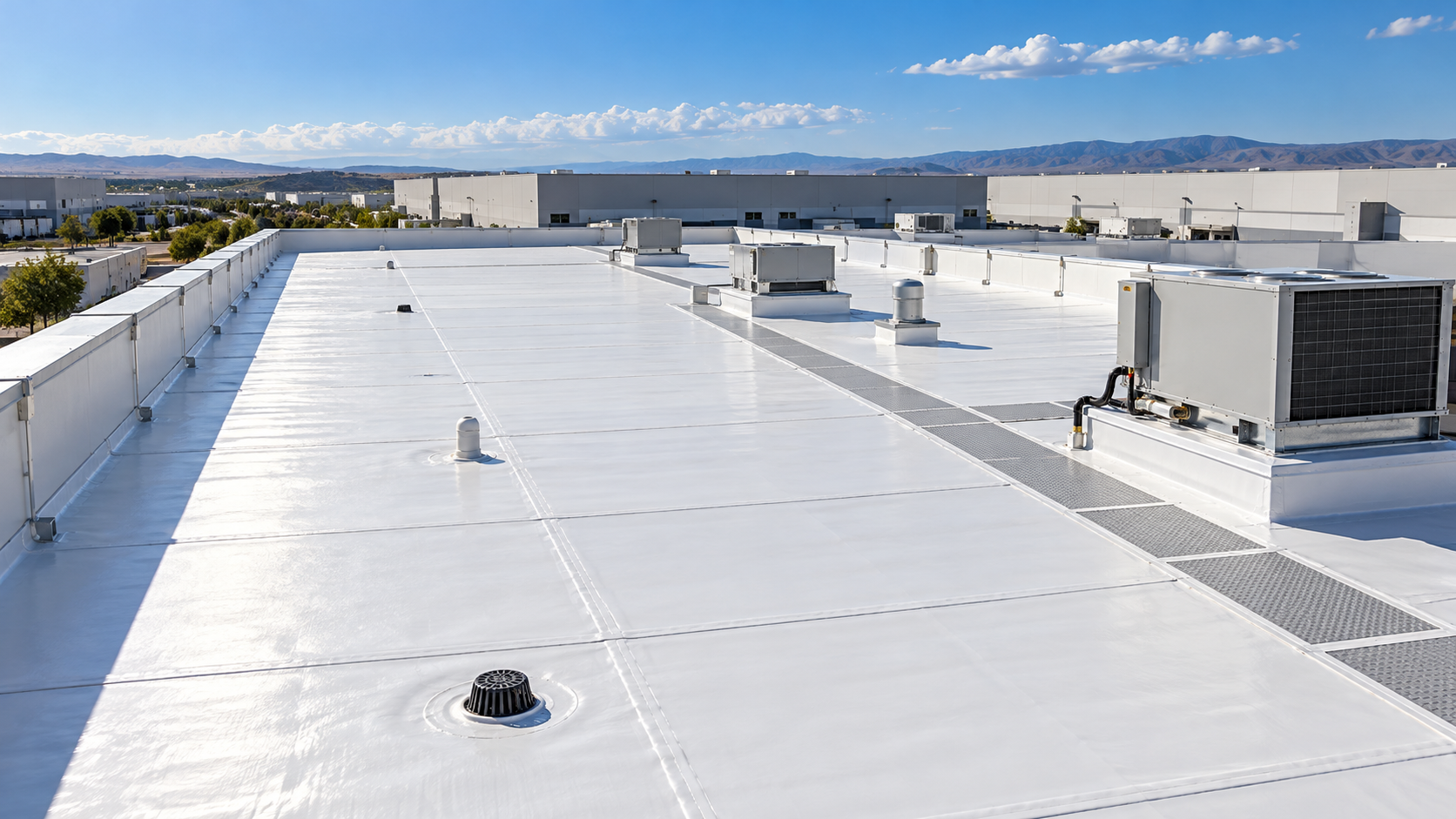
On a hot afternoon, the roof above a warehouse, shopping center, or production facility can become a substantial source of heat gain. What looks like a straightforward material purchase soon affects cooling demand, indoor comfort, maintenance access, and the risk of interrupting daily operations.
Choosing roofing materials for commercial buildings in hot climates therefore requires more than comparing membrane prices or selecting the whitest surface. Project managers need to evaluate the complete roof assembly: its solar performance, insulation, moisture behavior, attachment, drainage, and compatibility with the building’s use. The right choice is usually the system that meets those requirements with the fewest unresolved risks—not necessarily the lowest initial bid.
Start with the building’s operating conditions, not the product catalog
“Hot climate” covers very different environments. A dry inland logistics center faces intense sunlight, dust, and large day-to-night temperature swings. A coastal hotel must also contend with humidity, salt exposure, and wind-driven rain. A tropical factory may experience prolonged wet periods alongside high temperatures.
Before requesting quotations, establish a short project brief covering:
- Building use: conditioned offices, unconditioned storage, refrigerated areas, or heat-producing industrial processes.
- Roof geometry: slope, drainage routes, penetrations, equipment density, and areas vulnerable to ponding.
- Exposure: ultraviolet radiation, coastal conditions, hail, wind, airborne contaminants, and nearby exhausts.
- Operational constraints: permitted shutdowns, noise restrictions, odor sensitivity, and safe access.
- Existing conditions: deck capacity, moisture damage, insulation condition, and previous roof layers.
For a reroofing project, an investigation of the existing assembly is especially important. A new reflective membrane over wet insulation does not solve the underlying problem. Moisture surveys, selective openings, and structural checks may be necessary before deciding between restoration, recover, and full replacement.
What actually controls roof heat gain?
Three properties deserve separate attention: solar reflectance, thermal emittance, and insulation. They work together, but they are not interchangeable.
Solar reflectance describes how much incoming sunlight a surface reflects. Thermal emittance describes how effectively it releases heat as infrared radiation. A highly reflective surface with high thermal emittance generally stays cooler in sunlight than a dark, absorptive surface under comparable conditions.
The Solar Reflectance Index, or SRI, combines these surface properties into a comparative indicator. It is useful for screening options, but it is not a forecast of energy savings. Building use, climate, HVAC efficiency, insulation, and operating hours all influence the actual result.
Ask for independently rated initial and aged values where available. In markets using the Cool Roof Rating Council, its directory can help verify product ratings; other jurisdictions may use different recognized schemes. A rating documents surface performance, not the suitability of the entire roof assembly.
Insulation controls heat transfer through the roof. A reflective finish does not replace the required thermal resistance. Likewise, additional insulation does not remove every reason to specify a cooler surface: surface temperatures can still affect membrane movement, rooftop working conditions, and nearby equipment.
For procurement, compare aged reflectance and emittance alongside the assembly’s thermal performance. A claim such as “heat-reflective roofing” is too vague to support a purchasing decision without test data and a defined system specification.
Comparing roofing materials for commercial buildings
Most low-slope commercial projects shortlist reflective single-ply membranes, metal roofing, or bituminous systems with a suitable reflective surface. Roof coatings may also be viable, but only when the existing roof qualifies for restoration.
These categories are starting points, not interchangeable specifications. Two products within the same category can differ in reinforcement, thickness, weathering performance, and warranty conditions.
TPO and PVC: assess the membrane and the installer together
Thermoplastic polyolefin, or TPO, is commonly shortlisted for reflective commercial roofs. Its heat-welded seams can provide reliable performance when the material, welding settings, substrate preparation, and workmanship are properly controlled. A low membrane price, however, says little about the quality of perimeter details or equipment penetrations.
PVC also uses heat-welded seams. Certain formulations may be suitable where exposure to grease, oils, or chemicals matters, such as near food-service exhausts. Do not assume every PVC product tolerates every contaminant. Obtain written confirmation for the actual exposure and verify any required separation layers.
For both systems, assess puncture risks from maintenance traffic. Specify compatible walkways around equipment and service routes rather than expecting the field membrane to function as a general work surface.
Metal roofing: durable potential, with movement and corrosion to manage
Reflective factory-coated metal can suit commercial buildings with appropriate roof geometry. Performance depends on the metal substrate, coating system, panel configuration, and detailing—not simply the color. Unpainted metal may have relatively low thermal emittance, so its appearance alone is an unreliable guide to cooling performance.
Long panels expand and contract as temperatures change. Clips, joints, flashings, and penetrations must accommodate that movement. In coastal or industrial locations, confirm that the selected substrate, finish, fasteners, and accessories are compatible with the exposure and covered by applicable warranty terms.
Condensation also needs attention. An attractive external finish cannot compensate for a poorly designed insulated assembly beneath it.
Modified bitumen and coatings: distinguish a new roof from a restoration
Modified bitumen systems can provide multilayer construction and practical detailing options. For hot climates, evaluate a reflective cap sheet or compatible reflective coating rather than assuming all mineral-surfaced products deliver equivalent solar performance. Application methods also matter: hot work, odors, and site restrictions may influence the specification.
A restoration coating can reduce tear-off and operational disruption when the existing roof is dry, sound, and compatible. It is not a universal remedy for leaks. Failed flashings, wet insulation, poor drainage, or structural deterioration may require repairs or replacement before coating is considered.
Require documented preparation, adhesion testing where appropriate, application thickness controls, and curing conditions. Coating chemistry must match the substrate and exposure; different systems have different limitations under standing water and foot traffic.
The details that can overturn an otherwise good material choice
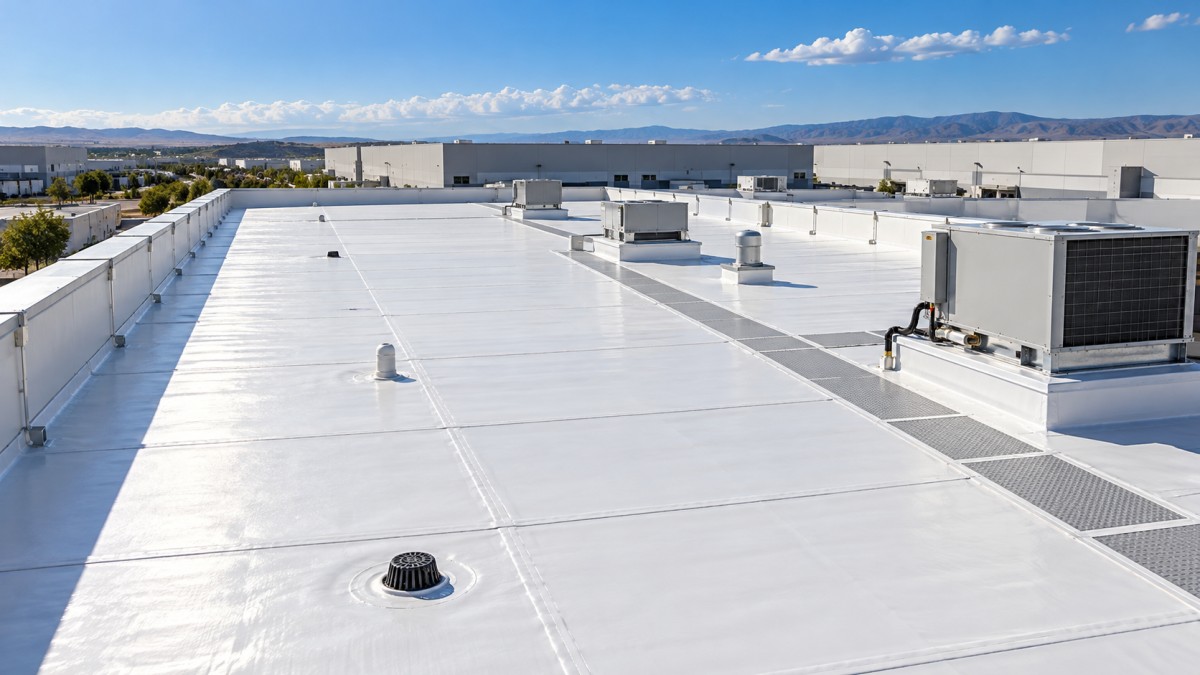
A roof rarely fails because its reflectance value was slightly below expectations. More immediate problems often begin at drains, edges, curbs, seams, and penetrations.
Drainage deserves its own review. Check finished falls, deflection, drain capacity, overflow provisions, and equipment obstructions. A material’s resistance to standing water does not justify accepting a drainage defect, and warranty exclusions may treat ponding differently from material degradation.
Wind resistance is an assembly issue. Membrane, insulation, cover board, fasteners or adhesive, deck, and edge securement must work together. Where required, use tested or approved assemblies appropriate to local design pressures, including higher-demand perimeter and corner zones. A membrane datasheet alone cannot establish compliance.
Fire performance also depends on the assembly. Confirm the applicable roof-covering classification and any additional insurer or authority requirements. Do not transfer a rating from one deck or insulation configuration to another without supporting documentation.
In hot-humid conditions, moisture design needs particular care. Air leakage, interior humidity, cooling setpoints, and vapor-pressure differences influence condensation risk. Vapor-control layers should follow a project-specific assessment rather than a blanket rule about placing a vapor barrier on one side of every roof.
Compare lifecycle costs on an equal basis
The cheapest quotation may exclude the work that determines whether the roof performs. Normalize bids before comparing totals: insulation thickness, cover boards, demolition, disposal, drainage modifications, edge details, access protection, and warranty scope should be clearly identified.
A practical lifecycle assessment includes installation, modeled energy consumption, inspections, cleaning where justified, repairs, planned recoating or renewal, and eventual replacement. Consider disruption costs as well. A distribution center that cannot stop shipping may reasonably value a different installation strategy from a vacant speculative building.
Keep energy projections grounded. Generic claims of percentage cooling savings are not a substitute for a building-specific model. An unconditioned warehouse and a continuously cooled retail facility will not gain the same financial benefit from an identical reflective roof.
Compare alternatives over the same study period and use sensitivity checks for uncertain inputs, including electricity prices and maintenance frequency. Avoid treating an advertised service life as guaranteed. Exposure, design, workmanship, and upkeep all affect how long the assembly remains serviceable.
What to request before awarding the roofing contract
A decision-ready submission should connect product data to the proposed construction. Ask shortlisted suppliers and contractors for:
- A complete assembly: deck assumptions, insulation, cover board, attachment, membrane or panels, flashings, and drainage interfaces.
- Relevant evidence: thermal and solar ratings, applicable fire and wind documentation, and compatibility statements.
- An installation plan: weather limits, temporary waterproofing, daily work boundaries, inspection hold points, and seam or adhesion checks.
- Clear warranty terms: issuer, covered components, workmanship coverage, exclusions, maintenance obligations, and claim procedures.
- Supply and service information: manufacturing source, lead time, storage requirements, local technical support, and repair-material availability.
For imported systems, verify that documentation applies to the exact product and assembly being supplied—not merely a similar product sold elsewhere. Confirm local acceptance, installer authorization where required, and who will provide practical support if a defect appears after handover. A long warranty is less reassuring when responsibility crosses several companies and jurisdictions.
Make the final choice around the project’s largest risk
For a large, conditioned low-slope building, a reflective single-ply assembly may be a strong candidate. For a sloped facility with suitable structural and architectural requirements, coated metal may deserve priority. A sound existing roof may justify restoration, while moisture damage or inadequate drainage can make replacement the more defensible decision.
There is no single best roofing material for every hot-climate commercial building. The strongest specification aligns verified surface performance with insulation, moisture control, drainage, structural requirements, and realistic maintenance capacity. When those elements are resolved before procurement, the project team can select a roof with a clear understanding of both its benefits and its obligations.
Facing technical bottlenecks in manufacturing or looking for more efficient industrial solutions? Leave your details below and let the engineering experts at GIi solve them for you.
“We respect your privacy. Your information is strictly confidential.”
Technical Specifications
- How to verify the consistency of PVC resin from a supplier in EuropeAuthor :Polymers & Rubber Editorial Team
- How to choose polyethylene grades in Saudi Arabia for film productionAuthor :Polymers & Rubber Editorial Team
- US Finds Imported Robots a Security Threat, Defers Tariffs for 180 DaysAuthor :Industrial Machinery Editorial Team
Expert Insights

Chief Security Architect
Dr. Thorne specializes in the intersection of structural engineering and digital resilience. He has advised three G7 governments on industrial infrastructure security.
Core Sector // 01
Security & Safety
- Choosing roofing materials for commercial buildings in hot climatesAuthor :Construction Materials Editorial Team

- Which roof tiles for a villa suit high-wind locationsAuthor :Construction Materials Editorial Team

- How to Choose Roof Tiles by Climate and LifespanAuthor :Construction Materials Editorial Team