How to check IP ratings for industrial connectors in Germany
Author
Date Published
Reading Time
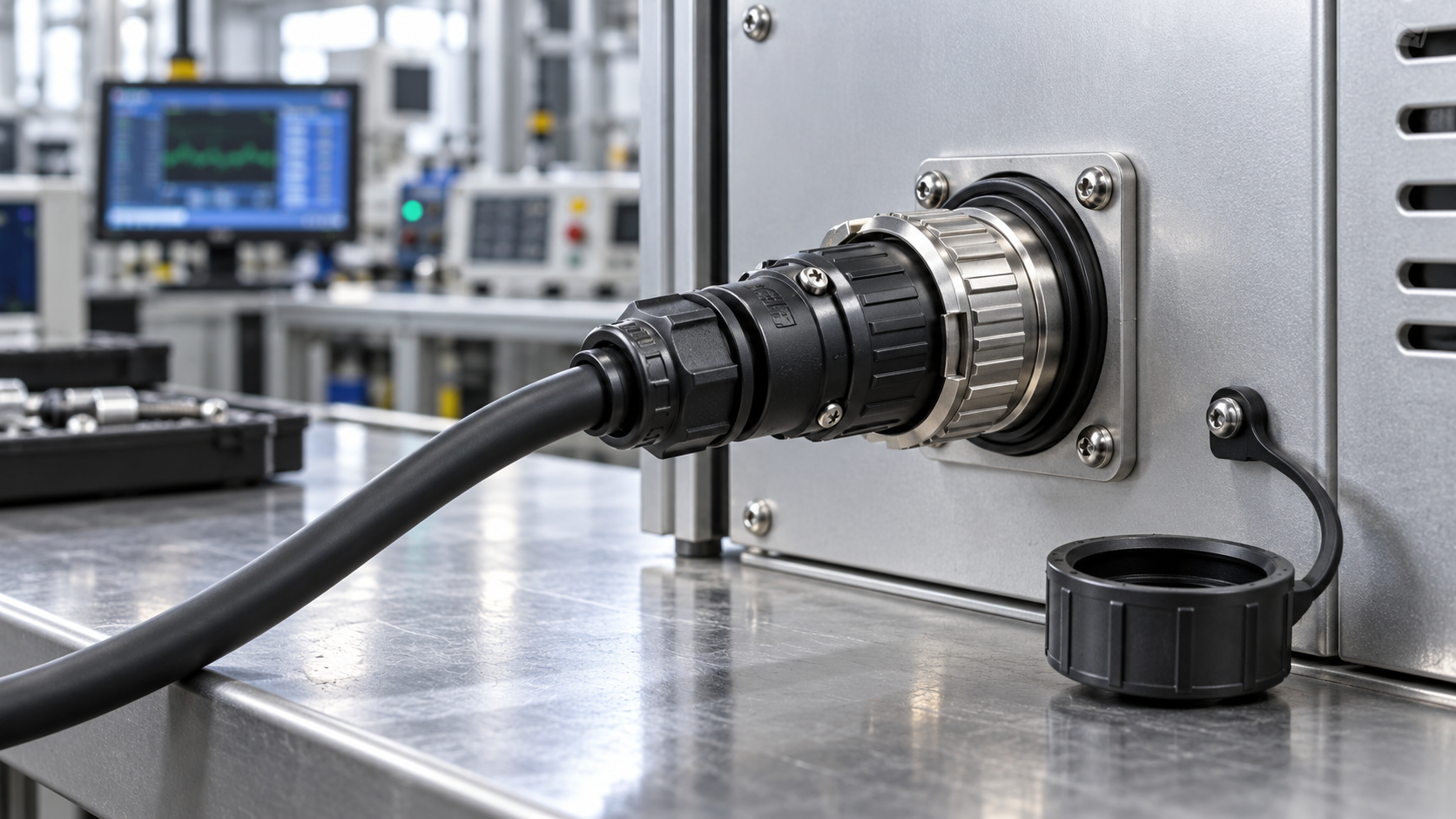
To check an industrial connector’s IP rating, start with the exact part number and the configuration in which it will be used. An IP67 marking may apply only when the connector is fully mated, correctly mounted and fitted with a specified cable gland. The same connector can have a different level of protection when unmated or when a protective cap is missing.
For technical teams evaluating connectors from Germany, the practical task is to connect three pieces of evidence: the relevant IP designation under IEC 60529 or its German adoption, the manufacturer’s documentation for the complete assembly, and the exposure expected at the installation site. A rating is useful only when all three line up.
Read the code against the exposure you expect
IP stands for ingress protection. Under IEC 60529, the first characteristic numeral describes protection against access to hazardous parts and the ingress of solid foreign objects. The second describes protection against water. For connector selection, the distinction matters: a high dust rating says nothing about water resistance, and a water rating does not establish resistance to dust.
For example, IP67 combines a dust-tight designation with temporary immersion protection. IP66 combines the same first numeral with protection against powerful water jets. Neither designation alone establishes the other water test. A product marked IP66/IP67 indicates that both are claimed, subject to the manufacturer’s stated conditions.
An X is not a zero. It indicates that the corresponding characteristic numeral has not been specified in the designation; it should not be read as proof that the connector offers no protection, or as evidence that it passed a particular test. Additional letters may also appear in an IP code. Read them against the applicable standard rather than treating them as part of the two-numeral dust-and-water scale.
Keep the operating scenario in view when comparing ratings. A connector exposed to rain, a cable lying briefly in pooled water and a connector on equipment cleaned with heated jets face different stresses. A single “high IP” requirement can conceal those differences and leave the wrong exposure unaddressed.
Identify exactly what was rated
Ingress protection is a property of a defined enclosure or assembly under defined test conditions. A connector catalogue may show a rating beside a product family, while the fine print limits it to particular housings, contacts, seals or mounting arrangements. Before accepting a claim, trace it to the exact combination being purchased.
Start with the manufacturer’s datasheet and installation instructions for the selected part number. Then check the following configuration details:
- Mated or unmated: Does the rating apply with both halves fully connected and locked? Is there a separate rating for an exposed connector, and does it require a protective cap?
- Panel or enclosure interface: Does the claim depend on a supplied gasket, a particular panel surface or an approved mounting method? A sealed connector body cannot compensate for an unsealed panel opening.
- Cable entry: Is the specified rating dependent on a particular gland, backshell, potting method or cable jacket diameter? Check the permitted cable range and assembly instructions.
- Accessories: Are caps, seals, adapters or blanking plugs included in the rated configuration? Establish whether they are part of the selected order or must be specified separately.
- Versions and variants: Confirm that the claim covers the housing material, locking mechanism and other variants associated with the part number, rather than a visually similar product.
For a panel-mounted receptacle, consider both sides of the panel. The exposed mating face may be protected when capped, while the rear termination or the panel interface may have different conditions. Documentation should make clear which surfaces and states are covered. Where it does not, ask the manufacturer to identify the rated boundary of the assembly.
This distinction becomes especially important for equipment that is disconnected during maintenance. A mated connector may meet the specified rating in service, but the mating face could be exposed during cleaning or while a cable is removed. If that state is part of the normal operating procedure, specify an appropriate cap and verify its rating and installation requirements. Do not assume a dust cover is also a water-sealing cap.
Check the standard reference and the evidence behind the claim
IEC 60529 is the international standard used for IP classifications. In Germany, documentation may refer to its German adoption as DIN EN 60529, also designated VDE 0470-1. The presence of one of these references helps identify the classification framework, but it does not explain which configuration was tested or whether a particular certificate applies to the item being purchased.
Check the edition cited in the document and any amendments relevant to the claim. Where a project specification names a particular edition, compare it with the manufacturer’s evidence and resolve any mismatch before accepting the part. IP testing may also be addressed alongside connector-specific requirements, such as those in IEC 61984, where applicable. The IP code alone does not establish compliance with every electrical or mechanical requirement for an industrial connector.
A datasheet claim can be a useful starting point. For a demanding or safety-relevant application, request supporting documentation that allows the claim to be evaluated. Depending on the project’s assurance requirements, this may include a manufacturer’s declaration, a test report or independent assessment evidence.
When reviewing a report or certificate, look for the following:
- Product identification: The tested model and relevant variants should match the proposed connector or be covered by a clearly stated product range.
- Tested configuration: The report should identify mating status, caps, cable entry, seals, mounting arrangement and any other components needed to reproduce the result.
- Standard and test: The document should identify the standard, edition and IP characteristics assessed, including the conditions used for any IPX8 claim.
- Scope and limitations: Check whether the document reports a test on a sample, covers a defined product family or makes a broader certification claim. These are not interchangeable forms of evidence.
- Document traceability: The issuing organisation, report identification and dates should be clear enough to connect the evidence to the product documentation.
Third-party testing can add confidence, but a laboratory report is evidence of the test described in that report. It should not be treated automatically as a certificate for every variation in a product family or as proof that every installed assembly will perform identically. Likewise, an IP rating is not, by itself, a CE marking or a general approval for use in Germany.
Compare the test conditions with the installation
The IP code gives a standardised way to describe protection; it does not reproduce every operating condition. Translate the installation into exposure requirements before deciding whether the cited test is sufficient.
Water jets and cleaning
A washdown specification should describe more than “waterproof.” Identify whether the equipment will see splashes, low-pressure jets or high-pressure, heated cleaning, and whether cleaning is directed at the connector from close range. Compare those conditions with the claimed IP test and the manufacturer’s cleaning instructions.
IPX9 is relevant to high-pressure, high-temperature jet exposure, but the designation does not automatically cover every industrial cleaning regime. Actual nozzle distance, angle, dwell time and cleaning frequency may differ from a standard test. Detergents and disinfectants introduce a separate material-compatibility question: an IP result using water does not establish long-term resistance to every chemical. Ask for compatibility information for the housing, seals and cable jacket where cleaning agents are used.
Immersion and pooling
For a connector that may sit in water, establish the expected depth and duration, as well as whether immersion is occasional or sustained. IPX7 addresses temporary immersion under specified conditions. IPX8 requires attention to the conditions agreed with the manufacturer, so two IP68 products should not be assumed equivalent without comparing their stated immersion limits.
Temperature changes can complicate the assessment. A warm connector exposed to cold water may experience pressure changes that are not fully represented by a simple reading of the IP marking. Where this is a credible operating condition, discuss it with the manufacturer and include representative temperature cycling or other application-specific validation in the qualification plan.
Dust, movement and ageing
IP6X is useful evidence for a dust-tight enclosure under the standard’s test conditions, but it is not a complete durability assessment. Cable movement, vibration, repeated mating, seal compression and exposure to oils or ultraviolet light can affect an assembly over its service life. The IP result does not necessarily establish performance after a particular number of mating cycles or years outdoors.
Review the connector’s mechanical and environmental ratings alongside its IP documentation. If the application places unusual strain on the cable or involves frequent disconnection, consider whether qualification should include those stresses before an ingress test. Such a sequence answers a different question from a test on a newly assembled sample.
Turn the evidence into an acceptance decision
A useful check ends with a documented match between the requirement and the proposed assembly. Record the connector part numbers, mating components, seals, cable entry hardware and any cap needed for the relevant operating state. Attach the applicable datasheet and supporting test evidence, and identify the installation instructions that must be followed.
Then compare each expected exposure with a specific claim. For a dust-prone machine that is also washed with jets, for example, confirm both the solid-ingress designation and the relevant jet rating. If temporary pooling is also credible, look for a separate immersion claim rather than assuming that jet protection covers it. Where the manufacturer lists multiple ratings, verify that they apply to the same assembly and operating state.
Finally, make the installed condition inspectable. Cable diameter, gland selection, seal placement, locking engagement and panel preparation are all easier to control when they are specified in the build documentation. If the planned installation differs from the tested configuration, the published rating alone is a weak basis for acceptance; obtain a configuration-specific assessment or qualify the assembled connector against the project’s exposure requirements.
Facing technical bottlenecks in manufacturing or looking for more efficient industrial solutions? Leave your details below and let the engineering experts at GIi solve them for you.
“We respect your privacy. Your information is strictly confidential.”
Technical Specifications
- How to verify the consistency of PVC resin from a supplier in EuropeAuthor :Polymers & Rubber Editorial Team
- How to choose polyethylene grades in Saudi Arabia for film productionAuthor :Polymers & Rubber Editorial Team
- US Finds Imported Robots a Security Threat, Defers Tariffs for 180 DaysAuthor :Industrial Machinery Editorial Team
Expert Insights

Chief Security Architect
Dr. Thorne specializes in the intersection of structural engineering and digital resilience. He has advised three G7 governments on industrial infrastructure security.
Core Sector // 01
Security & Safety
- How to check IP ratings for industrial connectors in GermanyAuthor :Electrical Components Editorial Team

- What to check when sourcing industrial connectors from GermanyAuthor :Electrical Components Editorial Team

- When DIN rail terminal blocks need end stops to prevent looseningAuthor :Electrical Components Editorial Team

- How to Evaluate a Terminal Blocks Supplier for Quality and Lead TimeAuthor :Electrical Components Editorial Team

- High Current Connectors: Common Failure Causes and How to Prevent OverheatingAuthor :Electrical Components Editorial Team

- Terminal Blocks Selection Guide for Reliable WiringAuthor :Electrical Components Editorial Team

- Industrial Connectors Explained: Main Types, Ratings, and Typical ApplicationsAuthor :Electrical Components Editorial Team

- How to Choose Connectors for Vibration, Moisture, and Repeated Plugging CyclesAuthor :Electrical Components Editorial Team