
How does grade affect the stainless steel price per kg?
Author
Date Published
Reading Time
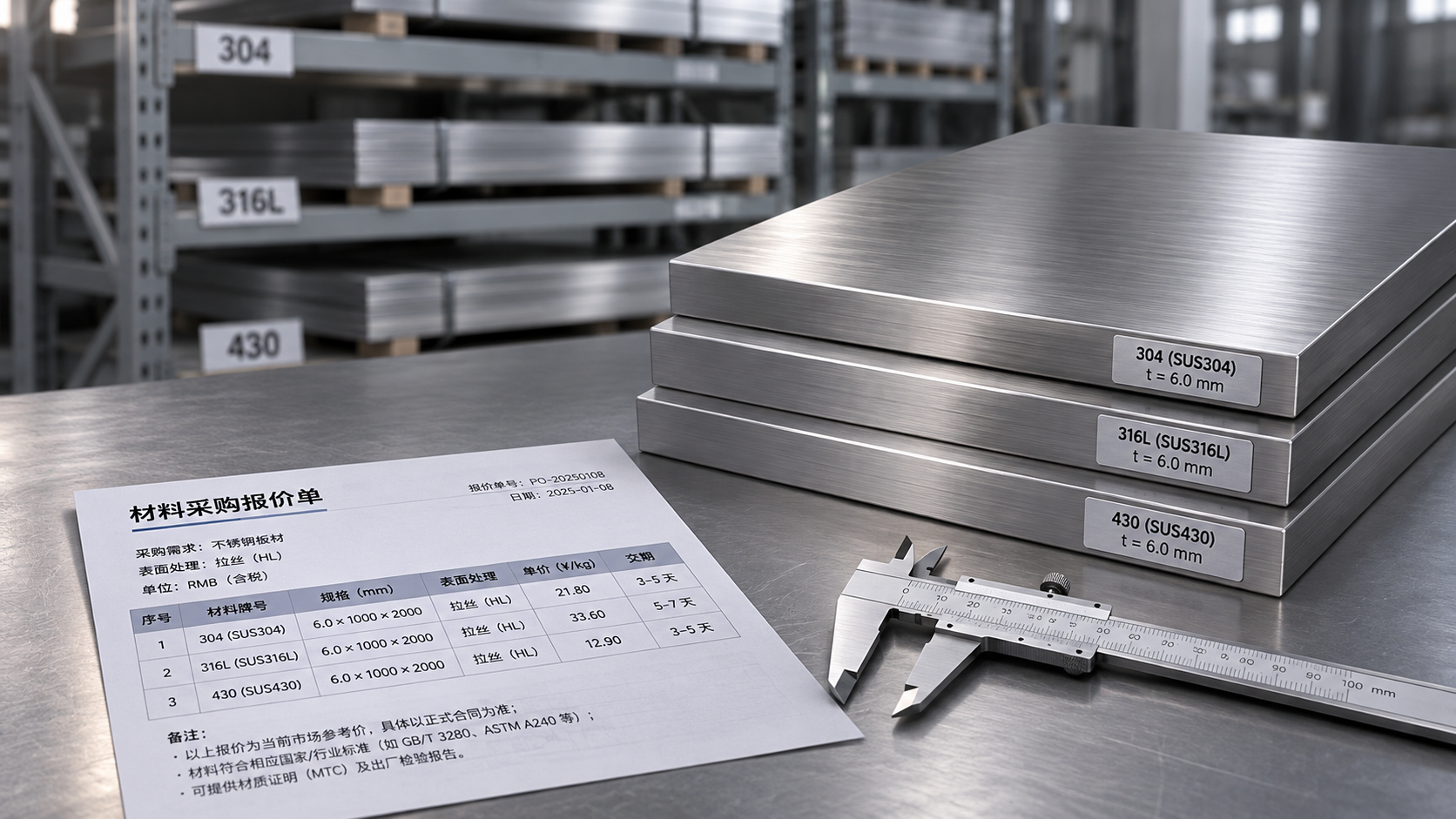
The stainless steel price per kg can vary significantly between grades, making material selection a critical purchasing decision. Grade 430 is often cheaper than 304, while 316 usually costs more because of its molybdenum content and corrosion performance.
For procurement professionals, the best choice is not necessarily the lowest-priced grade. Compare materials against the operating environment, required lifespan, applicable specifications, and the total delivered cost of the order.
How do 304, 316, and 430 compare on price?
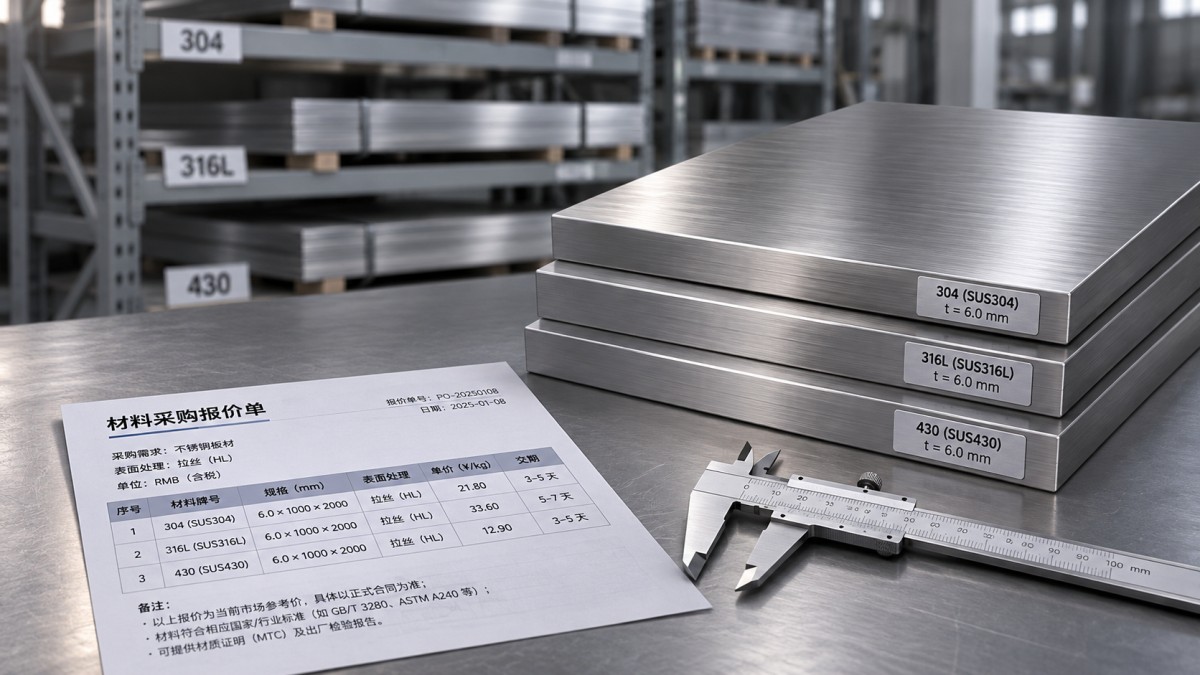
For comparable product forms, dimensions, finishes, quantities, and delivery terms, 430 commonly has the lowest price per kg, followed by 304 and then 316. This ranking is indicative, not guaranteed.
Grade 430 is a ferritic stainless steel with relatively high chromium content and little or no nickel. It suits many indoor or mildly corrosive applications where appearance and cost are important.
Grade 304 is an austenitic stainless steel containing chromium and nickel. Its balance of corrosion resistance, formability, and availability makes it a common choice for equipment, fabrication, and general-purpose applications.
Grade 316 is also austenitic but contains molybdenum. It generally offers better resistance to chloride-related pitting than 304, making it a frequent candidate for coastal and selected chemical-processing environments.
Relative pricing can change when alloy markets move or local availability tightens. A small order of uncommon 430 dimensions may even cost more per kg than readily available 304 stock.
Always compare quotations for the same product form and specification. A polished 316 sheet, for example, should not be compared directly with an unfinished 304 coil without accounting for processing.
Why does alloy composition change the price?
Stainless steel grades contain different proportions of alloying elements. The cost of those elements, combined with melting, processing, and quality-control requirements, affects the price a mill or distributor charges.
Chromium is essential to stainless steel’s protective passive layer. Differences in chromium content matter, although buyers should evaluate the complete chemistry and application rather than treat chromium percentage as a standalone quality score.
Nickel generally improves austenitic stability, formability, and toughness. Because nickel prices can be volatile, nickel-bearing grades such as 304 and 316 may experience different price movements from lower-nickel alternatives.
Molybdenum contributes to 316’s improved resistance to pitting in many chloride-containing conditions. Its cost is one reason 316 typically carries a premium over otherwise comparable 304 material.
Other elements and tighter chemistry limits can affect price too. Duplex, heat-resistant, and specialty grades may require more demanding production controls or have smaller supply volumes than standard commercial grades.
Supplier pricing mechanisms vary. Some mills or distributors quote a base price plus an alloy surcharge, while others provide a single figure that already includes expected raw-material costs.
Ask whether a surcharge applies, when it is calculated, and how long the quotation remains valid. This matters when comparing bids issued on different dates or covering staggered deliveries.
When is paying more for 316 justified?
Consider 316 when chloride exposure, cleaning chemicals, or the consequences of corrosion make 304 unsuitable. Examples can include coastal installations and equipment exposed to certain saline or chemical environments.
Before accepting the premium, document chloride concentration, temperature, exposure duration, cleaning practices, and any industry requirements. These conditions determine whether the extra corrosion resistance addresses a real operating risk.
For a dry indoor component with limited chemical exposure, 304 may offer sufficient performance at a lower initial cost. In some mild environments, 430 may also be appropriate.
For a critical component, a corrosion-related failure can create replacement, shutdown, safety, and contamination costs. Those potential losses can outweigh a higher material price, especially where maintenance access is difficult.
However, 316 is not immune to corrosion. Concentrated chlorides, high temperatures, crevices, and unsuitable cleaning chemicals can exceed its capabilities, so demanding service may require a different alloy or design.
Food-contact or pharmaceutical equipment should be selected against the relevant process, cleaning regime, surface finish, and applicable regulations. The industry name alone does not automatically make 316 mandatory.
Can a lower-priced grade meet the specification?
Start with the required properties, not a generic grade hierarchy. Identify corrosion exposure, mechanical loads, forming operations, welding needs, operating temperatures, appearance, and any customer or regulatory requirements.
Grade 430 can be economical for suitable indoor trim, appliance panels, and selected equipment. Its lower corrosion resistance and different fabrication characteristics make it unsuitable as an automatic replacement for 304.
Grade 201 may also be offered as a lower-cost alternative to 304 in some markets. Its suitability depends on the exact composition and service conditions; corrosion resistance is not interchangeable.
Grade 304L or 316L may be specified for welded applications because their lower carbon limits help reduce certain sensitization risks. Confirm the relevant standard and fabrication requirements before substitution.
Duplex grades can provide higher strength and useful corrosion resistance in appropriate applications, but their price per kg alone does not establish value. Fabrication requirements and engineering approval are essential.
Never accept a substitute solely because a supplier describes it as equivalent. Check the applicable standard, chemistry, mechanical properties, dimensional tolerances, and whether the end customer permits the change.
How can buyers compare supplier quotations fairly?
A meaningful price comparison starts with an identical request for quotation. State the grade, product form, dimensions, finish, quantity, standard, delivery location, and required documentation for every bidder.
Specify whether the requirement is sheet, plate, coil, bar, tube, or another form. Manufacturing routes, finishing operations, tolerances, and stock availability can create substantial differences within the same grade.
Include the exact specification and revision where relevant, such as an applicable ASTM or EN product standard. A grade designation alone does not define every property or inspection requirement.
For sheet and plate, specify thickness tolerance, width, length, edge condition, and surface finish. Small dimensional differences can influence processing charges, usable yield, and whether available stock is suitable.
Request a breakdown showing material price, alloy surcharge, cutting or finishing, packaging, freight, insurance, duties, taxes, and any other charges. Confirm which items are included in the quoted figure.
Use a consistent delivery basis and named location. Incoterms allocate certain costs and risks, but the chosen rule and contract terms must be checked to determine what each party actually pays.
Compare currency, payment terms, quotation validity, lead time, and minimum order quantity. A lower nominal price can be offset by financing costs, a longer lead time, or excess inventory.
Also confirm whether pricing is based on actual scale weight or calculated theoretical weight. For cut material, clarify whether the invoice includes offcuts, protective film, packaging, or processing losses.
What does the price per kg mean for the finished part?
The purchase price per kg is only one input into component cost. Material consumption, cutting yield, fabrication time, finishing, inspection, scrap, and expected service life can change the outcome.
Consider an illustrative order requiring 1,000 kg of purchased material. At $3.00 per kg, material costs $3,000; at $4.00 per kg, it costs $4,000 before processing and delivery.
The $1,000 difference is real, but it does not establish which option is better. If the more expensive grade prevents frequent replacements or costly shutdowns, its lifetime cost may be lower.
Conversely, paying the premium without a service requirement increases spending without a demonstrated benefit. The figures above are examples for comparison, not current market quotations or universal grade prices.
Yield also matters. If a supplier’s sheet dimensions reduce cutting scrap, a higher price per purchased kilogram may produce a lower cost per usable component than a cheaper sheet.
For engineered substitutions, assess finished-part weight as well as material price. A stronger grade might permit a thinner section, but only after design, deflection, corrosion allowance, and code requirements are verified.
Calculate delivered cost per accepted part using purchased material, processing, scrap, freight, inspection, and expected rejection rates. For long-lived equipment, add maintenance and replacement costs where reliable estimates exist.
How do order conditions affect the quoted price?
Volume often affects pricing because larger orders can reduce handling costs and allow direct mill sourcing. Savings are not automatic: inventory carrying costs and cash commitments may offset volume discounts.
Small orders may attract minimum charges, cutting fees, or distributor premiums. Consolidating compatible requirements can help, provided the additional stock can be stored safely and used before specifications change.
Lead time matters because urgent orders may rely on limited local stock or expedited freight. Ask for prices at both the required delivery date and a realistic alternative schedule.
Market conditions also influence quotes. Nickel, chromium-related inputs, molybdenum, energy, freight, exchange rates, and trade measures can change independently, so historical price relationships should not replace current bids.
For imports, verify applicable tariffs, origin rules, customs classification, and documentation before comparing landed costs. Requirements depend on the destination, origin, product classification, and transaction date.
Where purchases recur, consider a pricing formula or scheduled review tied to clearly identified inputs. Agree on the reference, calculation period, surcharge treatment, and adjustment frequency before signing.
What checks reduce the risk of buying the wrong grade?
Request material test certificates where required and verify that the reported chemistry and mechanical properties match the ordered specification. Match certificate details and heat numbers to the delivered material.
Confirm traceability requirements before ordering, especially for regulated or critical applications. Clarify whether the supplier provides original mill documentation, inspection records, and identification on each bundle or piece.
Positive material identification can provide an additional check, particularly where grades look alike. Select a suitable test method and understand its limitations; some handheld methods cannot reliably measure carbon.
Inspect dimensions, surface condition, packaging, and quantities on arrival. Agree in advance on acceptance criteria, handling of nonconforming material, and the process for claims or replacement.
Avoid comparing an unusually low offer on price alone. Ask whether the material is prime or secondary, whether certificates are available, and whether the supplier can meet the stated standard.
How should procurement teams make the final decision?
First, have engineering or the application owner define acceptable grades and minimum requirements. Then request comparable bids and calculate the delivered cost per accepted part for each approved option.
Use 304 as a common starting point where its properties meet the specification, consider 430 for suitable less-demanding service, and justify 316 through documented exposure or performance requirements.
The best stainless steel price per kg is therefore the price of a verified material that meets the application at an acceptable total cost. Review current quotations and operating risks before committing.
- Last One:No more articles
- Next Article:When is polypropylene homopolymer suitable for injection molding?Nov 04, 2026
Facing technical bottlenecks in manufacturing or looking for more efficient industrial solutions? Leave your details below and let the engineering experts at GIi solve them for you.
“We respect your privacy. Your information is strictly confidential.”
Technical Specifications
- How does grade affect the stainless steel price per kg?Author :Metals & Fabrication Editorial Team
- When is polypropylene homopolymer suitable for injection molding?Author :Polymers & Rubber Editorial Team
- German Chemical Industry Business Climate Index Falls to -5.9 in OctoberAuthor :Chemical Industry Editorial Team
Expert Insights

Chief Security Architect
Dr. Thorne specializes in the intersection of structural engineering and digital resilience. He has advised three G7 governments on industrial infrastructure security.
Core Sector // 01
Security & Safety
- How does grade affect the stainless steel price per kg?Author :Metals & Fabrication Editorial Team

- Which stainless steel coil properties should be verified before delivery acceptance?Author :Metals & Fabrication Editorial Team

- What should you verify before choosing a stainless steel coil supplier?Author :Metals & Fabrication Editorial Team

- Stainless Steel Grades Guide for Corrosion and Strength NeedsAuthor :Metals & Fabrication Editorial Team

- When Stainless Steel Costs Less Over the Full Service LifeAuthor :Metals & Fabrication Editorial Team


