When is polypropylene homopolymer suitable for injection molding?
Author
Date Published
Reading Time
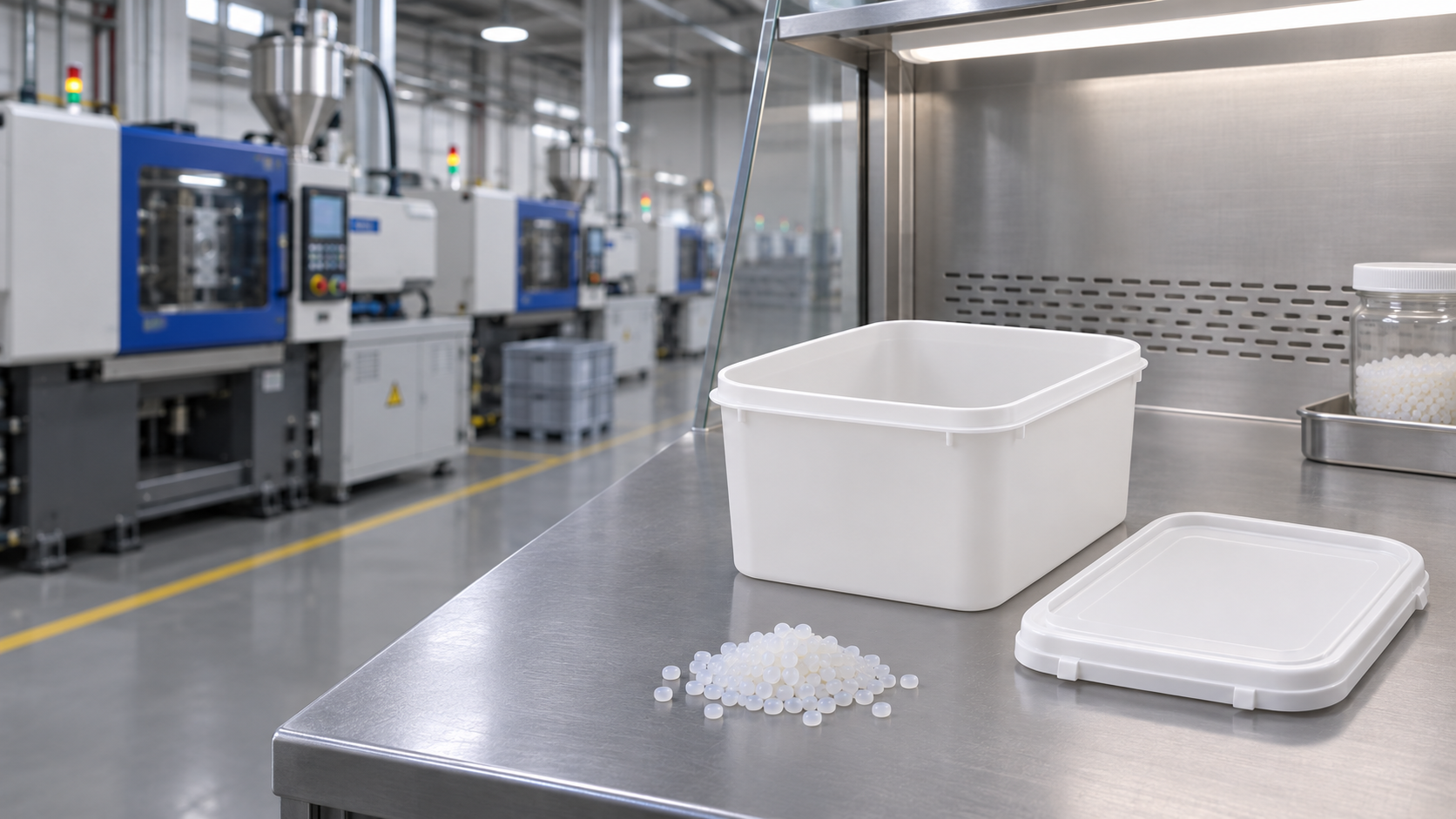
Polypropylene homopolymer is a strong candidate for injection molding when a part needs rigidity, low weight, chemical resistance, and efficient production, while operating temperatures and impact loads remain within the selected grade’s capabilities. It is often suitable for rigid containers, closures, household components, and interior automotive parts. The decision becomes less straightforward when the part must withstand freezing conditions, repeated impacts, sustained loads, or tight dimensional tolerances.
A grade’s published stiffness or melt flow rate is only a starting point. Part geometry, gate position, molding conditions, and the way the finished component is loaded can change the result substantially. A container that performs well when squeezed slowly at room temperature may crack when dropped after cold storage.
Start with the load and service temperature
Homopolymer polypropylene generally offers greater stiffness than comparable polypropylene copolymers. That is useful when a molded wall must retain its shape during handling, stacking, or assembly. A rigid tub, for example, may benefit from the material’s resistance to flexing without requiring the density of a heavier polymer.
Stiffness alone does not establish suitability. Determine whether the load is steady or sudden, whether it is applied repeatedly, and where stress concentrates. A broad panel under a distributed load behaves differently from a snap feature loaded at its root. Sharp internal corners, holes, thin sections, and weld lines can all become crack initiation points even when the nominal material properties look adequate.
Temperature changes the assessment. At low temperatures, polypropylene homopolymer becomes more vulnerable to brittle fracture. A part intended for a heated indoor space is therefore a different proposition from one exposed to winter handling, refrigerated distribution, or freezer storage. The relevant test is not simply whether the material survives cold air; it is whether the actual part tolerates the expected impact or assembly load at its coldest credible condition.
Impact copolymer polypropylene is often worth evaluating when cold impact resistance dominates the specification. Random copolymer grades can also be relevant for selected packaging and clarity requirements, although their properties vary by formulation. Neither alternative should be treated as an automatic substitute: the change in stiffness, shrinkage, processing behavior, and appearance needs to be assessed in the same part.
Match the grade to the flow path
Injection molding grades span a range of melt flow rates. Higher-flow grades are often considered for thin walls, long flow lengths, or molds with multiple cavities because the melt can fill restrictive sections more readily. A lower-flow grade may be preferable when the application calls for a different balance of flow and mechanical performance. The appropriate range depends on the geometry and the supplier’s grade data, not on a general rule that the highest flow is best.
Melt flow rate is measured under specified test conditions and provides a convenient comparison, but it is not a complete description of flow inside a mold. Shear rates, melt temperature, pressure, and the shape of the runner and gate differ from those in the test. Compare values only when the test conditions are the same, then confirm filling behavior in the intended tool.
Fast filling can introduce its own problems. A thin-wall part may fill successfully yet show poor packing at a distant rib, a weak weld line behind an opening, or distortion after ejection. Increasing injection pressure does not necessarily solve these issues; the flow path, venting, gate location, and local wall thickness may need attention.
Nor does a grade with a higher melt flow rate guarantee a weaker finished part in every design. Molecular characteristics and additives differ between grades, and processing can alter the outcome. Where impact or hinge performance matters, compare molded specimens and representative parts rather than ranking materials by melt flow rate alone.
Dimensions and appearance depend on crystallization
Polypropylene is a semicrystalline material. As the melt cools, crystallization and shrinkage influence final dimensions, surface appearance, and warpage. Shrinkage is not necessarily uniform: flow direction, wall thickness, packing pressure, mold temperature, and cooling balance can all produce different movement across a part.
A flat lid illustrates the issue. Uneven cooling or an asymmetric gate arrangement can leave the lid warped even when the average molded dimensions appear acceptable. On a large assembly, the effect may show up as a poor fit only after the part has cooled and stabilized. Measure critical dimensions after a defined conditioning period and at a relevant temperature, not immediately after ejection alone.
Ribs and bosses introduce a related trade-off. They add local stiffness and mounting features, but thick intersections cool differently from adjacent walls and can cause sink marks or internal voids. More uniform wall sections and gradual transitions make filling and cooling easier to control. The exact geometry still needs to support the applied load and the chosen mold design.
For close-fitting components, allow for both molding variation and changes during service. A lid and container made from different materials, for example, can respond differently to temperature. A satisfactory room-temperature fit does not establish reliable sealing after cooling, heating, or repeated opening.
Where homopolymer is a good fit
Rigid packaging is a common application because stiffness and low density can support a useful balance between wall weight and handling performance. The choice is more compelling when the package is used near room temperature and the contents do not impose unusual chemical or impact demands. For a container entering cold distribution, drop testing with the actual contents and closure is more informative than a room-temperature test on an empty part.
Household items such as storage components, trays, and rigid fittings can also suit homopolymer grades. Their suitability rests on how they are used: a tray resting on a shelf primarily needs sufficient stiffness, while a heavily loaded latch may be governed by repeated bending and local stress. A glossy or smooth surface requirement adds a separate evaluation of mold finish, processing, and the grade’s appearance.
Some interior automotive components use polypropylene where low mass, moldability, and stiffness are valuable. Service conditions still matter. A concealed trim feature protected from direct impact has a different exposure from an attachment point stressed during assembly or a component subjected to substantial temperature variation. Unfilled homopolymer should not be assumed to meet a vehicle application simply because polypropylene is already used elsewhere in the assembly.
Hinges and snap features
Polypropylene is used for molded hinges, but repeated flexing requires a suitable grade and carefully controlled geometry. Hinge thickness, transition radii, flow through the hinge, and molding conditions all affect performance. A stiff grade selected for the body of a closure does not automatically deliver the required hinge life.
Snap fits present a similar compromise. Higher stiffness can provide holding force, yet it also raises stress for a given deflection. Assembly method, repeated opening, temperature, and the possibility of stress whitening or cracking at the root should be included in part testing. A prototype produced by a different process may be useful for fit, but it may not reproduce the molecular orientation and weld lines of an injection-molded part.
Chemical contact and sustained stress
Polypropylene has useful resistance to many aqueous chemicals, but a broad chemical-resistance label is not sufficient for a specific service. The substance, concentration, temperature, contact time, and applied stress all matter. A molded fitting under a constant assembly load deserves a different assessment from an unstressed sample briefly exposed to the same liquid.
Cleaning agents, fragrances, oils, and other contents should be assessed in the finished application where exposure is credible. Look for changes in dimensions, surface condition, cracking, and mechanical performance after conditioning. Colorants, fillers, and recycled content can affect the behavior of a formulated grade, so results from a different formulation should not be transferred without evidence.
Sustained loading also introduces creep: deformation can increase over time even when the initial load is below the material’s short-term strength. A clip that holds securely immediately after assembly may gradually lose clamping force. Elevated temperature generally makes this concern more serious. Long-duration testing under representative load is more relevant than relying solely on tensile strength from a short-term data sheet.
Processing and qualification
Polypropylene homopolymer is generally straightforward to injection mold, but a stable production window still needs to be established for the selected grade and tool. Melt temperature, injection speed, holding pressure, cooling time, and ejection conditions affect both appearance and performance. Excessive heat or residence time can degrade the polymer; insufficient packing can leave sink, voids, or dimensional variation.
Drying requirements should follow the material supplier’s instructions and the condition of the pellets. Polypropylene absorbs relatively little moisture compared with some engineering polymers, but wet pellets or surface contamination can still cause defects. The absence of a routine drying requirement is not a reason to ignore storage conditions or visible moisture.
Regrind needs its own qualification. Its effect depends on the material’s processing history, the proportion returned, contamination, and the application. A noncritical internal component may tolerate a controlled stream that would be unsuitable for a demanding hinge, a tightly controlled appearance, or an application with specific composition restrictions.
A practical trial connects material selection to the intended production process. Mold representative parts, record the grade and processing conditions, and evaluate the features that govern acceptance: fit after conditioning, warpage, impact at the service temperature, assembly loads, and performance after relevant chemical or sustained-load exposure. Include weld lines and other weak locations in the assessment rather than testing only specimens taken from favorable areas.
Homopolymer is suitable when those part-level results meet the application requirements with an acceptable processing window. If cold impact, long-term deformation, or dimensional stability remains marginal, the evidence points toward revising the design or evaluating another polypropylene grade or material before committing to production tooling.
Facing technical bottlenecks in manufacturing or looking for more efficient industrial solutions? Leave your details below and let the engineering experts at GIi solve them for you.
“We respect your privacy. Your information is strictly confidential.”
Technical Specifications
- How does grade affect the stainless steel price per kg?Author :Metals & Fabrication Editorial Team
- When is polypropylene homopolymer suitable for injection molding?Author :Polymers & Rubber Editorial Team
- German Chemical Industry Business Climate Index Falls to -5.9 in OctoberAuthor :Chemical Industry Editorial Team
Expert Insights

Chief Security Architect
Dr. Thorne specializes in the intersection of structural engineering and digital resilience. He has advised three G7 governments on industrial infrastructure security.
Core Sector // 01
Security & Safety
- When is polypropylene homopolymer suitable for injection molding?Author :Polymers & Rubber Editorial Team

- ACC Reports 4% Rise in US Plastic Resin Production Through September 2026Author :Polymers & Rubber Editorial Team

- How to verify the consistency of PVC resin from a supplier in EuropeAuthor :Polymers & Rubber Editorial Team

- How to choose polyethylene grades in Saudi Arabia for film productionAuthor :Polymers & Rubber Editorial Team

- When is a recyclable thermoplastic elastomer suitable for seals?Author :Polymers & Rubber Editorial Team

- How to choose the right hardness for thermoplastic elastomersAuthor :Polymers & Rubber Editorial Team

- BASF, Chery and Coordinate Showcase EMB Brake-by-Wire System for Series ProductionAuthor :Polymers & Rubber Editorial Team

- India’s Bottle-Grade PET Resin Market Holds Steady on Festive DemandAuthor :Polymers & Rubber Editorial Team