How to choose the right hardness for thermoplastic elastomers
Author
Date Published
Reading Time

Choose the hardness of thermoplastic elastomers by defining the force, deformation, and recovery the finished part must deliver. Then use Shore hardness to narrow the available grades. A suitable choice allows the component to conform or flex while retaining enough support to resist excessive movement, permanent deformation, and damage under service conditions.
There is no universal hardness for a seal, grip, protective cover, or flexible connector. Geometry, temperature, loading time, and material formulation can change how a nominal hardness performs. For technical evaluation, the most useful starting point is an acceptable operating window: how easily the part must deform, how much load it must carry, and how well it must recover afterward.
Translate the application into measurable requirements
Descriptions such as “soft touch,” “flexible,” or “firm enough” help communicate an initial preference, but they leave too much room for interpretation. A grip may need surface compliance without twisting around its core. A gasket may need to accommodate dimensional variation while staying within an assembly force limit. A protective bumper may need enough travel to absorb an impact without bottoming out.
For each application, identify the primary deformation mode. Compression, bending, stretching, and local indentation place different demands on a material. Shore hardness measures resistance to indentation under specified conditions; it does not directly describe the force required to bend a thin hinge or compress a complex sealing profile.
A practical requirements sheet should establish:
- The available space, wall thickness, and supporting structure.
- The expected load or displacement, including assembly and occasional overloads.
- The operating temperature range and duration of loading.
- The permitted permanent deformation, leakage, movement, or loss of contact force.
- Exposure to fluids, cleaning agents, weathering, and repeated contact.
These requirements help resolve competing preferences. Choosing the softest candidate may improve initial conformity, yet allow excessive deflection. Increasing hardness may improve support while raising insertion force or reducing contact with an uneven surface. The appropriate balance depends on which failure would make the component unacceptable.
Read Shore values as screening data
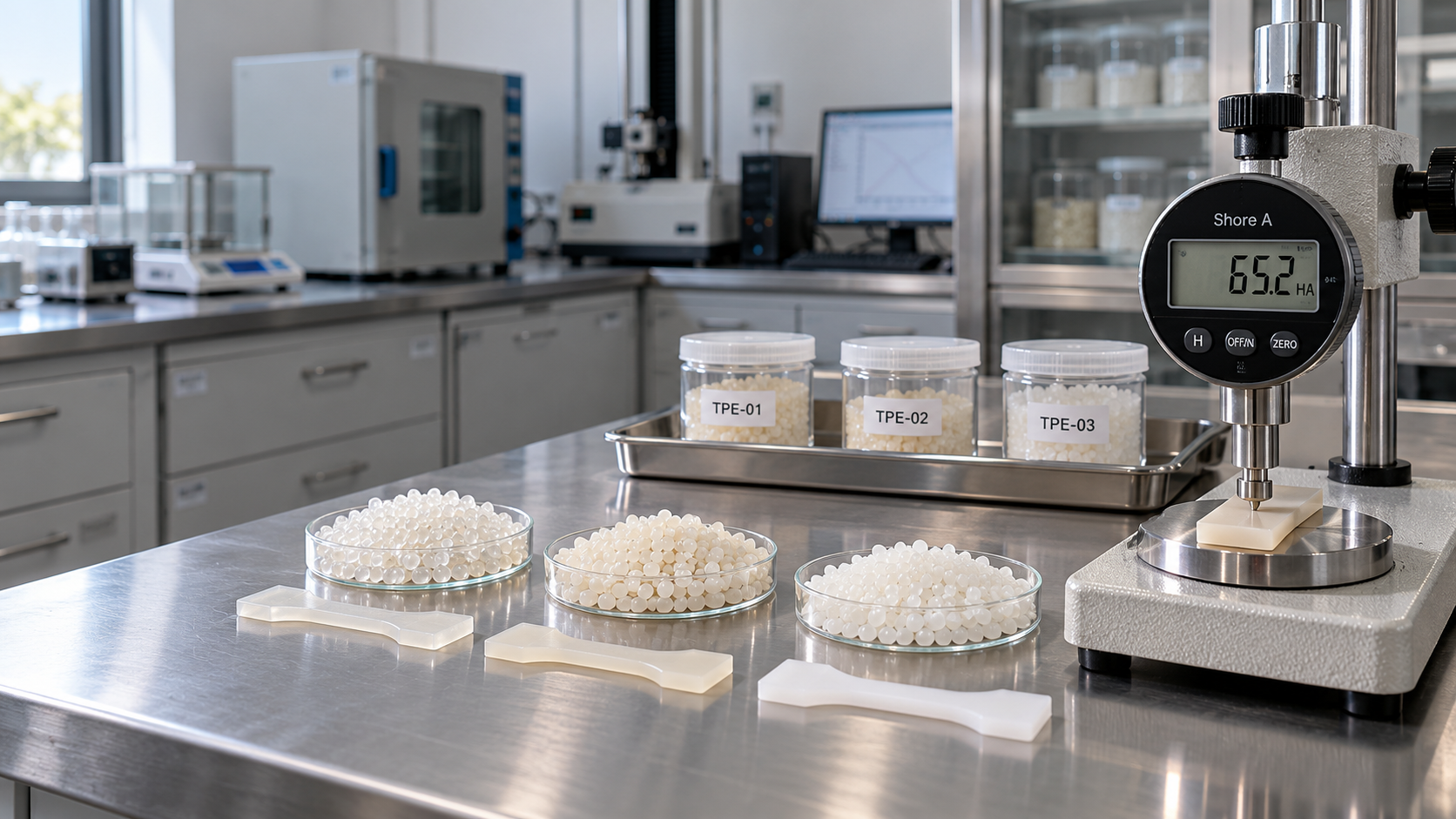
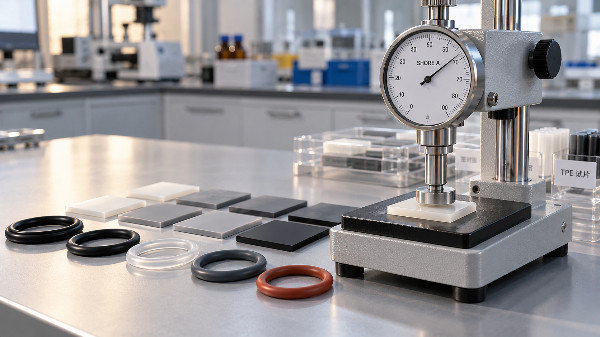
Shore A is widely used for softer elastomeric materials, while Shore D is used for harder materials. Very soft compounds may be characterized on other scales, including Shore OO. Always retain the scale designation when discussing a grade: “60 hardness” is incomplete and can lead to a substantially different material being quoted or approved.
Values from different scales are not interchangeable. Conversion charts can provide a rough orientation over limited ranges, but they should not determine a specification. If competing grades are reported on different scales, request comparable measurements where the test method and material range permit them.
Even values on the same scale require context. Specimen thickness, conditioning temperature, surface condition, and reading time can affect the result. ASTM D2240 and ISO 868 describe durometer hardness testing, but citing a standard alone does not establish that two reported measurements used identical conditions. Ask for the relevant test details when a small hardness difference could influence selection.
A typical datasheet value also differs from a guaranteed acceptance limit. Before treating a nominal value as a purchasing requirement, establish the supplier’s stated tolerance and how conformity will be assessed. Specifying an unnecessarily tight band can create rejection disputes without improving functional consistency, especially if the measurement method itself is poorly controlled.
Use hardness to create a manageable shortlist. If an existing component performs reasonably well, its material and hardness provide a useful reference, provided its aging condition and formulation are understood. Without such a reference, compare a few candidates spanning a meaningful range within a suitable material family. Small differences are unlikely to resolve a design problem dominated by wall thickness or unsupported span.
Match hardness to the component’s main job
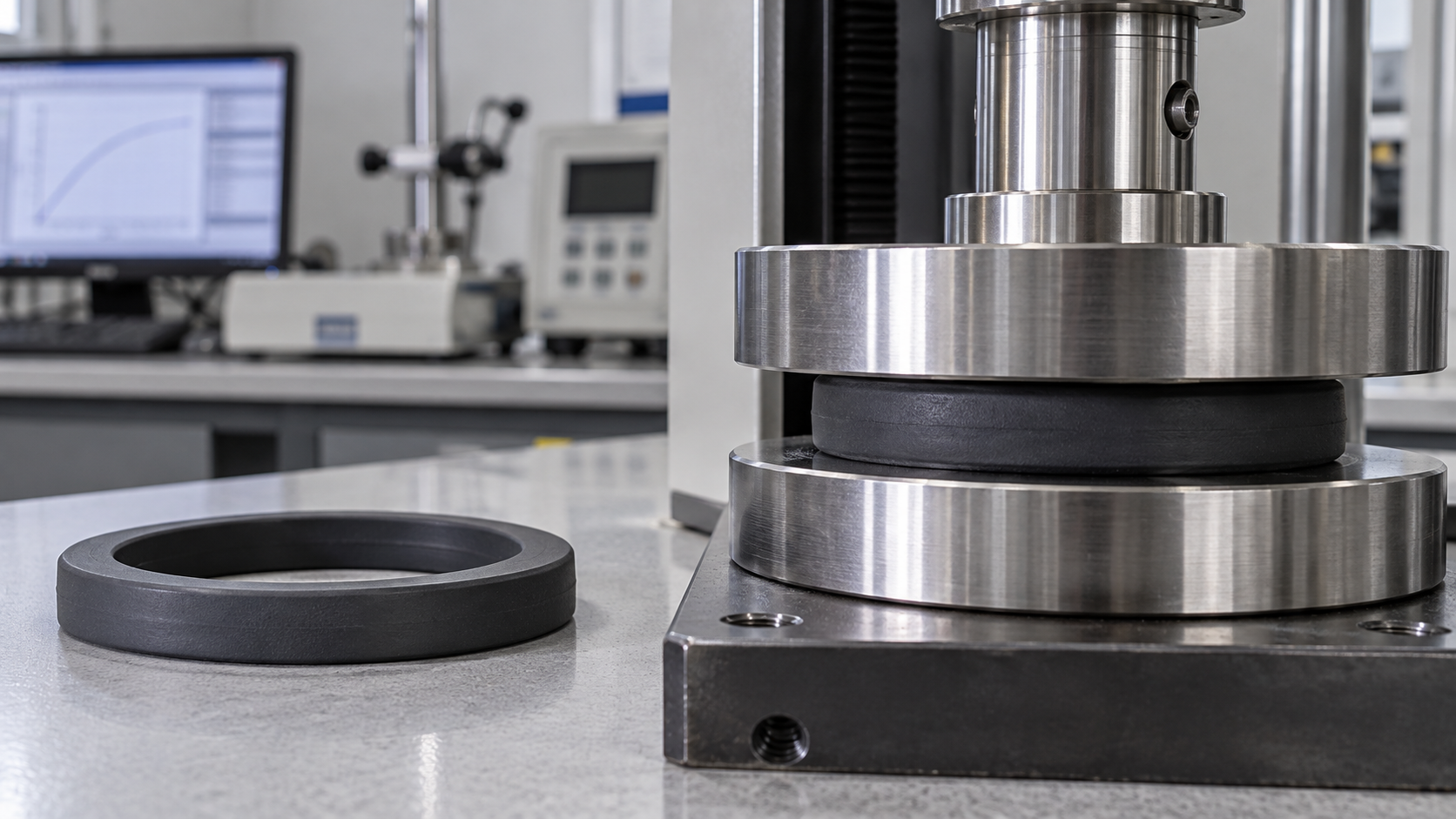
For a compression seal, evaluate the force needed to reach the intended squeeze and the contact force retained during service. A softer grade can help accommodate surface irregularities and assembly variation. It may also deform excessively where the design leaves an unsupported gap. A harder grade can provide more resistance to displacement, but may demand greater closure force or struggle to conform at the minimum permitted squeeze.
Hardness cannot establish long-term sealing performance by itself. Compression set describes residual deformation after a specified compression and recovery procedure. Stress relaxation describes the reduction in force while a material remains deformed. Both can matter to a seal, and neither can be reliably inferred from its Shore value. Compare results obtained under conditions relevant to the application, including temperature and exposure time.
For grips, handles, and touch surfaces, assess the complete construction. A thin elastomer layer over a rigid core may feel firmer than a thick pad made from the same grade. Surface texture, friction, and the shape of the contact area also influence perceived softness and control. A hardness plaque is useful for initial comparison, but it cannot reproduce the feel of every finished design.
In these applications, lower hardness may introduce tradeoffs involving scuffing, surface tack, dirt retention, or movement under the hand. Those outcomes depend on formulation and finish as well as hardness. Evaluate tactile preference alongside abrasion, cleaning resistance, and attachment to the supporting component. A comfortable surface that shifts during use has failed a different requirement.
For flexible connectors, boots, and strain reliefs, bending stiffness and fatigue behavior deserve particular attention. Wall thickness, ribs, and transition radii can strongly influence the force required to flex a part. If the component feels too stiff, reducing hardness is one possible response; changing the section geometry may address the problem more effectively while preserving support elsewhere.
For bumpers and cushioning elements, define the available deflection and the load or impact to be managed. Excessively soft material can run out of travel, allowing contact with a rigid stop. A harder material may transmit more force than the protected assembly can tolerate. Dynamic response also depends on loading rate and damping, so a static hardness measurement provides only part of the selection evidence.
Compare formulations before assuming equivalent performance
Thermoplastic elastomers include several material families, including styrenic compounds, thermoplastic vulcanizates, thermoplastic polyurethanes, and thermoplastic copolyesters. Two grades with similar Shore hardness can have substantially different tear resistance, abrasion performance, temperature response, fluid resistance, and recovery behavior.
Choose a material family that can meet the environmental and mechanical requirements, then refine hardness within that family. Otherwise, an apparently promising hardness match can distract from a more fundamental incompatibility. A fluid-exposed component, for example, needs evidence that the formulation tolerates the actual fluid and exposure conditions before tactile or compression comparisons become decisive.
Temperature can change the ranking of shortlisted materials. A grade that provides adequate support at room temperature may become too compliant when hot. Another may stiffen enough at low temperature to raise assembly force or restrict movement. Evaluate the component at the conditions where each function is most vulnerable: cold installation, hot sustained loading, or repeated transitions between the two.
Chemical exposure adds another variable. Swelling, shrinkage, softening, or embrittlement can change dimensions and function even when the initial hardness is correct. Compatibility tables can guide screening, but the actual fluid mixture, concentration, temperature, and contact duration determine whether a candidate remains suitable. Where exposure matters, assess dimensional change and retained mechanical performance alongside any hardness change.
Processing and attachment requirements can further narrow the shortlist. For an overmolded part, hardness does not establish adhesion to the substrate. Bonding depends on the particular material combination, surface condition, part design, and processing conditions. A grade that meets the desired feel still needs a credible attachment strategy and a processing window capable of producing the required features consistently.
Validate a shortlist in the finished geometry
Request supplier information that answers the unresolved decisions. Useful data may include compression set, stress relaxation, tensile stress at a stated strain, tear resistance, abrasion behavior, or properties after heat and fluid exposure. Each result needs its test conditions. A favorable value measured under mild conditions provides limited evidence for a component exposed to prolonged heat or sustained strain.
Then compare candidate grades in representative parts. Hold geometry and processing conditions sufficiently consistent to make the material comparison meaningful. If geometry changes between samples, record the change and its purpose; otherwise, a softer feel or lower assembly force may be attributed to hardness when it actually comes from a thinner section.
Set pass criteria before judging the samples. For a seal, these might include closure force, leakage, and retained function after compression and exposure. For a grip, they might include rotational movement, surface damage, cleaning performance, and user handling. For a flexible connector, they might include bending force, recovery, and damage after repeated movement. Subjective assessment can contribute, but should sit beside measurable requirements.
Include dimensional extremes in validation where tolerances affect performance. A sealing profile at minimum squeeze and the same profile at maximum squeeze can reveal different weaknesses. Likewise, evaluate the stiffest likely combination for assembly effort and the most compliant combination for support. Testing only nominal parts can conceal a narrow operating window.
Once a candidate passes, specify the material grade, hardness scale, agreed tolerance, and measurement conditions. Keep functional requirements visible in the approval record, particularly where hardness is being used as a routine quality check. An alternative compound should demonstrate the relevant performance even if its nominal Shore value matches the approved material.
The final choice should leave enough margin for manufacturing variation, temperature changes, and service exposure. When several hardness options pass, prefer the one that maintains that margin across the full operating range. If none passes, revisit the geometry or material family before narrowing the hardness tolerance further; the available evidence may be pointing to a design constraint that hardness alone cannot resolve.
Facing technical bottlenecks in manufacturing or looking for more efficient industrial solutions? Leave your details below and let the engineering experts at GIi solve them for you.
“We respect your privacy. Your information is strictly confidential.”
Technical Specifications
- How to verify the consistency of PVC resin from a supplier in EuropeAuthor :Polymers & Rubber Editorial Team
- How to choose polyethylene grades in Saudi Arabia for film productionAuthor :Polymers & Rubber Editorial Team
- US Finds Imported Robots a Security Threat, Defers Tariffs for 180 DaysAuthor :Industrial Machinery Editorial Team
Expert Insights

Chief Security Architect
Dr. Thorne specializes in the intersection of structural engineering and digital resilience. He has advised three G7 governments on industrial infrastructure security.
Core Sector // 01
Security & Safety
- How to verify the consistency of PVC resin from a supplier in EuropeAuthor :Polymers & Rubber Editorial Team

- How to choose polyethylene grades in Saudi Arabia for film productionAuthor :Polymers & Rubber Editorial Team

- When is a recyclable thermoplastic elastomer suitable for seals?Author :Polymers & Rubber Editorial Team

- How to choose the right hardness for thermoplastic elastomersAuthor :Polymers & Rubber Editorial Team

- BASF, Chery and Coordinate Showcase EMB Brake-by-Wire System for Series ProductionAuthor :Polymers & Rubber Editorial Team

- India’s Bottle-Grade PET Resin Market Holds Steady on Festive DemandAuthor :Polymers & Rubber Editorial Team

- How to evaluate a TPE material supplier for batch consistencyAuthor :Polymers & Rubber Editorial Team

- Which appliance resins withstand repeated hot-water exposure?Author :Polymers & Rubber Editorial Team