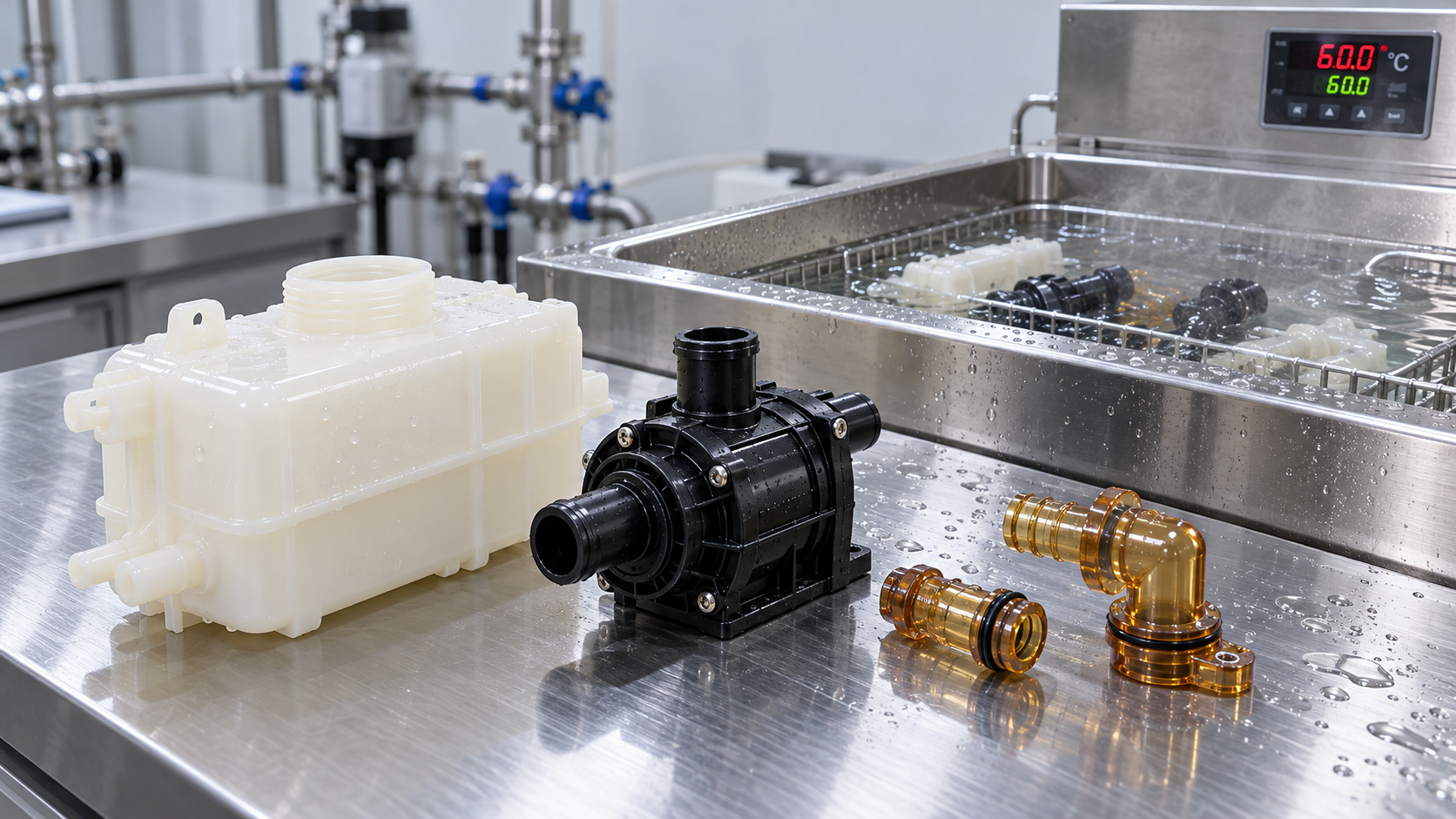
Polypropylene, PPS, and PPSU are strong candidates for repeated hot-water exposure, but the best choice depends on temperature, chemistry, pressure, and component geometry.
Repeated exposure can reduce strength, change dimensions, or trigger cracking. Technical evaluators therefore need evidence that connects material performance to actual appliance operating conditions.
For dishwashers, coffee makers, and hot-water components, hydrolysis resistance is only one requirement. Creep, oxidation, chemical compatibility, and molded-part quality also determine reliability.
The practical approach is to shortlist suitable resin families, then compare specific grades using representative aging conditions, retained properties, and tests on production-intent components.
Which resin families deserve a place on the shortlist?
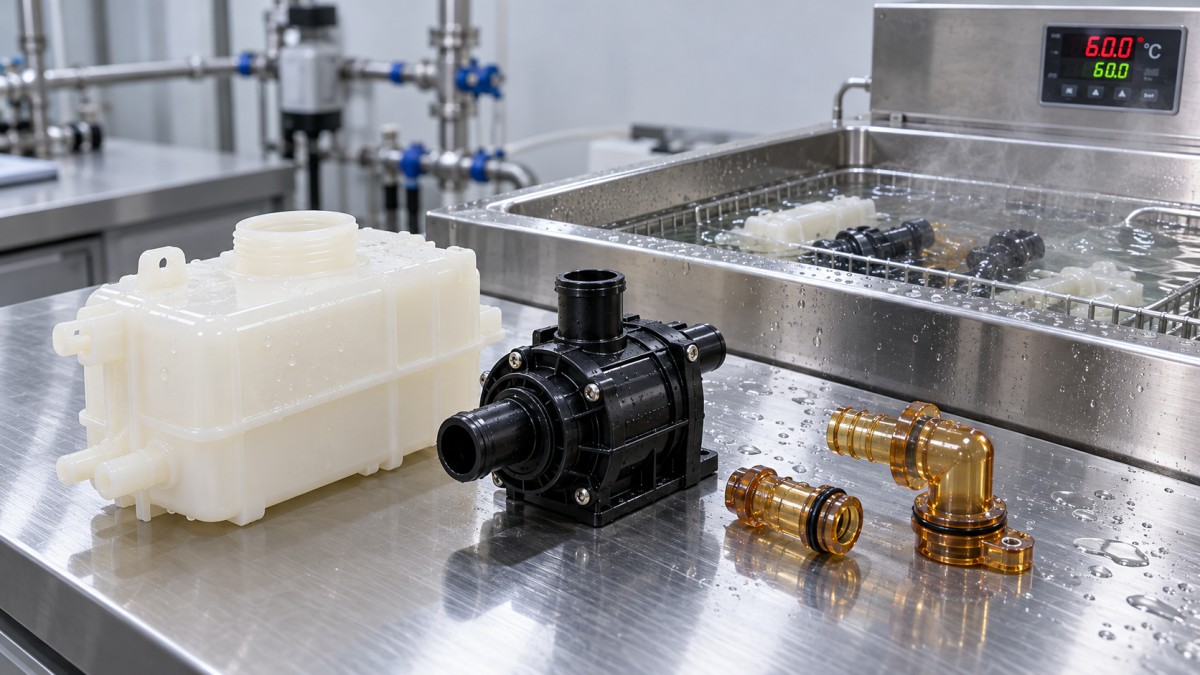
Start with polypropylene for economical, moderately loaded components; PPS for stiffness and dimensional control; and PPSU for toughness and demanding hot-water or steam exposure.
These are starting points, not universal rankings. Reinforcement, stabilizers, colorants, processing history, and part design can change how individual appliance resins perform over time.
Use this comparison to guide supplier discussions, rather than approve a material. Every family contains grades with different reinforcement levels, additives, processing requirements, and limitations.
Define the exposure before comparing material data
“Repeated hot water” can describe brief rinses, prolonged immersion, or alternating hot and cold cycles. These conditions impose different chemical, thermal, and mechanical demands.
Record normal water temperature, peak temperature, exposure duration, and expected lifetime cycles. Include dry intervals, startup transients, and credible overheating events in the specification.
Separate bulk-water temperature from local component temperature. Parts beside heaters, restricted channels, or trapped steam may experience conditions that reservoir measurements fail to capture.
Specify water chemistry, including hardness, disinfectant residuals, detergent concentration, and descaling agents. Cleaning cycles can create a more aggressive environment than normal appliance operation.
Document pressure, assembly preload, vibration, and thermal expansion constraints. A resin that survives unloaded immersion may fail when threaded, clamped, or repeatedly pressure cycled.
Define failure before testing begins. Leakage, unacceptable warpage, reduced burst strength, or brittle fracture may matter more than a modest change in tensile strength.
When is polypropylene sufficient for hot-water service?
Polypropylene is attractive because it absorbs little water and lacks the hydrolyzable backbone linkages found in polyesters and polyamides. Many aqueous environments suit it well.
Its main limitation is often mechanical performance at temperature. A component can resist water chemically while gradually deforming under sustained pressure or assembly stress.
For reservoirs and lightly loaded parts, suitable PP grades can offer a favorable balance of durability, weight, processing efficiency, and purchase cost over service life.
For pressurized housings or tightly toleranced features, request creep and dimensional data at the intended temperature. Room-temperature strength alone provides little assurance of long-term sealing.
Hot water containing oxidizing disinfectants can challenge stabilization systems. Resistance depends on the formulation, exposure chemistry, temperature, and time, so generic PP compatibility statements are insufficient.
Filled grades may improve stiffness, but reinforcement changes shrinkage, orientation, and joining behavior. Evaluate molded dimensions and connection durability using the proposed production geometry.
Also test welds, inserts, and snap features. A successful material coupon does not establish that a welded reservoir or loaded fastening point will remain leak-tight.
When do PPS and PPSU justify their higher cost?
PPS becomes attractive when hot-water components require greater stiffness, thermal capability, and dimensional stability. Glass-reinforced grades are especially relevant to precision housings and structural parts.
Low moisture uptake helps limit water-driven dimensional changes. However, fiber orientation and molding shrinkage can still affect roundness, flatness, sealing surfaces, and tolerance consistency.
Check aged weld-line strength carefully when flow fronts meet around openings or inserts. These locations can govern failure even when bulk material properties remain acceptable.
PPS performance also depends on chemical conditions and grade formulation. Validate resistance to the actual detergent, disinfectant, and descaling sequence specified for the appliance.
PPSU is a strong candidate when toughness must accompany repeated hot-water exposure. Suitable grades also have established applications involving repeated steam sterilization under defined conditions.
That history supports shortlisting PPSU, but it does not establish service life in a particular appliance. Steam cycles and detergent-filled hot-water cycles impose different conditions.
Residual stress and chemical exposure remain important. Evaluate molded PPSU parts after assembly because aggressive cleaners can interact with stress concentrations and initiate cracking.
Choose between PPS and PPSU using component priorities: stiffness, dimensional control, impact tolerance, joining method, manufacturing capability, and verified lifetime performance should guide the decision.
Why require stronger evidence for PA, PBT, and PET?
Polyamides absorb moisture, which can change dimensions and mechanical behavior. Extended hot-water exposure can also cause hydrolytic degradation, depending on chemistry, temperature, and grade.
Moisture conditioning and irreversible degradation must be distinguished. A temporary property shift caused by absorbed water does not necessarily indicate permanent polymer-chain damage during service.
Polyesters such as PBT and PET contain ester bonds susceptible to hydrolysis. High initial stiffness therefore does not guarantee adequate retention after prolonged hot-water aging.
Hydrolysis-stabilized grades can improve performance substantially, but their suitability remains conditional. Ask for aging results that match the required temperature, exposure duration, and chemical environment.
Glass reinforcement can improve stiffness without preventing matrix degradation. Inspect aged impact behavior, elongation, surface condition, and joint integrity alongside tensile strength and dimensional stability.
Do not exclude these families automatically. Approve them where application-relevant data demonstrate acceptable performance, while avoiding assumptions based solely on familiar appliance use elsewhere.
Which supplier data actually support a sourcing decision?
Request the exact commercial grade, reinforcement content, color designation, and intended manufacturing location. A family name or generic technical sheet leaves important formulation differences unresolved.
Ask suppliers to disclose test temperature, water composition, exposure schedule, specimen geometry, applied stress, and measurement timing. Without these details, comparisons can be misleading.
Prefer property-retention curves across multiple aging intervals over a single pass result. Trends help reveal whether deterioration stabilizes, progresses gradually, or accelerates near failure.
Useful measurements include tensile strength, elongation, impact resistance, dimensional change, and mass change. Select additional properties according to how the actual component could fail.
Heat-deflection temperature describes deformation under a specified short-term test. It does not establish continuous hot-water suitability, hydrolysis resistance, or lifetime pressure capability for a component.
Likewise, a relative thermal index generally reflects defined thermal-aging evaluations. It should not be treated as direct evidence of durability in the intended aqueous environment.
For drinking-water or food-contact applications, verify the applicable market requirements and permitted conditions. Compliance documentation and mechanical durability evidence answer different questions and require separate review.
Confirm whether listings cover the proposed grade, color, thickness, temperature, and use conditions. Supplier statements should identify the relevant standard or regulatory basis clearly.
How should evaluators validate repeated hot-water durability?
Use coupon testing to screen candidates, then test molded components made with representative tooling and processing conditions. Geometry and manufacturing can introduce critical failure mechanisms.
Establish baseline dimensions, leak performance, pressure capability, and relevant mechanical properties. Record molding parameters so later failures can be investigated against a documented starting condition.
Expose samples to representative water chemistry and temperature cycles, including intended cleaning procedures. Keep accelerated screening conditions separate from tests intended to represent actual use.
Apply realistic loads during aging where practical. Thread preload, internal pressure, seal compression, and constrained thermal expansion can expose weaknesses that unloaded immersion will miss.
Measure performance at intervals rather than only after final exposure. Interim inspections can reveal progressive deformation, crack initiation, leakage, or abrupt changes in failure behavior.
Control specimen conditioning before measurement. Testing immediately after removal and testing after drying can produce different results, particularly for materials that absorb appreciable moisture.
Inspect likely weak points, including weld lines, bosses, sharp corners, inserts, and sealing surfaces. Use microscopy or fracture analysis when failures require a clearer explanation.
Do not convert accelerated exposure directly into service years without a validated model. Higher temperatures or harsher chemicals may introduce mechanisms absent during normal operation.
Use enough specimens and production variation to assess consistency. A single surviving prototype provides limited confidence about molded parts manufactured across multiple batches and cavities.
Make the final choice on component reliability and total cost
Compare candidates only after setting common acceptance criteria. Otherwise, a low-cost resin may appear competitive because its evidence covers easier conditions or fewer performance requirements.
Calculate total component cost, including density, wall thickness, cycle time, drying, tooling wear, joining, inspection, and scrap. Pellet price alone can distort the business case.
Require traceability and change notification for approved grades. Formulation, reinforcement, colorant, or production changes may require review because the original qualification covers a defined material.
For many applications, PP is the economical starting point, PPS supports stiffness and dimensional control, and PPSU supports toughness under demanding hot-water exposure conditions.
The final approval should follow grade-specific aging data and loaded component testing. Select appliance resins by demonstrated retention of function throughout the intended service environment.