When DIN rail terminal blocks need end stops to prevent loosening
Author
Date Published
Reading Time
When DIN Rail Terminal Blocks Need End Stops to Prevent Loosening
DIN rail terminal blocks are designed to clip quickly onto a rail, making panel wiring easier to build, inspect, alter, and expand. That convenience can create a false sense of security: once a terminal block has snapped onto the rail, it may look fixed even when it is still free to slide sideways. In a quiet indoor panel with short, well-supported conductors, that movement may never become a practical issue. In many real installations, however, vibration, cable tension, door movement, repeated servicing, transport, or a crowded terminal strip can gradually shift the assembly.
This is where end stops, also called end clamps or end brackets depending on the supplier, earn their place. They are simple components, but they prevent several small mechanical problems from turning into electrical maintenance work. For operators, the key question is not whether end stops are inexpensive or easy to fit. It is whether the terminal assembly can remain in its intended position throughout normal operation, maintenance, and fault finding.
The short answer is that DIN rail terminal blocks generally need end stops whenever lateral movement could affect wiring, identification, clearances, accessories, or safe servicing. The detail matters because not every terminal row faces the same conditions.
A terminal block can be clipped on securely and still be unsecured as an assembly
Most DIN rail terminal blocks have a rail-foot mechanism that resists lift-off from the rail. This mechanism is not necessarily intended to lock the block against movement along the rail. A row of blocks may therefore remain firmly attached while being able to drift left or right when wires are pulled, ducts are opened, or adjacent equipment is handled.
A single block moving a few millimetres is not always an electrical failure. The problem is cumulative. A long row can compress against one end, open an unwanted gap at the other, displace end plates, or put stress on bridging accessories. In tightly arranged panels, movement can also make marker strips harder to read and leave conductors sitting at angles they were not intended to hold.
This distinction is especially relevant during panel shipment. A control cabinet may be wired and tested on a workshop floor, then transported by truck, handled by a freight terminal, lifted into place, and mounted at site. The terminal blocks may not detach from the rail, yet repeated shock loads can cause an unrestrained terminal row to settle toward one side. That is an avoidable commissioning annoyance, particularly when the panel will be inspected by a contractor who did not build it.
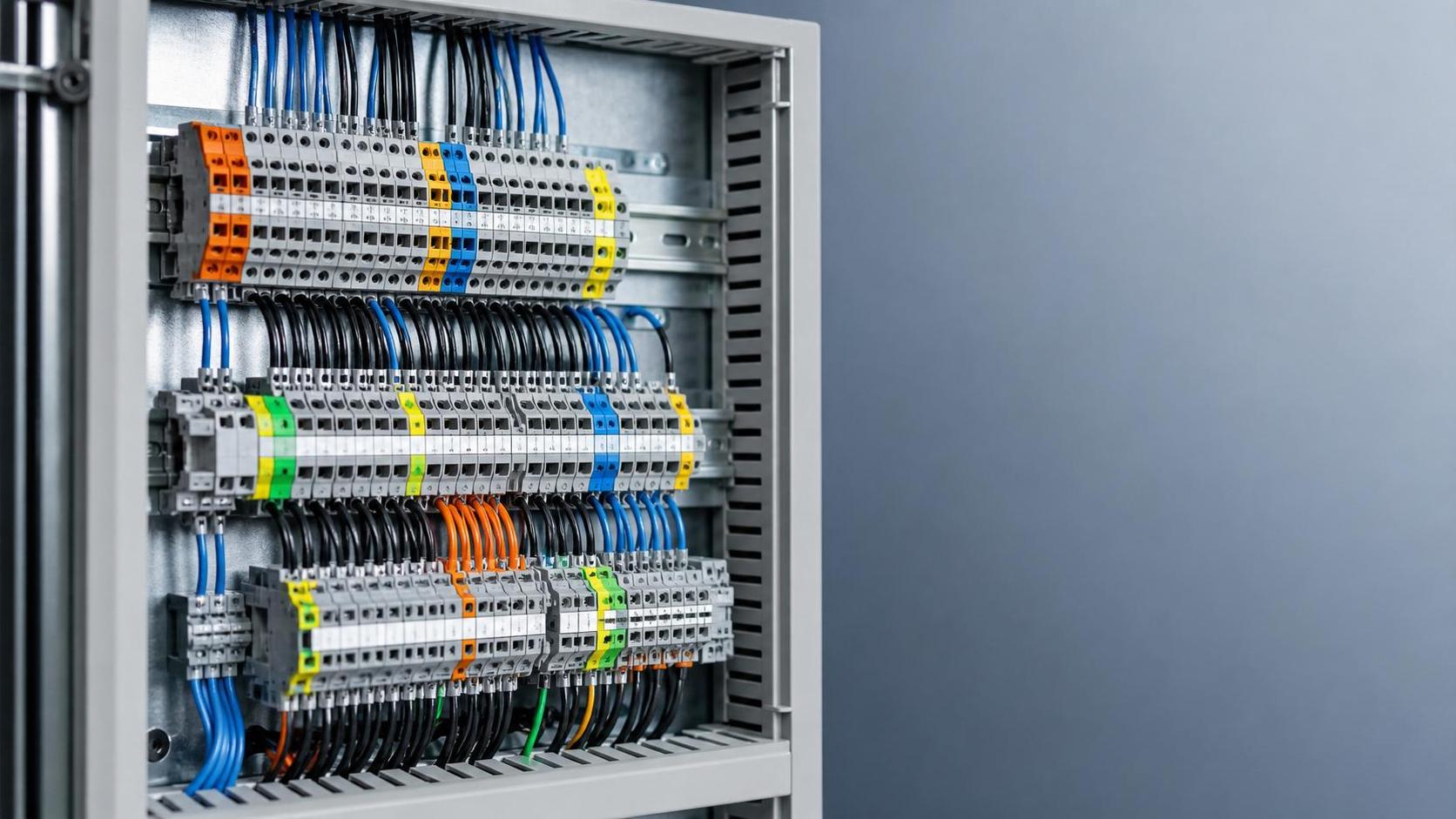
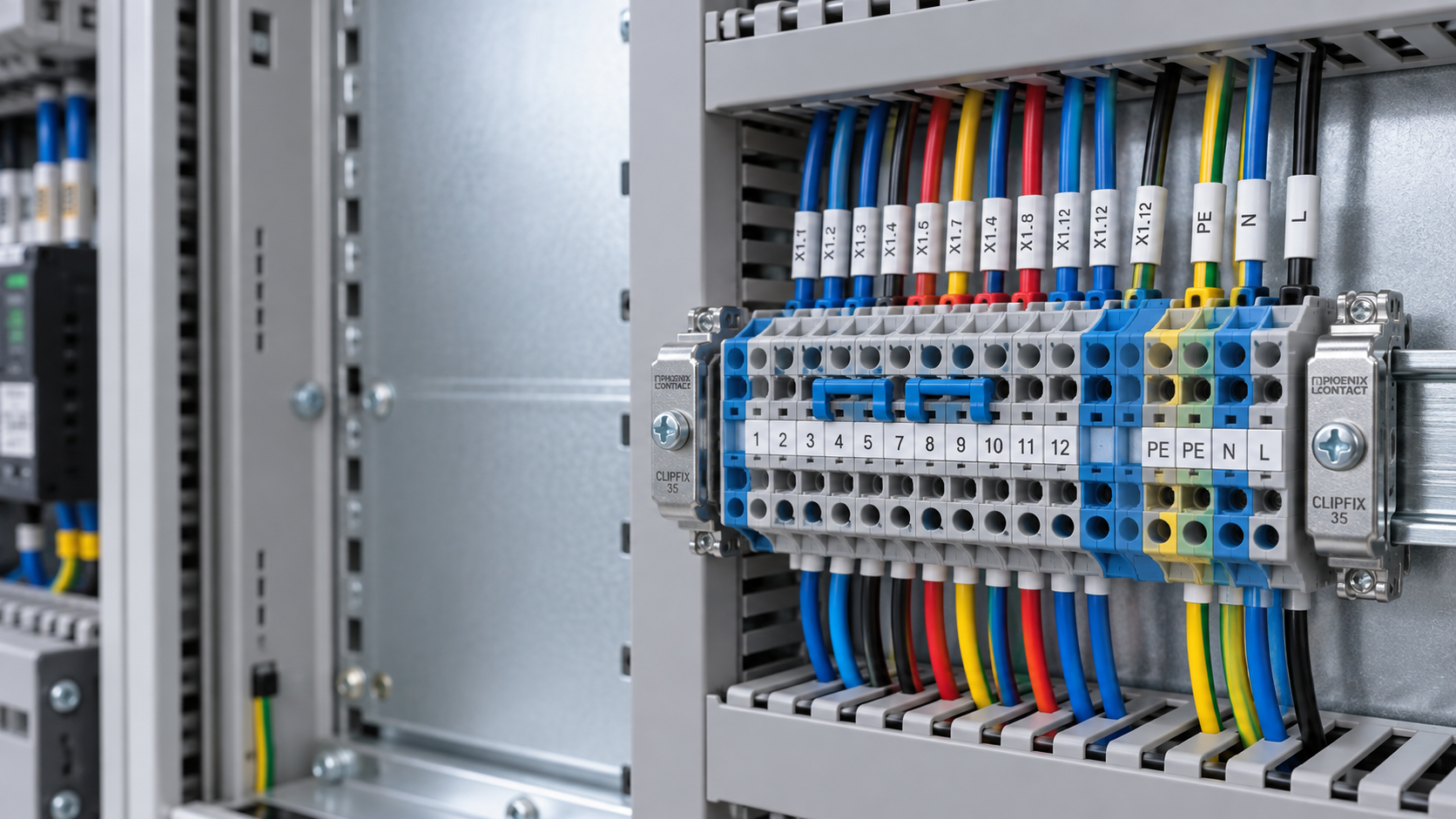
End stops turn a group of individual rail-mounted items into a contained assembly. They are usually installed at both ends of the terminal strip and tightened or latched so that the blocks cannot travel along the rail. The exact retention method differs by rail profile and component family, so compatibility should be checked rather than assumed.
Situations where end stops should be treated as necessary
The most obvious case is a panel exposed to vibration. Pumps, compressors, conveyors, machine tools, transport equipment, generator systems, and plant rooms with rotating equipment can all transmit vibration into an enclosure. The severity depends on the machine, mounting arrangement, enclosure construction, and rail orientation. It should not be guessed from the word “industrial” alone. Still, if vibration is expected, leaving terminal blocks free to migrate on the rail is rarely a sensible choice.
Wire tension is another common reason. Conductors should be routed and supported so their weight or movement does not load terminal connections, but actual panels are often less forgiving than drawings suggest. Stiff large-section conductors, screened cables, multicore cables entering from an awkward direction, and short service loops can all push or pull on a terminal row. A block may be electrically sound while the wiring arrangement applies sideways force to it every time a duct cover is removed.
End stops are also prudent in any terminal strip that will be serviced regularly. Operators may remove a separator, replace a fuse terminal, fit a test plug, add a jumper, or disconnect a field circuit during troubleshooting. These actions introduce small forces that are easy to overlook. Without end restraints, the person doing the work may unintentionally shift several neighbouring blocks. The result is usually not dramatic, but it can complicate reassembly and inspection.
Use them when the rail has spare length as well. An unused section of rail often invites later modifications. If an existing terminal group has no end stop, adding one new block may push the whole row sideways. This is a familiar issue in retrofit work, where the original installer may have left room for expansion but did not establish a clear mechanical boundary for each functional group.
The need is stronger where terminal blocks carry accessories that rely on alignment. Cross-connect bridges, end covers, partition plates, test accessories, marking systems, and certain fuse or disconnect arrangements work best when the row remains compact and correctly positioned. An end plate is not normally a substitute for an end stop. It may close exposed sides or provide electrical separation within a terminal system, but it does not necessarily secure the assembly to the DIN rail.
What can go wrong when the row is left loose?
The risk is often a chain of minor defects rather than one sudden failure. A terminal group that shifts can create uneven spaces between blocks. Marker carriers may no longer line up with the wiring schedule. A bridge may be harder to seat correctly after a repair. The end cover or partition can become misaligned, and a technician may spend unnecessary time checking whether the wrong terminal has been disturbed.
Cable strain deserves particular attention. Terminal blocks are intended to clamp conductors, not to serve as cable anchors. When a bundle is not adequately supported by ducting, clamps, or a suitable cable management arrangement, it can transmit movement to the terminal strip. If the blocks are free to slide, the entire row may move with the cable. If the blocks are restrained but the cable remains unsupported, the force can instead be concentrated at the conductor termination. End stops do not correct poor cable routing; they prevent the terminal assembly from becoming part of that movement.
There is also a practical safety issue during maintenance. Clear spacing and stable identification reduce the chance of touching or altering the wrong circuit. This matters in mixed-voltage panels, densely wired control sections, and cabinets where several teams may perform work over the equipment’s life. A loose row makes a panel feel untidy, but the more important concern is that mechanical disorder can obscure an otherwise well-documented wiring arrangement.
How to decide whether one end stop is enough
For a normal terminal strip, using one stop at each end is the dependable arrangement. One end stop can prevent movement in one direction if the other end is firmly bounded by a fixed device or enclosure feature. Yet that condition should be genuinely fixed, not merely assumed. A neighbouring relay base, power supply, or another terminal group should not be treated as a structural stop unless its own position is secured.
A useful field test is simple: with the panel de-energized and work procedures observed, apply light sideways pressure to the end of the assembled row. If the group shifts, rocks, or transfers motion into neighbouring components, it needs better retention. Do not use excessive force; the goal is to detect free travel, not to test the strength of every connection.
Two end stops are particularly advisable when the rail is mounted vertically. Gravity can encourage blocks to settle downward over time, especially during installation before all conductors are dressed and supported. The same applies to sloped mounting arrangements and mobile equipment. Horizontal rails in low-vibration indoor cabinets may appear less demanding, but wire pull and maintenance movement still justify end restraints in most professionally assembled strips.
Choosing the right end stop is not just a matter of rail width
Many panels use the familiar top-hat rail profile, often referred to in practice as 35 mm DIN rail. That does not mean every end stop fits every rail or every terminal block system. Rail depth, material thickness, perforation pattern, installation orientation, and the end-stop locking design can affect performance. Some stops use a screw to clamp onto the rail; others use a spring or lever mechanism. Each approach can work well when used within its intended system.
A screw-clamping end stop is often preferred where strong, adjustable retention is needed, but it introduces one more tightening point that needs to be checked during assembly. A spring-operated version can speed up installation and simplify later changes, although it should still be verified for the rail and environmental conditions involved. In panels exposed to strong vibration, the installer should follow the component manufacturer’s instructions on fitment, tightening, and compatible rail types rather than relying on visual similarity.
Material selection can matter in humid, corrosive, hot, or outdoor-adjacent environments. There is no universal “best” end stop. The appropriate choice depends on the enclosure environment, the expected service life, and the rest of the terminal system. Where a project has requirements related to flame behaviour, corrosion resistance, electrical separation, or particular local practices, those requirements need to be confirmed against the actual component documentation.
Installation details that prevent later frustration
Install the terminal blocks in their intended sequence before tightening the end stops. Make sure separators, end plates, bridging elements, and marker systems are fitted as required by the chosen terminal family. Then gently compress the row so there are no unintended gaps, but do not force components together so tightly that accessories are distorted or difficult to remove.
Place the end stop directly against the end component that needs restraint. Leaving a large open space between the stop and the terminal row defeats its purpose. If the design deliberately requires a gap for future expansion, consider whether that expansion zone needs its own boundary or whether the existing group should be locked independently.
After cable dressing, inspect the row again. This step is often skipped because the mechanical work seems finished before wiring begins. In reality, routing stiff wires can change the forces acting on the blocks. Check that conductors enter terminals without a constant sideways pull, cable ducts do not press against the row, and opening a duct cover does not move the end stop.
During periodic maintenance, look for a displaced end stop, gaps between blocks, shifted labels, damaged rail feet, or signs that cable bundles are carrying their own weight through the terminals. These checks take little time and are more useful than waiting for a loose terminal strip to become visible during a fault callout.
Avoid treating end stops as a cure for every mechanical problem
An end stop cannot compensate for a bent rail, a rail that is inadequately fixed to the backplate, incompatible components, poor conductor stripping, incorrect terminal tightening, or excessive load on a cable. It only addresses lateral retention of the rail-mounted assembly. If blocks continue to move after proper end stops have been installed, investigate the rail mounting, component compatibility, and cable routing rather than simply adding another clamp.
For buyers and maintenance teams comparing components from different sources, the most useful question is often not “Does this look like a DIN rail end stop?” but “Is it specified as compatible with this rail and terminal arrangement?” Product drawings, manufacturer instructions, and project documentation are more reliable than appearance. This is particularly important in international sourcing, where similar naming conventions can hide differences in rail geometry, locking methods, packaging, or accessory compatibility.
In practice, end stops are a low-cost detail that protects the order and serviceability of a terminal strip. Whenever vibration, cable force, transport, vertical mounting, long terminal rows, or regular intervention are part of the job, fit them at both ends from the start. It is easier to establish a stable boundary during assembly than to restore alignment after the panel has already entered service.
- Last One:No more articles
- Next Article:How to size electrical components for a reliable control panelSep 28, 2026
Technical Specifications
- When DIN rail terminal blocks need end stops to prevent looseningAuthor :Electrical Components Editorial Team
- How to size electrical components for a reliable control panelAuthor :Electrical Components Editorial Team
- What drives the price of LED panel lights for office projects?Author :Electrical Components Editorial Team
Expert Insights

Chief Security Architect
Dr. Thorne specializes in the intersection of structural engineering and digital resilience. He has advised three G7 governments on industrial infrastructure security.
Core Sector // 01
Security & Safety
- When DIN rail terminal blocks need end stops to prevent looseningAuthor :Electrical Components Editorial Team

- How to Evaluate a Terminal Blocks Supplier for Quality and Lead TimeAuthor :Electrical Components Editorial Team

- High Current Connectors: Common Failure Causes and How to Prevent OverheatingAuthor :Electrical Components Editorial Team

- Terminal Blocks Selection Guide for Reliable WiringAuthor :Electrical Components Editorial Team

- Industrial Connectors Explained: Main Types, Ratings, and Typical ApplicationsAuthor :Electrical Components Editorial Team

- How to Choose Connectors for Vibration, Moisture, and Repeated Plugging CyclesAuthor :Electrical Components Editorial Team