How much energy can LED lighting save in a warehouse?
Author
Date Published
Reading Time

Energy saving LED lighting can substantially reduce a warehouse’s lighting electricity use, but the result depends on the system it replaces and how the building operates. Replacing high-intensity discharge or fluorescent fixtures with lower-wattage LEDs reduces demand while the lights are on. Occupancy sensors and daylight controls can reduce consumption further by dimming or switching off lights when full output is unnecessary.
There is no single savings figure that applies to every warehouse. A reliable estimate starts with the existing fixtures’ actual power consumption, operating hours and light levels, then compares them with a proposed LED layout that meets the same operational needs. The calculation should also distinguish lighting savings from savings on the facility’s entire electricity bill.
Start with the lighting load, not the fixture count
A warehouse retrofit is sometimes estimated by counting fixtures and comparing the wattage printed on old and new lamps. That can produce a misleading result. The relevant figure is the power drawn by the complete lighting system, including ballasts or drivers and any other equipment included in the lighting load.
For a straightforward comparison, use this calculation for each group of fixtures with similar operating hours:
Annual lighting electricity use (kWh) = number of fixtures × system watts per fixture × annual operating hours ÷ 1,000
Calculate the existing and proposed systems separately, then subtract the proposed consumption from the existing consumption. Divide that difference by the existing consumption to express the lighting energy reduction as a percentage.
For example, consider a hypothetical area with 100 existing fixtures, each drawing 400 watts including associated equipment, operating for 4,000 hours a year. Its estimated consumption is 160,000 kWh. If a compliant LED design for the same area uses 100 fixtures drawing 150 watts each for the same hours, estimated consumption is 60,000 kWh. The difference is 100,000 kWh, or 62.5% of that area’s original lighting electricity use.
Those figures illustrate the calculation, not a guaranteed retrofit result. The proposed fixture count, power and operating hours must come from the actual design. In particular, a lower-wattage fixture is not a suitable replacement if it leaves picking locations, workstations or traffic routes inadequately illuminated.
To estimate electricity cost savings, multiply the expected reduction in kWh by the applicable energy charge. Where the electricity tariff also includes demand charges, the financial effect may differ: reducing watts can lower demand, but the benefit depends on when the reduction occurs relative to the facility’s billed peak.
Why two warehouses can see different results
The existing lighting technology provides the starting point, but it does not tell the whole story. An older high-intensity discharge installation may have substantial room for improvement, while a warehouse already using efficient lighting and effective controls may have less. A replacement that adds light to previously underlit areas can also reduce the apparent energy saving while improving working conditions.
Operating hours change the annual return. A fixture that runs through extended shifts has more opportunity to save energy than the same fixture in an infrequently used space. Check actual schedules, including cleaning, replenishment and maintenance periods, instead of assuming that all areas follow the main production shift.
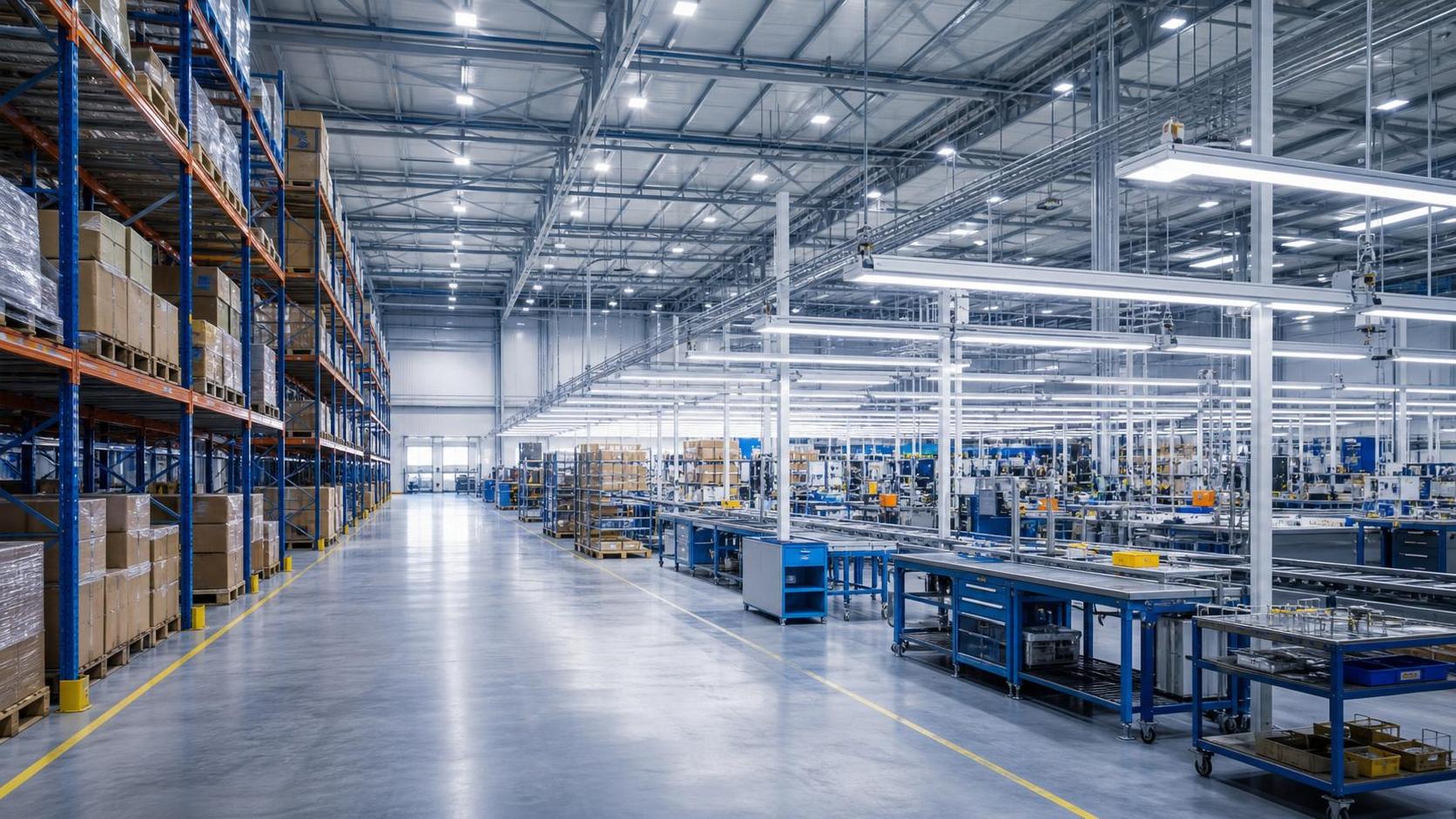
Layout affects how much light reaches the task. Ceiling height, rack arrangement, aisle width and storage height influence fixture placement and light distribution. A high-bay luminaire that performs well in an open floor area may not be the best choice for a narrow aisle where light needs to reach vertical rack faces.

Existing controls matter. If the current system already switches off unused zones, an estimate based on continuous operation will overstate savings. Likewise, if workers routinely leave lights on outside scheduled hours, a timetable alone may understate the existing baseline. Metering a representative circuit or using control-system records can give the estimate a stronger foundation.
Lighting requirements may change. A new racking layout, additional packing benches or longer shifts can alter both consumption and the lighting design. Where the project includes these changes, separate the effect of the upgrade from the effect of increased activity as far as practical.
How much can controls add?
LEDs save power at full output when the installed system uses fewer watts than the existing one. Controls create a separate opportunity: they reduce the time lights operate at full power. The two effects should be calculated together, without counting the same reduction twice.
Occupancy controls are often useful in storage aisles, loading areas and other zones where activity is intermittent. Depending on the application, lights may dim to a suitable background level or switch off when a space is unoccupied. A continuously staffed packing area has less opportunity for occupancy-based reductions during working hours, although scheduling may still help outside those hours.
Sensor placement needs to reflect how people and equipment move. Tall racks can block detection, and a sensor aimed at one end of an aisle may not reliably detect work at the other. The design should also provide appropriate light before workers or vehicles enter a controlled area, with settings that avoid distracting or unsafe switching.
Daylight controls can be useful near skylights, rooflights or windows. Their value depends on how much usable daylight reaches the work area and whether the system can dim the electric lighting in response. Racks, stored goods and changing daylight conditions can reduce the benefit, so it is more credible to assess daylight by zone than to apply one reduction to the entire building.
For a more realistic estimate, calculate each operating state separately. For example, multiply the full-output power by the hours at full output, then add the dimmed power multiplied by the hours at that setting. Include any control-system standby consumption where relevant. Use assumptions that reflect the intended settings, not merely the controls’ maximum advertised capability.
Choose a retrofit that delivers usable light
A one-for-one replacement is convenient to price, but it is not automatically the best design. Existing fixtures may be poorly positioned for the current rack layout, or their light distribution may no longer suit the work being done. A redesign can change fixture locations or quantities, although it may involve more installation work and disruption.
Compare proposals using a lighting layout for the actual space. Ask each supplier to show expected light levels at relevant working surfaces and locations, including rack faces where labels or inventory need to be read. Review uniformity and glare as well as average illumination: an attractive average can conceal dark areas or uncomfortable bright spots.
For the equipment itself, compare complete-system input power and the proposed light output and distribution under the intended installation conditions. Also consider mounting height, dust and moisture exposure, ambient temperature, impact risk and access for maintenance. The fixture and its driver need to be suitable for the environment, including any cold-storage areas or locations with special hazards.
Controls should be part of the specification rather than an afterthought. Confirm that luminaires, drivers, sensors and the chosen control system can operate together, and establish who will configure and commission them. A low-cost fixture package may offer less value if its controls cannot be adjusted to suit changing warehouse use.
Where operations cannot pause for a full installation, consider a phased rollout. A representative pilot area can help the team assess lighting quality, sensor coverage and installation constraints before committing to the remaining zones. Its energy results should be applied cautiously if other areas have different layouts or schedules.
Turn energy savings into a project decision
Simple payback is a useful initial screen: divide the installed project cost, less any applicable incentives, by the estimated annual financial savings. Include realistic costs for fixtures, controls, wiring changes, access equipment, installation, commissioning and disposal. Annual savings may include electricity and supportable maintenance reductions, but they should not depend on treating every avoided maintenance task as an immediate cash saving.
Payback alone does not capture everything that affects the decision. A proposal with a higher initial cost may offer better coverage, more suitable controls or less disruption to operations. Conversely, controls with a long incremental payback may be difficult to justify in a zone that is already occupied throughout the operating day.
Before approval, document the assumptions that drive the result:
- The number and measured or documented system watts of existing fixtures, grouped by operating schedule.
- The proposed fixture quantities, input watts, lighting layout and areas served.
- Expected hours at full output, dimmed output and off, including existing control behavior.
- The electricity tariff used in the calculation and the treatment of any demand charges.
- Installation scope, operational constraints, commissioning responsibilities and maintenance assumptions.
After installation, compare performance with the baseline using comparable operating periods. Track changes in schedules, occupied space and production activity so they are not mistaken for lighting performance. Check that sensors, schedules and dimming settings remain appropriate after commissioning; controls that are overridden or poorly configured can erode savings even when the fixtures themselves perform as specified.
The most useful next step is a fixture-and-hours inventory tied to a current warehouse layout. From there, request a lighting design and an itemized energy model for the areas under consideration. That makes it possible to compare proposals on the same basis: adequate light, credible operating assumptions and savings that reflect how the warehouse actually runs.
- Last One:No more articles
- Next Article:How mold design affects warpage in automotive injection moldingNov 02, 2026
Facing technical bottlenecks in manufacturing or looking for more efficient industrial solutions? Leave your details below and let the engineering experts at GIi solve them for you.
“We respect your privacy. Your information is strictly confidential.”
Technical Specifications
- How much energy can LED lighting save in a warehouse?Author :Electrical Components Editorial Team
- How mold design affects warpage in automotive injection moldingAuthor :Polymers & Rubber Editorial Team
- China-Peru Free Trade Agreement Upgrade Enters into ForceAuthor :Industrial Machinery Editorial Team
Expert Insights

Chief Security Architect
Dr. Thorne specializes in the intersection of structural engineering and digital resilience. He has advised three G7 governments on industrial infrastructure security.
Core Sector // 01
Security & Safety
- How much energy can LED lighting save in a warehouse?Author :Electrical Components Editorial Team

- What drives the price of LED panel lights for office projects?Author :Electrical Components Editorial Team

- LED Lighting Layout Tips for Warehouses and Production AreasAuthor :Electrical Components Editorial Team

- How to Compare LED Lighting Efficiency Beyond WattageAuthor :Electrical Components Editorial Team