Air Compressors: Fixed Speed or Variable Speed for Lower Energy Cost?
Author
Date Published
Reading Time
Energy cost is often the largest lifetime expense in compressed air systems. That is why the choice between fixed-speed and variable-speed air compressors matters far beyond equipment price, especially where load patterns change through the day.
In many factories, workshops, food plants, packaging lines, and construction support operations, compressed air demand is rarely flat. Short peaks, idle periods, and partial loads can turn an efficient machine on paper into an expensive asset in practice.
For sourcing decisions, the real question is not which type sounds more advanced. It is which setup delivers lower energy cost, stable output, manageable maintenance, and acceptable payback under actual operating conditions.
What separates fixed-speed from variable-speed operation
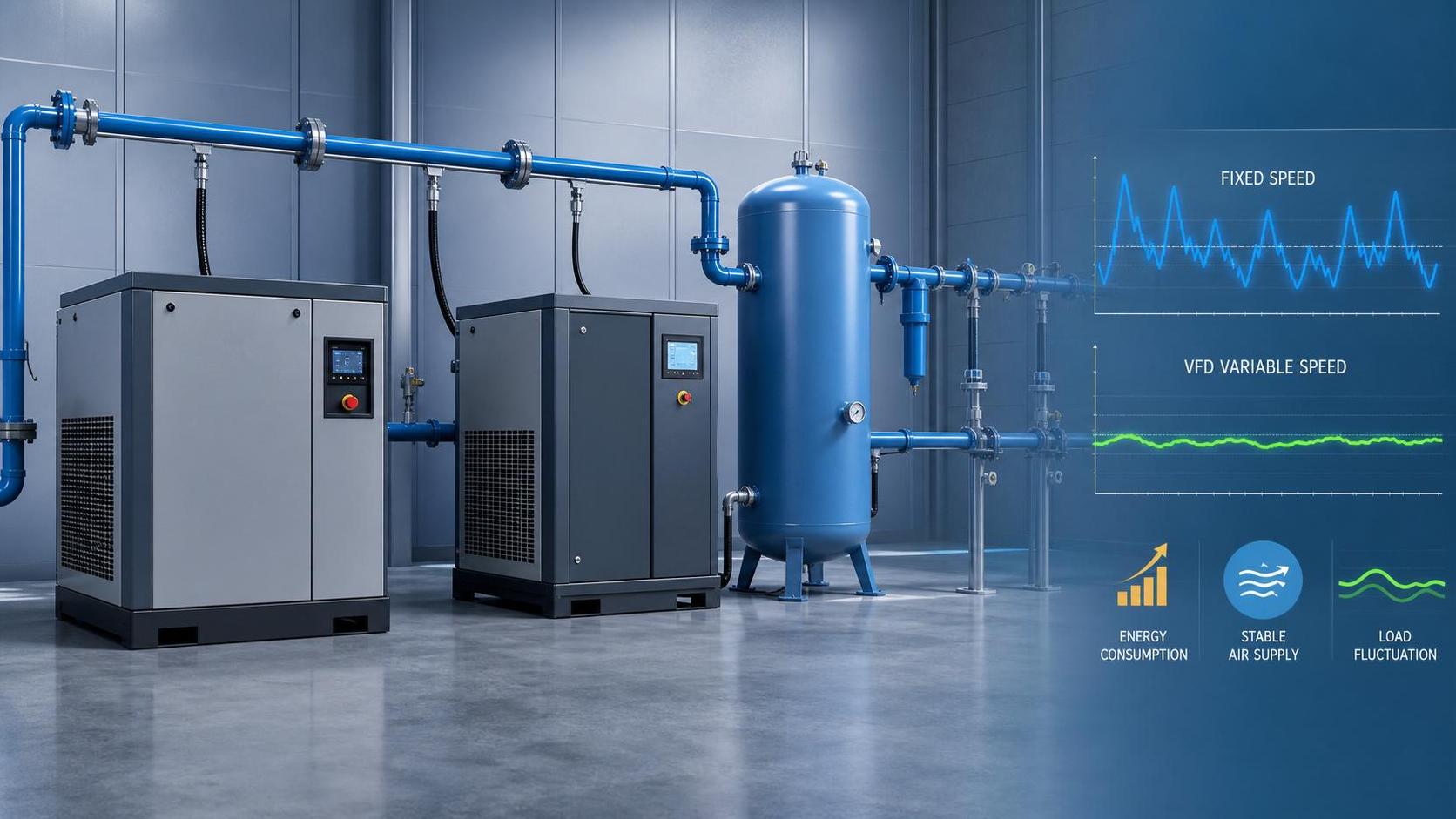
Fixed-speed air compressors run at one motor speed. When air demand drops, they usually unload, cycle, or rely on storage to manage excess capacity.
Variable-speed air compressors, often called VSD or inverter-driven units, adjust motor speed to match demand more closely. That reduces wasted power during partial-load operation.
This difference looks simple, but it changes the economics of compressed air significantly. Plants with stable, high utilization may favor simplicity. Operations with uneven consumption often benefit from flexibility.
Why the topic is getting more attention
Power prices remain volatile in many markets. At the same time, energy audits, carbon reporting, and internal efficiency targets are pushing buyers to look harder at utility-heavy equipment.
Compressed air is also under closer scrutiny because it is often one of the least visible operating costs. A system may run for years before anyone compares electricity use against true production demand.
Market behavior adds another layer. Importers and distributors now compare not only compressor price, but also spare parts availability, controller quality, certification, logistics lead time, and lifecycle cost.
Where each option usually makes sense
A fixed-speed model often works well when demand is predictable and the machine operates near full load for most of the shift. In these cases, the lower purchase cost can be attractive.
A variable-speed model usually performs better where air demand rises and falls. It is common in mixed production lines, multi-shift facilities, and plants that expand capacity gradually.
Energy savings are real, but not automatic
Variable-speed air compressors can cut electricity use substantially, but only when the demand profile supports them. A poorly sized VSD unit may never reach the expected savings.
Leakage, pressure drop, oversized motors, and weak system controls can erase the benefit. In other words, compressor technology alone does not fix an inefficient air network.
Fixed-speed air compressors can also be cost-effective if paired with proper receiver capacity, disciplined pressure settings, and stable production planning. Context matters more than brochure claims.
The payback calculation should include
- Annual running hours and daily load fluctuation
- Local electricity price and expected volatility
- Maintenance intervals, filters, and controller support
- Downtime risk and spare parts lead time
- Expansion plans that may change air demand within two to three years
Maintenance and sourcing implications
Maintenance is not only about service frequency. It also includes access to trained technicians, inverter reliability, software diagnostics, and parts commonality across regions.
For global buyers, this is increasingly important. A lower unit price can lose value quickly if replacement drives, sensors, or proprietary controllers are hard to source during peak production periods.
It is worth checking motor efficiency class, pressure control range, after-sales coverage, and compliance with relevant standards. These details often shape total cost more than headline efficiency claims.
A practical way to compare air compressors
A useful comparison starts with data from the site, not the catalog. Look at average demand, peak demand, idle hours, required pressure, and whether the process can tolerate pressure swings.
Then compare air compressors on delivered cost per usable cubic meter of air, not just rated power. Include installation, drying, filtration, storage, and control integration.
Where uncertainty is high, a demand study or temporary monitoring period can prevent an expensive mismatch. That is especially relevant when supply chains are tight or energy tariffs are rising.
Questions worth settling before placing an order
- Is demand stable enough for fixed-speed efficiency?
- How much time does the system spend below full load?
- Can the supplier document energy performance in similar applications?
- Are critical components available locally or regionally?
- Will future production changes alter the best compressor choice?
The better decision usually comes from system thinking
The answer to lower energy cost is not always variable-speed, and it is not always fixed-speed. The better answer usually comes from matching compressor behavior to the way the site really consumes air.
For current sourcing work, the most reliable next step is to build a simple comparison model using load profile, energy tariff, service support, and expansion risk. That will show which air compressors deserve serious evaluation.
When those inputs are clear, equipment choices become easier, negotiations become sharper, and long-term operating cost becomes far more predictable.
Technical Specifications
- How to test melt flow consistency in batches of recycled plasticsAuthor :Polymers & Rubber Editorial Team
- When does a cast resin transformer need high-altitude derating?Author :Electrical Components Editorial Team
- How to verify Global Industrial Insights sourcing informationAuthor :Industrial Machinery Editorial Team
Expert Insights

Chief Security Architect
Dr. Thorne specializes in the intersection of structural engineering and digital resilience. He has advised three G7 governments on industrial infrastructure security.