When does a cast resin transformer need high-altitude derating?
Author
Date Published
Reading Time
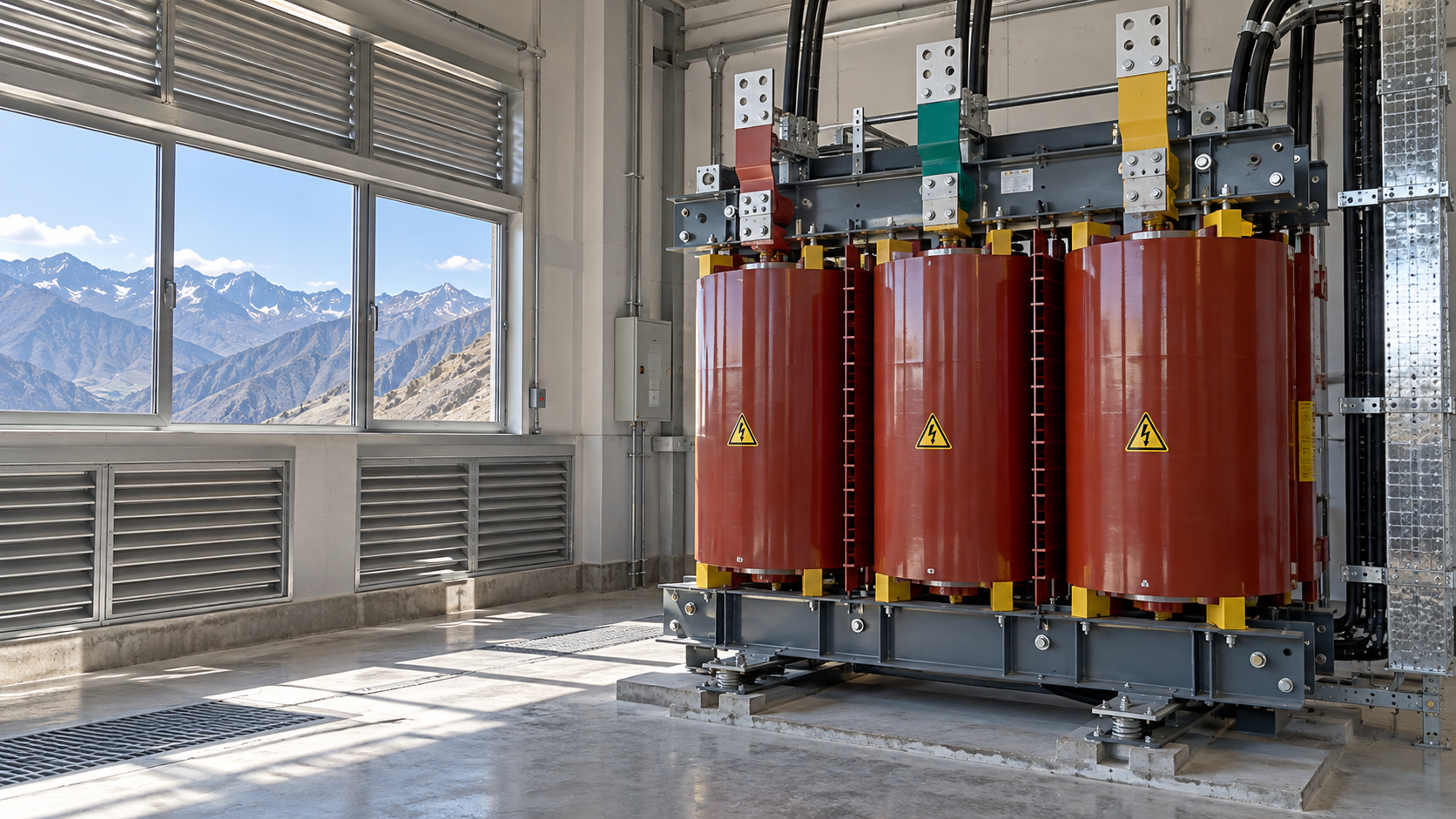
A cast resin transformer installed above 1,000 metres may need high-altitude derating, but elevation alone does not determine its allowable load. Thinner air reduces cooling effectiveness and external dielectric strength. Whether a standard rating remains valid therefore depends on ambient temperature, enclosure ventilation, insulation coordination, and the service conditions covered by the manufacturer’s design.
For engineers evaluating equipment for a mountain substation, mine, or elevated industrial facility, two questions need separate answers: Can the transformer carry the required load without exceeding its thermal limits, and can its insulation withstand the electrical stresses at that altitude? Reducing load may address the first issue. It does not automatically resolve the second.
The 1,000-metre threshold is an evaluation trigger
For dry-type transformers specified under IEC 60076-11, normal service conditions generally include an installation altitude not exceeding 1,000 metres above sea level. Above that elevation, the purchaser should declare the altitude and obtain confirmation of suitability for the actual site. The applicable standard edition, project specification, and manufacturer’s declared service conditions should govern the assessment.
This does not mean every installation at 1,001 metres requires a larger transformer. It means that an unqualified catalogue rating should no longer be accepted without checking its basis. Some products are designed and rated for higher elevations; others require a reduced allowable load, a modified cooling arrangement, changes to insulation clearances, or a combination of measures.
The distinction matters during tender comparisons. A transformer offered at its full rated output for the specified altitude is not directly comparable with an otherwise similar unit whose nameplate rating assumes normal-altitude service.
What thinner air changes inside and around the transformer
Cooling performance becomes less forgiving
A cast resin transformer transfers heat from its windings and core to the surrounding air. As altitude increases, lower air density changes convective heat transfer. For a conventional naturally air-cooled design, the same electrical losses can therefore produce a higher temperature rise than under the conditions used to establish its standard rating.
The thermal consequence is not simply a warmer enclosure. Higher winding temperatures reduce the margin to the insulation system’s operating limits and can accelerate ageing. A unit that appears acceptable during a cool commissioning week may have insufficient margin during sustained summer production.
Ambient temperature must be assessed at the transformer’s cooling-air inlet, not only at an outdoor weather station. A cool mountain climate offers little reassurance if the transformer draws air from a hot electrical room or recirculates its own exhaust.
External insulation has a separate altitude problem
Lower air density also reduces the dielectric strength of air. Exposed terminals, phase-to-phase gaps, phase-to-earth clearances, cable connections, and nearby conductive enclosure surfaces all need attention. Cast resin provides solid insulation around the windings, but it does not eliminate the air-insulated portions of the installation.
This creates a common selection mistake: accepting a reduced kVA rating as proof that all altitude requirements have been addressed. Lower current reduces load-related heating, but it does not proportionally reduce system voltage or lightning-impulse stress. A lightly loaded transformer can still have inadequate external insulation clearances.
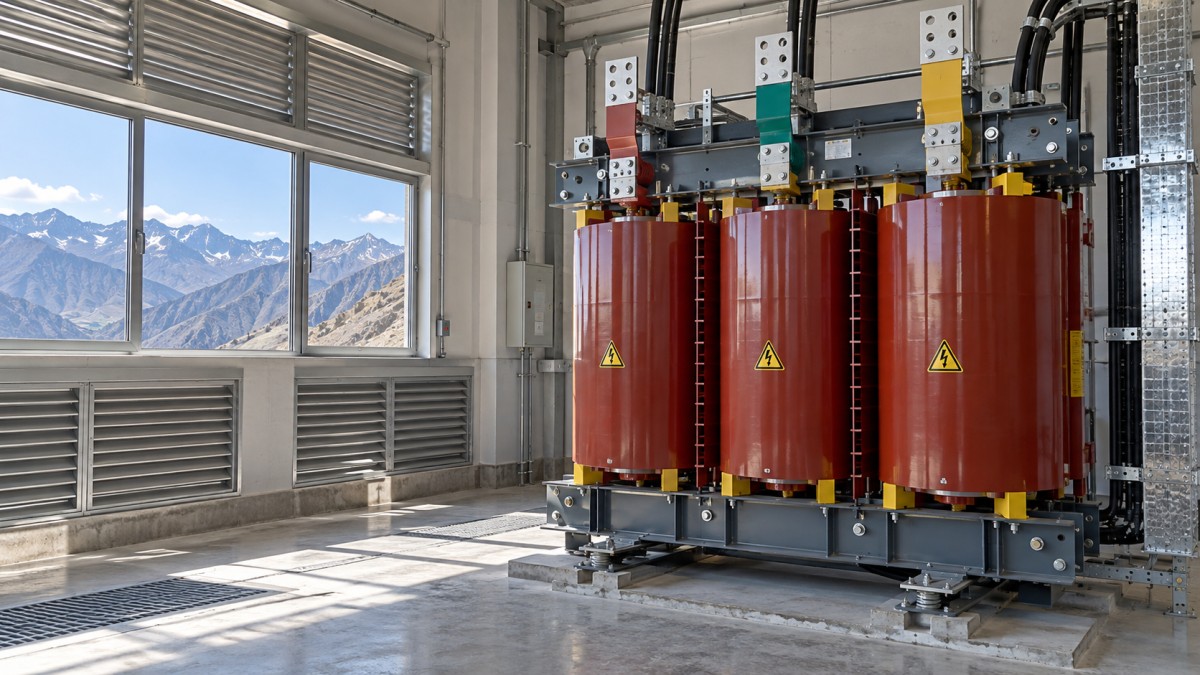
The appropriate solution may involve greater air clearances, different terminal arrangements, or an insulation design selected for the site elevation. Increasing a specified test level is not a substitute for checking the physical arrangement. The transformer, cable terminations, surge protection, and adjoining equipment must form a coordinated installation.
When does a cast resin transformer actually need derating?
Thermal derating is necessary when the proposed transformer cannot deliver the required output at the actual altitude and cooling conditions while staying within its permitted temperature limits. For an existing standard-altitude unit, reducing load may be the most practical response. For a new purchase, a design rated for the site can be preferable to accepting reduced usable capacity.
There are three common decision paths.
- Retain the standard design and reduce allowable loading. This can suit a site with sufficient spare capacity, provided external insulation remains suitable or is separately addressed.
- Select a transformer designed for full output at the specified altitude. The manufacturer may alter the electromagnetic, thermal, or physical design. The resulting site rating must be explicit.
- Change the cooling or installation conditions. Better room ventilation, a revised enclosure, or an engineered forced-air arrangement may improve thermal capability, subject to manufacturer verification.
A lower ambient temperature can offset some thermal disadvantage from altitude, but that benefit must be evaluated using the applicable standard and design method. It does not remove the need for an external dielectric assessment.
Why a universal altitude derating percentage is a weak purchasing rule
A quick search often produces a fixed percentage reduction per increment of elevation. Such guidance can be useful for preliminary screening, but it is not a reliable acceptance criterion unless its assumptions match the proposed transformer and governing specification.
Derating depends on the cooling mode, allowable temperature rise, winding losses, enclosure, ambient conditions, and design margins. A correction to permissible temperature rise is also not automatically the same percentage correction to rated kVA. Load losses vary approximately with the square of current, while no-load losses remain present whenever the transformer is energised; winding resistance also changes with temperature.
If the manufacturer supplies a validated load factor for the exact configuration, the capacity check is straightforward:
Permissible site capacity = declared base capacity × approved site load factor.
For illustration only, if a supplier confirms a combined site load factor of 0.92 for a particular 1,600 kVA unit, its allowable capacity under those stated conditions would be 1,472 kVA. The 0.92 factor is not a general altitude rule. It must come from the assessment for that equipment, enclosure, ambient profile, and cooling arrangement.
Ask whether the factor already includes temperature, altitude, and enclosure effects. Multiplying several unrelated correction factors can double-count restrictions—or miss important interactions.
Evaluate the installation, not just the transformer
Enclosures and room ventilation
A transformer assessed in an open arrangement may perform differently inside a protective enclosure. Louvres, filters, acoustic treatments, and restricted outlet paths introduce airflow resistance. Dust accumulation can further reduce cooling performance over time, particularly at mining and remote industrial sites.
Request confirmation for the supplied enclosure configuration. If project ventilation calculations assume a particular heat rejection, use the transformer’s declared losses at the relevant operating condition. The room design should prevent hot exhaust from returning to the inlet and allow access for cleaning.
Forced-air ratings and fan availability
Fans can increase cooling capability, but an air-forced rating should not be assumed to remain unchanged at altitude. Air density affects the cooling delivered by the airflow, and actual fan performance depends on the installed resistance and operating conditions.
Specify both the permitted naturally air-cooled capacity and the verified forced-air capacity at the site. For critical loads, determine what happens after fan failure: whether the load can be reduced, how quickly operators must respond, and which alarms or trips initiate that response.
Harmonics and duty cycle
Converters, variable-speed drives, rectifiers, and other nonlinear loads can create additional winding and stray losses. A high-altitude assessment based only on sinusoidal current may overstate capacity for these applications.
Provide the expected harmonic spectrum or an agreed representation of harmonic duty, along with the load profile. Continuous loading, short peaks, cyclic operation, and emergency overloads impose different thermal demands. A daily average demand is not enough to establish the required transformer rating.
The evidence to request before technical approval
A statement such as “suitable for high altitude” is too vague for procurement. It may refer to insulation capability, thermal operation, or merely an available product option. The approval package should connect the offered configuration to the project conditions.
- Declared service conditions: installation elevation, ambient temperature limits, indoor or outdoor arrangement, enclosure details, cooling mode, and relevant environmental restrictions.
- Site-specific capacity: continuous kVA at the specified altitude and ambient conditions, including separate natural-air and forced-air ratings where applicable.
- Thermal substantiation: the calculation or assessment method, assumed losses, permitted temperature rise, and supporting temperature-rise test evidence. Confirm how the evidence applies to the offered design.
- Dielectric suitability: rated insulation levels, external clearance assessment, altitude corrections where required, and compatibility with connected terminations and protection.
- Standards basis: applicable standards and editions, declared deviations, and any project-specific requirements beyond the product standard.
- Installation requirements: ventilation needs, minimum clearances, enclosure restrictions, monitoring provisions, and fan-maintenance requirements.
Tests performed at a lower-altitude factory do not automatically invalidate a high-altitude design. However, the supplier should explain how test results and design assessments establish suitability for the installation elevation. A general test certificate without that connection leaves an important gap.
Compare bids on usable site capacity
Consider a facility requiring 1,400 kVA of continuous demand at an elevated site. One bid offers a standard 1,600 kVA transformer subject to site derating. Another offers a 1,600 kVA unit explicitly rated for the specified altitude. The matching headline capacities do not establish technical equivalence.
If the first unit’s verified site capacity leaves little margin above demand, the buyer must examine future load growth, harmonics, ventilation deterioration, and peak ambient conditions. The second offer still needs supporting evidence; an altitude designation alone is not enough.
Commercial comparisons should therefore use guaranteed usable capacity, losses, installation requirements, and cooling-system dependencies—not nameplate kVA alone. A lower equipment price may be offset by a larger enclosure, additional ventilation, or insufficient operating headroom.
A practical approval boundary
For a cast resin transformer above 1,000 metres, begin with a service-condition review rather than an automatic percentage reduction. Derate when the verified thermal capability falls below the proposed loading, or select a design that provides the required output at the site. Separately confirm that the external insulation and connected equipment are appropriate for the elevation.
The selection is ready for approval when the supplier can state, in writing, the allowable continuous capacity, cooling conditions, insulation suitability, and installation limits for the actual project. Until those points are clear, a catalogue rating is a starting point—not an operating guarantee.
Technical Specifications
- How to test melt flow consistency in batches of recycled plasticsAuthor :Polymers & Rubber Editorial Team
- When does a cast resin transformer need high-altitude derating?Author :Electrical Components Editorial Team
- How to verify Global Industrial Insights sourcing informationAuthor :Industrial Machinery Editorial Team
Expert Insights

Chief Security Architect
Dr. Thorne specializes in the intersection of structural engineering and digital resilience. He has advised three G7 governments on industrial infrastructure security.
Core Sector // 01
Security & Safety
- When does a cast resin transformer need high-altitude derating?Author :Electrical Components Editorial Team

- How ambient temperature affects solar transformer specificationsAuthor :Electrical Components Editorial Team

- What to verify before selecting a transformer manufacturer in the USAAuthor :Electrical Components Editorial Team

- How to check transformer capacity for a solar system before commissioningAuthor :Electrical Components Editorial Team

- How to size solar transformer capacity for peak generationAuthor :Electrical Components Editorial Team

- Which solar transformer specifications must match inverter output?Author :Electrical Components Editorial Team

- How do you size a transformer for solar power projects?Author :Electrical Components Editorial Team

- How Transformers Affect Power Stability in Industrial FacilitiesAuthor :Electrical Components Editorial Team