Control Systems Basics: What Matters Most in Stable Industrial Automation
Author
Date Published
Reading Time
Control systems basics: what actually determines stability
A stable control system is not simply one that keeps a machine running. It is one that holds a process inside acceptable limits when conditions shift: load changes, raw material quality drifts, ambient temperature moves, operators intervene, or one part of the line responds slower than expected. That distinction matters because many automation problems are not caused by complete failure. They show up as oscillation, overshoot, nuisance alarms, uneven product quality, valve hunting, unnecessary energy use, or equipment wear that builds quietly over time.
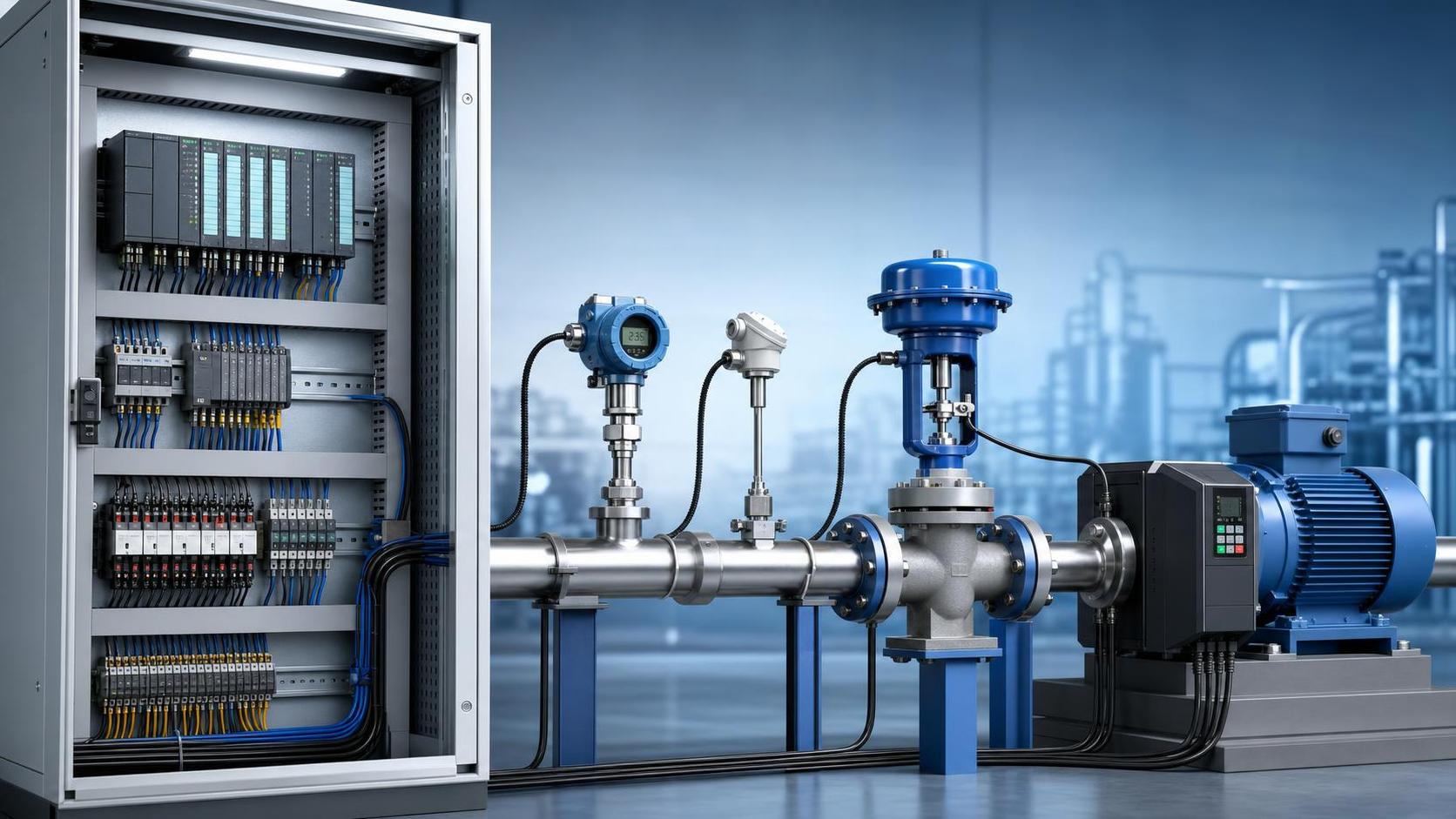
In industrial automation, the term usually covers the full loop of measurement, decision, and action. Sensors read pressure, temperature, flow, speed, level, position, or vibration. A controller, often a PLC, DCS, or dedicated drive controller, compares the measured value with a target. Actuators such as valves, motors, dampers, or variable frequency drives then adjust the process. Stability depends on how well those three parts fit together, not on the controller alone.
One common misunderstanding is to treat control performance as a software issue that can be fixed only by tuning. Tuning matters, especially in PID-based loops, but poor stability often starts earlier. A pressure transmitter with noise, a sticky valve, a badly sized actuator, long signal delay, or a process with strong interaction between loops can make a well-configured controller look unreliable. In practice, when engineers say a loop is hard to stabilize, they may be describing an instrumentation problem, a mechanical issue, or a process design constraint rather than a weak algorithm.
Where stable behavior comes from
The first requirement is measurement quality. If the input signal is noisy, drifting, poorly located, or too slow, the controller is reacting to a distorted picture of reality. A temperature loop, for example, may appear sluggish because the sensor is installed too far from the point where heat actually matters. A level signal may jump because of turbulence rather than true inventory change. In both cases, the control system can only be as stable as the signal it trusts.
The second is response matching. Every process has its own dynamics. Some react almost instantly, like motor speed control. Others, such as large thermal systems or chemical dosing, respond with delay. Stability gets harder when controller settings assume a faster or cleaner process than the real one. This is why settings copied from one machine to another often underperform even when the equipment looks similar on paper.
Then there is final control element behavior. Valves that stick, drives that have deadband, or dampers with backlash can produce repeated correction cycles. The controller keeps asking for a small move, nothing happens, then the actuator jumps too far. Operators often describe this as “the loop chasing itself,” which is a useful field description even if it is not a formal engineering term.
Why architecture matters more than many buyers expect
When evaluating industrial equipment, buyers often focus on controller brand, HMI appearance, or headline features. Those points matter, but stability is shaped just as much by system architecture: signal integrity, network reliability, controller scan time, fail-safe design, redundancy requirements, and how alarms are prioritized. A packaging line, a boiler system, and a water treatment skid can all use reputable hardware and still deliver very different operating stability depending on how the control layers were engineered.
This is also where application context starts to matter. Discrete manufacturing usually cares about synchronization, motion coordination, and repeatability. Process industries care more about continuous loop control, disturbance rejection, and maintaining product conditions within tolerance. The phrase control systems covers both worlds, but the stability questions are not identical. A sourcing review that ignores that difference can easily compare products that are not solving the same problem.
What to check when “stable” is used as a sales claim
“Stable operation” appears frequently in product literature, but on its own it says very little. A better review starts with a few grounded questions:
- What variables are being controlled, and how quickly do they change?
- What sensor type and installation method are used?
- What is the actuator rangeability, response time, and maintenance history?
- Is the loop independent, or does it interact with other loops?
- How does the system behave during startup, load swings, or communication loss?
Those questions are often more revealing than a long feature list. They also help importers and distributors judge whether a supplier understands application engineering or is mainly assembling standard components.
Standards, safety, and the limits of control performance
Not every stability issue is about productivity. In some sectors, it intersects directly with safety and compliance. Functional safety design, emergency shutdown logic, electrical compatibility, and documented control behavior under fault conditions may be as important as normal operating precision. The exact standards depend on industry and geography, so broad claims should be treated carefully. Still, the basic point holds: a control system can appear smooth in normal production and still be weak in abnormal or degraded states.
Another limit is that control cannot fully compensate for poor process design. If upstream variation is severe, if equipment sizing is wrong, or if the process window itself is too narrow, even advanced control strategies will have limited room to stabilize outcomes. That is why experienced engineers are cautious about promises that software alone will solve chronic instability.
A practical way to understand the market
For industry researchers and sourcing teams, the useful question is not “Which control system is best?” but “Best for which process conditions, risk profile, and maintenance capability?” Some users need simple, serviceable architectures with widely available spare parts. Others need tighter integration, diagnostics, remote monitoring, or high-availability design. Stability is therefore both a technical outcome and a procurement issue. It reflects component quality, engineering discipline, support capability, and how honestly the operating envelope is defined.
A good baseline understanding starts with the loop itself: what is measured, how fast the process moves, what disturbance is expected, and what happens when one element is wrong. Once those answers are clear, the term control systems stops being abstract. It becomes a practical way to judge equipment reliability, lifecycle cost, and whether an automation offer is built for real operating conditions rather than ideal test conditions.
Technical Specifications
- How to test melt flow consistency in batches of recycled plasticsAuthor :Polymers & Rubber Editorial Team
- When does a cast resin transformer need high-altitude derating?Author :Electrical Components Editorial Team
- How to verify Global Industrial Insights sourcing informationAuthor :Industrial Machinery Editorial Team
Expert Insights

Chief Security Architect
Dr. Thorne specializes in the intersection of structural engineering and digital resilience. He has advised three G7 governments on industrial infrastructure security.