Are Industrial Washers Subject to EU Compliance Checks?
Author
Date Published
Reading Time
Yes. Industrial washers placed on the EU market are generally subject to compliance checks, but the exact obligations depend on how the equipment is designed, powered, controlled, installed, and used. A tunnel washer for a commercial laundry, a parts-washing cabinet, a solvent-based cleaning unit, and a heated aqueous washer may all fall under different combinations of EU legislation.
The central issue is not whether the machine is described as “industrial.” The relevant question is whether it is machinery, electrical equipment, pressure equipment, equipment for a potentially explosive atmosphere, or a combination of these. In many cases, the machine will need CE marking before it can be legally placed on the EU market. That marking must be supported by a conformity assessment, technical documentation, an EU Declaration of Conformity, and the required safety and traceability information.
What does an EU compliance check involve?
Compliance is not normally a single inspection carried out automatically on every industrial washer entering Europe. Instead, it is a legal market-access system. The manufacturer must assess conformity before placing the machine on the market; importers and distributors must verify that the required steps have been completed; and national market-surveillance authorities may inspect products, request documentation, test equipment, or require corrective action when they identify a risk or suspect non-compliance.
Checks can occur at several points:
- during customs or import controls, especially where documentation, labelling, or the EU-based economic operator is unclear;
- through market-surveillance inspections after equipment has entered the supply chain;
- after an accident, fire, electrical incident, or workplace complaint;
- when a competitor, customer, installer, or regulator raises a formal concern;
- during procurement reviews by public bodies, large industrial users, insurers, or facility safety teams.
For this reason, CE marking should not be treated as a shipping label or a document produced only for customs clearance. It represents the manufacturer’s legal declaration that the machine complies with all applicable EU harmonisation legislation.
Is CE marking required for every industrial washer?
Many industrial washers are “machinery” because they contain moving parts, controls, drives, pumps, heaters, doors, interlocks, or automated operating sequences. Where the equipment falls within the scope of the Machinery Directive 2006/42/EC, CE marking is required before it is placed on the EU market or put into service.
The Machinery Directive remains applicable during its current transition period. It will be replaced by the EU Machinery Regulation (EU) 2023/1230, which becomes applicable on 20 January 2027. Equipment placed on the market before that date is assessed under the Directive; equipment placed on the market from that date must meet the Regulation’s requirements.
A conventional industrial washer is not automatically a “high-risk machine” requiring notified-body involvement. In many cases, the manufacturer can carry out the conformity assessment internally, provided that it has completed a proper risk assessment, compiled the technical file, applied the relevant safety requirements, and issued the EU Declaration of Conformity. However, self-declaration does not mean self-certification without evidence. Authorities can request the underlying technical documentation and challenge unsupported claims.
There are situations where the supplied item is not yet a complete machine. A washer module delivered without its final guarding, control integration, or safety system may be classified as partly completed machinery. It should then be supplied with a Declaration of Incorporation and assembly instructions rather than a CE mark under machinery rules. The party that completes and integrates the installation becomes responsible for the final conformity assessment of the completed machine.
Which EU rules may apply beyond machinery safety?
Industrial washing equipment often falls under more than one legal framework. The applicable set depends on the actual configuration, not on a supplier’s broad statement that the product is “CE certified.”
Environmental obligations should be assessed carefully rather than assumed. The EU’s household washing-machine ecodesign and energy-labelling rules do not automatically apply to every commercial or industrial washer. Their scope is tied to defined categories of household washing machines and washer-dryers. A supplier should identify the applicable product regulation rather than attaching an energy label merely because the machine washes textiles.
Where detergents, disinfectants, solvents, or process chemicals are supplied with the equipment, separate obligations may also arise under REACH and CLP rules. These obligations concern the substances and mixtures, their classification, labelling, safety data sheets, and permitted uses; they are not replaced by CE marking on the washer itself.
What documentation should exist before shipment?
A compliant machine should have a traceable document package. Buyers do not need access to every commercially sensitive engineering drawing, but they should be able to verify that the core legal documents exist and correspond to the exact model and configuration being purchased.
The EU Declaration of Conformity is the most important outward-facing document. It should identify the manufacturer, machine type or model, serial or type reference where appropriate, applicable EU legislation, any standards used, the authorised signatory, and the date and place of issue. A generic declaration listing a broad range of unrelated directives is a warning sign. So is a declaration issued for one model while the supplied machine has different heating, control, electrical, or safety features.
The technical file is usually retained by the manufacturer or its authorised representative and must be available to authorities on request. For a machinery product, it commonly includes the risk assessment, design and manufacturing information, relevant calculations and test records, applied standards, instructions, declarations for incorporated components, and copies of the Declaration of Conformity.
Instructions are not a minor administrative item. They must address safe transport, installation, commissioning, intended use, foreseeable misuse, cleaning, maintenance, residual risks, emergency procedures, and required personal protective equipment where relevant. The instructions and safety information must be supplied in the language required by the Member State where the machine is made available. English-only manuals may therefore be insufficient for equipment sold into many EU markets.
Why a CE certificate may not prove compliance
Industrial washer listings frequently refer to a “CE certificate.” This can be misleading. For many machinery products, EU law does not require a third-party CE certificate. The legally meaningful items are the conformity assessment, technical documentation, CE marking, and EU Declaration of Conformity.
A test report from a laboratory can support conformity, particularly for electrical safety, electromagnetic compatibility, or specific component performance. It does not by itself establish that the whole assembled machine complies with all applicable legal requirements. Similarly, a certificate from an organisation with no defined role under the relevant legislation may have limited value in an enforcement inquiry.
The more useful procurement question is: What evidence supports the declaration for this exact machine? A credible answer connects the machine’s risk assessment, electrical design, guarding, control functions, operating instructions, and applicable legislation. It does not rely on a logo, an expired document, or a certificate for a different product family.
Where are industrial washers most likely to fail a compliance review?
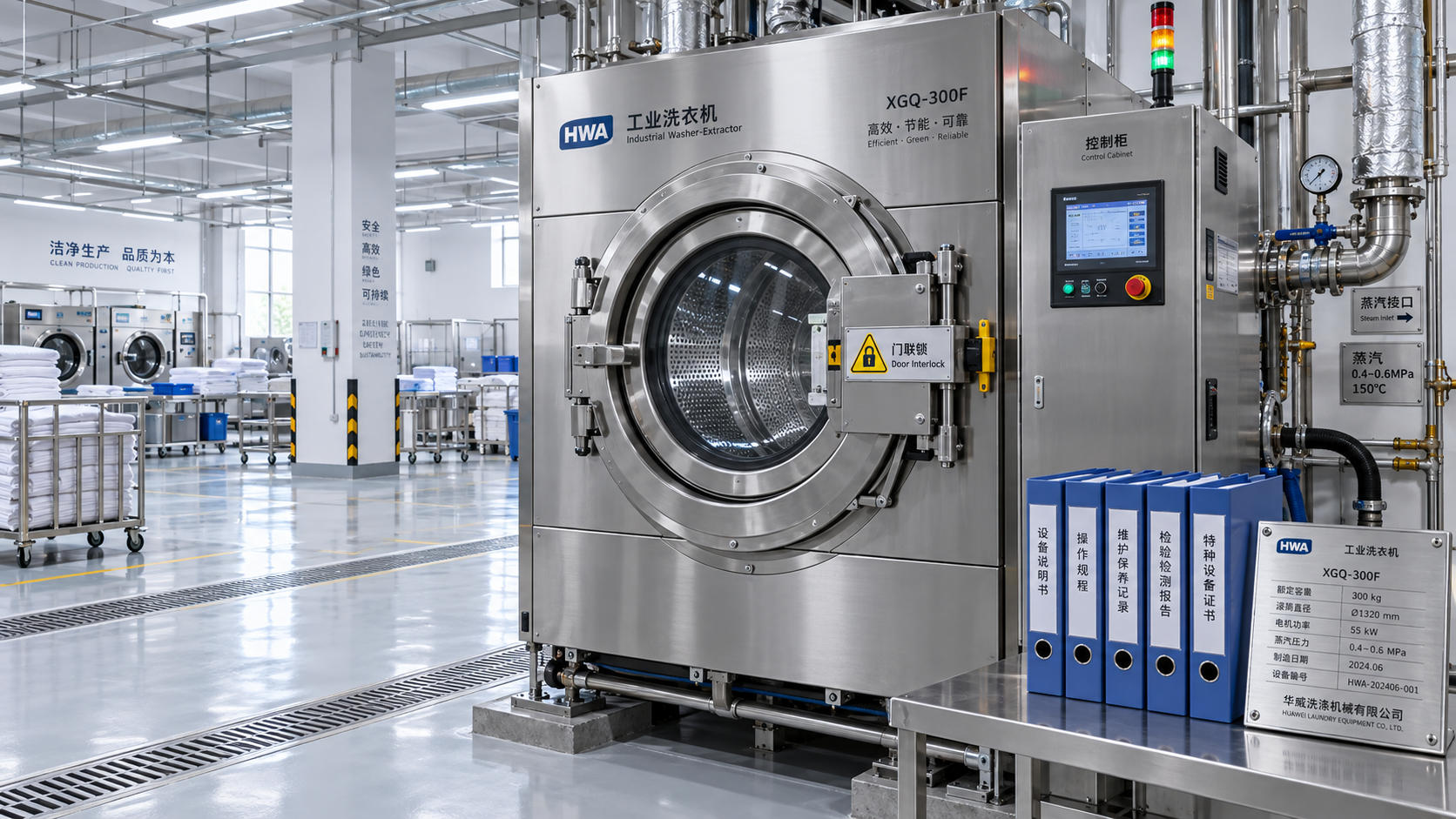
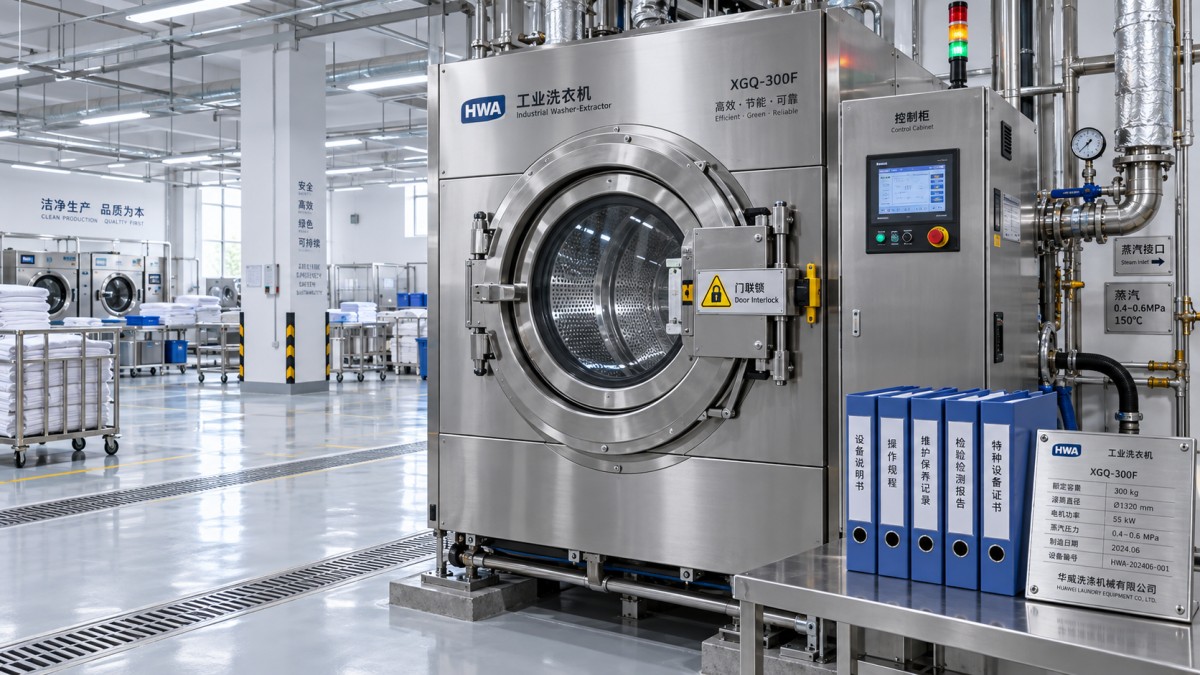
Mechanical access hazards are a recurring concern. Large drum washers, cabinet systems, conveyor washers, and automated laundry lines need appropriate safeguards against access to moving parts, trapping, crushing, entanglement, and unexpected start-up. Door interlocks require particular scrutiny: a door should not be opened while hazardous movement remains possible, and the machine should not restart merely because an interlock is restored.
Control-system safety is another frequent weak point. Emergency-stop devices, safety relays, guard switches, two-hand controls where used, and restart prevention must be selected and integrated according to the machine’s risk assessment. Adding an emergency-stop button does not correct a poorly designed safety function.
Thermal, chemical, and pressure-related risks may be more significant than the moving machinery itself. Heated wash chambers, steam connections, hot surfaces, caustic solutions, disinfectants, and pressurised spray systems can create burn, scalding, leakage, and exposure hazards. A washer intended for food processing, healthcare textiles, metal parts, or chemical-contaminated workwear may need operational controls that are very different from those of a standard laundry machine.
Electrical compliance problems often appear in the final configuration rather than in the main machine frame. Incorrect cable sizing, poor earthing, unprotected terminals, unsuitable enclosures, unverified variable-frequency drives, and changes to the control panel can undermine the declared conformity. The same is true when an importer modifies the original machine, adds a remote-control system, changes the heater, or integrates the washer into a production line. A substantial modification can shift legal responsibility to the party making the change.
What are the obligations of importers and distributors?
Importers cannot rely entirely on a foreign manufacturer’s declaration. Before placing equipment on the EU market, an importer must ensure that the manufacturer has carried out the relevant conformity assessment, prepared technical documentation, affixed CE marking where required, supplied the required instructions and information, and identified the product properly. Importers must also indicate their name, registered trade name or trademark, and contact address on the product, packaging, parcel, or accompanying documentation where permitted by the applicable rules.
EU market-surveillance rules also require an EU-based economic operator for products covered by listed harmonisation legislation, including machinery rules. Depending on the commercial arrangement, that role may be filled by the EU manufacturer, importer, authorised representative, or certain fulfilment service providers. The responsible operator must be able to cooperate with authorities and make the Declaration of Conformity and technical documentation available when requested.
Distributors have a lighter but still meaningful duty. They should check visible CE marking, required documentation and language requirements, traceability information, and obvious safety concerns before making the machine available. If they know, or have reason to believe, that a product is non-compliant, they must not continue distributing it as if the issue did not exist.
Does compliance end once the machine is installed?
No. CE conformity addresses the product’s market-access requirements, but the operating site remains subject to national workplace safety law. The EU Work Equipment Directive 2009/104/EC sets minimum requirements that Member States implement through national rules. Employers and operators must ensure that work equipment is suitable, maintained, inspected where required, and used by trained personnel.
A compliant standalone washer can become unsafe through poor installation, inadequate drainage, incorrect steam connections, missing extraction, insufficient floor loading, unsuitable chemical storage, bypassed interlocks, or unapproved integration with other equipment. Where the installation forms a combined production line, the final assembly may need its own risk assessment and conformity review.
What should be checked before placing an order?
The most practical approach is to define the intended EU use before requesting documents. Ask whether the washer is designed for textile laundry, parts cleaning, solvent cleaning, medical use, food-processing support, or another specialised process. Confirm heating method, supply voltage, pressure systems, radio functions, chemical compatibility, automation level, and whether it will operate as a standalone unit or within a larger line.
Then request the model-specific EU Declaration of Conformity, operating instructions in the required destination-country language, CE-marking details, electrical drawings or specifications, and evidence supporting key safety claims. For steam, pressurised, solvent, or potentially explosive applications, a generic declaration is not enough; the applicable pressure and ATEX assessments should be identified explicitly.
Industrial washers are therefore subject to EU compliance checks in both a legal and practical sense. The decisive issue is not whether an authority physically inspects every shipment, but whether the equipment can withstand scrutiny when documentation, safety design, labelling, installation, and traceability are examined. A machine that is properly engineered and documented is far easier to import, insure, install, and operate than one whose compliance rests only on a CE logo.
Technical Specifications
- Which local safety approvals apply to imported power suppliesAuthor :Electrical Components Editorial Team
- How to choose the right tempered glass panel for safety glazingAuthor :Construction Materials Editorial Team
- When do elastomers outperform thermoplastics in flexible seals?Author :Polymers & Rubber Editorial Team
Expert Insights

Chief Security Architect
Dr. Thorne specializes in the intersection of structural engineering and digital resilience. He has advised three G7 governments on industrial infrastructure security.