What to verify before choosing an inorganic pigments supplier
Author
Date Published
Reading Time
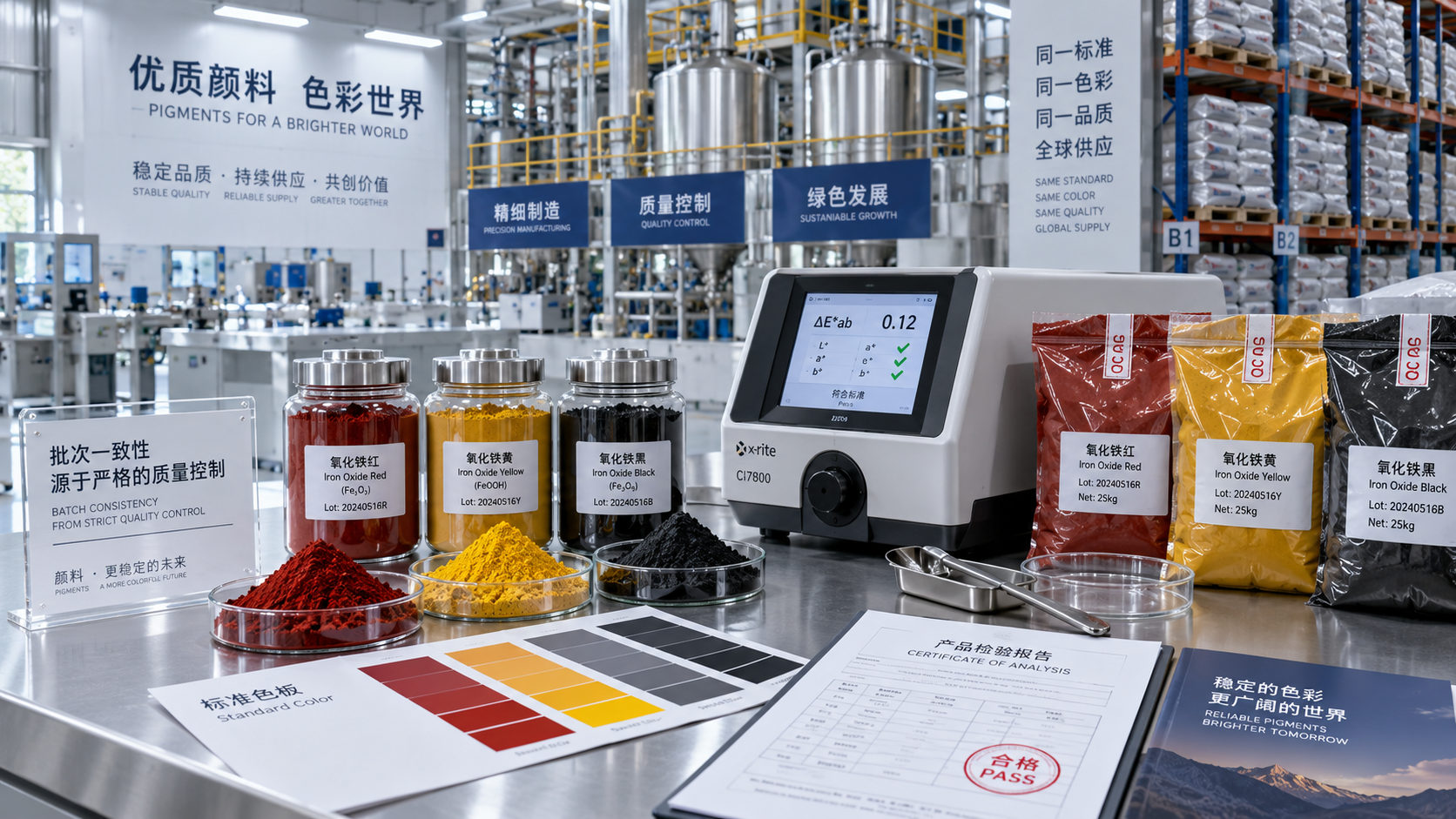
A low quotation and an acceptable color chip are not enough to qualify an inorganic pigments supplier. Pigments influence batch appearance, processing behavior, compliance exposure, inventory planning, and the cost of rejects. A supplier that looks competitive during sampling can become expensive once production depends on repeatable deliveries.
The practical question is not simply whether a supplier can provide iron oxides, titanium dioxide, chromium oxides, ultramarine, or other inorganic colorants. It is whether that supplier can provide the same usable material, with the right documentation and delivery discipline, under the conditions your formulation and operations require.
Before approving a source, verify the product against the real application, then verify the supplier's ability to maintain it. These two checks should be treated separately. A technically suitable sample does not automatically prove reliable commercial supply.
Start with the finished product, not the pigment name
An inorganic pigment can be described by a common color name, a shade, or a color index reference, but those descriptions do not define full interchangeability. Two red iron oxide pigments may look similar in a hand sample while behaving differently in concrete, coatings, plastics, rubber, ceramics, or construction materials. Differences in particle size, dispersion, undertone, moisture, surface treatment, and impurities can change the result.
Build the purchase specification around the properties that affect the finished product. For a concrete product, tinting strength, alkali resistance, dispersion in the dry mix, and color stability after curing may matter more than a laboratory color reading alone. For a coating or plastic compound, undertone, opacity, particle distribution, heat resistance, and compatibility with the binder can become more important. A pigment suitable for one application may be a poor substitute in another even when the basic chemistry is similar.
Ask the supplier to identify the intended application of the offered grade rather than accepting a broad statement such as “suitable for industrial use.” A serious technical offer should connect the grade to a use case and explain which parameters are controlled.
Compare technical data in a way that exposes meaningful differences
A technical data sheet is useful, but it is not a complete qualification file. Some sheets describe typical properties rather than guaranteed limits. Others leave out the variables most likely to create production variation. Read the document as a starting point for questions, not as final proof that two materials are equivalent.
For each candidate grade, request the specification limits, test methods, and a recent certificate of analysis from an actual production batch. The distinction matters: a target value tells you what the product often achieves; an acceptance range tells you what may be shipped. If the acceptable range is too wide for your formulation, the material can meet the supplier's specification while still causing visible variation in your product.
Do not over-specify every available property. Excessively narrow requirements can raise cost and reduce sourcing options without improving the finished product. The better approach is to identify the few variables that genuinely drive your quality risk, define realistic limits for those variables, and leave non-critical characteristics flexible.
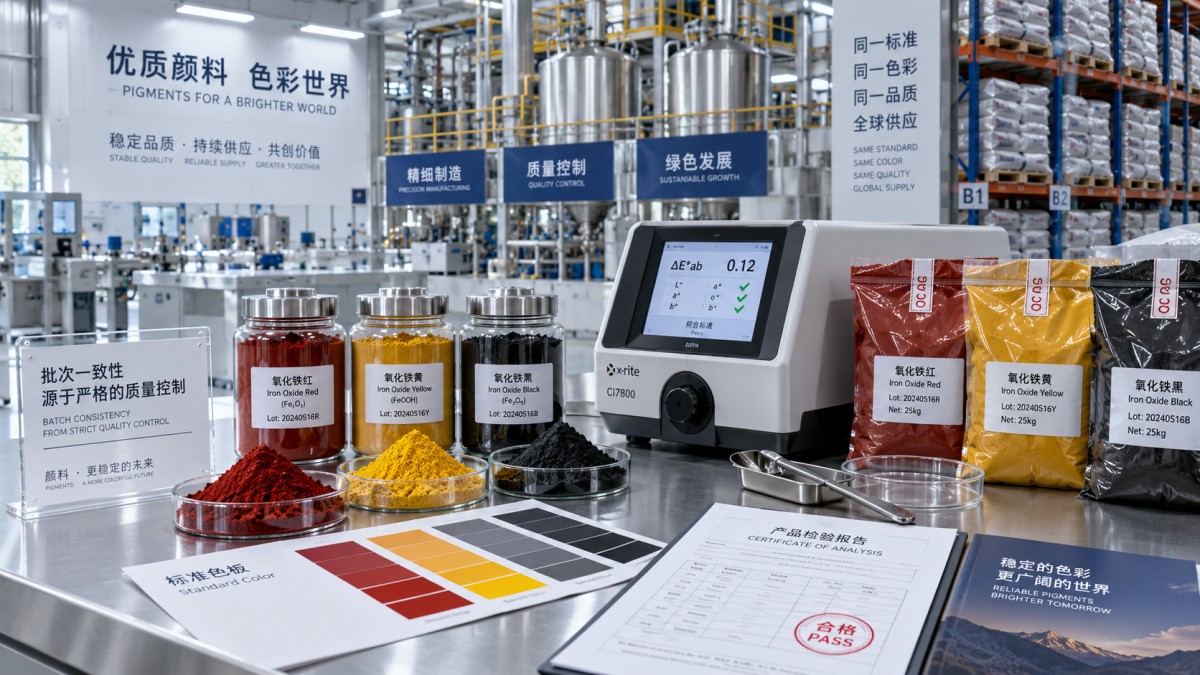
Qualify the sample through your own process
Supplier samples are often carefully prepared, fresh, and supplied in small quantities. Commercial material must work after transport, storage, weighing, mixing, and processing at normal scale. A qualification process should therefore move beyond a color card.
Begin with a controlled bench trial using the same raw materials, dosage method, mixing time, and processing conditions used in routine production. Record the pigment batch, formulation version, equipment settings, and visual result. Compare against the approved material under the same conditions. If the product has a curing, heating, molding, extrusion, or weathering stage, include that stage in the evaluation.
For a source intended for regular volume, a pilot or first-production trial is usually more revealing than repeated laboratory samples. It can show whether dusting, poor flow, inconsistent dispersion, packaging damage, or dosing variation creates operational costs that a lab test will not catch. A lower pigment price does not compensate for slower mixing, rework, cleaning time, customer complaints, or additional color correction.
Retain approved reference samples and define how future shipments will be compared. This is especially important where color continuity matters across multiple production runs, such as architectural finishes, paving products, molded components, printed materials, and coatings supplied in repeat orders.
Check consistency across batches, not just one good lot
Batch consistency is often the deciding factor when selecting an inorganic pigments supplier. Inorganic pigments are generally valued for durability, but their commercial performance still depends on controlled raw materials, process conditions, milling, blending, and packing. A supplier may deliver a satisfactory first batch and struggle to reproduce the same shade or strength later.
Ask how color is controlled before release, whether the supplier uses retained standards, and how deviations are handled. The answer should be concrete enough to explain the workflow: incoming material control, in-process checks, final batch release, and traceability from finished bag back to production records. A vague assurance that “quality is stable” provides little basis for managing future claims.
Where the material will be used in visible or tightly controlled products, request samples from more than one production lot where practical. This is not a demand for perfection. It is a way to understand the normal variation range before a production line is dependent on the material.
Also establish a clear rule for substitutions. Some suppliers may change a raw material source, plant, packaging format, or grade designation without realizing the customer treats that change as significant. The purchase agreement should require notification and approval before changes that could affect the agreed specification or application performance.
Confirm compliance as a product-and-market question
Compliance cannot be reduced to a generic statement that a pigment is “certified” or “non-toxic.” Requirements depend on the country of sale, the end-use sector, the finished article, and the chemicals or substances relevant to that product. A pigment used in an industrial coating may be assessed differently from one intended for toys, food-contact packaging, cosmetics, or consumer goods.
Define the market and intended use before requesting documents. Then ask for the material information needed by your own compliance process, such as safety documentation, substance declarations, and relevant test support where applicable. The important point is alignment: the documents must cover the exact grade, the manufacturing source, and the use case being evaluated.
Pay attention to the difference between a pigment supplier and a distributor. A distributor can be a strong supply partner, especially when it holds local stock and provides technical service, but it may rely on upstream manufacturers for detailed composition, change notifications, and long-term traceability. Make sure responsibility for documentation and product changes is explicit.
Assess supply capacity through the full delivery chain
Declared annual capacity alone does not tell you whether supply will be dependable. Availability can be affected by raw material constraints, plant maintenance, allocation priorities, export procedures, container access, inland transport, port congestion, and the supplier's inventory policy. These risks matter more for imported pigment grades, long replenishment routes, and colors with limited qualified alternatives.
Ask what stock is normally held, where it is held, what lead time applies to repeat orders, and whether the supplier can support a forecast rather than only spot purchases. A source that offers a low unit price but requires uncertain replenishment can create a costly production interruption. Conversely, local warehousing may justify a higher price when it reduces emergency freight, inventory buffers, and line stoppage risk.
Packaging deserves a specific check. Pigment bags must protect the material from moisture and contamination while remaining practical for warehouse handling and dosing. Confirm bag type, pallet configuration, net weight tolerance, labeling, lot identification, and whether the packaging has been proven on the intended shipping route. Damaged packaging may turn a technically acceptable shipment into unusable inventory.
Calculate landed cost and process cost, not only price per kilogram
A useful cost comparison starts with price per unit of usable color, then extends to the total cost of supply. A pigment with lower tinting strength may require a higher dosage. One with less favorable dispersion may consume more mixing time or require additives. A cheaper imported grade may lose its advantage after freight, customs handling, insurance, currency exposure, larger safety stock, and working capital are included.
Build the comparison around the formulation. If one pigment needs a different addition rate to achieve the required shade, compare its cost at the actual dosage. Add the operational effects that can reasonably be estimated: yield loss, rework risk, test frequency, storage needs, and expected logistics cost. This does not require false precision. Even a structured qualitative comparison will expose whether a quotation is low because the product is genuinely efficient or because costs have shifted elsewhere.
Payment terms and minimum order quantities also affect the economic result. A favorable unit price can be unattractive when it forces slow-moving inventory or locks cash into material with a limited internal use. For uncertain demand, a supplier able to support smaller, more frequent releases may provide better total value than a bulk-only offer.
Evaluate the supplier's response when something goes wrong
Quality problems are easier to manage when the supplier can identify the batch, review retained samples, explain the investigation process, and provide a timely corrective response. Before placing a major order, ask how complaints are logged, what information the supplier needs from the customer, and how replacement or credit decisions are handled. This is not merely a contractual issue; it indicates whether the supplier can support continuity under pressure.
Technical support should match the complexity of the application. A standard construction pigment may require responsive commercial support and reliable batch data. A sensitive coating, polymer, or specialty formulation may require help with dispersion, shade adjustment, or processing compatibility. Do not pay for extensive technical service if it adds no value, but do not assume a low-service supplier can resolve application failures quickly.
A practical approval sequence
Supplier selection becomes more reliable when commercial negotiations follow technical qualification rather than replace it. A workable sequence is:
- Define the finished-product requirements and the few pigment properties that control success.
- Screen suppliers for the correct grade, documentation capability, supply route, and commercial fit.
- Review specifications, recent batch data, packaging details, and change-control practices.
- Run a controlled comparison in the actual formulation and process.
- Approve an initial purchase with batch traceability and clear acceptance criteria.
- Monitor the first commercial deliveries before consolidating volume with one source.
Dual sourcing can be sensible for high-volume or production-critical colors, but only if both grades have been properly qualified. Keeping an untested backup supplier on a vendor list does not protect production. It simply postpones the qualification work until an urgent and expensive moment.
Questions that reveal whether a quotation is usable
Before comparing final offers, ask each supplier the same practical questions: Which exact grade and manufacturing site will supply this material? Which values are controlled at release, and which are typical only? Can batch documentation be supplied with each shipment? What changes trigger customer notification? What is the normal repeat-order lead time? Where is stock held? How are quality claims investigated? Can the supplier support a trial using the intended formulation?
The most suitable source is rarely the one with the shortest data sheet, the brightest sample, or the lowest opening quote. It is the one that can meet the application specification consistently, document what it ships, deliver within the required supply model, and resolve deviations without leaving production exposed. That is the basis for a pigment purchase that remains cost-effective after the first order.
Technical Specifications
Expert Insights

Chief Security Architect
Dr. Thorne specializes in the intersection of structural engineering and digital resilience. He has advised three G7 governments on industrial infrastructure security.
Core Sector // 01
Security & Safety
- When does industrial equipment downtime justify replacing a machine?Author :Industrial Machinery Editorial Team

- What to verify before choosing an inorganic pigments supplierAuthor :

- How to choose construction chemicals for concrete repair substratesAuthor :Chemical Industry Editorial Team

- How do I prevent connector compatibility problems when upgrading control panels?Author :Electrical Components Editorial Team

- How to choose ceramic tiles for bathroom floors with better slip resistanceAuthor :Construction Materials Editorial Team

- Which plumbing materials are best suited to hard-water systems?Author :Construction Materials Editorial Team

- When are porcelain wall tiles the right choice for shower walls?Author :Construction Materials Editorial Team

- How to verify REACH compliance for epoxy resin before purchaseAuthor :Chemical Industry Editorial Team