What to verify before choosing a motor drives manufacturer
Author
Date Published
Reading Time
What to Verify Before Choosing a Motor Drives Manufacturer
Choosing a motor drives manufacturer is rarely a simple catalog comparison. Two suppliers may both offer a drive with the same nominal voltage class, power rating, and control modes, yet create very different outcomes once the unit is installed in a pump skid, conveyor, compressor package, machine tool, hoist, or HVAC system.
For technical evaluators, the real question is not whether a drive can run a motor during a brief demonstration. It is whether the manufacturer can support the motor, load profile, installation environment, electrical network, controls architecture, compliance obligations, and maintenance requirements over the useful life of the equipment. A low purchase price can become expensive when commissioning is delayed by parameter issues, nuisance trips, unavailable spare parts, or unclear responsibility between the motor supplier, panel builder, and drive vendor.
A disciplined assessment of a motor drives manufacturer should therefore go beyond the nameplate. It should test the supplier’s engineering depth, documentation quality, production consistency, supply-chain transparency, and willingness to discuss project-specific limitations before an order is placed.
Start with the actual duty, not the motor nameplate
The first verification point is whether the proposed drive is sized for the real load. A motor’s rated kW or HP is an important input, but it is not the whole selection basis. Constant-torque loads such as conveyors, extruders, positive-displacement pumps, and many mixers place different demands on a drive than variable-torque centrifugal fans or pumps. A hoist, centrifuge, crusher, or high-inertia conveyor may also require short-term overload capability, controlled deceleration, regenerative handling, or a braking arrangement that a standard light-duty selection does not address.
Ask the manufacturer to explain the rating assumptions behind the proposed model. Is the quoted current rating based on normal-duty or heavy-duty operation? At what ambient temperature? Does the rating change with carrier frequency, altitude, enclosure arrangement, or reduced switching frequency? These details are often found in manuals, but a capable supplier should be able to identify them clearly instead of replying only with a model number.
The same applies to low-speed operation. If the motor will run slowly for long periods, especially at high torque, motor cooling and insulation stress need attention. A drive may be correctly sized electrically while the motor itself overheats because its shaft-mounted fan is no longer moving enough air. In such cases, an independently cooled motor, a larger motor frame, or a different operating profile may be needed. A manufacturer that never asks about speed range, torque demand, starts per hour, or stopping method is not helping to reduce project risk.
Verify control compatibility before discussing advanced features
Motor drives are selected as part of a control system, not as isolated electrical devices. Before approving a supplier, confirm how the drive will communicate with the PLC, DCS, building management system, safety controller, or local operator panel. “Supports industrial communication” is too vague for an engineering approval. The relevant question is whether the exact protocol, option card, firmware version, data mapping, update behavior, and diagnostic functions are available for the proposed configuration.
A site may require hardwired start/stop and speed reference signals. Another may need network control, remote fault history, parameter backup, energy monitoring, or integration with a defined automation platform. These requirements affect hardware selection, wiring, commissioning effort, and future troubleshooting. It is worth requesting a sample communication manual and checking whether the registers or function blocks actually expose the data the project needs.
Functional safety deserves the same level of scrutiny. A drive may offer a safety-related function such as Safe Torque Off, but that alone does not answer whether it fits the machine safety concept. Verify the terminals, wiring requirements, reset behavior, applicable documentation, and the boundary of responsibility between the drive manufacturer and the machine designer. Do not assume that a safety feature eliminates the need for a proper risk assessment.
For sensorless vector control, closed-loop vector control, servo applications, or permanent-magnet motors, ask for the supported motor types and feedback interfaces. A drive that performs well with a conventional induction motor may not be equally suitable for a high-dynamic application requiring encoder feedback, tight speed regulation, or precise positioning.
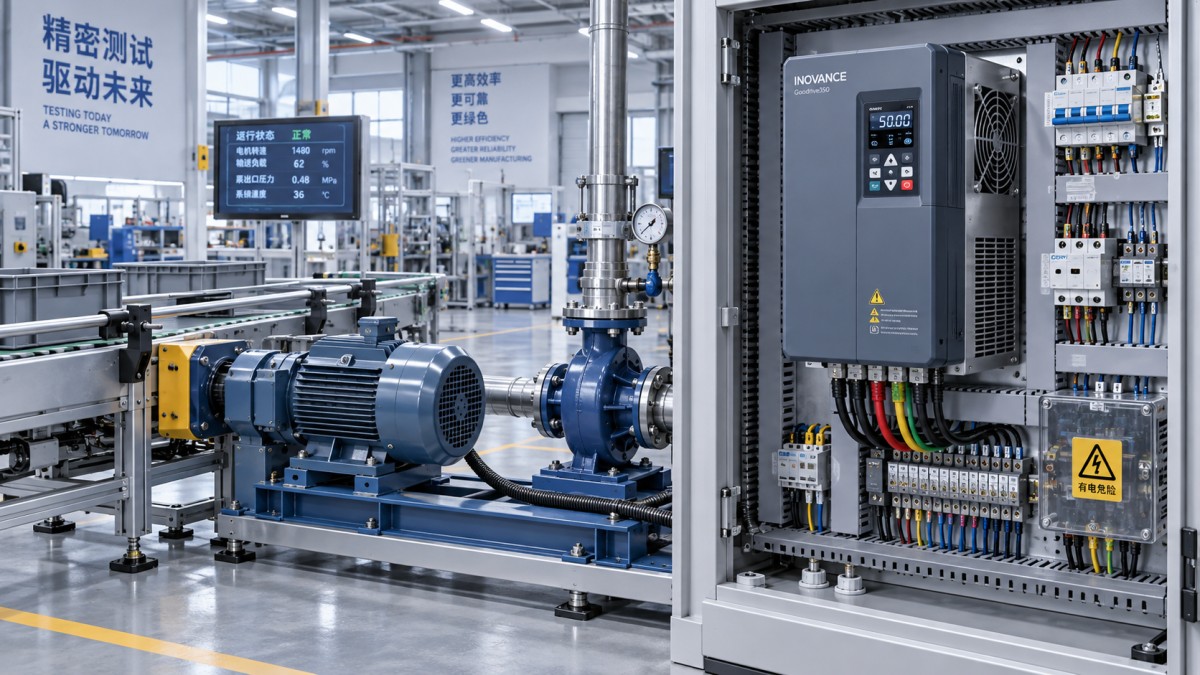
Check the installation conditions that are usually discovered too late
Many avoidable drive failures begin with conditions outside the drive cabinet. Supply quality, cable length, grounding practice, ambient temperature, airborne dust, moisture, vibration, and cabinet ventilation all influence reliability. A manufacturer should be prepared to review the basic installation context rather than treating every application as a clean, climate-controlled electrical room.
Long motor cables can increase reflected-wave stress at the motor terminals. Depending on the drive output, cable construction, motor insulation system, and cable length, output filtering or other mitigation may need to be considered. This should be discussed early because it can affect panel space, cost, heat dissipation, and the choice of motor. The same practical caution applies to common-mode current and bearing-current risks in certain motor and cable arrangements.
Input-side requirements also matter. Verify expected input voltage and frequency tolerance, phase-loss behavior, short-circuit protection coordination, and whether line reactors, harmonic mitigation measures, or EMC filters are needed. There is no universal answer: the right arrangement depends on the local grid, connected load, project specifications, and installation standard. What matters is that the manufacturer provides enough technical information for the system designer to make an informed decision.
If the equipment will be installed in coastal areas, food-processing washdown zones, mines, outdoor pump stations, or high-temperature production areas, enclosure and environmental claims should be read carefully. An enclosure rating does not automatically mean that every cable entry, keypad, cooling path, or external accessory is protected in the same way. Ask how the proposed assembly achieves the intended protection level once installed.
Treat certification and documentation as evidence, not marketing language
Compliance claims need to be specific. The relevant requirements vary by export destination, equipment category, voltage class, and end-use environment. A supplier’s website may display familiar marks or general statements about international compliance, but a technical evaluator should request the documents applicable to the exact drive family and configuration under consideration.
Useful verification documents may include declarations, test reports where available, product manuals, installation instructions, EMC guidance, safety-function documentation, material declarations, and traceability information. The key is consistency. The model number, revision, voltage range, and options listed in the documents should match the product being quoted. A generic certificate that does not clearly identify the relevant product range may be insufficient for a regulated project or a formal customer submittal.
Documentation quality is also a good proxy for engineering maturity. Well-structured manuals should explain terminals, parameter groups, alarm meanings, derating conditions, wiring practices, maintenance precautions, and limits of use. Poor translations, contradictory ratings, missing drawings, or unexplained parameter changes are not merely editorial problems. They can lengthen commissioning and make future field support unnecessarily difficult.
Look inside the manufacturer’s quality and change-control process
A drive is built from power semiconductors, capacitors, control boards, cooling components, connectors, firmware, and protective devices. The buyer does not need access to proprietary designs, but should understand how the manufacturer controls product consistency. Ask about serial-number traceability, incoming component inspection, routine production testing, burn-in or functional test practices where applicable, and procedures for handling nonconforming products.
Change control is particularly important for OEMs, panel builders, and distributors who need repeatable behavior across multiple shipments. If a component, firmware version, keypad, communication module, or mechanical layout changes, how will customers be notified? Is there a product change notice process? Can the supplier identify firmware revisions and maintain access to previous manuals? A drive that looks physically identical may behave differently after a firmware update, which can matter in standardized equipment designs.
It is also sensible to ask how field failures are analyzed. The answer should not be limited to “send it back.” A credible process normally distinguishes between installation-related causes, load-related faults, component failures, and configuration errors. Clear failure analysis becomes more valuable as installed quantities grow.
Assess supply continuity in the context of your maintenance strategy
Lead time is not just a purchasing issue. It can determine whether a production line, water system, warehouse conveyor, or packaged machine remains serviceable after a failure. Verify the manufacturer’s normal production lead time, regional inventory approach, minimum order requirements, and availability of critical accessories such as keypads, communication cards, braking units, filters, and replacement fans.
For projects involving export, ask practical logistics questions: Where is the product assembled? Where are spare parts stocked? Who handles warranty returns? Are packaging, labeling, and shipping documents suited to the destination market? Trade-policy changes, port congestion, component shortages, and transport restrictions can all alter supply conditions. Industry news and sourcing references are useful for spotting these broader risks, but supplier-specific confirmation is still required before relying on a promised delivery date.
Lifecycle planning matters as much as initial availability. Find out whether the manufacturer publishes end-of-life notices, recommends successor models, and offers a reasonable migration path. Replacing a discontinued drive is much easier when parameter conversion, mechanical dimensions, and control interfaces have been considered in advance.
Judge after-sales support by the questions the supplier asks
Support quality is difficult to measure from a brochure. One useful indicator is the supplier’s behavior during the pre-sale stage. Do they ask for motor data, load details, incoming supply information, drawings, operating environment, and control requirements? Do they identify open technical questions? Or do they simply send a quotation immediately?
Before selection, establish the available support channels, expected response process, language capability, commissioning options, warranty scope, and escalation route for complex faults. For an international project, time zones and local service coverage may be more important than a generic statement that “technical support is available.” If a local distributor will provide first-line assistance, verify that the distributor has access to current manuals, training, spare parts, and manufacturer-level engineering support.
A practical supplier should also be comfortable reviewing a commissioning checklist. This may include motor nameplate data, insulation checks where appropriate, grounding verification, parameter backup, rotation direction, acceleration and deceleration settings, protective limits, control signal validation, and fault-response testing. The checklist does not replace site engineering, but it makes responsibilities visible before problems reach the field.
Use a sample evaluation to expose gaps before a larger commitment
When the application is critical or the supplier is new, a sample drive evaluation is often more informative than a long presentation. The test should reflect the intended duty as closely as practical: the actual motor type, representative load, target acceleration, control method, cable arrangement, and operating environment. Check not only whether the motor runs, but whether fault behavior, tuning, communications, documentation, and parameter backup are manageable for the people who will commission and maintain the equipment.
Keep the acceptance criteria focused. A valid evaluation might confirm stable operation through the required speed range, correct response to control commands, usable diagnostics, appropriate protective behavior, and compatibility with the selected automation system. It should also reveal what still needs engineering work. A drive trial that hides limitations is less useful than one that identifies them early.
The strongest motor drives manufacturer is not necessarily the one with the broadest catalog or the lowest quoted price. It is the supplier that can demonstrate a defensible fit between its product and the intended application, provide documents that stand up to review, maintain predictable product support, and communicate clearly when a requirement falls outside the standard offering. That is the kind of verification that prevents a routine drive purchase from becoming a long commissioning problem.
Technical Specifications
- What to verify before selecting a transformer manufacturer in the USAAuthor :Electrical Components Editorial Team
- How to choose a cutting machine for stone based on slab thicknessAuthor :Construction Materials Editorial Team
- When are porcelain tiles for outdoor spaces at risk of cracking?Author :Construction Materials Editorial Team
Expert Insights

Chief Security Architect
Dr. Thorne specializes in the intersection of structural engineering and digital resilience. He has advised three G7 governments on industrial infrastructure security.
Core Sector // 01
Security & Safety
- What to verify before choosing a motor drives manufacturerAuthor :Electrical Components Editorial Team

- How motor efficiency ratings affect lifetime energy costsAuthor :Electrical Components Editorial Team

- AC Electric Motors: Which Efficiency Class Fits Your Load Profile?Author :Electrical Components Editorial Team

- Electric Motors: IE Ratings, Efficiency, and Energy CostAuthor :Electrical Components Editorial Team