When are porcelain tiles for outdoor spaces at risk of cracking?
Author
Date Published
Reading Time
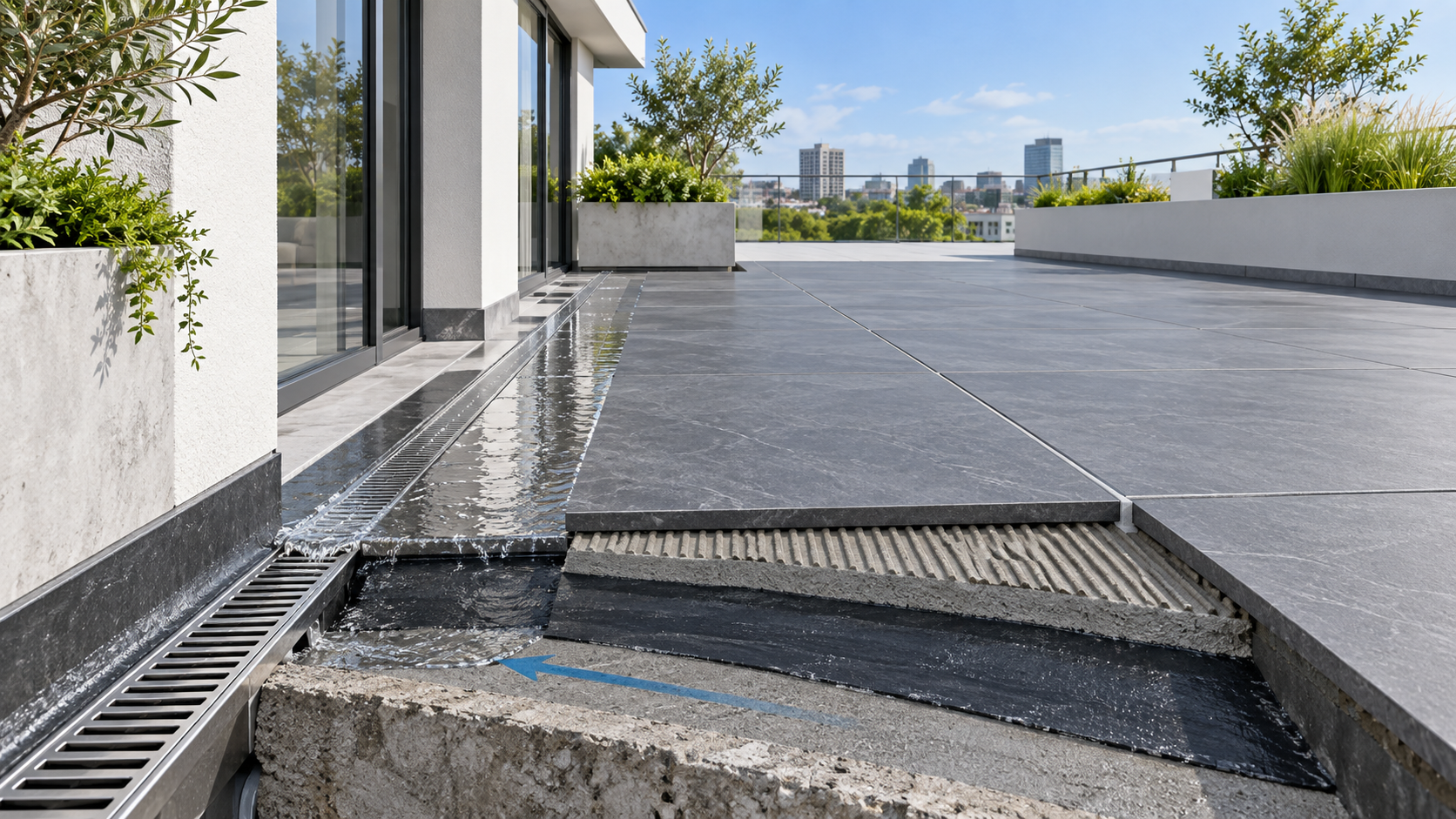
Outdoor porcelain tile rarely cracks because the tile itself is inherently weak. Most failures begin when a rigid finish is asked to bridge movement, retain water, or carry loads that the substrate and installation system were not designed to manage. A tile can have excellent density, low water absorption, and freeze-thaw resistance, yet still fracture when the concrete below it curls, the bedding contains voids, drainage is restricted, or movement joints have been omitted.
The critical distinction is between a cracked tile and a cracked tile assembly. In exposed terraces, podium decks, walkways, pool surrounds, balconies, driveways, and public plazas, porcelain tiles for outdoor use perform as one component of a layered system. Tile thickness, adhesive, grout, waterproofing, screed, concrete, drainage layers, edge details, and structural movement all affect the outcome. Procurement decisions that focus only on tile appearance, format, or nominal anti-slip rating often leave the highest failure risks unresolved.
Cracking risk rises when the substrate is still moving
Concrete is not a static base. It shrinks as it cures, expands and contracts with temperature, may deflect under load, and can develop cracks from restraint, settlement, or structural behavior. Cementitious screeds have similar movement characteristics, particularly where drying conditions are uneven or curing is inadequate. When porcelain is bonded directly to a substrate that continues to move, tensile stresses can transfer through the adhesive layer into the tile.
This is particularly important where tiles are installed over recently cast concrete or newly laid screed. A substrate can appear dry and sound while still undergoing shrinkage. Covering it too early may trap the consequences of that movement beneath a low-absorption finish. Porcelain does not accommodate meaningful deformation; the bond, grout joints, or tile body will eventually reveal the stress.
Visible cracking in the substrate is an immediate warning sign, but it is not the only one. Slab joints, changes in slab thickness, construction joints, transitions between old and new concrete, and locations above structural supports can all create predictable movement lines. Treating these areas as ordinary bonded tile fields is a common route to straight-line cracking or debonding.
A sound specification identifies where movement is expected and preserves those locations through the finished surface. Structural and movement joints should not be bridged with tile and grout. Their alignment needs to be coordinated before the tile layout is finalized, not corrected after installation has begun. Where a crack-isolation or uncoupling membrane is considered, its role and limits must be clear: it may accommodate certain localized substrate movements, but it does not replace structural joints, resolve major deflection, or compensate for a poorly designed base.
Thermal exposure creates stresses that indoor layouts do not face
Direct sunlight can heat a dark or dense tiled surface well above ambient air temperature, while rain or evening cooling can rapidly reduce the surface temperature. The tile, adhesive, screed, and concrete do not necessarily expand or contract at the same rate. Long uninterrupted tiled runs therefore accumulate stress, especially on south- or west-facing elevations in hot climates, roof terraces with little shade, and areas where one portion of the finish remains shaded while another is exposed.
Large-format tiles increase the importance of movement design. They create fewer grout joints across a given area, so there are fewer natural breaks in the tiled surface. A long tile field may look visually clean, but aesthetics cannot be allowed to eliminate perimeter joints, intermediate movement joints, or joint placement at changes in geometry.
Movement accommodation is required at perimeters, around columns, at walls, across changes in substrate, and at intervals determined by the exposure level, substrate design, tile system, and applicable local requirements. The exact spacing should be established by the project specification and installation-system guidance rather than copied from an indoor detail. Exterior joints must also remain functional: filling them with rigid grout, adhesive, or debris defeats their purpose.
Edge restraint deserves similar attention. Where tile terminates at parapets, kerbs, drains, door thresholds, or planters, the finish needs room to respond to movement without being locked in place. A hard-packed perimeter can convert normal expansion into compression stress, leading to tenting, debonding, or cracking near the restrained edge.
Water is often the hidden cause behind a later crack
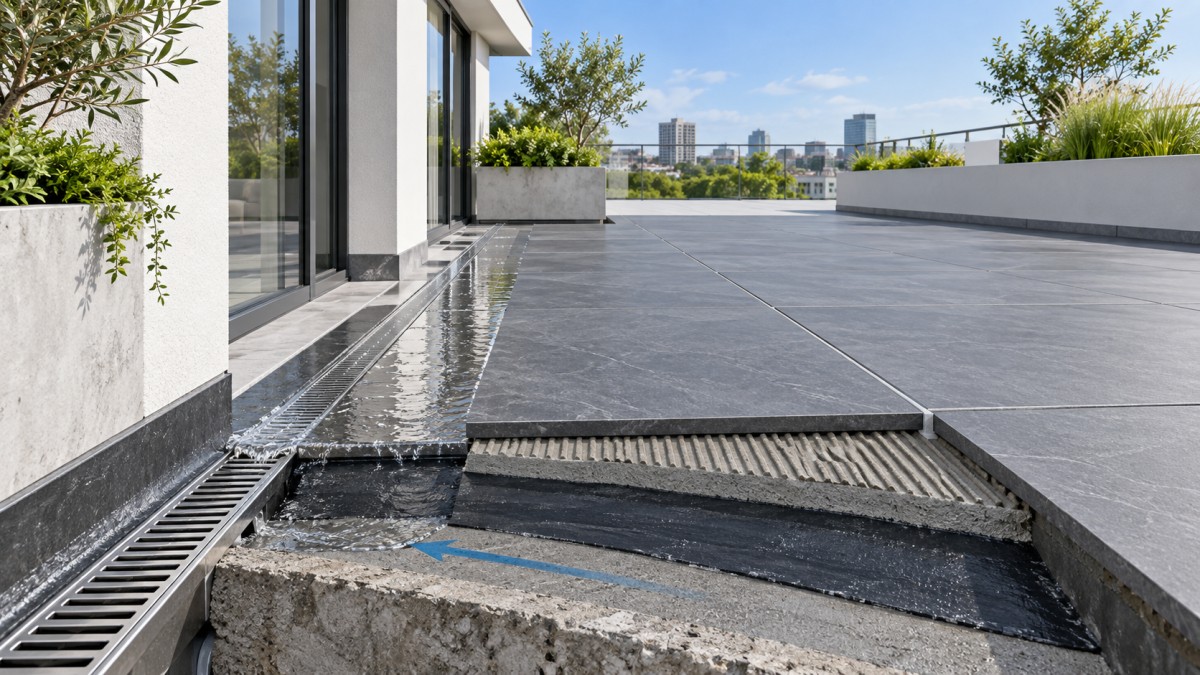
Porcelain itself has very low water absorption, but an outdoor tiled surface is not waterproof merely because the tile is dense. Water enters through grout joints, movement joints, perimeter interfaces, service penetrations, cracks, and incomplete bond areas. Once below the tile, it can saturate adhesive, screed, or bedding layers. The consequences differ by climate and construction type, but none should be ignored.
In freeze-thaw environments, trapped water is especially damaging. When moisture freezes, it expands. Repeated cycles can fracture weakened mortar, open existing microcracks, disrupt bond, and leave portions of the finish insufficiently supported. A tile may then crack under pedestrian loads even if frost did not directly break the tile body. The failure sequence is often water entry, bond deterioration or void formation, then mechanical breakage.
In non-freezing climates, poor drainage can still produce serious defects. Persistent moisture can contribute to efflorescence, weaken unsuitable adhesive systems, accelerate corrosion in poorly protected metal interfaces, and place waterproofing details under continuous stress. Surface ponding also increases slip and staining risks. A tiled finish cannot correct an inadequate falls design. Water must have a continuous route to drainage points, with no local depressions created by uneven screeds, displaced tiles, or poorly coordinated drain elevations.
Drainage design must be checked as a system rather than as a nominal slope on drawings. The relevant questions are whether the finished tile surface falls to outlets, whether drainage layers below the finish can discharge water where applicable, whether drain grates sit at the right finished level, and whether thresholds and upstands prevent water from escaping into the building envelope. A waterproofing membrane may protect the structure, but it does not remove the need to control water above it and within the tile assembly.
Inadequate support beneath the tile turns normal loading into fracture
Porcelain is strong in compression but vulnerable when a concentrated load bends it over an unsupported area. This is why voids in adhesive coverage matter so much outdoors. A tile that appears firmly installed at its corners can still have hollow areas beneath its center or edges. Foot traffic, wheeled maintenance equipment, furniture legs, dropped objects, and point loads from outdoor fittings can then create a bending force that the tile cannot absorb.
Full and continuous support is more important in exterior applications than in dry indoor wall or light-duty floor installations. The adhesive must be compatible with exterior exposure and applied in a way that minimizes voids. Depending on tile size, back-buttering may be necessary alongside combed adhesive on the substrate. Trowel ridges should be properly collapsed as the tile is bedded; simply placing a large-format tile onto uncompressed ridges can leave channels that retain water and reduce support.
The larger the tile, the more consequential installation technique becomes. Large pieces can conceal insufficient coverage because perimeter contact may make the tile feel stable during installation. A pull-up check at the beginning of work, after changes in adhesive consistency, and when a different installer or tile format is introduced provides direct evidence of actual contact rather than assumptions.
Thicker porcelain pavers, often supplied in 20 mm formats, may offer higher resistance to impact and loading in appropriate systems, but thickness does not solve a deficient base. A thick tile can still crack over a hollow adhesive bed, an unstable pedestal, a weak screed, or an uncompact granular layer. Conversely, a thinner bonded tile can perform well where the structural base, adhesive coverage, movement design, and drainage are properly controlled.
The installation method must match the use case
“Outdoor installation” is not a single condition. A bonded terrace over concrete, a ventilated raised floor on pedestals, a dry-laid paver system over compacted aggregate, and a mortar-bedded public walkway each manage loads and water differently. Failure can result when a tile suitable for one system is transferred to another without redesigning the supporting layers.
Bonded installations require a stable, correctly cured substrate, exterior-rated adhesive, movement accommodation, and reliable drainage. They are sensitive to substrate cracking and moisture trapped below the finish. Pedestal systems can improve access to waterproofing and services and allow water to pass below the surface, but they demand adequate tile thickness, pedestal spacing, edge restraint, wind-uplift consideration, and stable support at every corner and any required intermediate points.
Dry-laid systems over granular bases depend on subgrade preparation, compaction, drainage, confinement, and loading assumptions. They should not be evaluated as if they were rigid bonded assemblies. Differential settlement below a paver can create rocking, edge chipping, or breakage. In areas exposed to vehicles, service carts, or concentrated equipment loads, the base design and tile rating need to be assessed for those actual loads rather than pedestrian use alone.
Pool surrounds introduce additional variables. Chlorinated or saltwater exposure, frequent wetting, chemical cleaning, thermal contrast, and coping interfaces can all affect material selection and joint detailing. Tile cracking may occur at the waterline or coping transition when movement between the pool shell and surrounding deck is not properly separated.
Material selection can create avoidable compatibility problems
Not every porcelain tile sold for exterior use is appropriate for every exterior location. The relevant assessment extends beyond appearance and nominal frost resistance. Tile thickness, format, edge profile, intended installation system, surface finish, dimensional consistency, and declared performance should be reviewed against the project’s actual conditions.
Slip resistance is important for wet spaces, but an aggressive textured surface may collect dirt and make cleaning difficult if the maintenance plan is not realistic. Dark tiles may create more thermal movement in high solar exposure. Rectified edges support narrow joints visually, yet exterior installations still need grout joints wide enough to accommodate dimensional variation, enable proper grouting, and work with the movement strategy. Extremely narrow joints can make alignment look precise while reducing tolerance for thermal and installation variation.
Adhesive and grout selection require the same discipline. An indoor-grade adhesive, a product with insufficient deformability for the expected substrate behavior, or grout used in place of an elastomeric movement-joint sealant can undermine an otherwise sound tile choice. Product data should be evaluated for the climate, substrate, exposure, tile format, and curing conditions on site. Compatibility should also be checked across the full system, including primers, membranes, sealants, and cleaning products.
Cracks can originate from loading that was never included in the specification
A terrace designed for foot traffic may later receive planters, movable kitchens, glazed screens, delivery carts, maintenance lifts, or temporary event equipment. These additions can impose concentrated loads well beyond the assumptions used for the tile, pedestal, screed, or waterproofing system. Even small hard wheels can generate high contact stress, particularly over joints or areas with partial support.
Point loads near tile corners are especially problematic. Corners are more vulnerable to chipping and fracture where the underlying bed is discontinuous or where an elevated system lacks adequate support. Heavy planters can also obstruct drainage, retain moisture beneath their bases, and create local thermal differences. The design should identify permanent and foreseeable temporary loads before tile format and installation method are finalized.
Damage caused during construction should not be overlooked. Scaffold legs, metal ladders, pallet movement, cutting equipment, and construction debris can crack or chip tiles before handover. Installing porcelain too early in the construction sequence exposes the finish to avoidable risk. Protection methods must prevent abrasion and impact without sealing in moisture or preventing inspection of drainage and joints.
Warning signs that require intervention before handover
A hairline crack through both grout and tile, a repeated crack pattern following a straight line, hollow sounds during tapping, rocking tiles, tented sections, persistent ponding, open perimeter joints, and crumbling grout near drainage points are not cosmetic details. Each may indicate movement, insufficient support, water-related deterioration, or poor joint function.
The repair approach should follow the failure mechanism. Replacing an individual cracked tile is reasonable only when the damage is isolated and the support, drainage, and adjacent joints are sound. Replacing tiles over an active substrate crack without addressing the movement path merely resets the visible symptom. Similarly, regrouting a failed movement joint with rigid material can increase the likelihood of adjacent tile damage.
Before acceptance, the tile finish should be reviewed alongside the substrate records, waterproofing inspection records where relevant, drain tests, movement-joint layout, adhesive system documentation, and evidence of bond coverage checks. This is more useful than relying on a final visual inspection alone. Many conditions that later cause cracking are concealed once the tile field is complete.
The most reliable way to reduce cracking is to treat porcelain as the exposed surface of an engineered exterior assembly, not as a finish that can compensate for unresolved substrate or drainage problems. When movement paths are respected, water is directed away, support is continuous, and the selected system reflects actual loads and exposure, porcelain tiles for outdoor spaces can provide a durable finish without transferring predictable construction risks into the completed surface.
Technical Specifications
- What to verify before selecting a transformer manufacturer in the USAAuthor :Electrical Components Editorial Team
- How to choose a cutting machine for stone based on slab thicknessAuthor :Construction Materials Editorial Team
- When are porcelain tiles for outdoor spaces at risk of cracking?Author :Construction Materials Editorial Team
Expert Insights

Chief Security Architect
Dr. Thorne specializes in the intersection of structural engineering and digital resilience. He has advised three G7 governments on industrial infrastructure security.
Core Sector // 01
Security & Safety
- How to choose a cutting machine for stone based on slab thicknessAuthor :Construction Materials Editorial Team

- When are porcelain tiles for outdoor spaces at risk of cracking?Author :Construction Materials Editorial Team

- Marble Stone Price: What Changes Cost Across Grade, Finish, and Origin?Author :Construction Materials Editorial Team

- Marble vs Granite: Which Surface Performs Better Indoors?Author :Construction Materials Editorial Team

- Common Marble Problems and How to Prevent Stains and EtchingAuthor :Construction Materials Editorial Team

- Granite Countertop Selection: Finish, Density, and Daily WearAuthor :Construction Materials Editorial Team

- How Granite Performs in High-Traffic Commercial SpacesAuthor :Construction Materials Editorial Team