Are slip resistant porcelain tiles suitable for wet bathrooms?
Author
Date Published
Reading Time
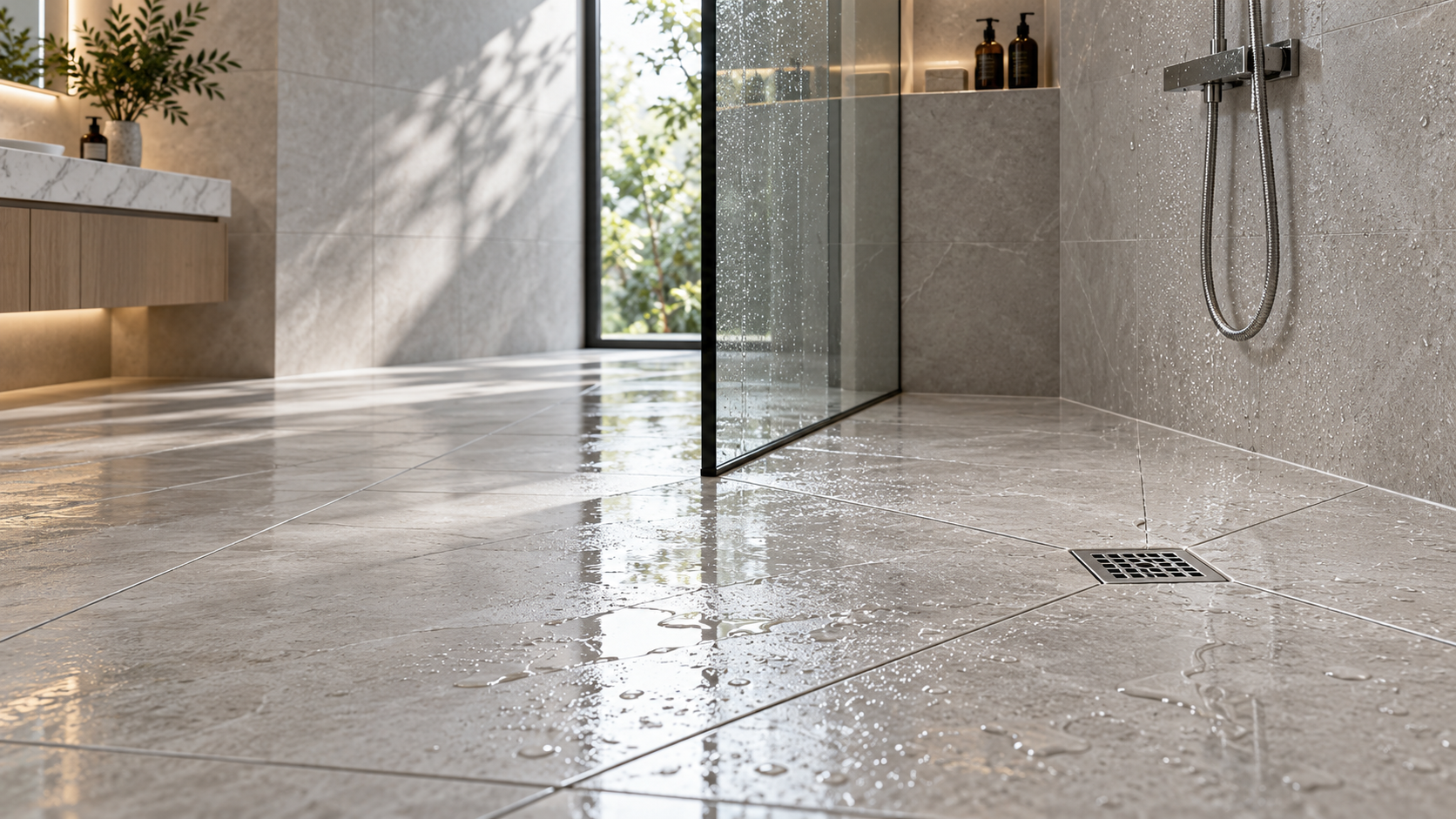
Yes. Slip resistant porcelain tiles can be a suitable choice for a wet bathroom, including a shower floor, provided the specific tile has been tested for the conditions in which it will be used. Porcelain’s low water absorption helps it withstand a damp environment, while an appropriate surface texture can provide better traction than a highly polished finish.
The important distinction is that water resistance and slip resistance are not the same thing. A tile can absorb very little water and still be slippery under a wet bare foot. No tile is completely slip-proof, particularly when soap, shampoo or cleaning residue is present, so the decision should take account of the shower layout, drainage, maintenance and the people using the room.
What makes a porcelain tile suitable for a wet floor?
Porcelain is a dense type of ceramic tile with a water absorption rate of 0.5% or less under the relevant product classification standards. That property makes it well suited to humid rooms and frequent splashes. It also means the tile body is less absorbent than many other ceramic materials. But the property does not describe how much grip the exposed surface provides.
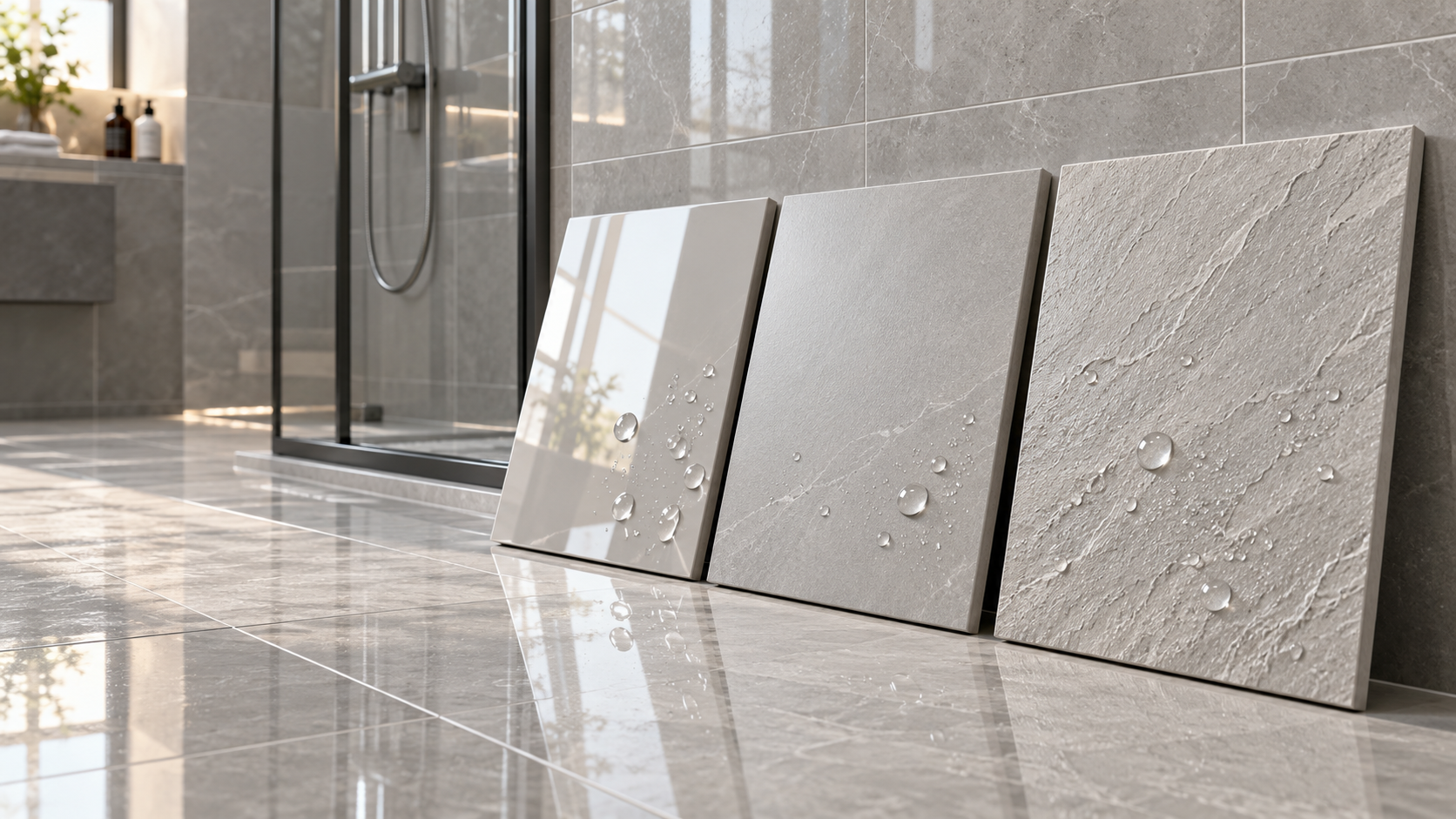
Traction depends on the finish that meets the foot. A glossy, polished porcelain tile may be easy to wipe down, but its smooth surface is not automatically a good choice for a shower floor. A matte appearance can be more reassuring, yet “matte” is a description of appearance rather than proof of wet slip performance. Some matte tiles still feel smooth when wet.
A suitable choice has a documented slip-resistance result for the intended setting, not merely a general claim such as “bathroom tile” or “anti-slip.” The finish shown in the test information should match the tile being purchased: the same design may be available in polished, matte and textured versions, with different performance for each.
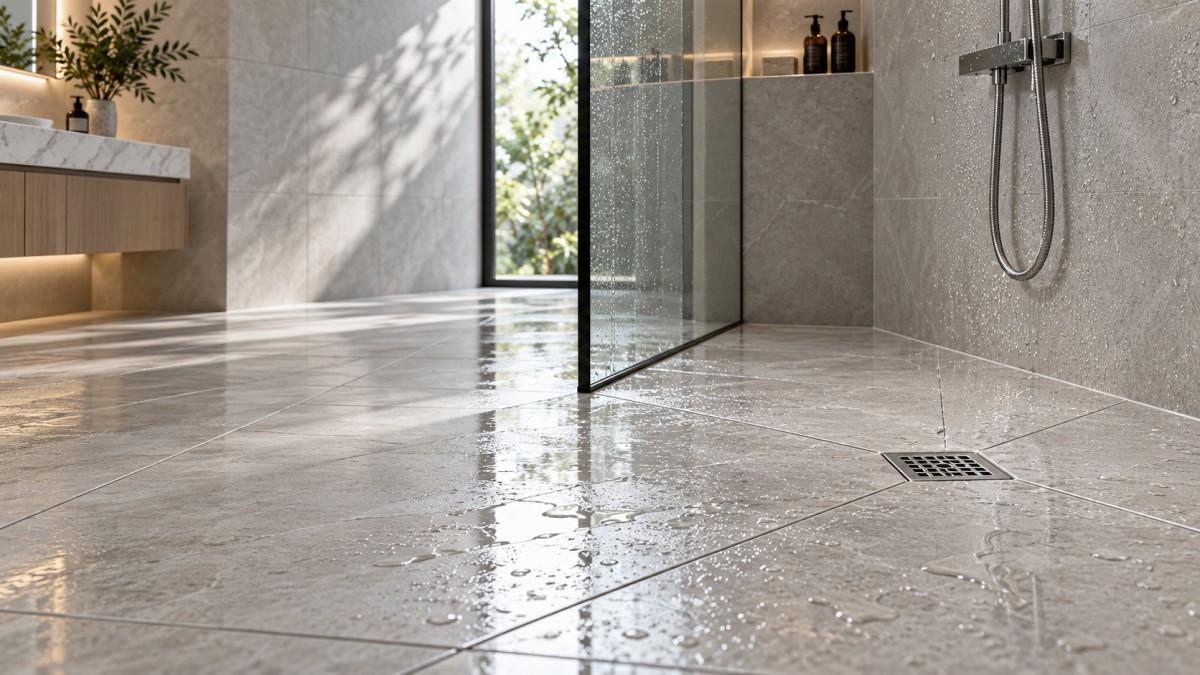
The location within the bathroom matters too. A floor beside a basin may receive occasional splashes, while a shower floor is repeatedly exposed to running water, soap and bare feet. A tile that is acceptable for the drier part of the room should not automatically be assumed suitable inside the shower.
How to interpret slip-resistance information
Slip ratings are useful only when read alongside the test method and the conditions used. Different methods measure different interactions between a surface and a foot or test slider. Their results are not interchangeable, so an impressive-looking number from one system cannot simply be compared with a number from another.
For a bathroom floor, ask for the manufacturer’s documented result for the exact tile and finish, along with the name of the test method. Pay particular attention to whether the test addresses wet conditions and whether it is relevant to barefoot use. A result obtained for a dry floor or for footwear may not answer the question of how the tile performs under a wet bare foot in a shower.
R ratings and barefoot classifications
Some products carry an R rating, such as R10 or R11, associated with a ramp test for shod feet. Within that classification, a higher R number indicates a greater measured angle before slipping under the test conditions. It does not mean a tile is slip-proof, and the rating alone does not establish its suitability for a barefoot shower.
Separate barefoot ramp classifications, commonly identified as A, B and C, relate to wet barefoot conditions. A tile with a documented barefoot classification can therefore provide more directly relevant information for a shower floor than an R rating alone. Even so, the classification should be considered alongside the manufacturer’s stated application and any local requirements.
Other test results
You may also encounter a dynamic coefficient of friction, or DCOF, result, including results reported under ANSI A326.3 in North America. The number is meaningful only with its test method and conditions. It should not be converted into an R rating or treated as a universal guarantee of safety.
Product literature may refer to the pendulum test, another approach used to assess slip potential. If the documentation is unclear, ask the retailer or manufacturer to explain whether the result applies to a wet, barefoot bathroom floor. For an accessible bathroom or a project subject to building rules, check the applicable local requirements rather than assuming that a residential product label satisfies them.
Choosing between a smoother and a more textured finish
A textured surface can improve grip by helping the foot make contact through a thin film of water. That advantage must be balanced against comfort and cleaning. Pronounced ridges or a coarse finish can feel less comfortable under bare feet and can hold onto soap deposits, body oils and dirt. If residue builds up, the surface may become less pleasant to use and harder to keep clean.
A slightly textured tile with a relevant wet barefoot test result can be a more practical choice than selecting the roughest surface available. Compare samples underfoot if possible, but treat a home sample check as a way to judge feel and appearance—not as a substitute for a documented test. Water alone on a sample cannot reproduce every combination of soap, wear, cleaning product and foot movement.
Consider the finish in the context of daily use. A household member who has difficulty balancing may need more than a different floor texture; a well-positioned grab bar, accessible shower design and unobstructed entry can also matter. Where support needs are significant, discussing the layout with an appropriate accessibility professional is more useful than relying on a tile rating alone.
Tile size, grout lines and the shower slope
The tile’s surface is only part of the floor beneath your feet. Tile size and the way the floor is built affect drainage, comfort and the number of grout joints.
Small mosaic tiles provide more grout lines across a given area. Those joints can add texture underfoot, and smaller pieces are easier to arrange around a shower floor that slopes toward a central drain. They do not, however, turn a slippery tile into a verified slip-resistant floor. The grout also needs cleaning, and a dense network of joints means more areas where residue can collect.
Large-format tiles have fewer joints and can create a cleaner visual appearance. They may work on a shower floor when the design, slope and drain layout support them. A floor that slopes in several directions toward a central drain can be harder to form neatly with large tiles; a linear drain and a single-direction slope may offer a more straightforward layout. The installer should assess the actual room and product rather than assuming any large tile can be laid over any drain arrangement.
Uneven tile edges, known as lippage, are another concern. They can create a trip point or feel uncomfortable under bare feet, even when the tile itself has good grip. A suitable tile and a competent installation therefore go together.
Porcelain does not replace waterproofing
Low water absorption does not make the finished floor waterproof. Water can reach grout joints, changes of plane and penetrations, and it can travel beneath the tile surface. A wet bathroom needs a waterproofing system appropriate to the floor and shower design, correctly connected to the drain and installed according to the system manufacturer’s instructions and local requirements.
Drainage is equally important. Standing water leaves the surface wet for longer and can allow soap residue to accumulate. A properly planned slope directs water toward the drain rather than allowing it to pool; the exact slope and construction requirements depend on the design and local rules. If water remains in a depression after showering, a tile’s slip rating cannot correct the underlying drainage problem.
Before committing to a tile, check that the installer considers it suitable for the intended floor, including its thickness, format and any substrate requirements. If underfloor heating is planned, confirm that the tile, adhesive, grout and waterproofing products are compatible with the chosen system.
Keeping the floor grippy over time
Slip resistance is not a quality that can be assessed once and then ignored. Soap films, conditioner, body oils and unsuitable cleaning products can leave deposits on the surface. These deposits can alter how the floor feels underfoot, even if the tile itself has not changed.
Use a cleaner appropriate for porcelain and the grout, following the manufacturer’s directions. Rinse away cleaning residue where instructed, and give textured areas and grout lines enough attention to prevent buildup. Avoid applying waxes, polishes or coatings unless the tile manufacturer specifically approves them for the application; an added film may change the surface’s traction.
Porcelain tile does not necessarily need sealing. Grout and any other materials in the installation may have different care requirements, so check each product separately. If a treatment is proposed to increase grip, ask whether it is compatible with the tile’s finish and how it affects appearance, cleaning and the manufacturer’s warranty.
A bath mat outside the shower can help manage drips, but it should have a suitable non-slip backing and be kept clean and dry as directed. Inside the shower, avoid assuming that any loose mat will stay in place on every textured or tiled surface.
Making the final choice
For a shower floor, the strongest choice is a porcelain tile whose exact finish is recommended for the application and supported by relevant wet barefoot slip-test information. Check the sample for comfort, consider how easily its texture and grout joints can be cleaned, and confirm that the format works with the proposed drain and floor slope.
For areas that receive only occasional splashes, a different finish may be acceptable, but it still needs to suit the conditions of the room. Where one tile is intended for the entire bathroom, assess it against the wettest area rather than choosing on appearance alone.
If the available information is limited to “porcelain,” “matte” or “non-slip,” ask for the test method and result before buying. Those labels can narrow the search, but they do not establish how the installed floor will perform when it is wet, soapy and used barefoot.
Facing technical bottlenecks in manufacturing or looking for more efficient industrial solutions? Leave your details below and let the engineering experts at GIi solve them for you.
“We respect your privacy. Your information is strictly confidential.”
Technical Specifications
- How to verify the consistency of PVC resin from a supplier in EuropeAuthor :Polymers & Rubber Editorial Team
- How to choose polyethylene grades in Saudi Arabia for film productionAuthor :Polymers & Rubber Editorial Team
- US Finds Imported Robots a Security Threat, Defers Tariffs for 180 DaysAuthor :Industrial Machinery Editorial Team
Expert Insights

Chief Security Architect
Dr. Thorne specializes in the intersection of structural engineering and digital resilience. He has advised three G7 governments on industrial infrastructure security.
Core Sector // 01
Security & Safety
- Are slip resistant porcelain tiles suitable for wet bathrooms?Author :Construction Materials Editorial Team

- Are polished porcelain tiles too slippery for bathroom floors?Author :Construction Materials Editorial Team

- How flat should the subfloor be for large format porcelain tiles?Author :Construction Materials Editorial Team

- How to measure for cut-to-size marble before placing an orderAuthor :Construction Materials Editorial Team

- What to verify before placing an order with a ceramic tiles supplierAuthor :Construction Materials Editorial Team

- How to prevent outdoor porcelain tiles from cracking in freeze-thaw conditionsAuthor :Construction Materials Editorial Team

- How to assess quality consistency from a granite exporter in BrazilAuthor :Construction Materials Editorial Team

- Which compliance standards apply to imported granite for building projects?Author :Construction Materials Editorial Team