How to prevent outdoor porcelain tiles from cracking in freeze-thaw conditions
Author
Date Published
Reading Time
Freeze-thaw cracking is usually a system failure, not simply a tile failure
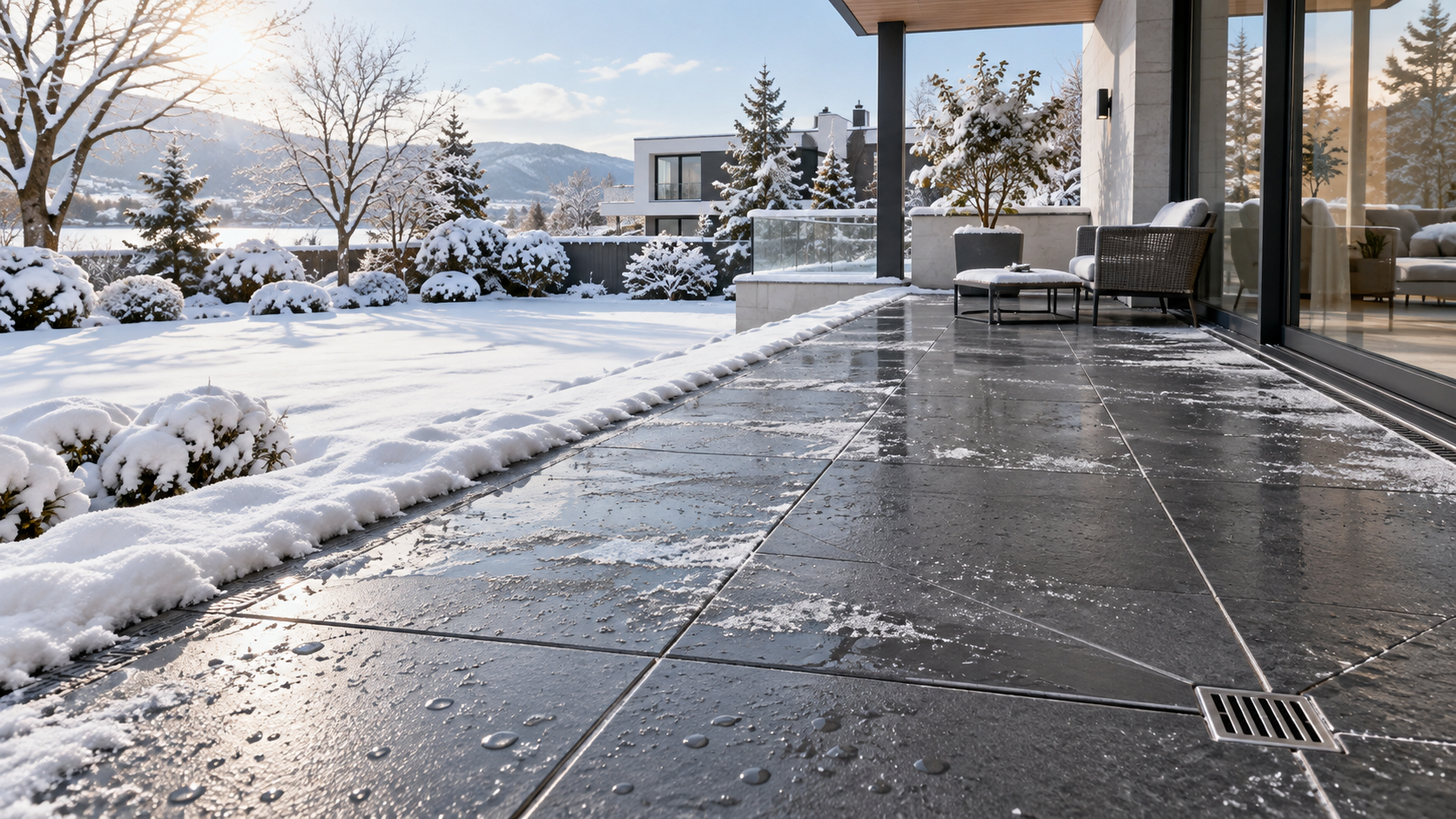
Outdoor porcelain tile can perform reliably in cold climates, but only when the tile, bedding layer, joints, substrate, drainage arrangement, and movement detailing work together. A porcelain tile with low water absorption does not by itself prevent cracking. Failures often begin when water enters beneath the surface, becomes trapped, freezes, expands, and transfers stress into a rigid tile assembly.
The most important distinction is between frost-resistant tile and a frost-resistant installation. Dense porcelain may survive freeze-thaw exposure without damage to its body, while the assembly beneath it can still crack, debond, heave, or force tiles upward. Technical evaluation therefore needs to assess the complete exterior build-up rather than treating frost resistance as a single product attribute.
Where repeated freezing, snow accumulation, de-icing salts, prolonged rain, or poor winter drainage are expected, the controlling issue is not merely whether water reaches the surface. It is whether water can enter the system and whether it has a dependable path to leave before freeze-thaw cycling occurs.
Why water causes cracking in exterior tile assemblies
Water expands by roughly 9% when it freezes. In a porous ceramic body, absorbed water can generate internal stress as ice forms within pores. In an exterior tile assembly, however, the more common risk is water retained in voids under tiles, within adhesive ridges, at poorly compacted grout joints, around drains, or in cracks in the substrate.
When that water freezes, several damage mechanisms can occur at the same time:
- Bond-line disruption: Ice formation in unfilled adhesive voids can break or weaken the bond between the tile and substrate.
- Localized point loading: Frozen water below a tile can create upward pressure at isolated points, increasing the chance of cracking under traffic or thermal movement.
- Joint deterioration: Open, cracked, or weak grout permits repeated water entry, widening the defect during each freeze-thaw cycle.
- Substrate movement: Saturated concrete, screeds, or underlying soil can expand, crack, or heave, transferring movement to the tiled finish.
- Edge spalling: Water retained along exposed edges or within inadequately protected tile cuts can contribute to localized damage.
The resulting defect is not always a visibly shattered tile. Hollow-sounding areas, debonding, cracked grout lines, tented tiles, edge lifting, and recurring cracks along the same substrate line are all signs that moisture and movement are acting beneath the surface.
Start with a tile body that has verified frost performance
For porcelain tiles for outdoor use, low water absorption remains the starting point. Under ISO 10545-3, water absorption is measured by determining the amount of water absorbed by the tile body under defined test conditions. Porcelain products are commonly associated with very low absorption; under EN 14411, Group BIa tiles have water absorption of 0.5% or less.
That classification is useful, but it should not be treated as a complete frost-resistance certificate. The actual product documentation should identify the relevant standard, product group, and declared performance. For projects requiring explicit freeze-thaw verification, ISO 10545-12 provides a test method for determining frost resistance of ceramic tiles. ASTM C1026 is also used in some specifications to assess resistance of ceramic and glass tile to freeze-thaw cycling.
A technical submittal should distinguish between a general statement such as “suitable for outdoor use” and traceable documentation that identifies the tested product, format, finish, and applicable method. This distinction matters because an outdoor range may contain multiple formats, thicknesses, surface finishes, trims, mosaics, and special pieces. A declaration relating to one item should not automatically be extended to all related components.
Low absorption reduces the likelihood of damage caused by water entering the tile itself. It does not compensate for poor installation design. Even a tile meeting the BIa absorption classification can crack if it bridges substrate movement, receives inadequate support, or is placed over a wet, poorly drained mortar bed.
Drainage is the primary defense against freeze-thaw stress
A tiled surface should not depend on grout as its only water-management layer. Cementitious grout is not a waterproof membrane, and even well-executed grout joints do not eliminate water transmission over the service life of an exterior installation. Water can also enter through perimeter gaps, service penetrations, cracks, thresholds, and changes in plane.
The assembly needs a continuous drainage logic: water should run off the finished tile surface, water that passes below the surface should be managed by the waterproofing and drainage layers, and no horizontal pocket should remain where water can collect. This is particularly important on balconies, terraces, podium decks, stairs, pool surrounds, and elevated slabs, where water trapped above a membrane or within a bonded bed can have no natural route to escape.
The slope must be formed in the substrate or drainage layer, not assumed to be created by varying adhesive thickness beneath individual tiles. A nominal slope can still fail in practice if it contains local depressions, inconsistent falls around drains, or low points at door thresholds and parapet edges. Large-format units make this more difficult because the finished surface must retain the intended fall while maintaining acceptable lippage control.
Drain locations require particular scrutiny. Drainage capacity, drain flange compatibility with the waterproofing system, clamping or bonding details, grate elevation, and access for maintenance all affect whether water is removed or retained. A visually dry terrace after rain may still hold water beneath the tile if the drainage plane is discontinuous or blocked.
Substrate stability matters as much as frost resistance
Outdoor tile should be installed only over a substrate that is stable, adequately cured, clean, and designed for the expected structural and thermal movement. Freeze-thaw cycling intensifies existing substrate defects. A crack in concrete that may appear minor in warm weather can become a direct path for water ingress and a movement line during winter.
Concrete shrinkage, thermal expansion, deflection, settlement, and cracking must be considered before tile is specified. Tile is a relatively rigid finish and cannot be expected to restrain a moving base. Where a substrate has active cracks or expected differential movement, the appropriate response may involve structural repair, a compatible crack-isolation or uncoupling approach, movement-joint detailing, or redesign of the finish system. No membrane should be assumed to solve unlimited movement; each system has defined performance limits and installation requirements.
Ground-supported installations need a different assessment from bonded systems over structural concrete. Frost-susceptible soils, inadequate compaction, poor aggregate grading, and water retained below paving can produce frost heave. In this condition, the tile surface may crack even if the tile itself is frost-resistant, because the base has moved unevenly. A free-draining, properly compacted base and positive subsurface drainage are often more decisive than the nominal strength of the tile adhesive.
For pedestal-supported porcelain pavers, water can drain through open joints, reducing the risk of water trapped directly beneath the surface. That does not remove the need to evaluate the waterproofed deck, drainage outlets, wind uplift, edge restraint, pedestal bearing, and paver thickness. This system changes the failure modes rather than eliminating them.
Specify the setting material for exterior exposure, not for indoor convenience
The adhesive layer must retain bond strength while exposed to wetting, temperature variation, and movement. Exterior conditions are materially different from an interior floor where temperature, moisture, and substrate behavior are more controlled. Cement-based tile adhesives are commonly classified under EN 12004, which includes performance classes and optional characteristics such as improved adhesion and deformability. Deformability classes such as S1 or S2 can be relevant where the system requires accommodation of limited movement, but the specification must remain compatible with the substrate, tile format, loading, and waterproofing system.
The adhesive selection should also account for the installation method. Large-format porcelain, textured backs, heavy units, and exterior vertical applications place greater demands on transfer and coverage. A premium adhesive cannot perform as intended if it is applied over a dusty substrate, mixed with excess water, allowed to skin over, or used outside its stated thickness range.
Grout should be selected as part of the weathering system rather than as a cosmetic finish. Under EN 13888, cementitious grouts are designated CG and reaction-resin grouts RG, with additional performance characteristics available depending on the classification. The correct choice depends on joint width, exposure, cleaning requirements, chemical exposure, and movement detailing. A denser grout may reduce water uptake at joints, but it does not replace waterproofing, slope, or movement joints.
Full bedding is critical: voids become water reservoirs
Insufficient adhesive contact is one of the most consequential installation defects in freeze-thaw environments. Voids under outdoor tiles collect water. Once frozen, those pockets can create concentrated stress below the tile and progressively weaken adhesion. The risk is especially high beneath corners and edges, where traffic loads also generate bending stress.
Proper trowel selection, directional combing, fresh adhesive, correct mortar consistency, and tile movement perpendicular to the ridges are used to improve mortar collapse and coverage. Back-buttering may be necessary for large-format tiles or heavily profiled backs, depending on the adhesive manufacturer’s instructions and the installation system. The objective is not simply to make the tile adhere; it is to minimize unsupported areas where water and ice can accumulate.
Coverage should be checked during installation by lifting placed tiles at intervals. This is more informative than relying on visual inspection of the trowel pattern alone. Particular attention is needed at perimeter pieces, cuts around columns and drains, stair treads, and tiles adjacent to movement joints, because these locations combine complex cuts, reduced support, and higher water exposure.
Thick adhesive beds used to compensate for an uneven substrate are a warning sign. Excessive or variable bed thickness can shrink, cure unevenly, retain moisture, and make it harder to preserve the designed slope. The substrate should be corrected before tiling with materials appropriate to exterior service and compatible with the complete system.
Movement joints must remain functional through winter
Thermal movement is unavoidable outdoors. Dark surfaces exposed to sun can heat substantially above ambient air temperature, while winter conditions may drive the assembly below freezing. Tile, concrete, adhesive, waterproofing, and metal edge components do not expand and contract at identical rates. If movement is restrained, stress accumulates until the weakest element cracks or debonds.
Movement joints should be located and dimensioned according to the project design, local requirements, substrate geometry, tile layout, exposure, and system guidance. Their function is defeated when filled with rigid grout or bridged by adhesive. Perimeter joints, changes in plane, transitions to walls, columns, thresholds, drains, and areas over structural joints all require deliberate treatment.
Sealant selection is not a minor finishing decision. The sealant must be compatible with expected movement, ultraviolet exposure, moisture, temperature range, and adjacent materials. Bond-breaker placement and joint geometry affect how the sealant stretches and compresses. A sealant bead bonded on three sides can be overstressed and fail prematurely, allowing water into the assembly.
Detail edges, stairs, and transitions where water enters most easily
Flat field areas are only part of the risk. Exterior failures frequently begin at edges and interfaces: the termination at a wall, the leading edge of a stair tread, a balcony threshold, a planter boundary, or a drain penetration. These points must shed water outward and prevent it from entering behind the tile finish.
Stair treads need positive drainage and durable edge support. A tread that holds water against its riser or has an exposed horizontal cut edge can be vulnerable to repeated saturation. Metal trims, where used, need to be suitable for the environment and coordinated with waterproofing and movement joints. Rigidly locking a tile field between inflexible edge details can create restraint-related cracking.
At building thresholds, the waterproofing transition, drainage path, and finished elevation must be resolved together. Raising the tile finish without reconsidering flashing or door drainage can direct water toward the building rather than away from it. Freeze-thaw durability cannot be evaluated separately from these envelope details.
Do not confuse slip resistance, thickness, or “outdoor rated” labeling with freeze-thaw suitability
Surface texture may improve wet traction but says little about the ability of the entire assembly to survive freeze-thaw exposure. Likewise, a thicker tile or paver may offer greater mechanical robustness, but thickness alone does not prevent water entrapment, inadequate bonding, or frost heave.
“Outdoor rated” is a useful initial designation only when accompanied by technical evidence and installation limits. Evaluation should identify whether the statement refers to frost resistance of the tile body, suitability for bonded installation, use over pedestals, use on ground-prepared bases, resistance to de-icing chemicals, or a particular climate category. These are related but not interchangeable claims.
De-icing salt exposure deserves separate attention. Salts can increase the severity of wetting and drying, contribute to chemical stress in adjacent concrete, and remain in joints and drainage paths. Compatibility should be checked across tile, grout, sealant, concrete, waterproofing, and metal accessories rather than inferred from the tile’s frost-resistance declaration.
What should be verified before installation begins
A durable exterior tiled surface is largely determined before the first tile is set. The technical review should confirm that the specified tile has documented low water absorption and, where required, frost-resistance test evidence; that the substrate is structurally suitable and sloped to drainage; and that the adhesive, grout, membrane, sealants, trims, and drainage components form a compatible system.
It should also establish how movement joints will align with structural joints and perimeter conditions, how full adhesive coverage will be verified, how drains will remain accessible, and whether the proposed installation method matches the product format and exposure class. These checks are more valuable than relying on a generic assurance that the selected porcelain tile is suitable for exterior use.
Freeze-thaw cracking is best prevented by keeping water from being retained within the assembly and by giving unavoidable movement a controlled path. Dense porcelain is an essential material choice, but drainage, full support, stable substrates, functional movement joints, and disciplined installation are what allow it to perform through repeated winters.
Technical Specifications
- Is a higher DC power supply price justified by lower ripple?Author :Electrical Components Editorial Team
- How to measure for cut-to-size marble before placing an orderAuthor :Construction Materials Editorial Team
- What to verify before placing an order with a ceramic tiles supplierAuthor :Construction Materials Editorial Team
Expert Insights

Chief Security Architect
Dr. Thorne specializes in the intersection of structural engineering and digital resilience. He has advised three G7 governments on industrial infrastructure security.
Core Sector // 01
Security & Safety
- How to measure for cut-to-size marble before placing an orderAuthor :Construction Materials Editorial Team

- What to verify before placing an order with a ceramic tiles supplierAuthor :Construction Materials Editorial Team

- How to prevent outdoor porcelain tiles from cracking in freeze-thaw conditionsAuthor :Construction Materials Editorial Team

- How to assess quality consistency from a granite exporter in BrazilAuthor :Construction Materials Editorial Team

- Which compliance standards apply to imported granite for building projects?Author :Construction Materials Editorial Team

- How to choose ceramic tiles for bathroom floors with better slip resistanceAuthor :Construction Materials Editorial Team

- When are porcelain wall tiles the right choice for shower walls?Author :Construction Materials Editorial Team

- How to choose porcelain floor tiles for high-traffic areasAuthor :Construction Materials Editorial Team