How to choose porcelain floor tiles for high-traffic areas
Author
Date Published
Reading Time
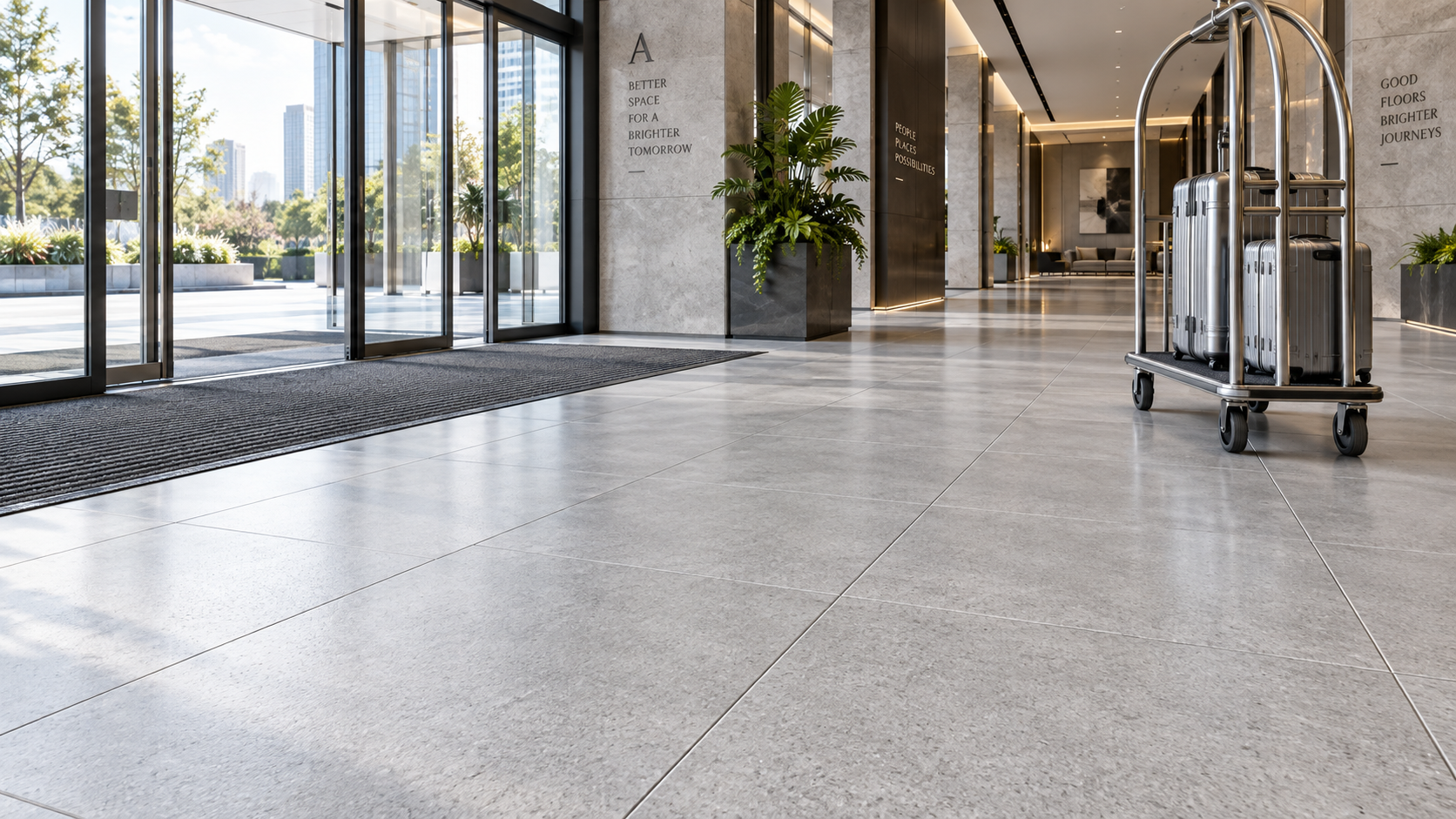
High-traffic floors fail for predictable reasons: the tile surface is too polished for the contamination risk, the wear rating does not match the traffic pattern, the selected format creates installation problems, or the specification treats porcelain as a single performance category. Porcelain is generally a strong choice for busy interiors and many exterior zones, but “porcelain” alone does not establish abrasion resistance, slip resistance, loading capacity, or long-term visual performance.
The right selection starts with the actual exposure of the floor rather than the building type. A hotel lobby, airport corridor, supermarket entrance, school circulation area, restaurant dining room, hospital passageway, and retail showroom may all be described as high traffic, yet they impose very different combinations of grit abrasion, rolling loads, moisture, cleaning chemicals, staining, and safety risk.
Define the traffic condition before reviewing tile samples
Footfall volume matters, but it is not the most useful standalone measure. A covered office corridor with high pedestrian use may be less demanding than a moderately used entrance where visitors bring in sand, water, de-icing salts, and fine abrasive particles. Surface wear is often driven by the material carried under shoes and wheels, not by walking alone.
A practical specification should identify the conditions the tile must withstand:
- Dry internal circulation: corridors, concourses, lift lobbies, public waiting areas, and classroom access routes.
- Entrance and transition zones: main doors, vestibules, retail thresholds, and covered drop-off areas exposed to grit and rainwater.
- Wet or spill-prone interiors: food service areas, washroom approaches, healthcare spaces, beverage counters, and pool-adjacent circulation.
- Rolling traffic: luggage carts, wheelchairs, pallet jacks, cleaning machines, trolleys, and display equipment.
- Exterior pedestrian areas: covered walkways, terraces, platforms, and entrances subject to weather, temperature cycling, and drainage conditions.
The same tile can be appropriate for a dry central corridor and unsuitable at the entrance to that corridor. Breaking the plan into exposure zones often produces a better result than applying one finish across an entire floor plate. It also avoids paying for a highly textured, harder-to-clean finish in areas where it adds little safety value.
Porcelain body quality is necessary, but surface performance decides suitability
Porcelain floor tiles are commonly specified because of their dense body and low water absorption. Under ISO 13006, porcelain tiles are generally classified as Group BIa, with water absorption not exceeding 0.5%. Low absorption supports resistance to moisture ingress and can be particularly relevant in wet spaces and climates where freeze-thaw exposure is a concern.
That characteristic should not be confused with surface durability. A glazed porcelain tile may have a dense, low-absorption body but still show visible wear if its glaze is not designed for the intended traffic. Conversely, an unglazed or through-body porcelain tile can be highly resistant to wear, but may require a different cleaning regime and may offer a more limited decorative range.
For glazed products, abrasion resistance is commonly evaluated through ISO 10545-7, which classifies resistance to surface abrasion. Suppliers may also refer to PEI classes, a widely used market designation associated with glazed tile wear performance. The label is useful only when supported by the relevant test documentation and when its meaning is clear in the project specification.
For unglazed porcelain, deep abrasion resistance is commonly assessed under ISO 10545-6. This test is more relevant where the decorative appearance extends through the body or where the surface is not protected by a glaze. It does not provide a direct one-to-one comparison with glazed-tile abrasion classes; the construction of the product and the test method are different.
Visual durability deserves separate attention. A finish can meet a wear requirement and still show traffic lanes early because its color, sheen, or pattern makes dirt and micro-scratching conspicuous. Very dark polished surfaces, uniform high-gloss finishes, and designs with strong directional movement may reveal scuffing more readily than matte, structured, or variegated alternatives. The appropriate question is not simply whether a tile resists wear, but how it will look after repeated cleaning and abrasive exposure.
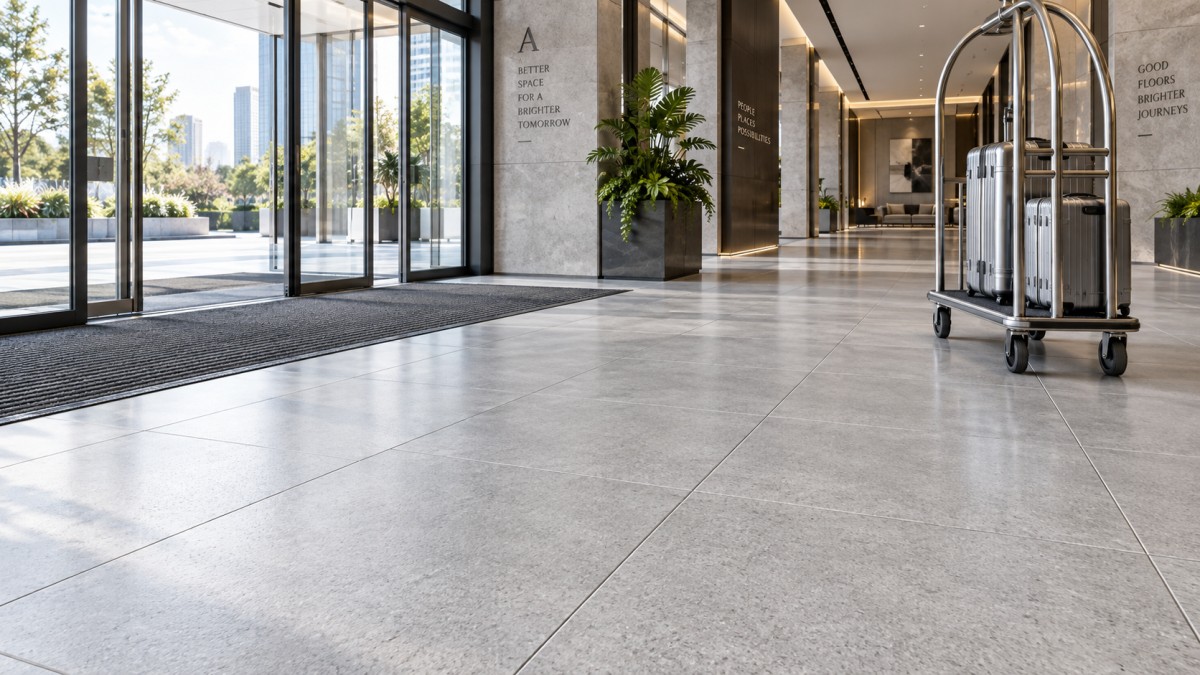
Slip resistance must be matched to the real contamination risk
Slip resistance is one of the most consequential decisions in public flooring, yet it is frequently reduced to a request for “anti-slip tiles.” That description has little value without knowing the test method, test conditions, footwear, contaminants, and local regulatory expectations.
For projects governed by US practice, ANSI A326.3 provides a commonly referenced wet dynamic coefficient of friction (DCOF) test method for hard surface flooring materials. It is important to distinguish a test result from a complete safety assessment: the result applies to the defined laboratory method, while floor safety in service is also affected by slope, drainage, maintenance, contaminants, entrance matting, footwear, lighting, and transitions between materials.
In European specifications, slip classification may be expressed through other methods. DIN 51130 uses ramp testing with shod persons and oil contamination, producing R classifications; DIN 51097 addresses barefoot wet areas. EN 16165 provides a framework covering several pendulum, ramp, and tribometer-based methods. These methods are not interchangeable. An R rating should not be converted casually into a DCOF value, and a pendulum test result should not be treated as evidence of compliance with a requirement written around another method.
The finish selection should reflect the operating environment:
- Dry public interiors: a matte or satin finish may provide an acceptable balance of appearance, cleanability, and traction where liquid contamination is controlled.
- Building entrances and wet transition zones: more textured surfaces may be justified, particularly where rainwater, grit, or snowmelt can reach the floor.
- Food and beverage spill zones: select against the expected contaminants, not water alone. Oils, detergents, and food residues can alter traction.
- External walkways: texture, drainage, frost exposure, and cleanability require joint consideration. A rough tile does not solve standing-water problems.
An overly aggressive texture can create its own operational cost. Deeply structured surfaces can retain soil, complicate machine cleaning, and lose practical slip performance if contaminants accumulate in recesses. Obtain cleaning guidance from the tile manufacturer and assess it against the equipment, chemicals, and staffing model planned for the completed facility.
Do not specify format and thickness as aesthetic choices alone
Large-format porcelain creates a continuous visual field with fewer grout joints, but it raises execution requirements. Substrate flatness becomes more critical as tile dimensions increase. Lippage, corner chipping, adhesive coverage, handling damage, and replacement difficulty all become more consequential in busy areas where the floor must remain presentable and operational.
A tile can comply with dimensional tolerances while still require careful sorting, setting-out, and installation control. This is particularly relevant for rectified tiles installed with narrow joints. A narrow grout joint may be visually desirable, but it reduces the installer’s ability to accommodate dimensional variation and can make local level differences more visible under grazing light.
Thickness should be evaluated in relation to the complete floor assembly, not treated as an isolated proxy for strength. The important questions include:
- What is the substrate type and condition?
- Will the floor receive point loads from equipment, shelving, carts, or temporary construction activity?
- Is the tile installed on a bonded screed, concrete slab, raised floor system, or exterior pedestal system?
- Are movement joints correctly located and continued through the tile finish?
- Can the specified adhesive system achieve the necessary coverage and bond under the selected format?
Porcelain tile itself is hard and strong in compression, but a tiled floor performs as a system. Voids beneath tiles, inadequate substrate preparation, insufficient movement accommodation, and inappropriate adhesive selection can lead to cracking or debonding even where the tile product is technically suitable.
Check loading, edges, and transitions early
High traffic is often accompanied by loads that do not appear in the architectural finish schedule. Luggage carts and wheelchairs are different from pallet trucks; a powered scrubber may introduce concentrated wheel loads; movable partitions, service trolleys, or event equipment may cross the floor at specific points. These conditions should be identified before finalizing tile thickness, setting bed, and transition details.
Tile edges are particularly vulnerable at thresholds, expansion joints, doorways, access panels, and changes in elevation. A durable field tile can still fail visually if exposed edges chip under wheeled traffic. Metal or engineered edge profiles, flush transition details, and correct joint placement can be more important to long-term appearance than a marginal increase in tile wear rating.
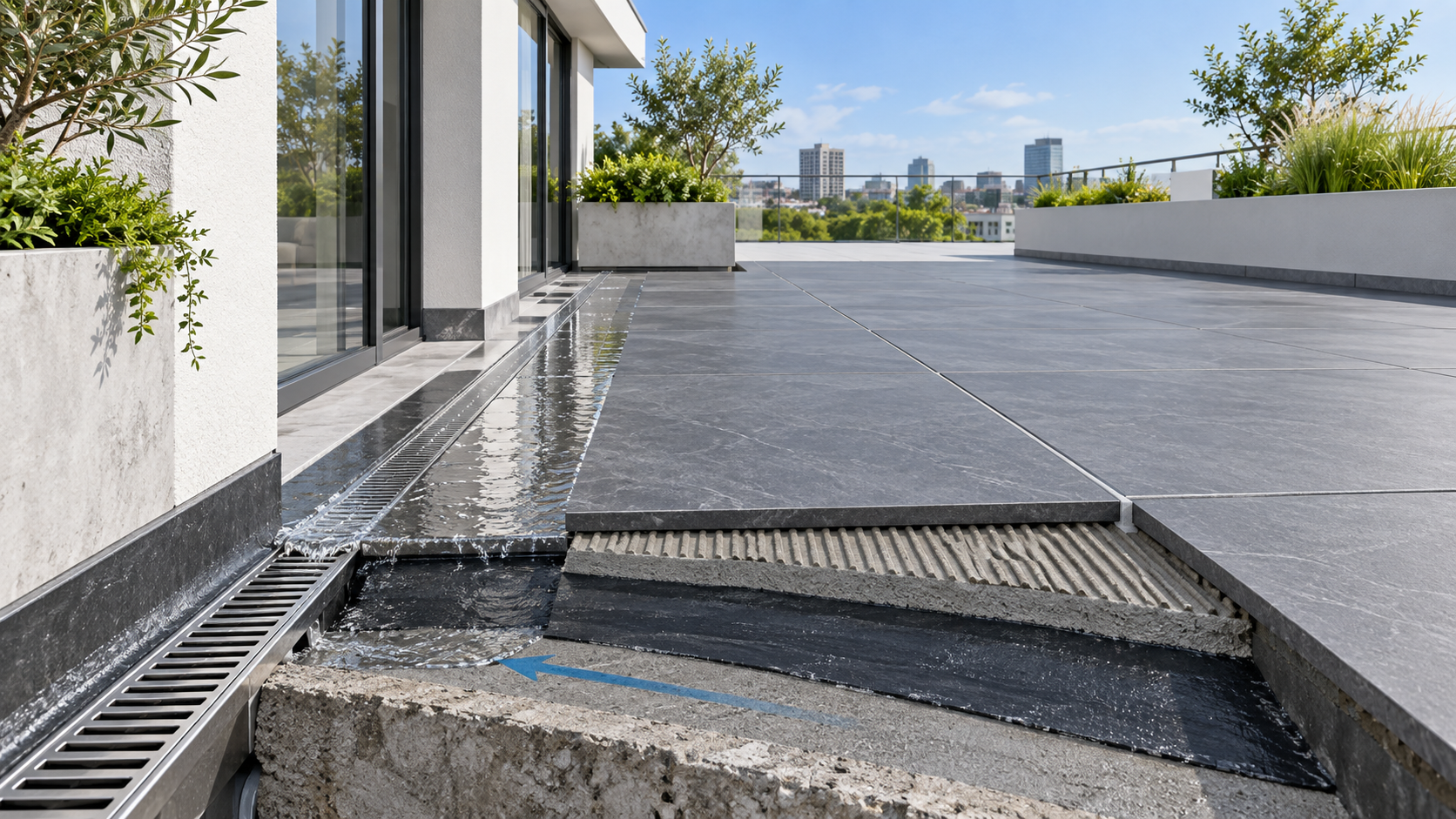
Where drainage is required, avoid assuming that a large-format tile will adapt easily to multiple falls. Smaller formats or purpose-designed cut layouts may be more workable around floor drains. The priority is to achieve drainage without unacceptable lippage, sharp edges, or awkward narrow cuts that are difficult to install and vulnerable in use.
Review technical documents, not only showroom boards
A showroom sample is useful for judging color and texture, but it cannot establish lot consistency or project suitability. The submittal process should request product-specific technical information for the exact series, finish, format, and intended application. A generic company brochure is not enough where safety, durability, or compliance is material to the decision.
Relevant documentation may include the declared water absorption classification, abrasion test results appropriate to glazed or unglazed construction, slip-resistance results with the named test method, breaking strength or load-related information where applicable, dimensional and warpage data, chemical resistance information, frost resistance for exterior exposure, and installation recommendations.
Confirm whether results relate to the selected finish. A manufacturer may offer a collection in polished, matte, structured, and exterior variants. A technical claim for one finish should not automatically be applied to all of them. The same caution applies to digital renderings: batch variation, shade range, directional patterns, and edge treatment should be reviewed through physical samples from the proposed production run where appearance control is important.
For imported tile, verify the documentation expected by the destination market and by the project contract. Standards referenced in a supplier’s country may not satisfy local building regulations, accessibility requirements, insurer conditions, or client specifications. The relevant authority or contract requirement should determine the acceptance route, especially for slip resistance and fire-related documentation.
Use mock-ups to resolve issues that laboratory values cannot answer
A representative mock-up is particularly valuable when the project combines large formats, narrow joints, strong lighting, textured surfaces, or demanding cleaning conditions. It allows assessment of visual uniformity, lippage, grout color, transition details, cleaning response, and the interaction between the floor finish and the actual lighting direction.
Mock-ups are also useful for confirming that the specified surface can be maintained as intended. A tile that is safe and attractive when new may be operationally problematic if standard cleaning equipment cannot remove tracked soil without leaving residues. The review should include the proposed grout, sealers if any are contemplated, cleaning chemicals, and equipment pads or brushes. Porcelain often does not require sealing, but grout selection and maintenance practice still influence stain resistance and the floor’s overall appearance.
Evaluate lifecycle value through replacement risk and maintenance burden
The lowest purchase price rarely captures the cost of a high-traffic floor. Material waste, cutting complexity, installation productivity, substrate correction, delivery sequencing, spare stock, cleaning labor, and disruption during future repair can materially affect the final cost.
Stocking a reasonable quantity of matching spare tiles is a practical safeguard, particularly for imported materials, distinctive colors, or collections with changing production runs. Future availability cannot be assumed. Spare material should be clearly labeled by product code, caliber, shade, finish, and batch where applicable, then stored in suitable dry conditions.
The strongest porcelain floor tile specification is therefore not the one with the longest list of generic performance claims. It is the one that links each finish and format to a defined exposure zone, names the applicable test methods, accounts for the installed system, and gives equal weight to safety, maintainability, and visual aging. That approach reduces the risk of selecting a tile that performs well in a sample room but poorly over years of daily use.
Technical Specifications
- How precision metal fabrication reduces fit-up issues in assembliesAuthor :Metals & Fabrication Editorial Team
- When do CNC machines justify their higher upfront cost?Author :Industrial Machinery Editorial Team
- How to choose porcelain floor tiles for high-traffic areasAuthor :Construction Materials Editorial Team
Expert Insights

Chief Security Architect
Dr. Thorne specializes in the intersection of structural engineering and digital resilience. He has advised three G7 governments on industrial infrastructure security.
Core Sector // 01
Security & Safety
- How to choose porcelain floor tiles for high-traffic areasAuthor :Construction Materials Editorial Team

- How to choose a cutting machine for stone based on slab thicknessAuthor :Construction Materials Editorial Team

- When are porcelain tiles for outdoor spaces at risk of cracking?Author :Construction Materials Editorial Team

- Marble Stone Price: What Changes Cost Across Grade, Finish, and Origin?Author :Construction Materials Editorial Team

- Marble vs Granite: Which Surface Performs Better Indoors?Author :Construction Materials Editorial Team

- Common Marble Problems and How to Prevent Stains and EtchingAuthor :Construction Materials Editorial Team

- Granite Countertop Selection: Finish, Density, and Daily WearAuthor :Construction Materials Editorial Team

- How Granite Performs in High-Traffic Commercial SpacesAuthor :Construction Materials Editorial Team