Is a higher DC power supply price justified by lower ripple?
Author
Date Published
Reading Time
A higher DC power supply price is justified by lower ripple when the improvement helps your circuit meet a measurable performance requirement. If both supplies already deliver acceptable noise at the point of use, paying more for a smaller datasheet number may add little value. The decision depends on which frequencies reach the load, how strongly the circuit responds to them, and what happens under actual operating conditions.
A precision analog circuit may benefit from a quieter source. A system with effective local regulation may show little improvement. Before comparing prices, establish the noise the application can tolerate, then determine whether the more expensive supply provides useful margin across the conditions that matter.
Start with the circuit’s tolerance, not the supply’s ripple rating
Ripple is the repeating variation superimposed on a supply’s DC output. Switching supplies can produce ripple at their switching frequency and harmonics, while other designs may show components associated with rectified mains power. Output noise also includes broadband fluctuations and short spikes. Datasheets sometimes combine these under “ripple and noise,” so the headline value may describe more than periodic ripple alone.
The practical question is how these disturbances affect the powered circuit. Supply variation can appear as an unwanted signal in an amplifier, disturb a voltage reference, or modulate an oscillator. In a measurement system, it may create a repeating artifact that resembles a real input. These effects depend on the circuit’s design and the frequency of the disturbance.
Use the application’s performance requirement as the starting point. For an analog measurement channel, that might be allowable input-referred noise or measurement uncertainty. For an oscillator, it could be phase noise or unwanted spectral components. For a controller, voltage tolerance, resets, and reliable operation during load changes may matter more than residual ripple.
A useful noise budget allocates part of the permissible error to the power path. It accounts for the supply, local regulators, references, grounding, and coupling into sensitive nodes. Random, uncorrelated noise sources are often combined by a root-sum-square calculation; coherent ripple components need different treatment because their relative phase can affect the result. The budget need not be elaborate, but it should show whether supply noise is a meaningful contributor.
Compare ripple specifications on equal terms
Two ripple figures are comparable only when their measurement conditions match. A smaller published value can result from a narrower measurement bandwidth, a different load, or additional output capacitance. It does not automatically identify the cleaner supply in your installation.
A single aggregate value also hides the noise spectrum. A supply with modest total noise may have a concentrated component at a frequency your circuit handles poorly. Another with a higher aggregate reading may place much of its noise outside the sensitive band. Frequency information is particularly useful for audio, RF, and sampled measurement systems.
Keep ripple separate from load-transient response. A supply can have low steady-state ripple yet experience a significant voltage dip when the load changes abruptly. If the equipment draws pulsed current, recovery behavior may influence performance more than the steady-state specification.
Local regulation can change the value of a quieter source
Many systems use a DC supply to feed local regulators that generate the final circuit rails. In that arrangement, the external supply’s ripple matters through the attenuation provided by the downstream power path.
Power supply rejection ratio, or PSRR, describes how effectively a device rejects supply variation. It varies with frequency and operating conditions. Strong rejection at low frequencies does not establish equally strong rejection at switching frequencies. A regulator’s PSRR curve is therefore more useful than an isolated headline figure.
Check regulator headroom as well. A linear regulator needs sufficient input voltage above its output to regulate properly. If cable loss, ripple troughs, or load-related dips bring it close to dropout, its rejection can deteriorate. A quieter supply may help, but correcting insufficient headroom or excessive wiring resistance may solve the underlying problem more directly.
Local regulators also generate noise of their own. Once their noise or the circuit’s internal noise dominates, reducing the upstream ripple further may produce little measurable benefit. Conversely, a sensitive rail with limited filtering and poor rejection can make source quality a major design factor.
External filtering offers another option, but it carries engineering costs. A passive filter can introduce voltage drop, resonance, or slower transient response. Added capacitance may affect startup, inrush current, and control-loop stability. A linear post-regulator dissipates heat and needs voltage headroom. Compare these complete arrangements against the price premium for the quieter supply.
Where paying more for lower ripple makes sense
The premium is easier to justify when supply disturbances remain visible in the application after practical grounding, decoupling, and regulation measures are in place. Typical candidates include low-level sensor interfaces, sensitive analog stages, voltage-reference circuits, and RF equipment where supply modulation affects the wanted signal.
Consider a precision sensor interface powered through a local regulator. If the regulator sufficiently attenuates the external ripple and the remaining error is dominated by the sensor and amplifier, a quieter external source may have limited value. If switching components pass through the power path and appear in the measurement band, lower source ripple can become a worthwhile purchase.
Sampled systems need particular care. High-frequency interference can fold into the measured band through aliasing or enter through other coupling paths. A disturbance does not have to sit inside the signal band at the supply terminals to affect the final reading. Its effect should be assessed in the complete acquisition chain.
Test equipment presents another reason to pay for lower noise. When a supply powers a device whose own noise is being measured, supply interference can obscure the result or complicate fault diagnosis. A cleaner source can improve measurement confidence if its contribution would otherwise limit the test.
For many general control loads, heaters, and circuits with effective downstream conditioning, very low ripple may offer little return once electrical requirements are met. With motors and actuators, starting current, regenerative energy, protection behavior, and voltage recovery often deserve closer attention. Shared sensitive electronics still need assessment because disturbances can travel through common power and ground connections.
Measure at the load before making the price decision
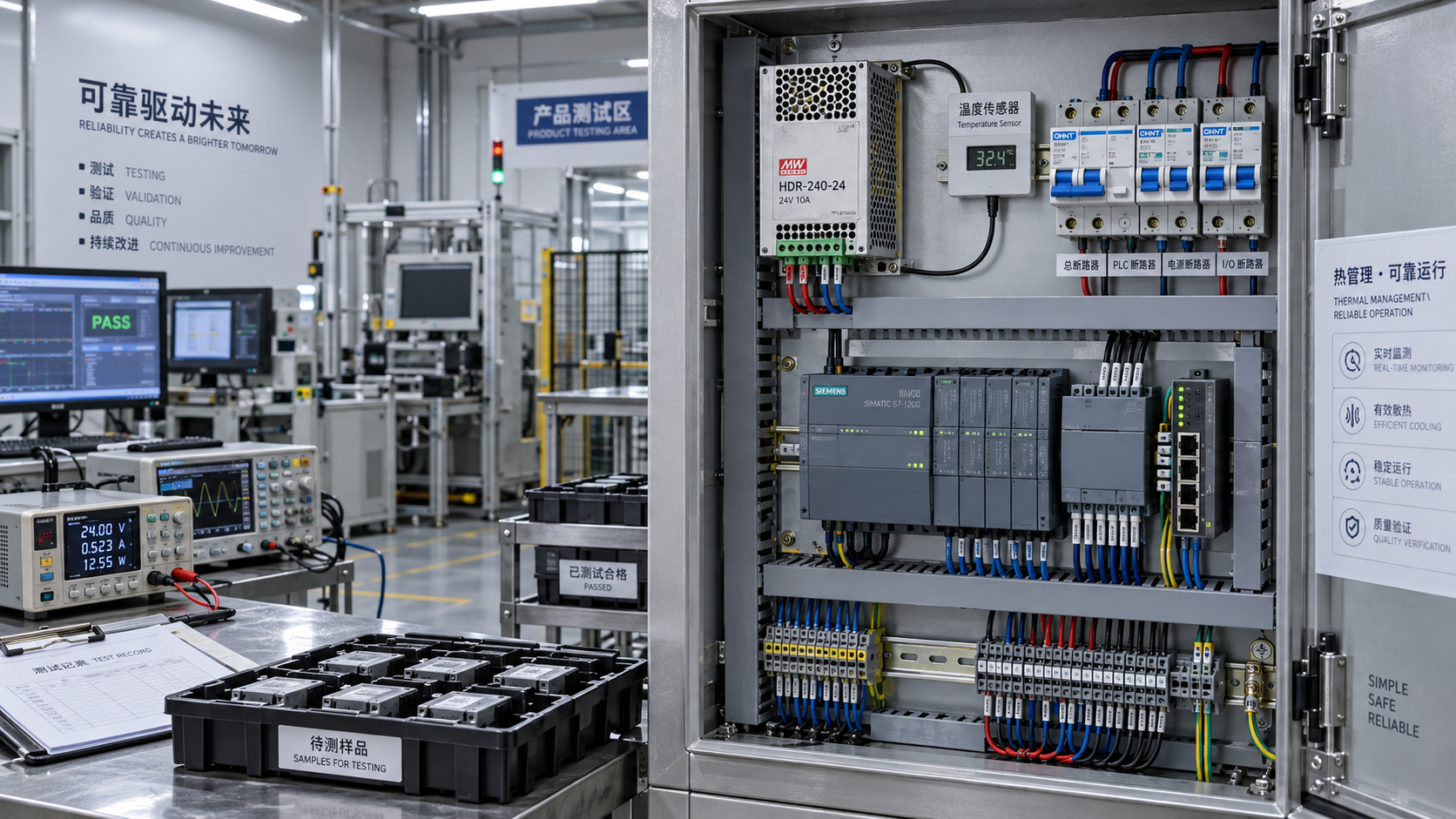
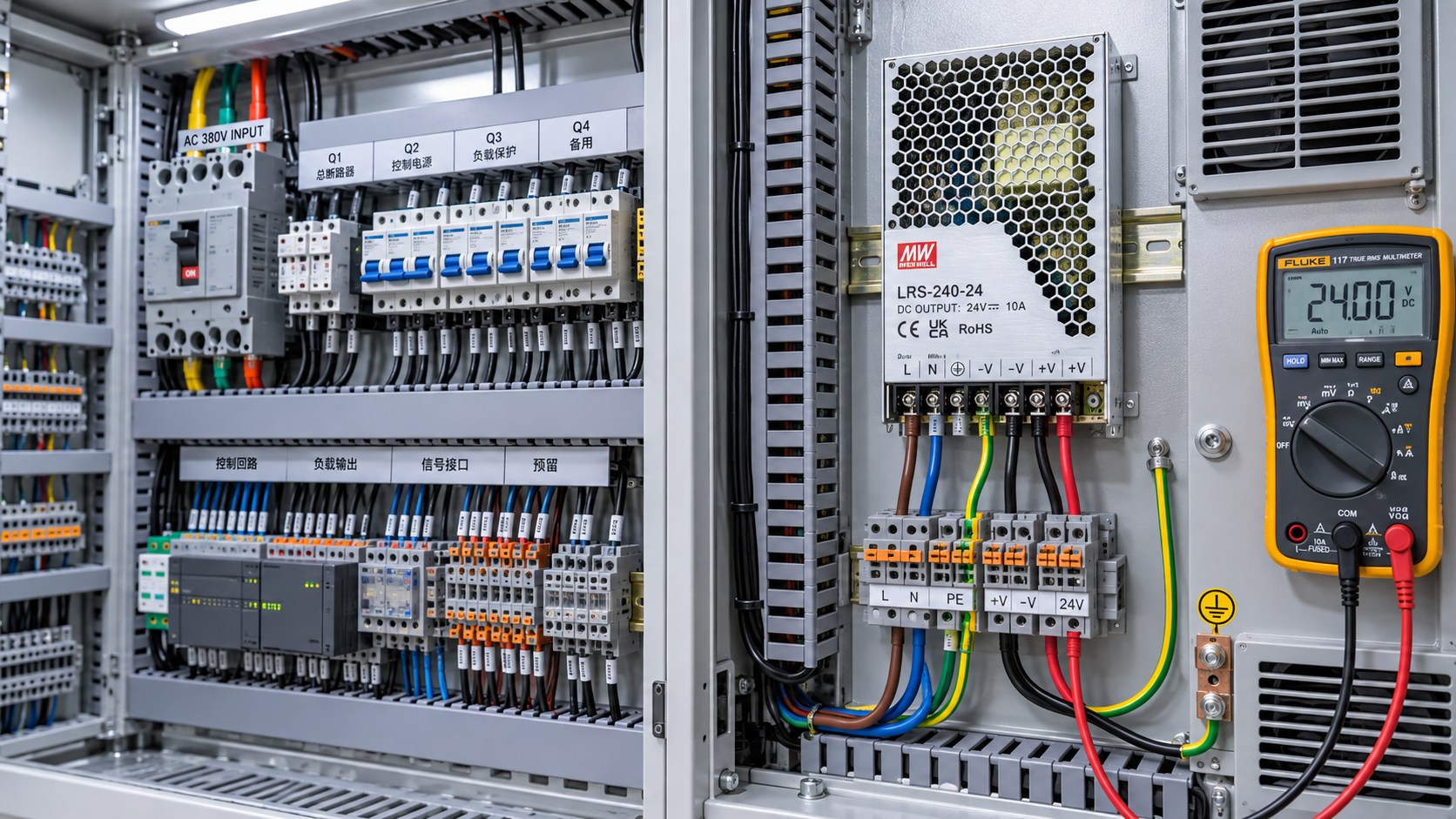
Supply terminals are only one measurement point. Cables, connectors, board traces, and shared return paths influence the voltage that reaches the circuit. A clean terminal reading does not establish a clean local rail, particularly when another load draws changing current through the same wiring.
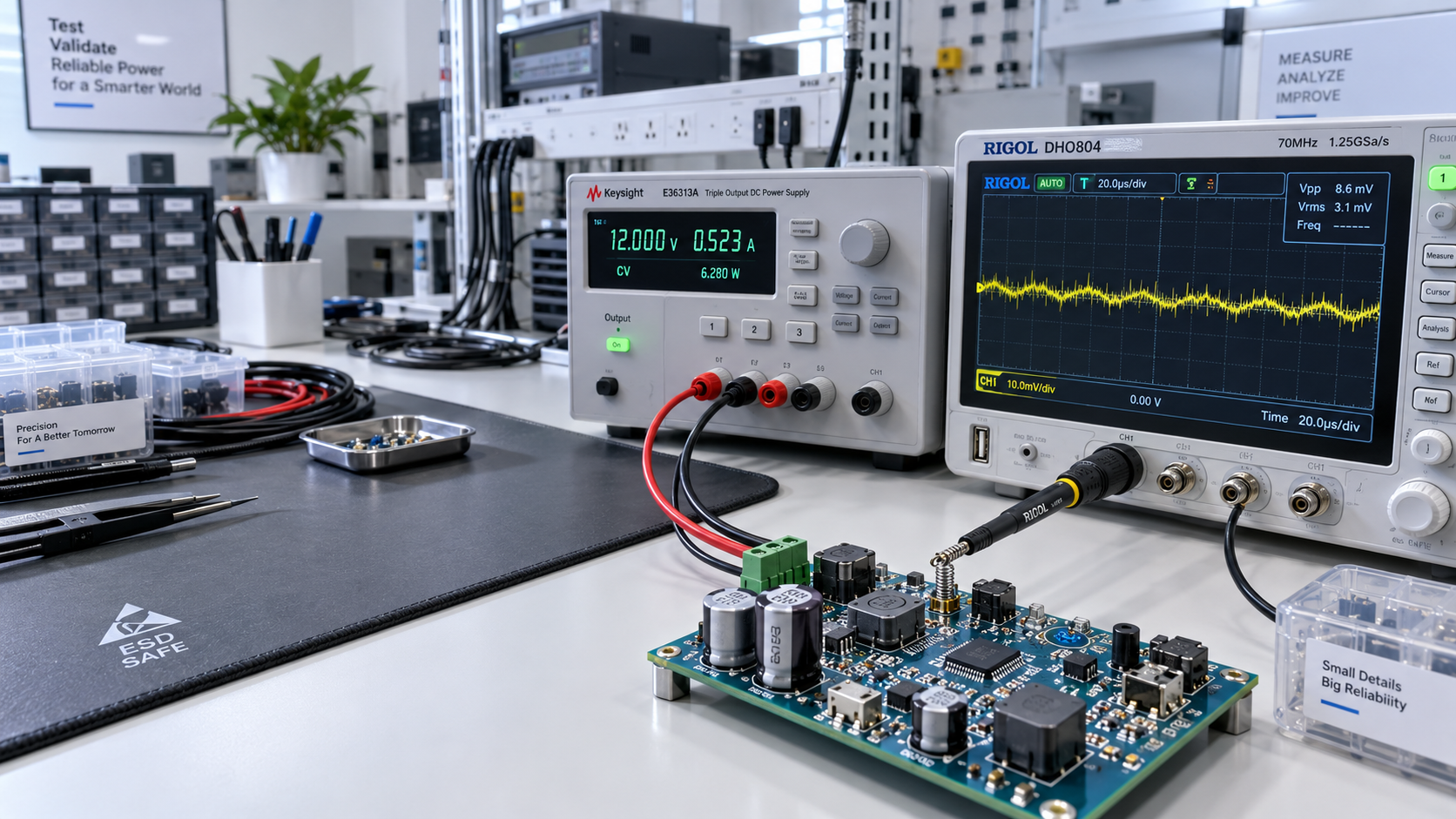
Probe technique can also distort the result. A long oscilloscope ground lead forms a loop that can pick up interference and exaggerate spikes. Use a short ground connection or an appropriate differential measurement arrangement. Set the bandwidth deliberately and keep the measurement setup consistent between candidates.
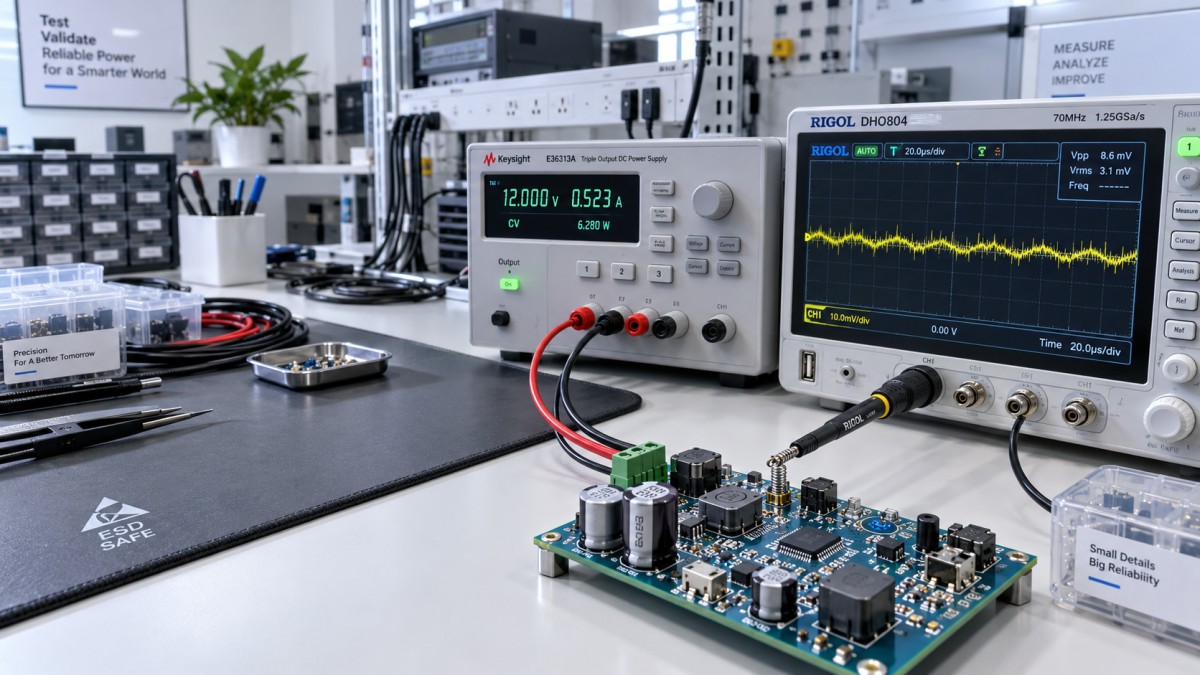
Establish the instrument’s noise floor so it does not obscure the difference being assessed. For small ripple measurements, AC coupling can help reveal variation around the DC level, but its low-frequency cutoff can exclude slow disturbances. Use a separate suitable measurement for startup behavior, long-duration droop, and other events that AC coupling may hide.
A focused comparison should cover a few representative conditions:
- The normal load and output setting, with the intended cables and local components.
- Light load, where some switching supplies may enter operating modes with different noise characteristics.
- High load and relevant temperature conditions, where losses and available margin change.
- Representative load steps, startup, and protection recovery.
- The application’s actual output quality, such as measurement stability, unwanted tones, or reliable operation.
That final observation connects the purchase to a useful result. A lower ripple trace supports the decision when it accompanies improved system performance or necessary operating margin. If the application behaves the same with both candidates, the quieter specification alone provides a weaker reason to spend more.
If interference remains after changing supplies, investigate its path. Shared return impedance, magnetic pickup, radiated coupling, or an unsuitable grounding arrangement can dominate. Reducing differential output ripple may have limited effect on common-mode noise flowing through other connections.
Judge the premium against the complete power solution
A DC power supply price includes more than ripple performance. Isolation, output power, control features, protection, thermal design, support, and documentation can all contribute to the difference between products. Comparing differently equipped units can make lower ripple appear responsible for a premium that actually covers several capabilities.
Compare supplies that meet the same essential electrical and functional requirements. Then assess what extra work the cheaper option requires. Filters, regulators, cooling, assembly, and validation consume money and development time. A more expensive supply may be economical if it removes substantial work while meeting the noise requirement.
The reverse can also be true. A system with well-designed local conditioning may gain little from an exceptionally quiet external supply. If that source serves many unrelated loads, improving only the sensitive rail may provide better value than specifying low ripple across the entire power system.
For purchasing decisions, include the quality of the specification. Clearly stated limits, test conditions, operating-mode behavior, and integration guidance make a product easier to evaluate and qualify. These details help distinguish a dependable performance commitment from an attractive typical reading.
Set the acceptance criteria before choosing between candidates: allowable rail disturbance, relevant frequency range, load conditions, transient limits, and required application performance. Specify enough margin to accommodate temperature, tolerances, and operating variation. The higher-priced supply earns its place when it meets those criteria with useful margin or reduces the total cost of achieving them. Once both options comfortably satisfy the system, direct the remaining budget toward the factors that still limit performance.
Technical Specifications
- How to fix sliding doors and windows that are difficult to openAuthor :Construction Materials Editorial Team
- Which resin types suit composite parts exposed to high temperatures?Author :Chemical Industry Editorial Team
- Is a higher DC power supply price justified by lower ripple?Author :Electrical Components Editorial Team
Expert Insights

Chief Security Architect
Dr. Thorne specializes in the intersection of structural engineering and digital resilience. He has advised three G7 governments on industrial infrastructure security.
Core Sector // 01
Security & Safety
- Is a higher DC power supply price justified by lower ripple?Author :Electrical Components Editorial Team

- What to verify before choosing an industrial power supply manufacturerAuthor :Electrical Components Editorial Team

- When can an imported power supply be used without local certification?Author :Electrical Components Editorial Team

- Which local safety approvals apply to imported power suppliesAuthor :Electrical Components Editorial Team

- What Causes Power Supply Failures After Installation?Author :Electrical Components Editorial Team

- Do Imported Power Supplies Need Local Safety Certification?Author :Electrical Components Editorial Team

- How to Size Power Supplies for Industrial Control PanelsAuthor :Electrical Components Editorial Team

- DIN Rail Power Supplies vs Enclosed Power Supplies: What Is the Difference?Author :Electrical Components Editorial Team