Is E1 laminate flooring suitable for high-traffic retail stores?
Author
Date Published
Reading Time
Is E1 laminate flooring suitable for high-traffic retail stores?
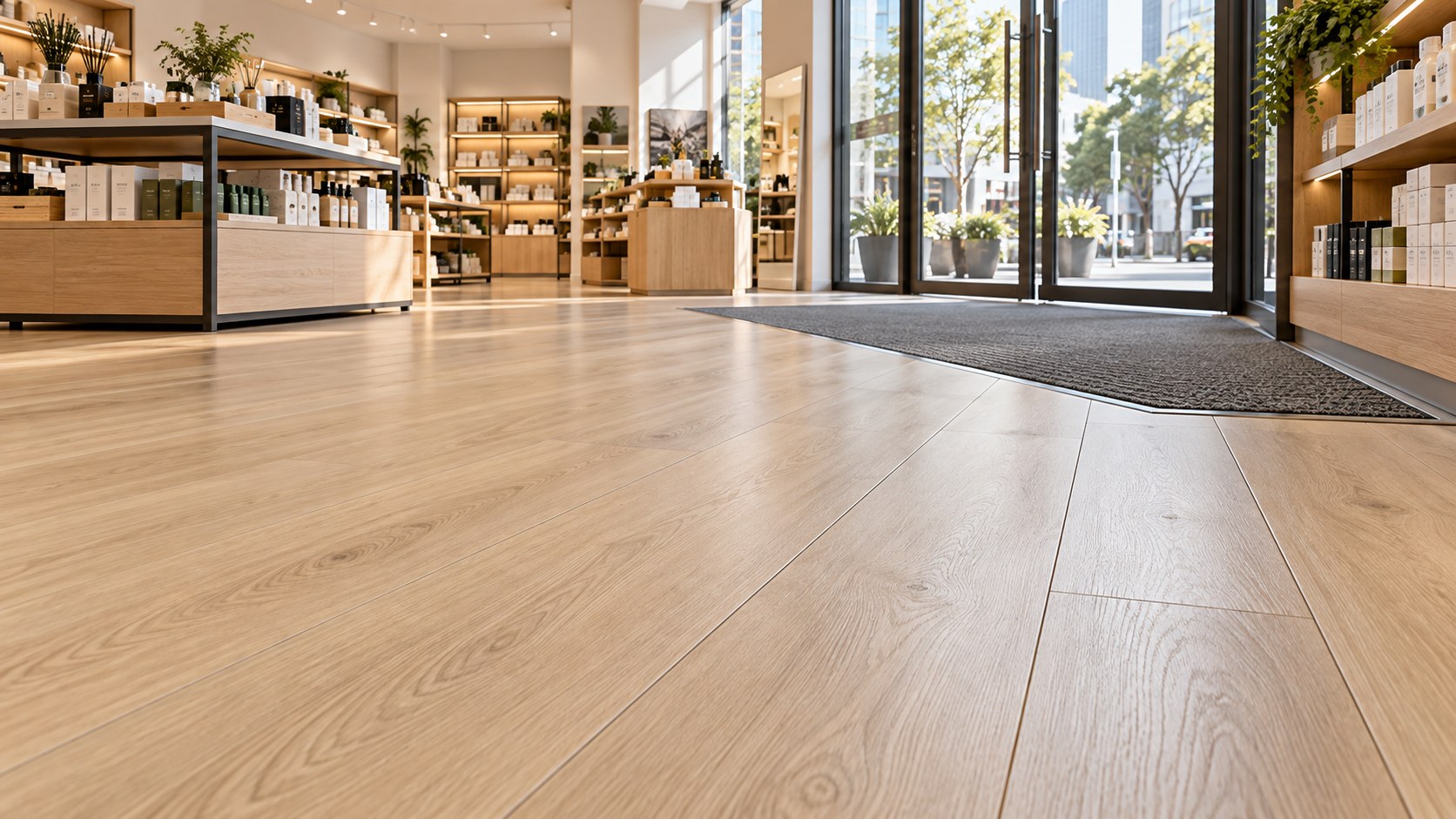
Yes, E1 laminate flooring can be suitable for a busy retail store—but E1 is not the reason it will withstand the traffic. E1 addresses formaldehyde emissions, not surface wear, joint strength, moisture resistance, or commercial service life. A floor may meet its stated E1 classification and still be unsuitable for a heavily used sales area.
For project managers, the decision rests on the complete flooring specification and the conditions inside the store. Commercial use classification, abrasion performance, cleaning methods, entrance exposure, installation requirements, and warranty exclusions all matter. The practical question is whether the exact product can handle the store’s busiest zones without creating avoidable maintenance or replacement work.
Separate the emissions claim from the performance claim
E1 is a formaldehyde emission classification used in European wood-based panel standards. It does not mean “formaldehyde-free,” and it does not establish that a product meets every indoor-air requirement in every destination market. An E1 statement also should not be treated as evidence of low emissions for all other volatile organic compounds.
Ask the supplier which standard and test method support the claim, whether the evidence covers the finished flooring or only its core board, and whether the tested product matches the proposed specification. A generic certificate covering an unidentified panel is weaker evidence than a traceable report linked to the flooring being supplied.
For imported flooring, check the destination’s current requirements separately. European emission classifications are not automatically interchangeable with US requirements such as TSCA Title VI, where applicable, or with other national rules. Retail landlords and tenant fit-out guides may also require additional indoor-air documentation. Compliance should be confirmed before purchase, not after the shipment arrives.
What actually demonstrates suitability for heavy retail use?
Start with a documented commercial use classification. Under EN ISO 10874, Class 33 denotes heavy commercial use. For a high-traffic sales floor, this is a more relevant starting point than a description such as “premium,” “heavy-duty,” or “commercial quality.” However, the classification still needs to be read alongside the product’s technical documentation and intended-use restrictions.
For laminate assessed under EN 13329, an abrasion class such as AC5 provides evidence about surface resistance under a defined test. It does not independently prove resistance to scratches, dropped merchandise, concentrated fixture loads, water penetration, or joint failure. Nor should an AC label be accepted as a substitute for a complete commercial suitability assessment.
Thickness alone is another unreliable shortcut. A thicker board may feel more substantial, but it does not automatically have a better wear layer, stronger locking profile, or greater moisture tolerance. Compare the complete construction rather than ranking products by millimetres.
Map the store’s risks before choosing one floor throughout
Footfall is only part of the load. A fashion store with controlled entrances places different demands on flooring from a convenience store with frequent spills, or a showroom where staff move heavy displays. Even within one premises, the fitting rooms, entrance, checkout queue, and stock-transfer route may need different treatment.
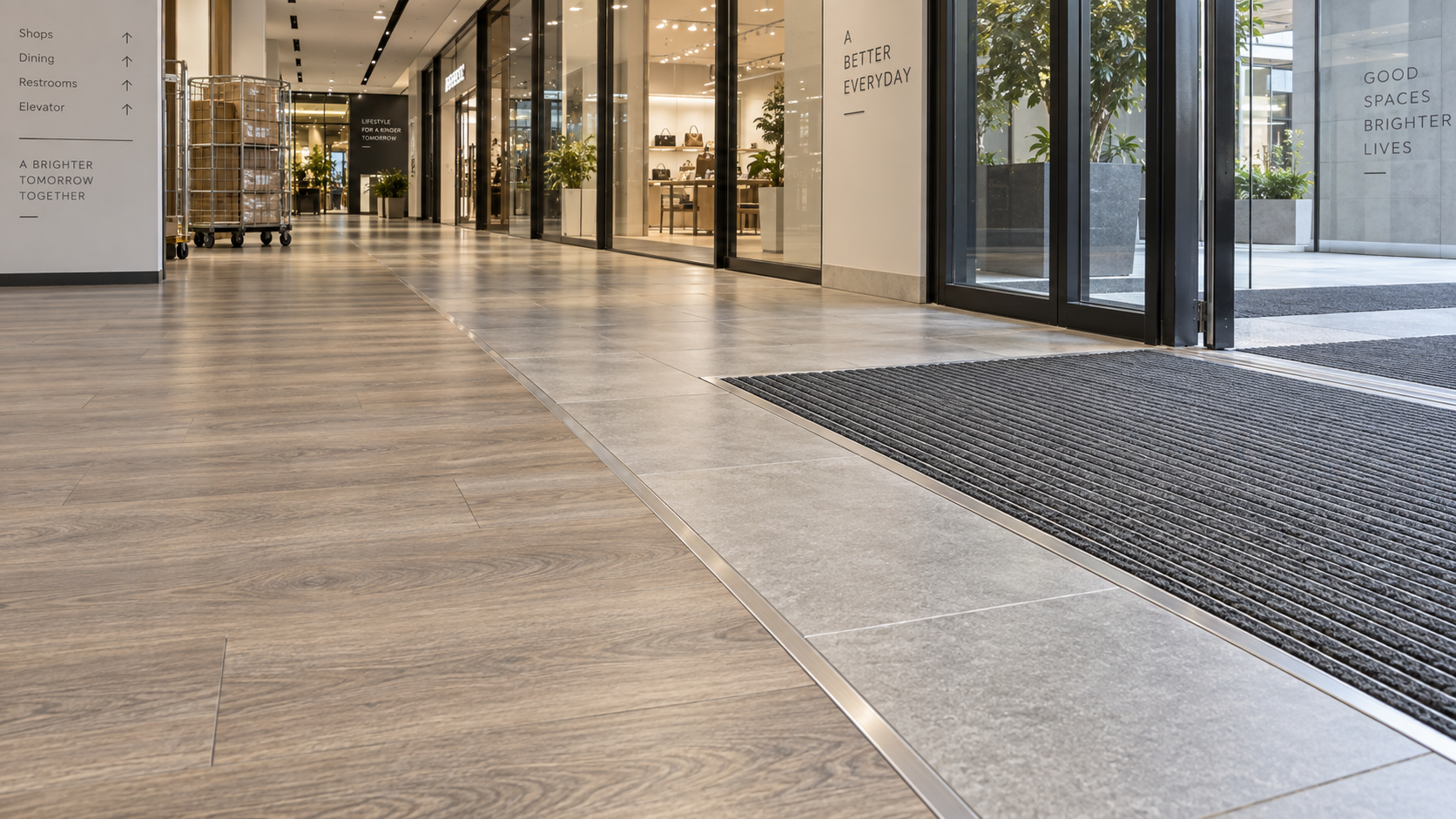
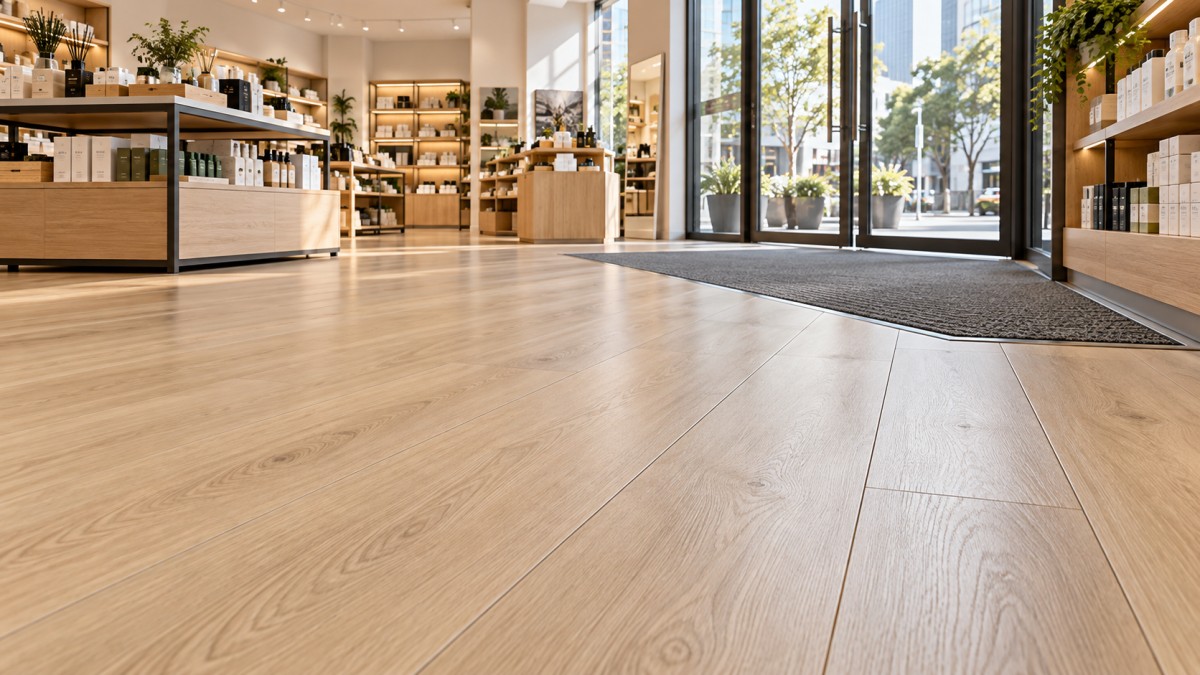
Entrances are especially demanding because footwear brings in grit and rainwater. Grit can abrade or scratch the surface, while moisture can reach vulnerable joints and edges. A properly sized, maintained entrance matting system reduces exposure; a small loose mat that quickly becomes saturated is not an equivalent control.
Rolling loads deserve separate scrutiny. Delivery trolleys, stock cages, cleaning equipment, and movable display stands can apply concentrated forces repeatedly along the same route. Ask for written confirmation that the proposed floor is suitable for the actual wheel type and load. A general statement about heavy pedestrian traffic does not answer that question.
Zoning can be more practical than forcing one material across the entire unit. Commercial-grade laminate may suit a dry sales area, while an entrance, beverage station, or wet-cleaned service zone may justify another finish. The transitions must still address accessibility, cleaning, and movement requirements.
Moisture and installation can defeat a strong specification
Many conventional laminate products use a wood-fibre core that can swell when water penetrates. Water-resistant products may provide additional protection, but the claim needs boundaries: exposure duration, permitted rooms, perimeter treatment, and cleaning restrictions. “Water-resistant” should never be interpreted as permission for standing water or unrestricted wet cleaning.
Check the cleaning plan before approving the finish. If the store’s contractor routinely uses a scrubber-dryer, steam equipment, or generous amounts of water, obtain explicit manufacturer approval or reconsider the material. A flooring specification that depends on a cleaning routine the operator cannot maintain is a weak specification.
Subfloor preparation is equally consequential. Unevenness can allow boards to flex under traffic, stressing locking joints. Residual moisture in a concrete slab can create problems below an apparently dry surface. Require moisture testing, flatness checks, and any vapour-control measures specified by the flooring manufacturer; avoid relying on a visual inspection alone.
Floating installations also need room to move. Large continuous areas, narrow doorways, fixed joinery, and heavy fixtures can complicate expansion requirements. Confirm permitted installation dimensions, movement-joint locations, underlay suitability, and treatment around display units. The shopfitting team and flooring installer need a coordinated plan before either starts work.
Read the warranty as an operating agreement
A prominent warranty duration is not enough. Verify that coverage applies to commercial retail use and to the exact product being offered. Residential coverage, even when lengthy, provides little reassurance for a busy store.
Look closely at the definition of wear. A warranty may address wear-through of the decorative surface but exclude scratches, dents, edge swelling, appearance changes, or damage from grit. Those exclusions matter because a floor can become visually unacceptable to a retailer before it meets the warranty’s definition of failure.
Also establish who pays for removal, replacement labour, fixture movement, and business interruption. Material-only compensation may cover only a fraction of the operational cost. Retain installation records, moisture results, delivery batch details, and cleaning instructions so that responsibility can be assessed if a problem arises.
Compare alternatives against the likely failure mode
Laminate can be a reasonable choice where the brief prioritises a wood-look finish, controlled installation scheduling, and dry commercial use. It becomes less convincing when repeated water exposure, aggressive cleaning, or unusually demanding rolling loads dominate the operating conditions.
Commercial luxury vinyl products may address some moisture concerns, but they still require checks for indentation, dimensional stability, subfloor condition, and application suitability. Porcelain tile may be worth evaluating for wet or abrasive zones, although installation time, substrate requirements, slip performance, and acoustic comfort need attention. No alternative removes the need for a project-specific assessment.
Compare installed and operating costs, not just the price per square metre. Include preparation, underlay, transitions, entrance matting, maintenance, spare stock, and the disruption of future repairs. A floating floor may allow damaged boards to be replaced, but access can require lifting surrounding flooring or moving displays. Replacement is not always a quick, isolated task.
Turn the shortlist into a verifiable purchase
For international sourcing, separate product evidence from supplier promotion. Industry news and market-price comparisons can help identify options, but neither verifies a particular shipment. Check that quotations, samples, technical sheets, emission documents, and warranty terms all refer to the same product code and construction.
- Request the commercial classification, relevant test documentation, and written acceptance of the intended retail application.
- Confirm compatibility with the cleaning equipment, rolling loads, fixtures, and entrance conditions.
- Review destination-market compliance and any landlord-specific fire, slip, acoustic, or indoor-air requirements.
- Agree on batch consistency, spare-board availability, delivery timing, and a prohibition on unapproved substitutions.
Where schedules allow, inspect a mock-up under the store’s planned lighting. Texture, joint visibility, trolley noise, and ease of cleaning are difficult to judge from a small showroom sample. A mock-up supports selection, though it cannot replace laboratory evidence or predict years of service.
The decision is therefore conditional: E1 laminate flooring is a credible option for high-traffic retail only when its commercial performance, installation system, and operating limits match the site. If the supplier provides an E1 label but cannot substantiate those other points, the specification is not ready for approval.
Technical Specifications
- Steel Dynamics Reports Record 3.8 Million Tonnes of Steel Shipments in Q3 2026Author :Metals & Fabrication Editorial Team
- U.S. Metalworking Machinery Orders Surge to $733 Million in August 2026Author :Industrial Machinery Editorial Team
- Is E1 laminate flooring suitable for high-traffic retail stores?Author :Construction Materials Editorial Team
Expert Insights

Chief Security Architect
Dr. Thorne specializes in the intersection of structural engineering and digital resilience. He has advised three G7 governments on industrial infrastructure security.
Core Sector // 01
Security & Safety
- Is E1 laminate flooring suitable for high-traffic retail stores?Author :Construction Materials Editorial Team

- How to stop oak wood flooring from developing gaps in winterAuthor :Construction Materials Editorial Team

- Is solid wood flooring suitable for kitchens with changing humidity?Author :Construction Materials Editorial Team

- Does E1 laminate flooring meet low-emission needs for bedrooms?Author :Construction Materials Editorial Team

- Which flooring materials hold up best in high-traffic commercial spaces?Author :Construction Materials Editorial Team

- What Should Buyers Check Before Importing Wood Flooring?Author :Construction Materials Editorial Team

- Is Demand for Imported Wood Flooring Growing in Europe?Author :Construction Materials Editorial Team

- Laminate Flooring vs Wood Flooring: Which Option Fits Rental Renovations?Author :Construction Materials Editorial Team