Is Demand for Imported Wood Flooring Growing in Europe?
Author
Date Published
Reading Time
Is Demand for Imported Wood Flooring Growing in Europe?
The short answer is: demand is still present, but it is becoming more selective. Europe continues to import substantial volumes of wood flooring, engineered boards, parquet components, veneers, and related timber products. Yet the old assumption that imported flooring will sell simply because it offers a lower ex-works price is no longer reliable. Buyers are weighing design, delivery reliability, legal documentation, carbon expectations, indoor-use performance, and after-sales risk more closely than before.
So, is wood flooring import demand growing in Europe? In some segments and countries, yes. Renovation-oriented demand, premium engineered flooring, wide-plank products, and specialist surfaces can remain active even when new-build construction is soft. But growth is uneven. A distributor serving refurbishment projects in a major city may see steady enquiries while a supplier focused on volume housing developments faces delayed orders and price pressure. “Europe” is not one flooring market, and import demand cannot be read from construction headlines alone.
For overseas manufacturers and sourcing teams, the useful question is not whether Europe is buying imported flooring at all. It is which buyers are still importing, what they are unwilling to compromise on, and where a shipment can become commercially difficult after it reaches the port.
Why imported flooring remains relevant
European production remains important, particularly in established parquet and engineered flooring regions. However, imports continue to fill gaps in species availability, cost structure, finishing capacity, board formats, and design variety. Oak may dominate many European collections, but buyers also source ash, walnut, hickory, acacia, teak alternatives, bamboo-based products, and other species or constructions that are not always available locally at the required scale.
Imported products are also relevant because flooring is not a single commodity. A basic lacquered strip board, a smoked brushed engineered plank, chevron panels, and waterproof wood-look flooring may all be sold through similar channels, but they involve different production skills and buyer expectations. Some importers are looking for a dependable private-label line with stable dimensions and repeatable colour. Others are sourcing a project-specific floor where surface character matters more than a perfectly uniform appearance.
The practical advantage of an overseas supplier is often range flexibility rather than headline price. A European distributor may need several grades, finishes, widths, and packaging configurations from one programme. If a factory can keep those details consistent across repeat orders, it can be more useful than a cheaper supplier that changes veneer appearance, board construction, or carton information from batch to batch.
The demand picture differs by market and application
New residential construction has a strong influence on flooring consumption, but it is not the whole story. When housing starts slow, developers may reduce purchasing volumes or postpone fit-out decisions. That usually affects standardised, price-sensitive flooring first. At the same time, refurbishment can provide a separate stream of demand, especially in mature urban housing markets where owners are upgrading existing apartments, retail spaces, hospitality interiors, and offices.
This distinction matters for import planning. A contractor buying for a phased apartment project may value ready stock, delivery windows, technical documentation, and identical replacement material. An interior retailer may instead want a collection that photographs well, offers visible natural character, and can be reordered in smaller quantities. Treating both as “European flooring demand” leads to the wrong product and inventory decisions.
Northern and central European markets often place particular emphasis on technical conformity, documented timber origin, and underfloor-heating compatibility. In southern markets, climate, installation practices, and design preferences may shift the product conversation. The United Kingdom is also commercially important for many exporters, but it has its own customs and market-access considerations outside the EU framework. A supplier should not assume that a document pack accepted by one importer will automatically satisfy another market’s commercial or regulatory process.
Sustainability paperwork is now part of the product
The biggest change in European wood flooring trade is not a new finish trend. It is the growing importance of traceability. Buyers increasingly ask where the timber came from, which species are used, how the material moved through the supply chain, and whether the supplier can support due-diligence requirements. This is especially relevant as the EU Deforestation Regulation covers wood and wood-derived products. Its detailed application requirements and timelines should always be checked against the current legal position, but the direction of travel is clear: vague origin statements are becoming harder to defend.
Certification can help, but it is not a universal shortcut. FSC or PEFC chain-of-custody claims may be requested by customers and can strengthen a sourcing file when properly managed. They do not remove the need to verify whether a claim is valid, whether the chain-of-custody scope covers the relevant product, or whether the exact material in the shipment matches the sales documentation. Buyers who have dealt with claim mismatches know that a logo on a brochure is not enough.
For flooring products used in construction, importers may also need technical documentation tied to the applicable European rules and harmonised standards. EN 14342 is commonly relevant for wood flooring and parquet. The precise obligations can depend on product type, intended use, and the market where it is sold. Exporters should avoid sending generic test reports without checking that the report corresponds to the actual board construction, finish, thickness, and declared performance.
There is a commercial lesson here. Documentation is not merely a compliance cost absorbed by the importer. It can decide whether a product is listed, specified, insured, or rejected before samples ever reach an installer.
Price still matters, but landed cost matters more
Wood flooring buyers are highly price-aware, particularly in a cautious construction environment. Still, the lowest quotation is rarely the lowest landed cost. Ocean freight, inland transport, port handling, duty treatment, insurance, exchange-rate movement, storage, damage allowances, and financing all affect the real number. So does the cost of a quality issue found after the container is opened.
A common sourcing mistake is comparing only price per square metre while ignoring usable yield. If boards have inconsistent milling, excessive short lengths, unstable moisture content, surface defects outside the agreed grade, or packing that does not survive handling, the apparent saving disappears quickly. Flooring is installed in highly visible spaces. A minor colour variation may be acceptable in a rustic grade, but cupping, edge damage, finish inconsistency, or board movement can turn into a dispute involving the retailer, installer, distributor, and manufacturer.
The tighter the project schedule, the more expensive uncertainty becomes. Importers commonly prefer a supplier who is realistic about lead times and production constraints over one who promises an attractive date and then changes it after deposit. In practical terms, reliable communication before shipment is a pricing factor.
What buyers are actually checking before they reorder
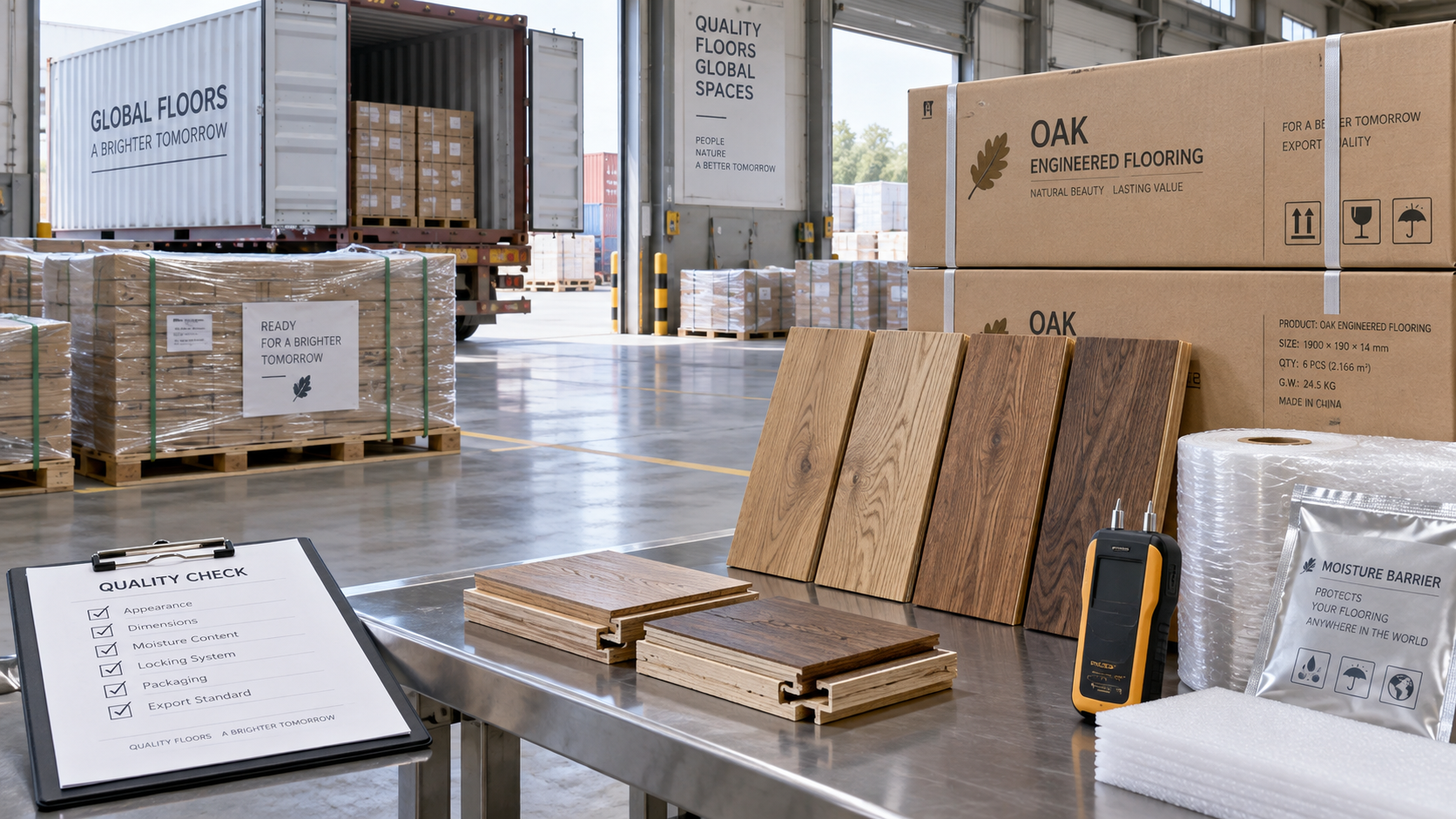
Experienced European flooring buyers usually examine a sample beyond its visual appeal. They may ask about the species’ botanical name, veneer thickness for engineered products, core material, adhesive system, finish, moisture specifications, edge treatment, installation method, and suitability for underfloor heating. They will also look at the grade definition. “ABC grade,” “natural,” and “rustic” do not mean exactly the same thing from one factory to another.
The following checks are especially useful before a first shipment:
- Confirm the complete bill of materials, not only the face veneer species.
- Agree the acceptable range for knots, sapwood, filled cracks, colour variation, and short boards.
- Match test reports and declarations to the exact product being offered.
- Review carton markings, barcode needs, pallet configuration, and language requirements early.
- Set an inspection point before loading, especially for first orders or custom finishes.
- Clarify how claims will be handled if an installer identifies a problem after delivery.
That last point is frequently overlooked. A factory may consider its responsibility finished once cargo passes inspection, while an importer knows that many defects only become visible during acclimatisation, installation, or use. The contract does not need to predict every dispute, but it should state the evidence required for a claim and the practical remedy available.
Where opportunities are more credible
The most credible opportunities are usually not generic “European market entry” offers. They are narrower: engineered wide-plank collections with dependable construction; renovation-friendly products suited to existing subfloors; consistent private-label ranges; flooring with credible sourcing documentation; or specialist formats that local competitors do not keep in stock.
There is also room for suppliers who can communicate technical limits honestly. For example, a wood floor should not be presented as maintenance-free or universally suitable for wet rooms simply because a buyer requests that claim. It is better to explain the recommended use conditions, installation requirements, and finish limitations than to create an expensive downstream expectation. Contractors generally respect clear limits when they are disclosed before specification.
For importers, market monitoring should combine more than trade-volume headlines. Watch housing and renovation activity, freight conditions, wood raw-material availability, exchange rates, regulatory updates, and retailer stock levels. A decline in container bookings may indicate weaker demand, but it may also reflect destocking after earlier over-ordering. Context matters.
A sensible conclusion for suppliers and buyers
Imported wood flooring is unlikely to disappear from Europe’s sourcing landscape. The market still needs choice, specialist supply, and price alternatives. What is changing is the threshold for participation. Buyers increasingly expect the product, paperwork, packaging, and delivery plan to work together.
The strongest demand is likely to favour suppliers that understand this broader job. Before quoting, confirm the destination market, intended application, required documents, product construction, and realistic replenishment plan. Before buying, test more than appearance and unit price. In wood flooring, the costly problems are rarely hidden in the quotation; they usually emerge in the details that were never properly agreed.
Technical Specifications
- Which local safety approvals apply to imported power suppliesAuthor :Electrical Components Editorial Team
- How to choose the right tempered glass panel for safety glazingAuthor :Construction Materials Editorial Team
- When do elastomers outperform thermoplastics in flexible seals?Author :Polymers & Rubber Editorial Team
Expert Insights

Chief Security Architect
Dr. Thorne specializes in the intersection of structural engineering and digital resilience. He has advised three G7 governments on industrial infrastructure security.
Core Sector // 01
Security & Safety
- Which flooring materials hold up best in high-traffic commercial spaces?Author :Construction Materials Editorial Team

- What Should Buyers Check Before Importing Wood Flooring?Author :Construction Materials Editorial Team

- Is Demand for Imported Wood Flooring Growing in Europe?Author :Construction Materials Editorial Team

- Laminate Flooring vs Wood Flooring: Which Option Fits Rental Renovations?Author :Construction Materials Editorial Team

- How to Choose Laminate Flooring Wear Ratings for High-Traffic Commercial AreasAuthor :Construction Materials Editorial Team

- Engineered Wood Flooring vs Solid Wood Flooring: Pros, Limits, and Best UsesAuthor :Construction Materials Editorial Team

- How to Check Moisture Conditions Before Installing Wood FlooringAuthor :Construction Materials Editorial Team