Does E1 laminate flooring meet low-emission needs for bedrooms?
Author
Date Published
Reading Time
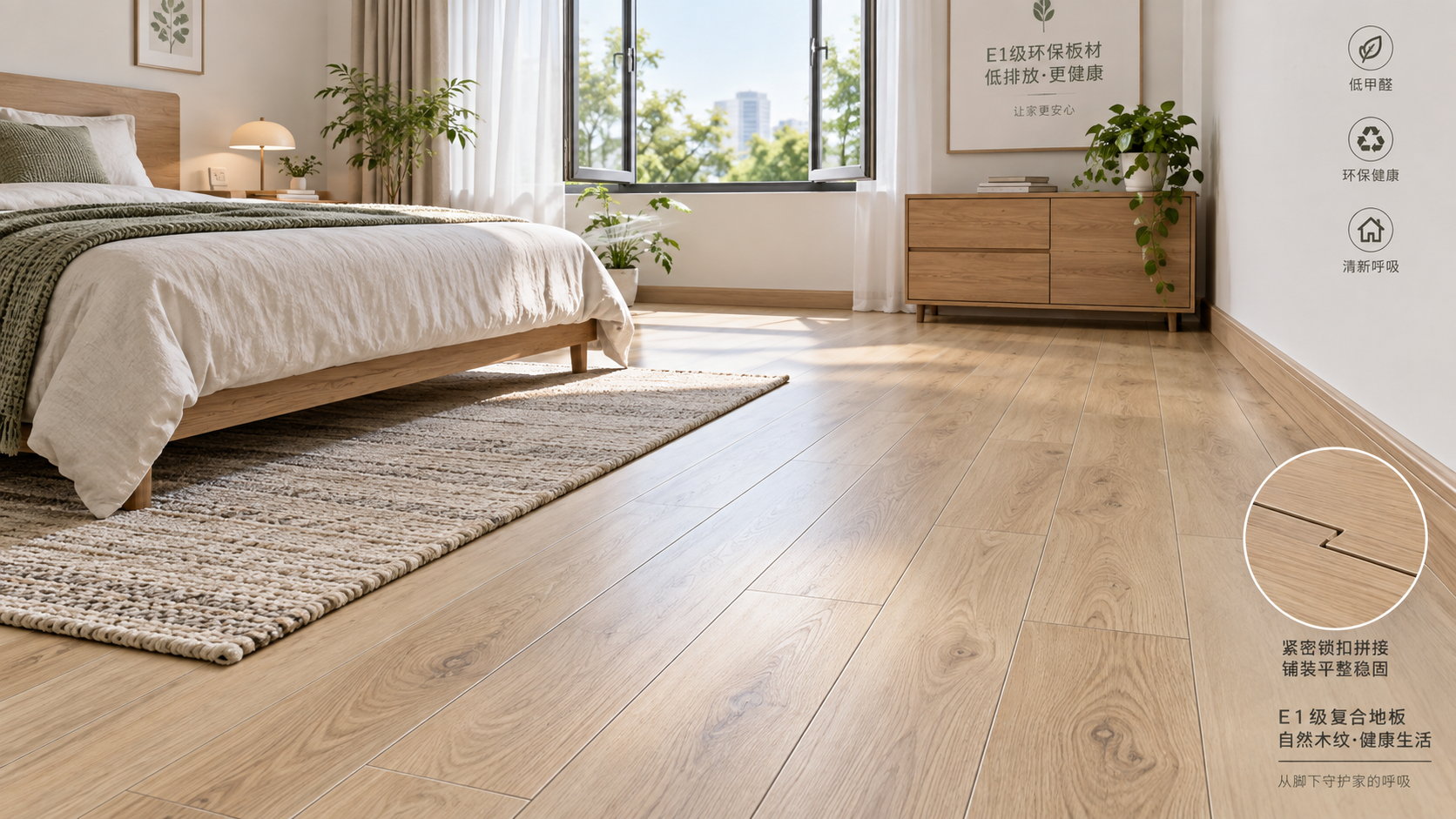
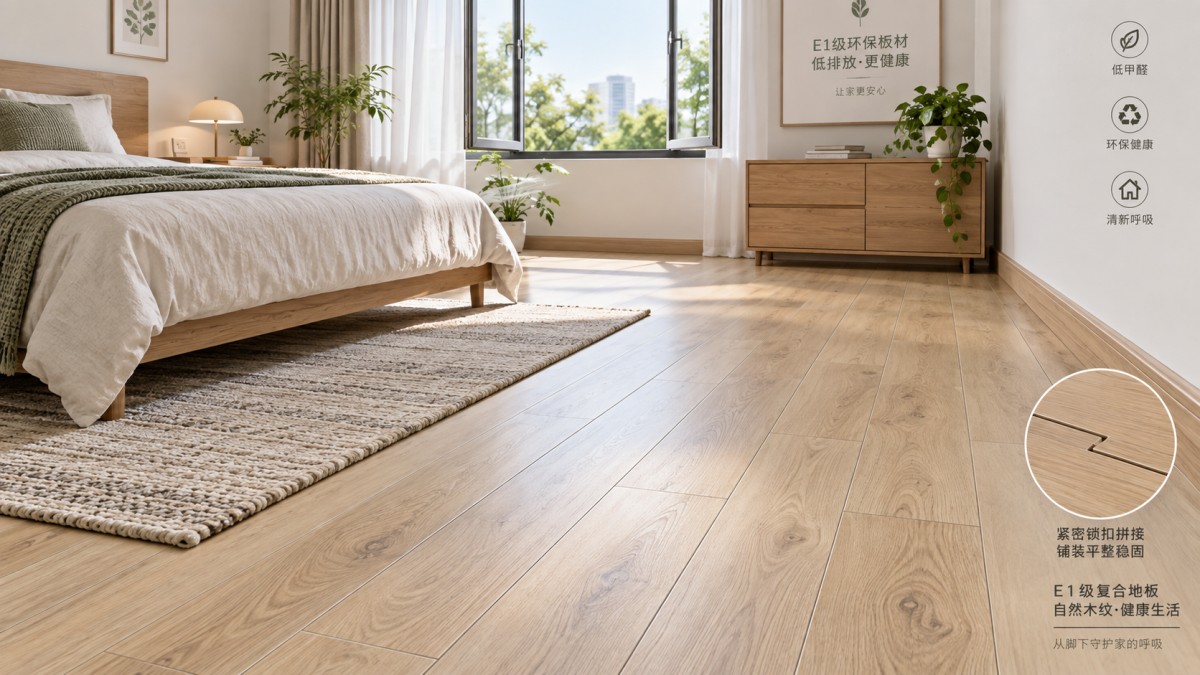
E1 laminate flooring can be an appropriate lower-emission choice for a bedroom, but the E1 label alone does not prove that the finished room will meet every low-emission expectation. It primarily concerns formaldehyde release from wood-based components under a defined test method. A bedroom result also depends on the full flooring construction, the amount installed, underlay and adhesive emissions, room temperature, ventilation, and the way the product was stored and fitted.
For an ordinary dry bedroom with sound installation conditions, an E1-rated product is usually a more defensible starting point than a floor with no disclosed emissions classification. For a child's room, a poorly ventilated bedroom, or a space used by someone sensitive to indoor odours or respiratory irritants, it is sensible to seek clearer documentation on the finished product and to control the installation environment carefully.
What the E1 classification actually covers
Laminate flooring is built in layers. A decorative surface and protective wear layer sit above a core, commonly a high-density fibreboard or similar wood-based board, with a balancing layer underneath. Formaldehyde concerns are mainly associated with resins used in the engineered wood core and, in some constructions, other bonded paper or backing components.
E1 is an emissions classification used for certain wood-based panels and related products in several markets. It is associated with a formaldehyde emission limit measured through specified test procedures. The exact legal meaning, accepted test method, and applicable threshold can vary by jurisdiction and product category. Therefore, an E1 statement should be read with its supporting standard reference, test date, and declared product scope rather than treated as a universal indoor-air certificate.
A useful distinction is that a board classification and a floor-system claim are not automatically identical. A retailer may describe a laminate floor as E1 because the core board meets that class. That is relevant, since the core is a substantial part of the material. Yet the final packaged plank includes coatings, printed papers, edge treatments, and possible attached underlay. Those additions do not necessarily make the floor unsuitable, but they are outside what a narrow core-board claim alone can establish.
The label also does not mean “formaldehyde-free.” Wood itself contains naturally occurring formaldehyde at low levels, while composite wood products can contain additional formaldehyde linked to bonding resins. E1 indicates controlled emissions within the applicable classification framework; it does not remove the need to consider the product as installed.
Why a bedroom changes the assessment
Bedrooms have a different exposure pattern from a hallway or living room. The floor may emit at a low rate, but the room is occupied for long stretches, often with doors and windows closed overnight. Small rooms have less air volume to dilute airborne compounds. Warm conditions, direct sun through glazing, or heating beneath the floor can also increase the release of volatile substances from several materials at once.
That does not make laminate inherently unsuitable for bedrooms. It means that the question is not limited to whether a plank meets one material class. A low-emission bedroom depends on the combined emissions load and the room’s ability to exchange air.
A recently renovated room can be more challenging than a room receiving flooring only. New paint, wardrobes made from composite board, curtains, mattresses, sealants, and storage furniture may each contribute odours or volatile organic compounds. If a smell develops after installation, assigning it immediately to the floor is often inaccurate. The timing may point toward the renovation package, while the source may be an adhesive, an underlay, newly assembled furniture, moisture exposure, or several materials together.
Documents that give a more reliable answer
The strongest evidence is product-specific and current. A generic statement on a shop page is weaker than a technical sheet or test document that identifies the flooring collection, construction, and testing basis. Product codes matter because a range can include different core thicknesses, surface finishes, or attached pads under similar marketing names.
Ask for the declared emissions information for the finished floor where available. If the documentation refers only to the fibreboard core, treat that as partial information rather than proof about the entire plank. The documents should make clear whether the result is a factory declaration, an independent laboratory result, or a certification claim verified under a continuing program.
Do not rely on phrases such as “eco,” “healthy,” or “low odour” in place of a defined test result. Odour is also an imperfect screening tool. Some volatile substances have noticeable smells at low concentrations, while other emissions may have little or no obvious odour. A product that initially smells like packaging, ink, or new material is not automatically a high-formaldehyde product; a product that smells neutral is not automatically verified as low-emission.
The installation materials can change the result
Many laminate floors are floating systems, joined mechanically without adhesive between planks. This can reduce one possible source of emissions compared with installations that require broad adhesive coverage. Even so, the assembly often includes other materials: foam or felt underlay, a vapour retarder, perimeter sealant in selected locations, transition strips, and repair materials. A plank with a well-documented E1 core can still be installed alongside products with less transparent emissions information.
Attached underlay deserves attention because it is purchased as part of the plank but may have a different material composition from the laminate core. Where a separate underlay is used, select one intended for interior residential flooring and review its product documentation independently. Avoid adding layers merely to make a floor feel softer or quieter when the installation instructions permit only a specified thickness and type. Excess cushioning can damage locking joints and create movement, which later leads to repairs and replacement work inside the bedroom.
Moisture protection is another frequent source of confusion. On a mineral subfloor, a vapour-control layer may be required by the flooring instructions. Skipping it to reduce material use can expose the wood-based core to moisture rising from below. A swollen or stressed floor may need removal, creating more disruption and introducing a new set of materials into the room. Use the prescribed membrane where it is required, and choose a documented product rather than treating it as an interchangeable accessory.
Acclimation is about stability, not emissions reduction
Letting unopened packs acclimate in the intended room helps the flooring adjust to the room’s temperature and humidity before fitting. This supports dimensional stability and can reduce gaps, raised edges, or stressed joints. It should not be presented as a method for “airing out” the product. Leaving open cartons or loose planks in a bedroom for long periods can expose them to dust, accidental moisture, and uneven temperature without delivering a reliable emissions benefit.
Ventilation after installation is more useful. Keep the room within the temperature and humidity conditions specified for the floor, increase fresh-air exchange where practical, and avoid closing the room immediately after a full renovation. Fresh air works better than masking scents with sprays or fragrances, which add other airborne compounds and make it harder to identify the source of a persistent odour.
Conditions that deserve extra caution
An E1 declaration is often sufficient as one part of a normal bedroom material selection, but certain conditions justify a higher level of verification. A compact room with limited window opening, a home with many new composite-wood furnishings, or a project scheduled immediately before occupancy leaves little margin for uncertainty. The same applies when the flooring will sit over active underfloor heating, because the surface and core may experience more frequent warming cycles.
For heated floors, check that the laminate is specifically approved for the heating system and follow limits for floor temperature and heat-up procedure. Excessive heat can affect joint movement, wear-layer performance, and emissions from several room materials. A sudden rise in temperature after installation is a poor test of whether the floor “smells”; it is a condition that may amplify temporary odours from the whole room.
Allergy sensitivity also needs careful wording. Formaldehyde and other volatile emissions are indoor-air concerns, but laminate flooring is not a cure for allergies, and no E1 class predicts every individual response. Dust accumulation, cleaning residues, dampness, textile furnishings, and ventilation quality can matter as much as the plank classification. A hard, cleanable floor can be easier to maintain than carpet in some rooms, provided the joints remain dry and the cleaning method does not leave a chemical film.
Reading competing claims without overvaluing one number
Flooring specifications are often compared as though lower formaldehyde figures always settle the choice. The test method, sample preparation, chamber conditions, and unit of expression determine whether two values can be compared at all. A number from one method should not be ranked directly against a number from another without confirmation that the basis is equivalent.
There is also a difference between an initial laboratory result and ongoing conformity. One tested sample can demonstrate performance for that sample. A documented certification or quality-control scheme may provide stronger confidence that production is monitored over time, although its scope should still be read carefully. Neither type of evidence eliminates the need to keep invoices, packaging labels, and product documents until the work is complete.
Imported flooring can add a practical documentation issue. A carton label may use an emissions term familiar in the country of manufacture while local building, product, or indoor-air requirements use another terminology. Before ordering, compare the supplied evidence with the requirements that apply where the floor will be installed. This is especially important when material is bought well in advance, because a later substitution for a missing colour or damaged carton can result in a different construction or a different documented class.
A practical bedroom selection approach
Start by deciding whether the evidence applies to the finished flooring product. Then look at the whole installation package: underlay, membrane, trim, sealants, and any adhesive. Keep those materials to the specified system rather than adding unverified extras. A compatible, correctly installed floor is less likely to require premature removal.
Before delivery, ensure the bedroom is dry, clean, and reasonably stable in temperature. Do not install over a subfloor with unresolved dampness or a recent leak. Moisture damage can create musty odours that are easily mistaken for chemical emissions, while damp conditions can support mould growth in concealed areas. The appropriate response is to identify and correct the moisture source, not to cover it with thicker underlay or stronger sealant.
After fitting, ventilate the room and allow ordinary renovation odours to dissipate before prolonged overnight use where the schedule permits. If a sharp or persistent odour remains, first record when it occurs and whether it changes with heat, closed windows, or use of the heating system. Review every recently added material rather than assuming the flooring is responsible. Product documentation, carton identifiers, and unused sample pieces can make a later inquiry more precise.
E1 laminate flooring is therefore a reasonable baseline for a bedroom when the claim is properly documented and the rest of the room is managed with the same care. It is not a standalone guarantee of low indoor emissions. The more enclosed, newly furnished, heated, or sensitivity-focused the bedroom is, the more important it becomes to verify the completed product, select compatible installation materials, and avoid introducing preventable sources of odour or moisture.
Technical Specifications
- What drives the price of LED panel lights for office projects?Author :Electrical Components Editorial Team
- Does E1 laminate flooring meet low-emission needs for bedrooms?Author :Construction Materials Editorial Team
- How to assess an injection molding manufacturer’s quality controlAuthor :Industrial Machinery Editorial Team
Expert Insights

Chief Security Architect
Dr. Thorne specializes in the intersection of structural engineering and digital resilience. He has advised three G7 governments on industrial infrastructure security.
Core Sector // 01
Security & Safety
- Does E1 laminate flooring meet low-emission needs for bedrooms?Author :Construction Materials Editorial Team

- Which flooring materials hold up best in high-traffic commercial spaces?Author :Construction Materials Editorial Team

- What Should Buyers Check Before Importing Wood Flooring?Author :Construction Materials Editorial Team

- Is Demand for Imported Wood Flooring Growing in Europe?Author :Construction Materials Editorial Team

- Laminate Flooring vs Wood Flooring: Which Option Fits Rental Renovations?Author :Construction Materials Editorial Team

- How to Choose Laminate Flooring Wear Ratings for High-Traffic Commercial AreasAuthor :Construction Materials Editorial Team

- Engineered Wood Flooring vs Solid Wood Flooring: Pros, Limits, and Best UsesAuthor :Construction Materials Editorial Team

- How to Check Moisture Conditions Before Installing Wood FlooringAuthor :Construction Materials Editorial Team