What to verify before choosing an industrial power supply manufacturer
Author
Date Published
Reading Time
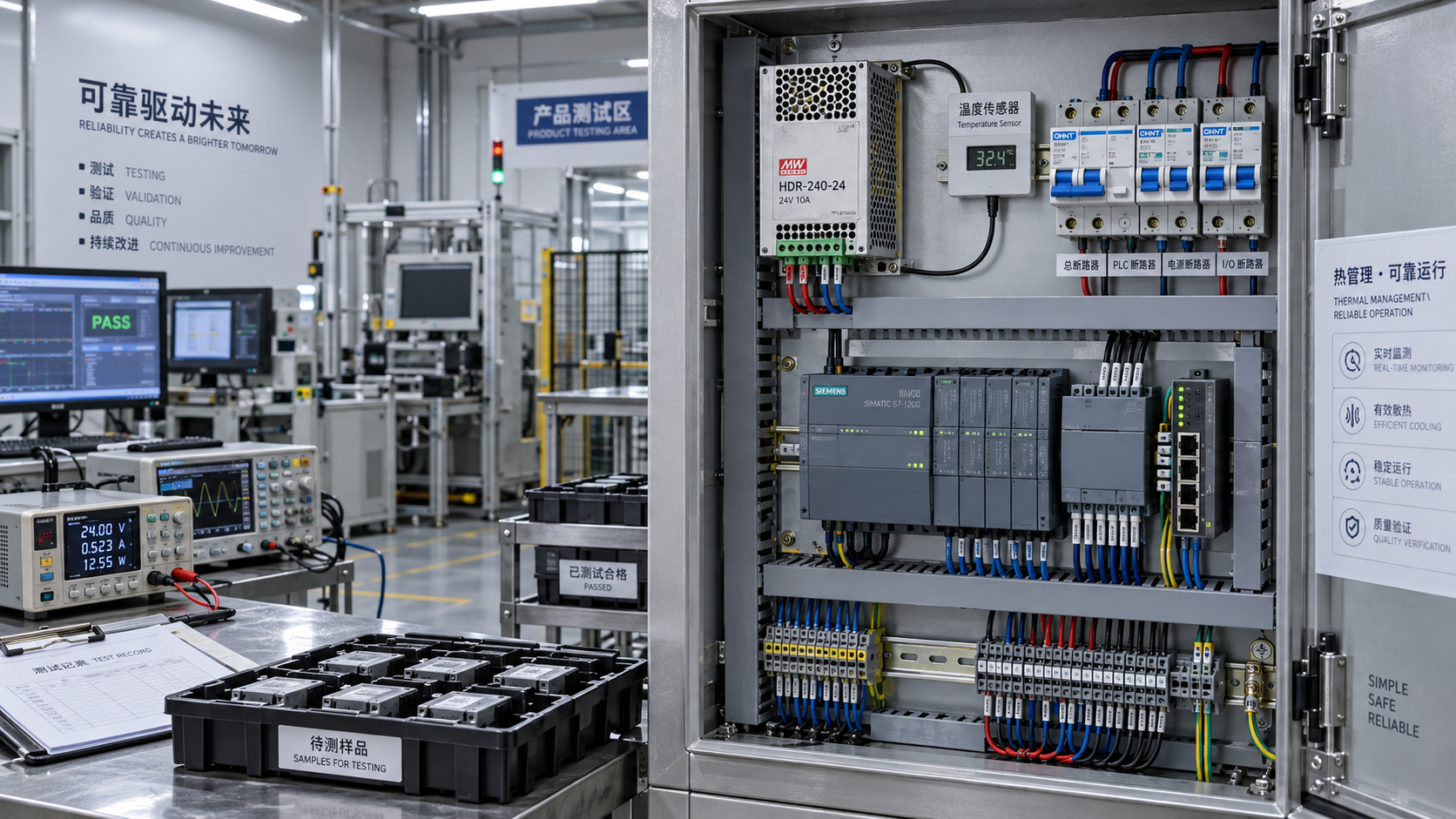
A power supply is often treated as a line item until it becomes the reason a control cabinet overheats, a field installation fails compliance review, or a production line suffers intermittent resets that no one can immediately explain. For technical evaluators, choosing an industrial power supply manufacturer is therefore not simply a matter of matching output voltage, wattage, and unit price. It is a decision about electrical safety, operating continuity, serviceability, and long-term sourcing risk.
The right supplier should be able to show how its products perform under real industrial conditions—not only on a clean specification sheet. That means looking beyond headline efficiency and rated output to verify certifications, derating behavior, component control, test methods, engineering responsiveness, and supply-chain resilience. The checks below provide a practical framework for approving a manufacturer before a product is specified into equipment or purchased for a large-scale project.
Start with the actual operating environment, not the catalog rating
A 24 VDC, 10 A power supply may appear interchangeable across several supplier catalogs. In practice, its suitability depends heavily on where and how it will operate. A unit installed in a ventilated electrical cabinet in a stable indoor facility faces very different stresses from one placed near a furnace, on a mobile machine, in a humid processing area, or in an outdoor communications enclosure.
Before contacting an industrial power supply manufacturer, define the operating envelope in terms the supplier can evaluate:
- Input voltage range, frequency, and expected grid instability
- Required output voltage accuracy and allowable ripple/noise
- Continuous load, peak load, inrush current, and startup sequence
- Ambient temperature, altitude, humidity, dust, vibration, and corrosive exposure
- Cabinet ventilation, mounting direction, spacing, and thermal constraints
- Need for redundancy, battery charging, remote monitoring, or parallel operation
- Expected service life and maintenance access after installation
This exercise often exposes a common approval error: selecting by nominal output alone. An industrial unit may deliver its full rated power only within a defined temperature range and mounting orientation. Above that range, derating can be substantial. If the supplier does not provide a clear derating curve, thermal guidance, and installation limitations, the stated power rating is incomplete information.
Ask whether the proposed model has been assessed in conditions close to yours. A capable manufacturer will not promise universal suitability; it will identify the conditions requiring additional validation, such as high altitude, high inrush loads, restricted airflow, or repeated cycling.
Verify certifications by part number and market—not by logo
Certification marks are important, but they should not end the conversation. Technical teams should verify which exact model, variant, input configuration, and production version are covered. A manufacturer may advertise compliance at the product-family level while a specific high-power option, terminal variant, or regional input version has different approvals.
For many industrial applications, relevant requirements may include electrical safety standards, electromagnetic compatibility requirements, hazardous-location requirements, environmental restrictions, and industry-specific approvals. The necessary set depends on the destination market and application. Machinery builders selling internationally may need to consider the compliance obligations of their finished equipment as well as those of the internal power supply.
Request current certificates, declarations, test reports where appropriate, and the associated model list. Check the issuing body, document date, standard edition, and any conditions or exclusions. For critical projects, it is sensible to cross-check information through the certification organization’s public database when available.
EMC deserves particular attention. A power supply can meet a basic emissions requirement yet still create installation-level problems when connected to long cables, switching loads, motion drives, sensitive sensors, or communications equipment. Clarify the intended installation category, recommended external filtering, grounding requirements, cable considerations, and whether test results assume a specific configuration.
Environmental compliance should also be traceable. Rather than accepting a general statement, ask how the manufacturer manages material declarations and component changes. This matters when the end product is shipped into regulated markets or when your own documentation must support customer audits.
Read the reliability evidence behind the brochure claims
Reliability is not a single number. A mean-time-between-failures figure can be useful for comparison when the calculation method, operating conditions, component stress assumptions, and temperature are disclosed. Without that context, it can create more confidence than it deserves.
More revealing questions include: What are the dominant failure modes? Which components are life-limiting? What happens at end of life? How are high-temperature operation, capacitor aging, relay wear, and fan degradation addressed? A sealed convection-cooled design eliminates one maintenance item, but it may impose stricter thermal demands. A fan-cooled design can offer higher density, yet its fan quality, replacement procedure, and alarm function become relevant.
Ask the supplier to explain its reliability validation approach. Depending on the product type, this may include burn-in, temperature cycling, surge testing, vibration testing, humidity exposure, load cycling, and protection-function verification. The goal is not to demand every possible test document for every purchase. It is to understand whether validation is systematic and whether it reflects the application risks you are managing.
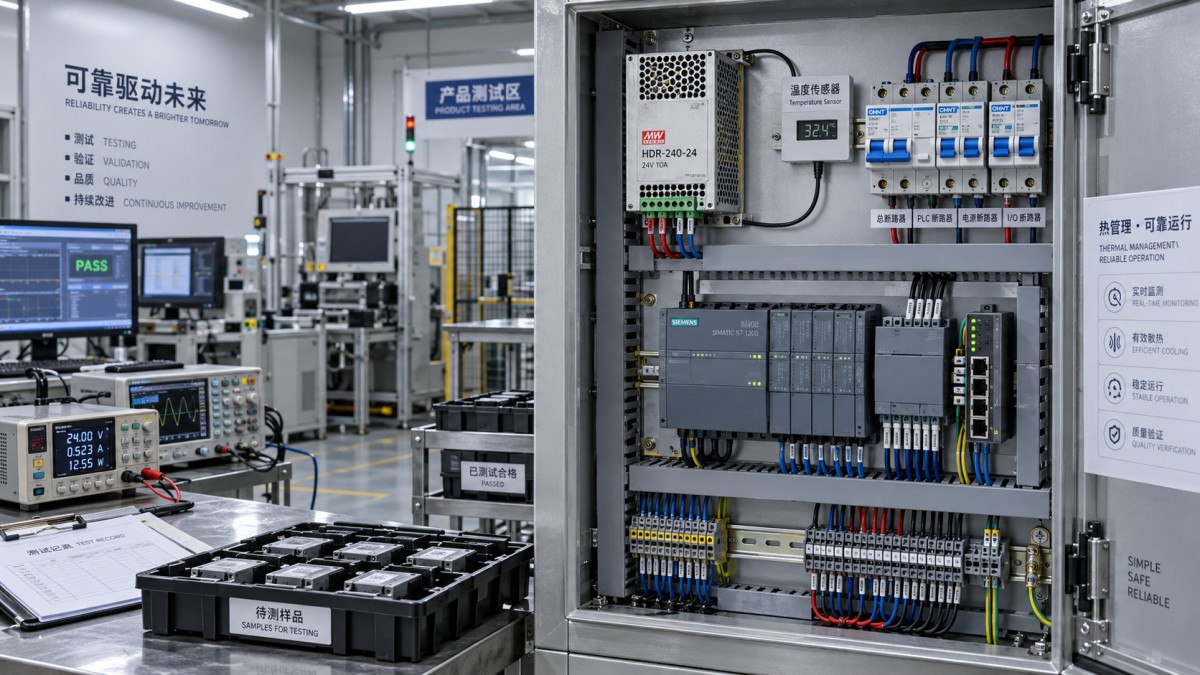
Protection behavior should be reviewed with equal care. Overvoltage, overload, short-circuit, and overtemperature protection are standard terms, but their real behavior differs. Does the unit enter hiccup mode, constant-current limiting, latch-off, or automatic restart? Will it reliably start capacitive loads? Can it support a downstream breaker or electronic circuit protector without collapsing the entire control voltage? These details affect fault isolation and recovery on the shop floor.
Look closely at thermal design and derating discipline
Heat is one of the most persistent enemies of electronic power conversion. A manufacturer that takes thermal performance seriously should provide more than a maximum ambient temperature. It should state the output capability across temperature, permissible mounting positions, ventilation clearance, surface temperature expectations, and any restrictions associated with side-by-side installation.
In crowded control panels, the margin between an acceptable design and a problematic one is often small. Nearby variable-frequency drives, contactors, PLCs, and cable bundles can raise local temperatures well above the average cabinet reading. Evaluators should compare thermal performance at the intended load—not just at a lightly loaded bench condition.
Where the application is demanding, ask for guidance on power reserve. A supplier that recommends some operating margin is usually being more realistic than one that assumes continuous operation at the absolute nameplate limit. The right margin will depend on temperature, load profile, redundancy architecture, and consequences of shutdown.
Assess electrical performance in the context of the load
Output stability, ripple, transient response, hold-up time, and inrush current are not abstract laboratory values. They determine whether controllers remain stable during switching events, whether relays behave predictably, and whether a system rides through brief input disturbances.
For PLC panels and automation systems, verify voltage adjustment range, load regulation, ripple/noise specifications, remote sensing availability, and the behavior under dynamic loads. For motors, solenoids, printers, actuators, or devices with large capacitive input stages, focus on peak-current capability and recovery characteristics. Medical, laboratory, communications, and measurement applications may place tighter emphasis on leakage current, noise, isolation, or conducted emissions.
Input-side behavior also matters. Check power factor correction where relevant, input current at full load, inrush limitation, surge immunity, and operation on generators or unstable grids. If the facility uses backup power, determine whether the unit behaves acceptably during transfer events and voltage dips. These questions are especially valuable for distributed installations where diagnosing a marginal input condition can be expensive.
Audit quality control as a process, not a factory-tour impression
A clean production floor can be reassuring, but it does not by itself demonstrate consistent product quality. The more useful question is how the manufacturer prevents variation from entering production and how it detects failures before shipment.
Ask for an overview of incoming inspection, supplier qualification, traceability, production testing, and change-control procedures. Can the manufacturer trace a finished unit back to production batch information and key components? Are functional and safety tests performed on every unit or through sampling? How are test limits maintained and test equipment calibrated? What happens when a nonconforming lot is discovered?
Component substitution deserves direct attention. Supply disruptions have made alternative sourcing more common across electronics manufacturing. An industrial power supply manufacturer should have a formal engineering change process covering substitutions that may affect electrical, thermal, safety, or EMC performance. Buyers do not necessarily need to approve every internal adjustment, but they should know when notification is required and whether a change can affect certifications, form-fit-function compatibility, or documentation.
For high-volume or regulated programs, discuss lot traceability, retention of quality records, failure analysis procedures, and corrective-action reporting. The level of scrutiny should match the risk. A standard DIN-rail supply for a noncritical auxiliary circuit and a power platform embedded in essential industrial equipment do not demand the same approval depth.
Test the manufacturer’s engineering support before the project depends on it
Datasheets answer routine questions. Difficult projects need people who can interpret requirements, review schematics, and explain trade-offs. This is where one industrial power supply manufacturer can differ sharply from another, even when products look comparable on paper.
During evaluation, submit a few application-specific questions. For example: Can the supply handle a stated inrush profile? What circuit protection coordinates with its output mode? What is the expected derating in a sealed enclosure? Can two units be configured for redundancy? How should the DC output be grounded in a particular control architecture?
The quality of the response is informative. Look for answers that are technically bounded, documented, and willing to identify uncertainty. Vague reassurance may feel convenient early in sourcing, but it becomes costly when commissioning begins. Confirm the availability of application engineers, local technical contacts, repair support, return-material procedures, and response expectations for field failures.
Customization can be valuable, but it changes the approval burden
Custom output voltages, connector layouts, enclosure formats, labeling, cable assemblies, conformal coating, and monitoring interfaces can simplify equipment design. Yet customization also introduces questions about minimum order quantities, validation ownership, lead time, revision control, and future service availability.
Before approving a modified product, establish whether the design is based on an existing qualified platform or is materially new. Determine which safety and EMC assessments remain applicable after the modification. Make sure drawings, revision codes, test requirements, and acceptance criteria are controlled in writing. A customized power supply that cannot be reproduced consistently over the life of a machine program can create a difficult spare-parts problem later.
Examine supply continuity before signing off on a sole source
Technical suitability is only half the selection decision. If a power supply becomes unavailable, undergoes an unannounced revision, or faces long lead times, an otherwise sound design may become a procurement issue. This is particularly important for OEMs with multi-year equipment lifecycles and distributors supporting installed bases.
Discuss manufacturing locations, approved component sources, inventory strategy, normal and extended lead-time patterns, and end-of-life notification practices. No supplier can eliminate market disruption, but transparent communication and disciplined lifecycle management reduce avoidable surprises.
For critical designs, identify an approved alternate or define a second-source strategy early. This does not always mean qualifying a duplicate product immediately. It may mean designing enough panel space, wiring flexibility, and control tolerance to accommodate a qualified replacement if required. When evaluating alternatives, do not assume matching voltage and current are enough; terminals, protections, EMC behavior, physical dimensions, and approval status may differ.
Use samples to validate the system, not merely the unit
A sample evaluation should resemble the intended installation as closely as practical. Test at realistic ambient temperatures, load profiles, input conditions, and wiring lengths. Observe startup, overload recovery, fault behavior, cabinet heating, and interaction with other equipment. If redundancy or battery backup is required, test the complete architecture rather than each component in isolation.
Document the acceptance criteria before testing. This helps prevent a familiar problem: a sample “works” on the bench, but no one has agreed whether it meets the actual application requirement. Capture model numbers, firmware or hardware revisions where applicable, date codes, test setup, instruments used, and findings. Those records will be useful if the approved design later changes.
A practical approval decision
The best choice is rarely the unit with the most impressive headline specification or the lowest purchase price. A suitable manufacturer provides evidence that its products are safe, repeatable, supportable, and available for the realities of your application. It also communicates clearly when a requirement falls outside the normal design envelope.
Before final approval, technical evaluators should be able to answer a simple set of questions: Is the exact product compliant for its intended market? Will it deliver the required output in the actual thermal and electrical environment? Are its protection and fault behaviors compatible with the wider system? Can the supplier control product quality and changes over time? And if something goes wrong in the field, will knowledgeable support be available?
When those answers are documented rather than assumed, selecting an industrial power supply manufacturer becomes a defensible engineering decision—not a gamble hidden behind a familiar voltage label.
Technical Specifications
- How to assess fastener traceability when sourcing in EuropeAuthor :Metals & Fabrication Editorial Team
- What to verify before choosing an industrial power supply manufacturerAuthor :Electrical Components Editorial Team
- How supply disruptions in the manufacturing supply chain affect lead timesAuthor :Global Industrial Core Editorial Team
Expert Insights

Chief Security Architect
Dr. Thorne specializes in the intersection of structural engineering and digital resilience. He has advised three G7 governments on industrial infrastructure security.
Core Sector // 01
Security & Safety
- What to verify before choosing an industrial power supply manufacturerAuthor :Electrical Components Editorial Team

- When can an imported power supply be used without local certification?Author :Electrical Components Editorial Team

- Which local safety approvals apply to imported power suppliesAuthor :Electrical Components Editorial Team

- What Causes Power Supply Failures After Installation?Author :Electrical Components Editorial Team

- Do Imported Power Supplies Need Local Safety Certification?Author :Electrical Components Editorial Team

- How to Size Power Supplies for Industrial Control PanelsAuthor :Electrical Components Editorial Team

- DIN Rail Power Supplies vs Enclosed Power Supplies: What Is the Difference?Author :Electrical Components Editorial Team