How to Size Power Supplies for Industrial Control Panels
Author
Date Published
Reading Time
How to Size Power Supplies for Industrial Control Panels
Choosing the right power supplies for industrial control panels is critical to system stability, safety, and long-term performance.
Correct sizing is not only about adding up watts.
It also involves startup current, load diversity, ambient heat, voltage drop, and future expansion.
A panel that looks fine on paper can still fail in the field.
That usually happens when the selected power supplies have no real operating margin.
This guide breaks down a practical sizing method and the mistakes that most often cause trouble.
Start with the actual load profile
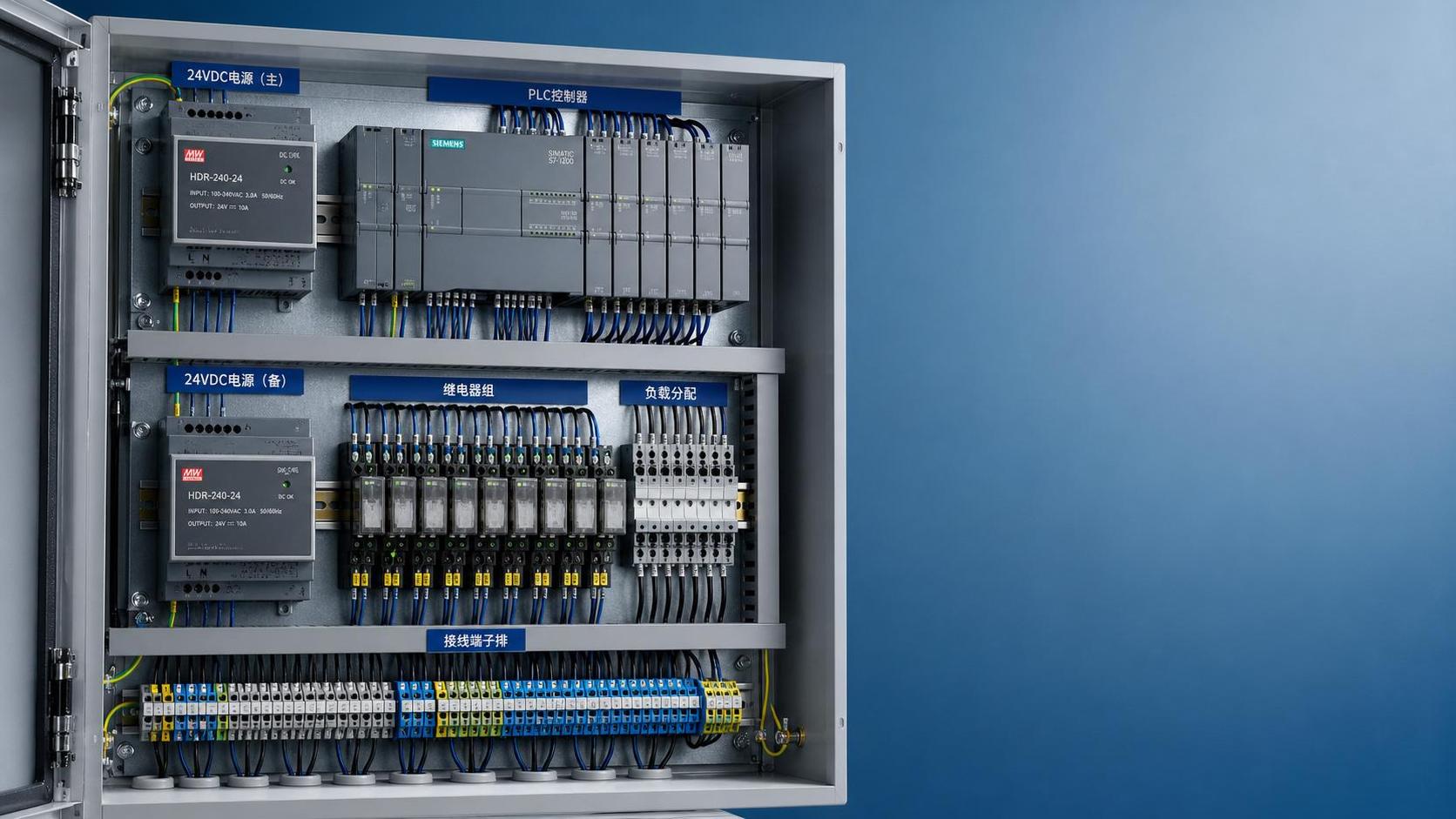
Begin by listing every device powered by the DC output.
This often includes PLCs, HMIs, sensors, relays, contactors, communication modules, and safety devices.
Use the rated current from each datasheet, then separate continuous loads from intermittent loads.
That distinction matters because not all devices draw peak current at the same time.
- Continuous loads: controller electronics, network switches, signal conditioners.
- Intermittent loads: solenoids, relays, valve coils, alarm devices.
- High-startup loads: motor starters, capacitive devices, remote I/O banks.
Once the list is complete, calculate the steady-state current first.
Then review the worst-case operating condition, not the average production day.
Do not ignore inrush current
One of the most common sizing errors is overlooking inrush current.
Many industrial devices draw a brief but significant current spike during startup.
If the chosen power supplies cannot support that spike, the panel may trip, reset, or start unpredictably.
This is especially relevant in 24VDC control panels with multiple electronic loads.
Look for terms such as peak current, boost current, or short-term overload capacity.
A unit with 120% to 150% temporary overload capability may prevent nuisance issues.
In practical sourcing work, this specification is often more valuable than nameplate wattage alone.
Apply a realistic safety margin
After calculating total demand, add margin for reliability.
A common rule is to size power supplies at 80% or less of rated output during normal operation.
This leaves room for startup peaks, line fluctuation, aging, and later panel modifications.
For example, a calculated 8A load usually calls for a 10A or larger supply.
If the application is safety critical or has unstable utility power, more margin is justified.
Oversizing too far is also not ideal.
Very large power supplies can increase cost, cabinet heat, and available fault energy.
Check environmental and installation conditions
Power supplies rarely operate in ideal lab conditions.
Inside industrial control panels, temperature can rise quickly, especially near drives or transformers.
Many units are derated at higher ambient temperatures.
That means the real output current may be lower than the catalog value.
- Verify operating temperature and derating curves.
- Check enclosure ventilation and mounting orientation.
- Consider altitude, dust, humidity, and vibration.
- Review required certifications and EMC performance.
These factors directly affect which power supplies remain stable over time.
Think about redundancy and selectivity
Not every panel needs redundancy, but many industrial processes do.
If downtime is expensive, dual power supplies with a redundancy module can be a sensible design choice.
This setup allows one supply to fail without shutting down the entire control system.
Also review branch protection and selective tripping.
A short circuit on one load should not collapse the whole 24VDC bus.
Some modern power supplies support electronic circuit protection for better fault isolation.
A simple sizing workflow
- List all DC loads and their rated current.
- Identify simultaneous operation and startup peaks.
- Add the steady-state current total.
- Check inrush and temporary overload requirements.
- Add 20% to 30% design margin.
- Confirm derating under real enclosure conditions.
- Review redundancy, fault protection, and future expansion.
This process keeps power supplies aligned with actual operating risk, not just nominal load numbers.
Final selection advice
The best power supplies are sized for real conditions, not optimistic assumptions.
A good selection balances electrical demand, surge behavior, panel environment, and system availability.
When comparing vendors, look beyond price and rated output.
Check service life, approvals, diagnostics, and local supply continuity as well.
In real projects, careful sizing early on usually prevents the most expensive field problems later.
Technical Specifications
- How to test melt flow consistency in batches of recycled plasticsAuthor :Polymers & Rubber Editorial Team
- When does a cast resin transformer need high-altitude derating?Author :Electrical Components Editorial Team
- How to verify Global Industrial Insights sourcing informationAuthor :Industrial Machinery Editorial Team
Expert Insights

Chief Security Architect
Dr. Thorne specializes in the intersection of structural engineering and digital resilience. He has advised three G7 governments on industrial infrastructure security.
Core Sector // 01
Security & Safety
- Is a higher DC power supply price justified by lower ripple?Author :Electrical Components Editorial Team

- What to verify before choosing an industrial power supply manufacturerAuthor :Electrical Components Editorial Team

- When can an imported power supply be used without local certification?Author :Electrical Components Editorial Team

- Which local safety approvals apply to imported power suppliesAuthor :Electrical Components Editorial Team

- What Causes Power Supply Failures After Installation?Author :Electrical Components Editorial Team

- Do Imported Power Supplies Need Local Safety Certification?Author :Electrical Components Editorial Team

- How to Size Power Supplies for Industrial Control PanelsAuthor :Electrical Components Editorial Team

- DIN Rail Power Supplies vs Enclosed Power Supplies: What Is the Difference?Author :Electrical Components Editorial Team