Can laminate flooring for offices withstand rolling chair traffic?
Author
Date Published
Reading Time
Can laminate flooring for offices withstand rolling chair traffic?
Yes—appropriately specified laminate can withstand rolling office chairs, but a hard-wearing surface alone does not guarantee reliable performance. Repeated movement can stress plank joints, expose weaknesses in the supporting floor, and grind trapped grit into the finish. A product that handles foot traffic well may still be unsuitable beneath a workstation used throughout the day.
For project managers evaluating laminate flooring for office spaces, the decision should rest on documented castor-chair performance, commercial-use classification, installation requirements, and warranty terms. Chair wheels and maintenance matter too. The practical question is not simply whether laminate is durable, but whether the complete floor-and-chair arrangement suits the intended workload.
Why rolling chairs create a different kind of wear
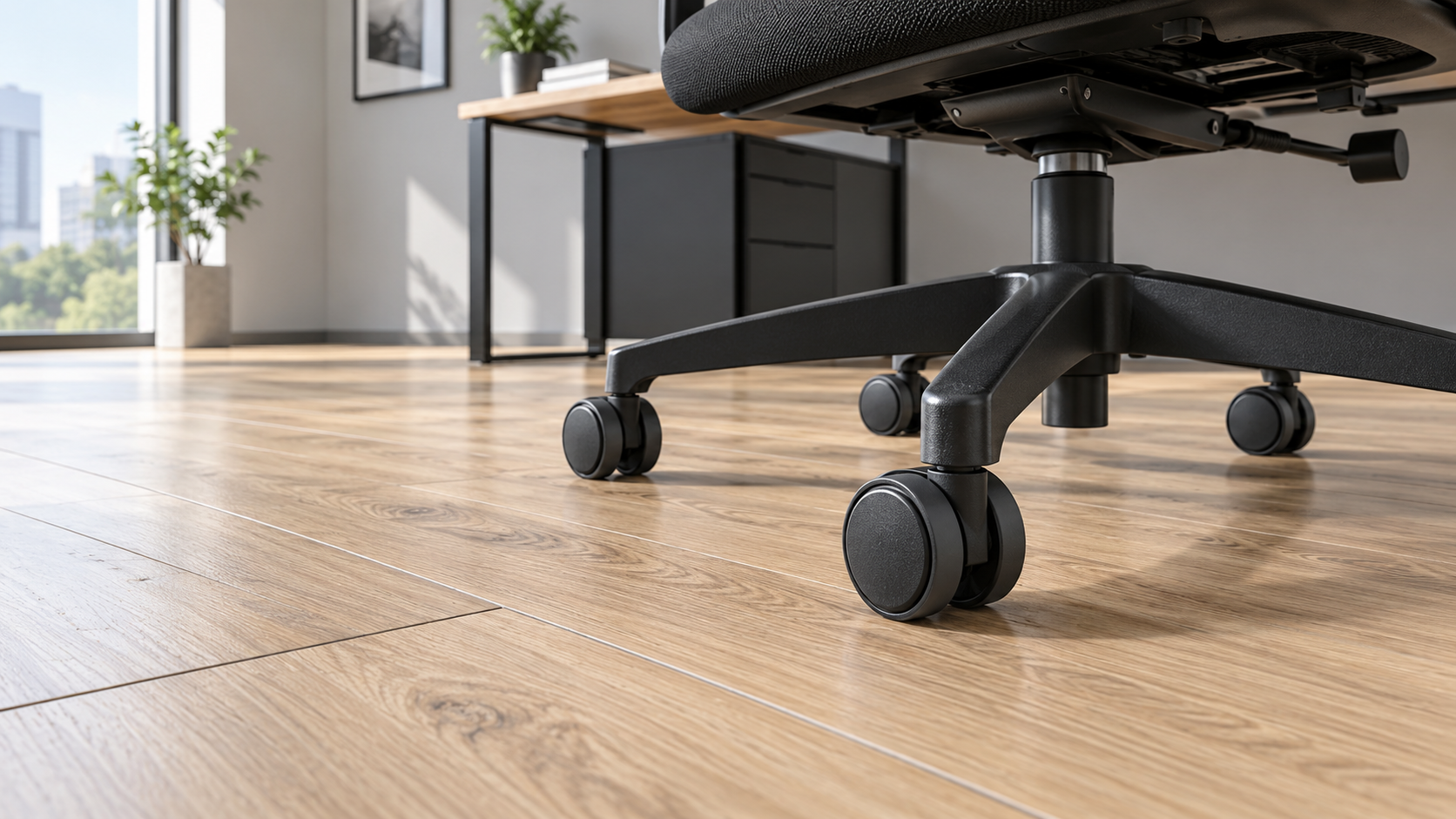
Walking spreads movement across a room. A desk chair repeatedly loads a small area, often crossing the same plank edges whenever its user turns, reaches, or pushes away from the desk. Swiveling wheels also introduce turning forces rather than straightforward rolling alone.
Three damage mechanisms deserve attention. Surface abrasion can dull the decorative finish, particularly where dust and grit collect. Repeated loading can stress locking joints if the planks flex excessively. Moisture from spills or unsuitable cleaning can swell vulnerable edges, leaving raised lips that receive further wheel impacts.
These problems do not necessarily appear together. A floor may retain an attractive surface while developing movement at its joints. Conversely, a mechanically sound installation can show visible scratching caused by damaged wheels. Inspection should therefore consider appearance, joint condition, and underfoot stability separately.
Read beyond the AC rating
An abrasion class, commonly expressed as an AC rating, describes resistance to a specified abrasion test. It is useful when screening laminate products, but it does not independently establish resistance to rolling-chair damage. Treating a higher AC number as blanket approval for office use leaves an important gap in the specification.
Commercial-use classifications provide broader context. In the European classification framework, classes 31, 32, and 33 distinguish levels of commercial use. However, a classification should be read alongside the applicable product standard and technical documentation—not translated automatically into approval for every workstation arrangement.
For laminate supplied to European specifications, EN 13329 is a relevant product standard. ISO 4918 is a relevant castor-chair test method for floor coverings. References and editions can vary between documents, so request the actual test basis rather than accepting an unexplained “chair-resistant” symbol.
The supplier should identify the tested product, its construction, the test method, the result, and any limitations. Ask whether the tested assembly included a particular underlay and what castor type was used. A report for another collection or a different floor build-up may not support the proposed installation.
- Abrasion rating: useful evidence of surface wear resistance, not a complete rolling-load assessment.
- Commercial classification: an indication of intended use intensity within the stated framework.
- Castor-chair testing: evidence addressing repeated chair movement under defined laboratory conditions.
- Written application approval: confirmation that the manufacturer accepts the proposed office use and protection measures.
No single item replaces the others. A test result is especially valuable when its conditions can be compared meaningfully with the planned workspace.
The subfloor and underlay can determine the outcome
Floating laminate depends on continuous, stable support. Where the subfloor has local depressions, chair wheels can repeatedly deflect the boards over those areas. The resulting movement puts stress on the locking connections, even when the surface itself resists wear.
Specify flatness against the flooring manufacturer's installation limits and verify it before laying begins. “Level” and “flat” are not interchangeable: a gently sloping surface may provide consistent support, while an apparently level floor can contain problematic hollows. Record moisture checks and any remedial work as part of installation acceptance.
Underlay should be selected for compatibility with the floor system, not simply for softness or advertised acoustic comfort. An excessively yielding layer can allow more joint movement under chair loads. Request the manufacturer's approved underlay requirements, including relevant compressive and dynamic-load properties. Do not add another layer beneath boards with integrated backing unless expressly permitted.
Expansion provisions also need coordination with the fit-out. Fixed cabinetry, partitions, or heavy installations can restrain a floating floor if detailed incorrectly. Before handover, confirm that workstation installation has not compromised the movement allowances required by the flooring supplier.
Specify the chair wheels, not just the flooring
Furniture procurement and flooring procurement often run separately. That separation creates avoidable risk: the floor package may assume suitable soft-tread castors, while the furniture package supplies hard wheels intended for carpet.
Use castors explicitly approved for hard floors and compatible with the laminate manufacturer's requirements. These commonly have a softer running surface, but appearance and color are unreliable guides. Obtain the chair or castor supplier's description rather than assuming that every replacement wheel is suitable.
Wheel condition matters after occupancy. A seized castor can drag instead of roll; embedded grit can turn the tread into an abrasive contact point. Cleaning and checking castors should therefore be part of workstation maintenance, especially near entrances or in spaces where outdoor dirt is frequently tracked inside.
A chair mat can add protection where required by the warranty or justified by concentrated use. Choose one approved for hard floors, with a compatible backing and sufficient coverage for the chair's actual movement. Carpet-style studs can damage laminate, and a mat that is too small leaves wheels repeatedly crossing its edge.
Protection still needs maintenance. Dirt or moisture trapped beneath a mat can create another damage mechanism. Include periodic lifting and cleaning in the facilities plan, and check that mat edges do not obstruct nearby circulation routes.
Match the decision to the workstation, not the building label
An “office” can mean a meeting room used intermittently or a densely occupied operation with chairs moving across several shifts. Those are different exposures. Map the areas where chairs actually roll and identify grit, moisture, and maintenance conditions before selecting a single finish throughout.
Laminate's hard surface can also make rolling noise noticeable. If acoustic comfort is important, assess the complete floor assembly and room design. An impact-sound figure for an underlay does not, by itself, describe how chair movement will sound within an occupied office.
When another flooring system deserves consideration
Laminate can be a reasonable choice for dry offices seeking a wood-look finish with documented commercial performance. It becomes less attractive when persistent moisture, unusually intensive chair use, or difficult subfloor conditions conflict with the proposed system's limitations.
Commercial resilient flooring, carpet tile, and other finishes may offer different trade-offs, but none should be assumed immune to rolling-chair problems. Resilient products require assessment for indentation and rolling loads. Carpet tile needs appropriate chair compatibility and can make movement harder. Repair methods, acoustics, cleaning, and installation constraints should be compared alongside purchase price.
A representative mock-up can help resolve uncertainty about rolling resistance, noise, mat coverage, and visible joint movement. It is useful for evaluating usability, though it does not replace laboratory testing or establish long-term durability.
Close the documentation gaps before placing the order
A commercial warranty may contain conditions that are not obvious in a brochure. Check whether rolling chairs are covered, whether protective mats are mandatory, which castors are permitted, and what installation records must be retained. Also distinguish wear-through coverage from scratches, edge damage, joint failure, and moisture exclusions.
For cross-border sourcing, verify that technical documents and warranty terms apply to the exact product supplied and the destination market. A collection name can cover different constructions or regional offers. Confirm product codes, installation accessories, replacement availability, and who handles claims locally. Attractive pricing offers limited reassurance if the supporting documentation belongs to another specification.
Before approval, assemble one coordinated record: the intended workstation use, product data, relevant test evidence, approved underlay, subfloor acceptance criteria, castor requirements, and maintenance instructions. Give the furniture supplier and facilities team the same requirements rather than leaving them in the flooring contractor's file.
Laminate flooring for office projects can withstand rolling chair traffic when those elements align. If the supplier cannot confirm the proposed use in writing, do not compensate by choosing a higher abrasion rating alone. Resolve the missing evidence, change the protection strategy, or select a floor system with clearer support for the actual working conditions.
Facing technical bottlenecks in manufacturing or looking for more efficient industrial solutions? Leave your details below and let the engineering experts at GIi solve them for you.
“We respect your privacy. Your information is strictly confidential.”
Technical Specifications
- How to verify the consistency of PVC resin from a supplier in EuropeAuthor :Polymers & Rubber Editorial Team
- How to choose polyethylene grades in Saudi Arabia for film productionAuthor :Polymers & Rubber Editorial Team
- US Finds Imported Robots a Security Threat, Defers Tariffs for 180 DaysAuthor :Industrial Machinery Editorial Team
Expert Insights

Chief Security Architect
Dr. Thorne specializes in the intersection of structural engineering and digital resilience. He has advised three G7 governments on industrial infrastructure security.
Core Sector // 01
Security & Safety
- Can laminate flooring for offices withstand rolling chair traffic?Author :Construction Materials Editorial Team

- Is E1 laminate flooring suitable for high-traffic retail stores?Author :Construction Materials Editorial Team

- How to stop oak wood flooring from developing gaps in winterAuthor :Construction Materials Editorial Team

- Is solid wood flooring suitable for kitchens with changing humidity?Author :Construction Materials Editorial Team

- Does E1 laminate flooring meet low-emission needs for bedrooms?Author :Construction Materials Editorial Team

- Which flooring materials hold up best in high-traffic commercial spaces?Author :Construction Materials Editorial Team

- What Should Buyers Check Before Importing Wood Flooring?Author :Construction Materials Editorial Team

- Is Demand for Imported Wood Flooring Growing in Europe?Author :Construction Materials Editorial Team