Selected grades of TPE-S, polyether TPU, TPV, and TPE-E remain useful below freezing, but no material family guarantees flexibility at a specified temperature.
For technical evaluators comparing thermoplastics elastomers, the answer depends on polymer chemistry, formulation, and mechanical demands, rather than simply a supplier’s minimum service temperature.
A cable jacket that bends successfully at −40°C may still perform poorly as a compressed seal, where recovery and contact pressure determine functional reliability.
The strongest shortlist combines a suitable soft-phase glass-transition temperature with measured stiffness, relevant cold testing, and evidence from components manufactured using the intended process.
This guide explains which families deserve consideration, how their limitations differ, and what evidence supports approval for seals, cables, hoses, and other demanding applications.
Which TPE families should you shortlist for cold service?
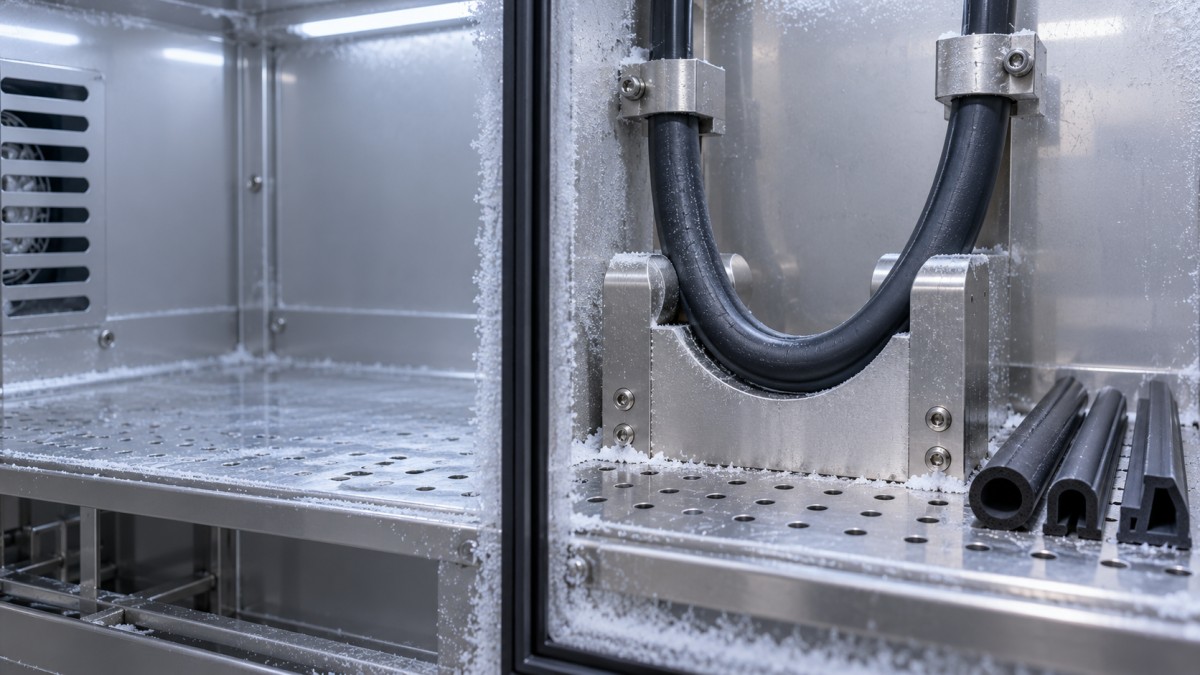
Start with the failure mode your application cannot tolerate. Flexibility, resistance to sudden impact, and elastic recovery describe different behaviors and require different evidence.
The following comparison identifies useful starting points. It does not establish temperature ratings: commercial grades within each family can differ substantially in cold performance.
At −20°C, a broader range of grades may qualify. At −40°C, grade selection and component testing become especially important for repeated movement or sealing.
For −50°C or colder conditions, seek explicit grade-specific evidence. Avoid extending a supplier’s published range beyond the tested conditions without additional qualification data.
Why glass-transition temperature cannot answer the question alone
Glass-transition temperature, or Tg, indicates a transition toward reduced molecular mobility. Approaching this region generally increases stiffness and can reduce an elastomer’s ability to recover.
Many TPEs contain distinct soft and hard phases. A reported Tg may describe the soft phase without capturing the stiffness of the finished compound.
Consequently, a low Tg supports initial screening but does not prove that a molded gasket will maintain contact pressure or a hose will remain bendable.
Dynamic mechanical analysis helps show how storage modulus changes with temperature. Request the curve, test frequency, strain conditions, and the method used to identify Tg.
Testing frequency matters because polymer response depends on loading timescale. Slow handling, continuous vibration, and sudden impact can produce different outcomes at the same temperature.
Room-temperature Shore hardness also needs context. Two grades with similar hardness can stiffen differently in the cold because their polymer structures and formulations differ.
For design calculations, request modulus or force measurements at the actual operating temperature. Room-temperature hardness should support purchasing consistency, rather than replace cold-performance evidence.
When are TPE-S and polyether TPU the strongest candidates?
TPE-S for soft, flexible components
TPE-S compounds include styrenic block copolymers such as SBS and SEBS. Their soft phases can support cold flexibility, while hard domains provide physical crosslinks.
SEBS-based compounds often deserve consideration where outdoor exposure and aging resistance matter. Nevertheless, the complete formulation determines whether a particular grade meets cold requirements.
Plasticizing oils can improve softness, while fillers and other ingredients alter stiffness, strength, and recovery. Check whether fluid exposure or aging changes those properties.
For boots, grips, and lightly loaded seals, evaluate bending force and recovery after cold conditioning. A soft feel at room temperature provides insufficient assurance.
Polyether TPU for moving parts exposed to wear
Polyether TPU is frequently a strong starting point for flexible cables, tubing, and protective components that require abrasion resistance alongside useful performance below freezing.
Compared with many polyester TPU grades, polyether TPU often provides better low-temperature flexibility and hydrolysis resistance. However, specialized formulations can change this general comparison.
Polyester TPU may still suit applications where oil resistance or mechanical properties dominate. Compare actual candidate grades under the relevant combination of temperature and exposure.
For moving cables, qualify the completed cable construction. Conductor arrangement, jacket thickness, bend radius, and movement frequency can determine failure even when the polymer performs well.
When do TPV and TPE-E make more sense?
TPV for weather-exposed seals and flexible profiles
Many commercial TPVs contain dynamically vulcanized EPDM rubber within a polypropylene phase. Selected grades offer useful combinations of weatherability, processing efficiency, and elastic behavior.
For cold sealing, assess the compound as a complete system. The EPDM phase alone cannot establish the stiffness or recovery of the finished TPV.
A gasket may remain unbroken while becoming too stiff to follow joint movement. Leakage can therefore occur without visible cracking or obvious material damage.
Request cold recovery and sealing-force data under representative compression. Include the mating surfaces, tolerances, and pressure differential when validating a proposed sealing grade for production.
TPE-E for flexible parts carrying mechanical loads
TPE-E grades can provide fatigue resistance, strength, and useful cold toughness. They often suit bellows, boots, and tubing that must flex while retaining shape.
Some grades remain comparatively stiff despite resisting brittle failure. This makes them potential candidates for mechanical components, but does not establish suitability for soft seals.
Check hydrolysis stabilization when warm moisture, cleaning, or fluid exposure precedes cold service. An aged component may behave differently from a freshly molded specimen.
For pressure tubing or bellows, measure cold actuation forces and fatigue life. Excessive stiffness can overload surrounding equipment before the material itself visibly fails.
Which low-temperature tests actually support a material decision?
A useful test plan separates brittle failure, deformation resistance, elastic recovery, and assembly performance. Each answers a different question about the proposed service conditions.
Ask suppliers to identify the test method and edition, specimen geometry, conditioning period, temperature, and pass criterion. A temperature value without these details is ambiguous.
- Brittleness testing: ASTM D746 or ASTM D2137, where applicable, assesses failure under specified impact conditions. Passing does not demonstrate easy bending, fatigue life, or sealing recovery.
- Stiffness testing: DMA or a suitable low-temperature stiffness method helps quantify resistance to deformation. ASTM D1053 may be relevant when its scope fits the material and specimen.
- Temperature retraction: ASTM D1329 or ISO 2921 can help characterize low-temperature recovery of suitable rubber-like materials. Confirm applicability to the candidate TPE and intended interpretation.
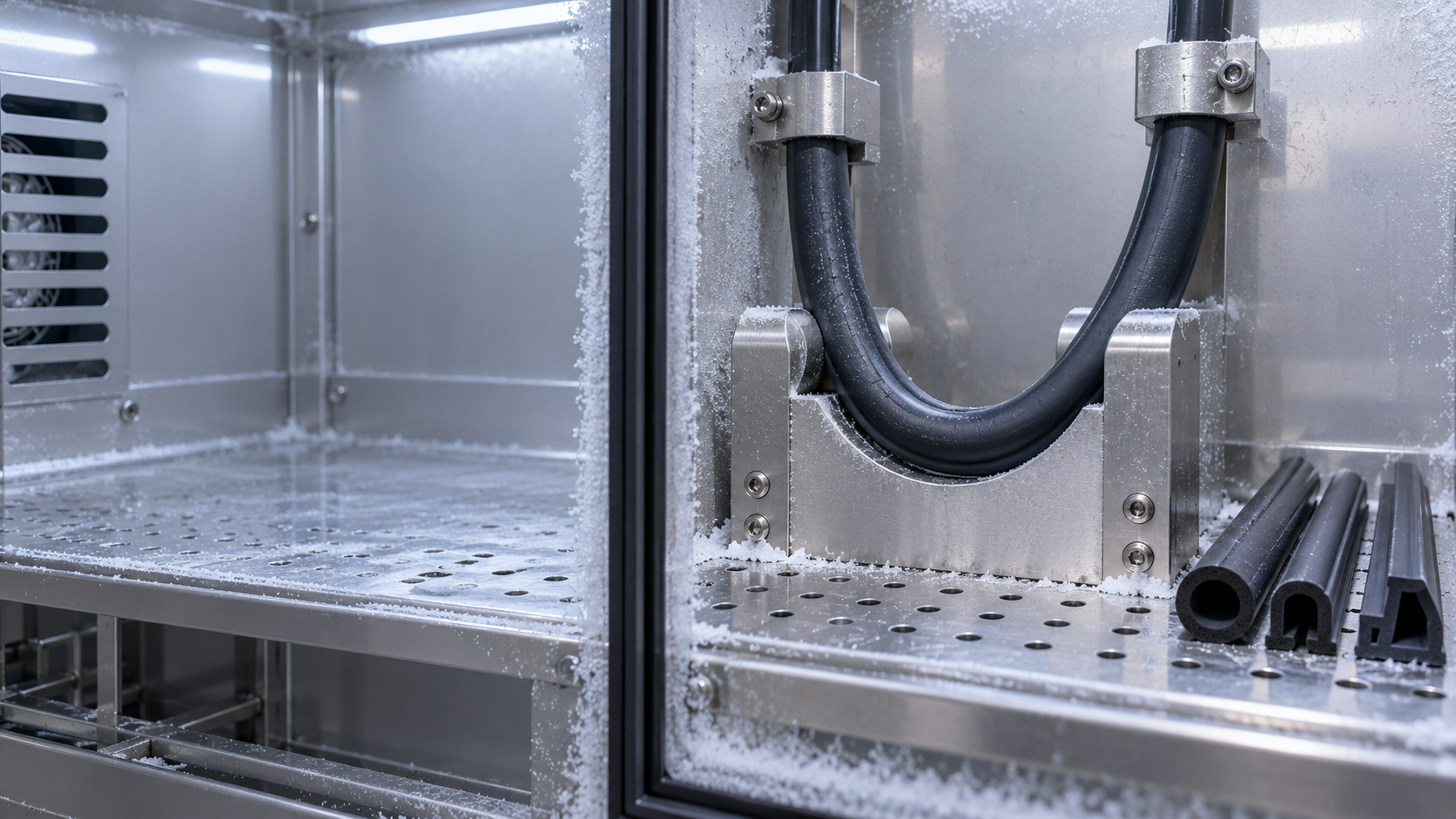
- Component testing: Cold bending, leakage, pressure cycling, or repeated flexing should reproduce the actual assembly, loading rate, installation constraints, and expected exposure sequence.
For seals, room-temperature compression set cannot predict cold contact force by itself. Evaluate recovery and leakage while the assembly remains at the specified low temperature.
For hoses and cables, distinguish a single installation bend from continuous movement. A material may tolerate occasional handling yet fail during repeated cold flexing.
Condition samples long enough for their temperature to stabilize, including thick sections. Testing immediately after chamber entry can overstate performance because the core remains warmer.
Likewise, avoid warming specimens during transfer or fixture setup. Where practical, perform measurements inside a controlled chamber and document the temperature at the specimen.
How should you compare supplier claims and qualify a grade?
Translate the application into measurable requirements before requesting recommendations. “Flexible at −40°C” is incomplete unless flexibility has a defined load, displacement, recovery, or leakage limit.
Separate storage, installation, and continuous operating temperatures. A component stored outdoors may tolerate conditions that would prevent safe installation or reliable movement under load.
Build qualification around the following information so suppliers can recommend specific grades and provide evidence that matches your application, rather than broad product-family claims.
- Define service conditions: Specify minimum temperature, exposure duration, movement frequency, applied loads, pressure, chemicals, weathering, and whether the component must function during cold startup.
- Set acceptance criteria: Establish maximum bending force, allowable leakage, minimum recovery, or required fatigue cycles. Tie each threshold to a functional need in the assembly.
- Request comparable evidence: Obtain grade identification, hardness, cold-property data, test conditions, and relevant aging results. Clarify whether published values are typical results or guaranteed limits.
- Validate production parts: Test components made with the intended tooling, wall thickness, processing conditions, pigments, and permitted regrind content. Include representative dimensional tolerances and assembly variation.
Cold exposure should also follow relevant aging where service demands it. Oil immersion, heat, ultraviolet exposure, or cleaning chemicals can change subsequent stiffness and recovery.
Where moisture or condensation occurs, distinguish polymer limitations from ice-related failure. Frozen water in joints or mechanisms can restrict movement independently of material flexibility.
For sourcing decisions, confirm the exact grade, manufacturing location where relevant, and formulation-change notification process. Similar product descriptions do not establish equivalent cold performance.
Compare total functional cost after qualification. A cheaper compound can require thicker sections, higher actuation forces, or more frequent replacement, changing the economics of selection.
What is the practical selection rule?
Shortlist TPE-S for soft flexibility, polyether TPU for flexibility with wear resistance, TPV for weather-exposed elastic components, and TPE-E for mechanically demanding flexible parts.
Then narrow the choice using grade-specific stiffness, recovery, and failure data at your operating temperature. Treat Tg and service-temperature claims as screening information requiring context.
Approve the material only after representative components meet defined functional limits following relevant conditioning and aging. That evidence connects laboratory properties to reliable field performance.
The best low-temperature thermoplastic elastomer is the grade that preserves the required movement, sealing force, or toughness throughout service, with consistent supply and documented performance.