Why Do Polypropylene Prices Differ by Region?
Author
Date Published
Reading Time
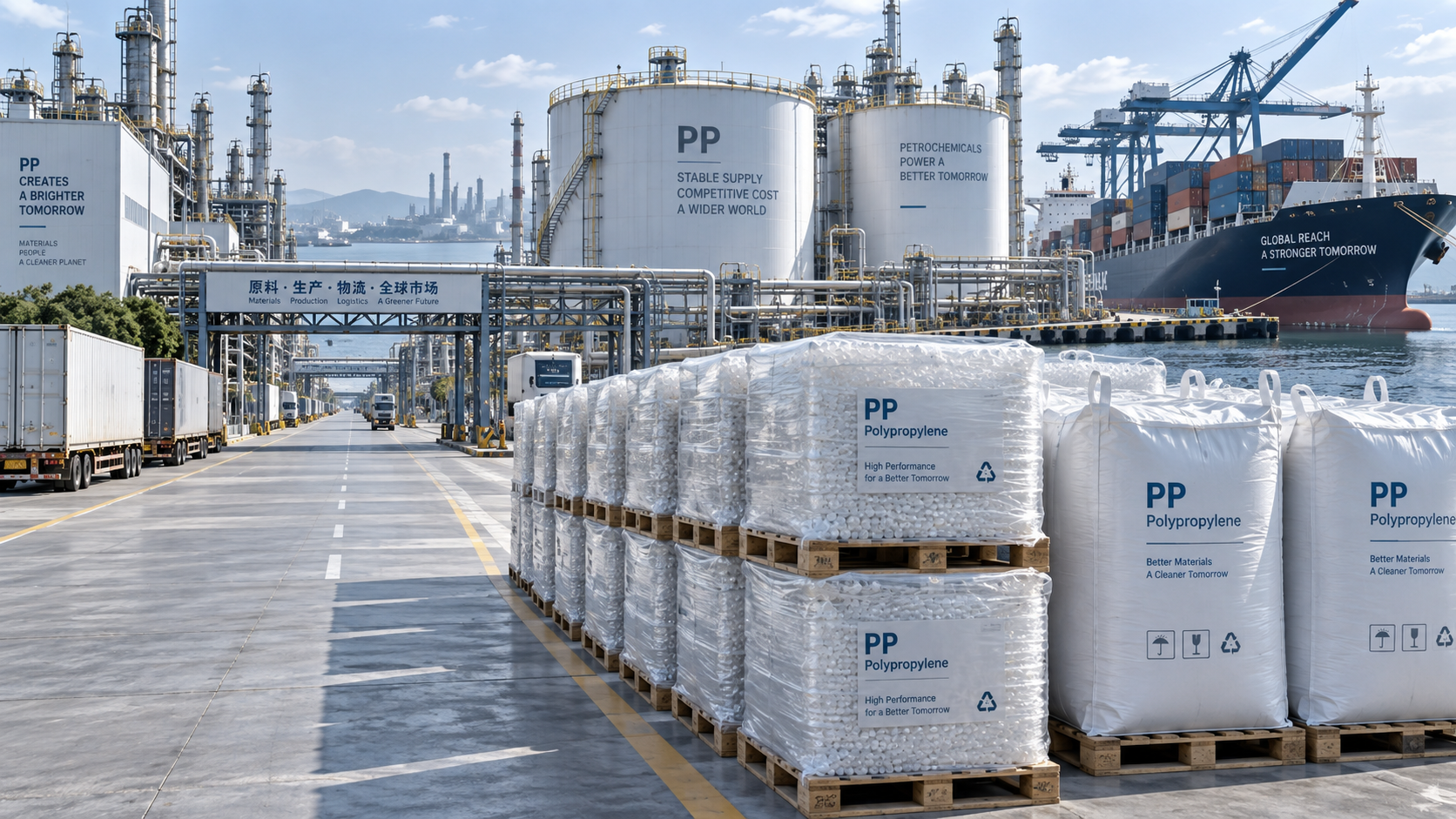
Polypropylene prices differ by region because polypropylene is not traded as a single, fully interchangeable global commodity. The same broad grade category—such as raffia, injection, film, fiber, impact copolymer, or random copolymer—can carry very different delivered costs depending on the local feedstock chain, plant economics, available supply, trade barriers, logistics conditions, and the specific demand mix in that market.
A low ex-works price in one producing country does not automatically make that origin the lowest-cost option for an importer. Ocean freight, port handling, duties, currency movements, financing costs, lead time, and the risk of grade substitution can remove an apparent price advantage. The useful comparison is therefore not simply regional quotes, but the landed and usable cost of a compliant grade at the destination.
How does feedstock availability affect polypropylene pricing?
Polypropylene (PP) is produced from propylene, which is obtained through several refinery and petrochemical pathways. The cost and availability of propylene are among the most important reasons why regional PP pricing differs.
In refinery-centered markets, propylene may be generated from fluid catalytic cracking units. In regions with large steam-cracking systems, propylene supply may be linked to naphtha, liquefied petroleum gas, or other cracker feedstocks. In some locations, propane dehydrogenation (PDH) has become an important dedicated source of propylene. Each route has a different exposure to crude oil, naphtha, propane, natural gas liquids, refinery operating rates, and by-product economics.
This matters because a PP producer does not buy “global propylene” at one universal price. A producer integrated with a refinery or an upstream propylene unit may have a different cost position from a merchant PP producer that purchases propylene under a local contract formula. Even when two producers use similar polymerization technology, their economics can diverge sharply.
Feedstock advantages are also conditional. A region with access to competitively priced propane may support attractive PDH economics, but this advantage can narrow if propane prices rise, propylene demand weakens, or new capacity competes for the same feedstock. Likewise, naphtha-based producers can face cost pressure when crude-linked feedstocks rise faster than regional PP selling prices.
Why do production capacity and operating rates matter so much?
Polypropylene pricing reflects the balance between local supply and local consumption, not merely the total nameplate capacity announced for a region. Large capacity additions can place pressure on prices when output exceeds nearby demand and producers need export outlets. Conversely, a region may show high prices despite having local production if plants are running below normal rates or if supply is concentrated among a small number of producers.
Operating disruptions often have a stronger immediate effect than long-term capacity statistics. Unplanned outages at a propylene unit, refinery, cracker, PP reactor, port terminal, or power facility can tighten local availability quickly. Planned maintenance can have a similar effect when inventories are already low. The impact differs by region because some markets have multiple nearby suppliers and flexible import channels, while others depend on a limited number of plants or a single trade route.
Grade availability is equally important. A market may have ample supply of general-purpose homopolymer injection grades but limited availability of high-melt-flow fiber grades, clarified random copolymers, reactor-grade impact copolymers, or grades with specific regulatory documentation. The premium for the required grade may therefore be much wider than the published gap between benchmark PP prices.
Why can the same PP grade have different regional demand value?
Polypropylene demand is not uniform across regions. Packaging, automotive components, household goods, nonwovens, fibers, pipes, appliances, caps and closures, and industrial molded products each consume different PP grade families. Their buying patterns are shaped by local manufacturing activity, conversion capacity, product standards, seasonality, and export demand for finished goods.
A region with strong demand for woven sacks and flexible packaging may place greater emphasis on raffia and film grades. Another market with significant automotive compounding and molding activity may absorb more impact copolymers. Where hygiene-product manufacturing is important, fiber-grade PP and stable supply specifications can command closer attention. These differences influence both the price level and the relative premium between grades.
Demand also affects seller behavior. When domestic converters are purchasing steadily, producers may prioritize local contractual customers over spot exports. When domestic demand is weak, surplus material may be offered into export markets more aggressively. That does not mean exported cargo is inferior; it means the commercial urgency and destination alternatives affect the price at which material is offered.
What role do freight and logistics play in regional PP price gaps?
Freight is one of the clearest explanations for why is polypropylene pricing different by region, yet it is often underestimated when buyers compare headline offers. PP is commonly shipped in containers or breakbulk cargoes, depending on route, volume, port infrastructure, and contractual arrangements. The delivered cost can be affected by ocean freight, inland trucking or rail, terminal handling, container availability, documentation charges, insurance, detention exposure, and demurrage risk.
For destinations far from major producing hubs, logistics can form a material share of the total acquisition cost. A low-priced export offer may become uncompetitive after freight and destination charges are included. Short-haul regional supply can remain preferable even when its resin price is higher, particularly where it reduces inventory requirements and protects production continuity.
Transit time is a cost factor as well. Long import lead times require larger safety stocks, tie up working capital, and increase exposure to price movements between order placement and delivery. Importers also need to consider the practical reliability of the route: port congestion, transshipment dependency, weather disruption, shipping-line schedule changes, and the availability of suitable equipment can all affect whether a nominally cheaper origin is commercially viable.
It is useful to distinguish between freight cost and logistics risk. Freight may be known at the time of booking; the cost of late arrival, production interruption, or emergency replacement buying is much harder to capture in a unit-price comparison.
Do tariffs, trade remedies, and local taxes create lasting price differences?
Yes. Import duties, anti-dumping measures, countervailing duties, safeguard actions, customs procedures, and local indirect taxes can alter the competitive position of imported PP. These measures are not uniform across countries, and their effect depends on product classification, origin, producer identity, and the exact legal scope of the measure.
A buyer should not assume that all PP under a broad customs heading receives identical treatment. Trade remedies can apply to specified origins, exporters, or product definitions. Certain grades, applications, or tariff codes may be treated differently. Preferential tariff arrangements may also be available when origin rules are met, but those rules require valid supporting documentation and cannot be inferred from the loading port alone.
Taxes need to be separated into recoverable and non-recoverable costs. Import VAT or goods-and-services tax may be recoverable for some businesses, while customs duty or a trade-remedy duty generally becomes a direct cost. Brokerage fees, compliance administration, testing requirements, and delays caused by document discrepancies can also affect the real import cost.
Policy changes can shift trade flows even before a formal duty is imposed. If importers anticipate stricter trade measures, they may build inventory, redirect sourcing, or favor domestic supply. These actions can temporarily widen regional price gaps independent of feedstock fundamentals.
Why does currency matter if PP is often quoted in US dollars?
Dollar-denominated offers do not eliminate currency exposure. A buyer that sells finished goods in a local currency but pays for resin in US dollars faces a margin risk whenever the local currency moves. A weakening local currency raises the domestic-currency cost of imports even if the seller’s dollar price is unchanged.
Currency also affects producers. Export-oriented producers may become more competitive when their domestic currency weakens against the dollar, while import-dependent regions can see local PP prices rise because replacement cargo becomes more expensive. The timing of payment terms, letters of credit, forward contracts, and inventory turnover can therefore influence purchasing decisions as much as the resin quote itself.
For cross-border comparisons, prices should be converted on a consistent basis: same currency, same incoterm, same shipment period, same payment assumptions, and the same treatment of taxes and duties. Comparing a spot CFR offer with a domestic price that includes credit terms and local delivery is not a valid price comparison.
Are published regional benchmarks enough for making a sourcing decision?
They are useful indicators, but they are not a substitute for a grade-specific purchasing calculation. Published assessments may refer to a defined product category, volume range, delivery basis, and assessment period. An actual transaction can differ because of grade specification, packaging format, credit quality, order size, monthly contract commitments, supplier relationship, certification requirements, and destination logistics.
A benchmark for homopolymer injection may not represent the economics of a random copolymer used in transparent food packaging. An index may also reflect bulk market conditions while a converter needs palletized bagged material, consistent lot traceability, and a narrow processing window. The commercial premium for those requirements can be significant even where the base resin market is soft.
Regional pricing should therefore be treated as a directional signal: it shows where supply may be long or tight, where import arbitrage may be open, and where a supplier’s export incentive may be changing. It does not prove that a specific cargo can be bought, cleared, processed, and delivered at that benchmark level.
Why are polymer specifications more important than a simple “PP price per ton”?
Polypropylene is a family of materials, not one identical resin. Homopolymers, random copolymers, and impact copolymers have different performance profiles. Within those families, melt flow rate, stiffness, impact resistance, ethylene content, additive package, odor, color control, clarity, food-contact status, and regulatory declarations can determine whether a grade is usable for a particular conversion process.
Replacing one origin with another based only on a lower price can create hidden costs. A change in melt flow may alter molding cycle behavior; a different additive package may affect slip, blocking, odor, antistatic performance, or printability; variation in stiffness and impact balance can affect finished-part quality. For film, fiber, extrusion, thermoforming, and injection molding applications, processing consistency can be more valuable than a small nominal discount.
The relevant comparison is the cost of producing an acceptable finished product, including scrap rate, downtime, qualification work, and customer approval requirements. A lower-cost resin that causes instability or fails downstream compliance checks is not a lower-cost sourcing option.
How should regional PP offers be compared on a like-for-like basis?
A practical comparison starts by fixing the exact technical and commercial basis of the requirement. The following questions prevent many misleading comparisons:
- Is the polymer type and grade family equivalent, including melt flow, copolymer structure, additives, and intended application?
- Are food-contact, chemical, automotive, electrical, or other compliance declarations required for the finished product?
- What incoterm applies, and which party pays freight, insurance, destination handling, customs clearance, and inland delivery?
- What duties, trade remedies, taxes, and origin-document requirements apply to the proposed cargo?
- How long is the lead time, and what inventory level is needed to manage it?
- Are payment terms, currency exposure, credit costs, and price-validity periods comparable?
- Can the supplier provide consistent lots, technical data, certificates of analysis, and traceability at the required volume?
Once those items are aligned, calculate landed cost and then adjust for usable value. The lowest landed number may still not be the best decision if it introduces unacceptable quality, continuity, or compliance risk. Conversely, a regional premium can be justified when local supply offers faster replenishment, reliable technical equivalence, and lower inventory exposure.
What is the most common misunderstanding about regional polypropylene prices?
The most common mistake is treating a regional price gap as a guaranteed arbitrage opportunity. A visible difference between two market quotations may reflect different grade definitions, delivery terms, timing, taxes, or local availability. Even where the gap is real, it may be too narrow to cover freight, financing, duties, handling losses, and the risk that the market moves before the cargo arrives.
A second mistake is assuming that domestic supply and imported supply are direct substitutes. They may not be. Local producers may offer short lead times, established approvals, technical support, or application-specific grades that are difficult to replace. Imported material may be fully suitable, but suitability should be established through documentation and controlled qualification rather than inferred from a similar product name.
Regional PP prices are best understood as the output of several connected markets: feedstocks, propylene, polymer capacity, converter demand, logistics, currencies, and trade rules. The price difference is not an anomaly to be explained away. It is the commercial result of those local conditions—and it can change quickly when any one of them shifts.
Technical Specifications
- Which local safety approvals apply to imported power suppliesAuthor :Electrical Components Editorial Team
- How to choose the right tempered glass panel for safety glazingAuthor :Construction Materials Editorial Team
- When do elastomers outperform thermoplastics in flexible seals?Author :Polymers & Rubber Editorial Team
Expert Insights

Chief Security Architect
Dr. Thorne specializes in the intersection of structural engineering and digital resilience. He has advised three G7 governments on industrial infrastructure security.
Core Sector // 01
Security & Safety
- Should Buyers Lock In Polypropylene Prices for Six Months?Author :Polymers & Rubber Editorial Team

- Why Do Polypropylene Prices Differ by Region?Author :Polymers & Rubber Editorial Team

- What Drives Polypropylene Price Changes in Packaging and Injection Molding?Author :Polymers & Rubber Editorial Team

- How to Evaluate a Polyethylene Manufacturer for Long-Term Supply ReliabilityAuthor :Polymers & Rubber Editorial Team

- Polypropylene Material Properties: Where PP Works Well and Where It Does NotAuthor :Polymers & Rubber Editorial Team

- Polypropylene vs PE: How to Select the Right Resin for Packaging ProductsAuthor :Polymers & Rubber Editorial Team

- Polyvinyl Chloride Grades Explained for Pipes, Sheets, and ProfilesAuthor :Polymers & Rubber Editorial Team

- What Affects Polyvinyl Chloride Pricing in Global Supply Chains?Author :Polymers & Rubber Editorial Team