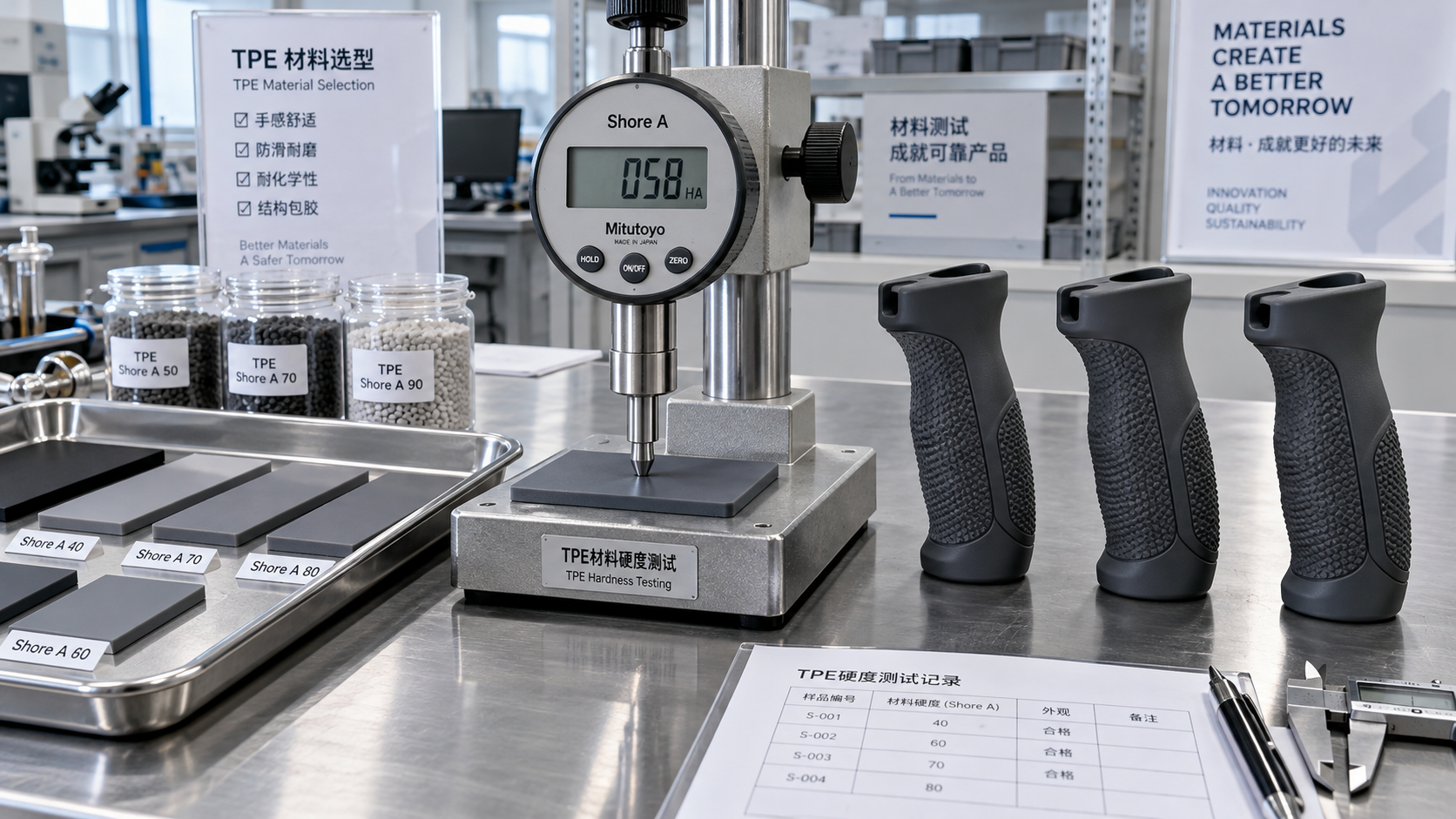
For handheld grips, soft touch TPE in the 30–60 Shore A range is a practical starting point, but hardness alone does not determine comfort or control.
A softer grade may improve cushioning, while a firmer formulation can offer greater support and resistance to deformation under sustained pressure or repeated handling loads.
For technical evaluators, the right choice also depends on grip geometry, overmold thickness, substrate adhesion, surface texture, and exposure to sweat, oils, or cleaning agents.
Start near 40–50 Shore A for general screening, then compare softer and firmer candidates using the intended grip construction, operating conditions, and representative user tasks.
Which Shore A Range Should You Evaluate First?
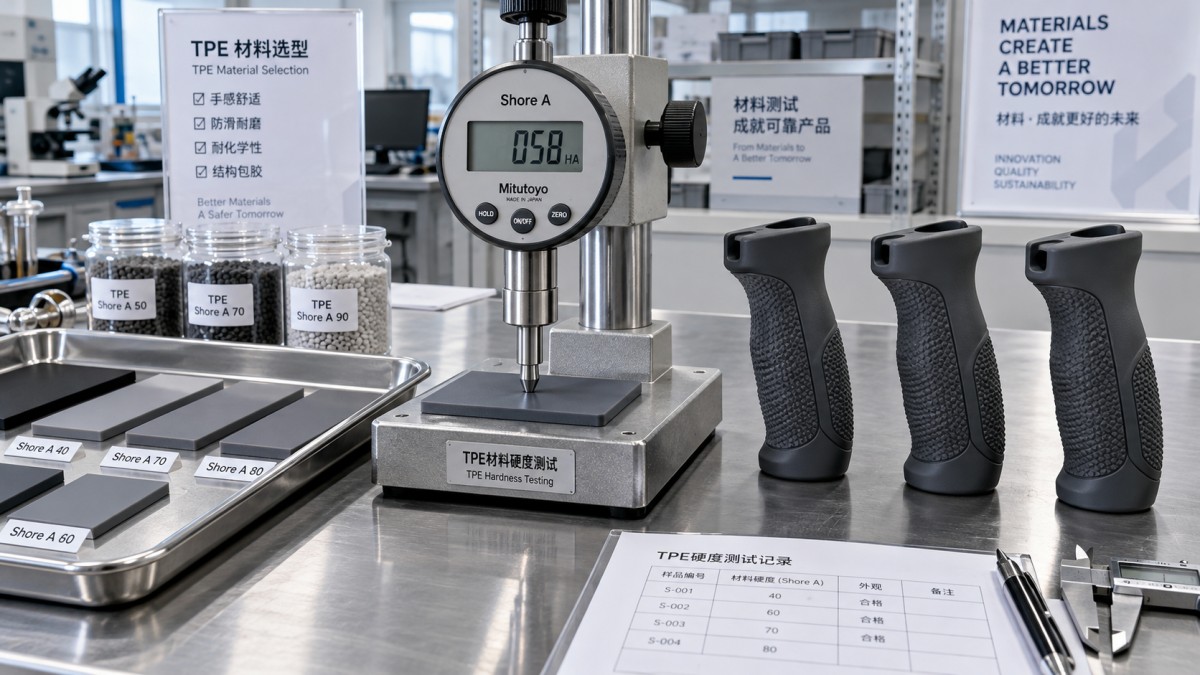
Use the following ranges to organize initial sampling. They describe useful evaluation directions, rather than universal specifications or guaranteed performance boundaries for finished handheld grips.
For an unspecified handheld product, request approximately 35, 45, and 55 Shore A samples within a suitable material family to establish an initial comparison set.
These separated points make differences easier to detect than closely spaced grades. Narrow the range after evaluating comfort, movement, traction, and visible damage on prototypes.
A grip supporting high torque may favor greater firmness, while a lightly loaded control may benefit from more compliance. Neither application has one mandatory hardness.
Keep the substrate and geometry consistent during this comparison. Otherwise, a construction change can appear to be a material improvement and misdirect the selection decision.
Why Can Two Grips With the Same Hardness Feel Different?
Shore A measures resistance to indentation under defined conditions. It does not directly measure comfort, friction, vibration damping, abrasion resistance, or the quality of adhesion.
Two compounds rated 45 Shore A can differ in rebound, stress relaxation, surface tack, and friction. Those differences become noticeable during squeezing, repositioning, and sustained holding.
Material family also matters. Styrenic TPE, TPU, and TPV formulations can offer different property combinations, although performance varies substantially within each family and individual grade.
A soft formulation may feel initially comfortable yet allow unwanted movement during precision work. Another may feel less yielding but maintain more consistent hand positioning.
Ask suppliers for grade-specific data covering the relevant properties. General statements about a polymer family cannot establish how a particular commercial compound will perform.
Record both subjective impressions and measurable outcomes. A panel preference becomes more useful when connected to task accuracy, grip movement, pressure distribution, or fatigue ratings.
How Do Overmold Thickness and Grip Geometry Change the Choice?
The same soft touch TPE can feel noticeably firmer over a thin section because the rigid substrate limits indentation and dominates the response under pressure.
A thicker section permits more displacement, but additional thickness can introduce molding challenges, dimensional variation, or excessive movement. Increasing thickness is therefore not automatically beneficial.
Compare candidate materials at the intended nominal thickness and at critical local sections. Flat supplier plaques are useful for screening, but cannot reproduce every grip feature.
Rounded transitions, grip diameter, ribs, and finger contact areas influence pressure distribution. Correcting a narrow pressure ridge may improve comfort more than reducing compound hardness.
For example, a thin 35 Shore A skin over a rigid handle may feel less compliant than a thicker 45 Shore A contact pad.
That comparison illustrates construction effects rather than a predictable ranking. Prototype measurements and handling trials must establish whether the difference holds for your specific design.
Does Softer TPE Actually Improve Grip With Sweat or Oil?
Lower hardness does not guarantee greater friction. Traction depends on the compound, surface finish, contact pressure, contamination, and whether the user wears gloves during operation.
A dry surface that feels reassuringly tacky can behave differently after exposure to perspiration, skin oils, sunscreen, or cleaning residues encountered in its intended environment.
Texture can improve purchase, but sharp or closely spaced features may create pressure points or retain contamination. Evaluate texture together with the chosen material formulation.
Use representative handling conditions instead of relying only on a fingertip assessment. Include dry hands, damp hands, and the actual glove types specified for use.
Where slip could compromise control, measure resistance to axial movement and rotation using a defined fixture or repeatable task with consistent loading and contact conditions.
Compare results before and after relevant contamination and cleaning cycles. A candidate should preserve adequate control throughout expected service conditions, not merely when newly molded.
Which Durability and Adhesion Checks Matter Before Approval?
Hardness cannot substitute for wear testing. Assess abrasion, edge tearing, scratching, and damage around thin features using loads and contact materials representative of actual service.
For grips exposed to sustained compression, examine permanent deformation and recovery. Compression set data can support screening, but the test conditions must match the comparison.
Chemical compatibility requires similar care. Specify the substances, concentrations, exposure times, and temperatures rather than asking whether the material is broadly oil-resistant or cleaner-resistant.
Check for swelling, softening, hardening, discoloration, tack development, and loss of strength after exposure. Also inspect whether chemical contact weakens the overmold-to-substrate interface over time.
Adhesion depends on the exact TPE grade, substrate resin, surface condition, and molding process. Compatibility with one substrate does not establish compatibility with another.
Use a defined peel or pull method on representative molded parts, recording failure location. Interfacial separation and tearing within the elastomer indicate different failure mechanisms.
- Wear: Define acceptable surface loss, texture retention, and damage after a representative number of handling or abrasion cycles.
- Recovery: Specify acceptable residual deformation after sustained loading and an agreed recovery period at relevant temperatures.
- Adhesion: Establish force requirements, specimen geometry, conditioning, and acceptable failure behavior before comparing supplier results.
- Aging: Repeat critical checks after relevant heat, humidity, chemical, or ultraviolet exposure where the application requires them.
How Should You Compare Shore Hardness Data From Suppliers?
Ask which test method produced the reported value, commonly ASTM D2240 or ISO 48-4. Confirm the scale, specimen preparation, thickness, conditioning, and reading time.
Use the same method and conditions for comparative testing. Values reported under different procedures should not be treated as precisely interchangeable without establishing suitable correlation.
Thin overmolds and curved surfaces can produce misleading readings because the substrate and geometry influence indentation. Measure suitable specimens when establishing the compound’s reference hardness.
Keep finished-part checks separate from standardized material measurements. Both can support quality control, provided their purposes, fixtures, and acceptance limits are clearly documented in advance.
Request the supplier’s specification range and lot documentation, not only a nominal brochure value. A nominal 45 Shore A designation is not a complete acceptance criterion.
If two candidate grades differ by only a few Shore A points, confirm that measurement variation and specification tolerances do not obscure the intended distinction.
What Should a Practical Grip Evaluation Include?
Begin with a short application brief covering grip loads, holding duration, operating temperature, contamination, cleaning, substrate resin, and intended overmold dimensions before requesting production candidates.
Identify the dominant failure risk first. Precision controls may prioritize positional stability, while frequently carried equipment may place greater emphasis on sustained comfort and cleanability.
Then compare three candidate hardness levels with consistent construction. Select grades designed for the substrate and molding process, rather than forcing unsuitable materials into testing.
- Screen materials: Review technical data, processing requirements, chemical compatibility, and application-specific regulatory documentation before investing in prototype tooling.
- Mold representative samples: Include realistic thickness, texture, edges, substrate preparation, and process settings so handling results reflect the intended construction.
- Run controlled handling trials: Use representative users, repeatable tasks, consistent conditions, and randomized sample order where practical to reduce preference bias.
- Challenge shortlisted candidates: Test wear, adhesion, contamination, cleaning, and environmental aging against predefined requirements before selecting the production grade.
Keep separate scores for comfort, traction, stability, and durability. Combining everything into one immediate preference score can hide a critical weakness in an otherwise appealing sample.
Define mandatory pass criteria before reviewing preferences. A comfortable grip that fails adhesion or loses control after cleaning should not advance solely because users like it.
After selection, confirm performance on parts made within the proposed production process window. Processing variation can alter surface quality, bonding, dimensions, and the resulting handling experience.
Final Selection: Choose a Tested Construction, Not Just a Hardness Number
For most initial evaluations, 30–60 Shore A provides a useful search range, with 40–50 Shore A serving as a practical center for comparative sampling.
Move softer when testing demonstrates useful cushioning without excessive displacement. Move firmer when support and control improve without creating unacceptable pressure concentration or handling fatigue.
The strongest soft touch TPE specification combines a hardness range with defined geometry, adhesion, traction, exposure resistance, and durability requirements verified on representative finished grips.