What Should Buyers Do When TPE Quality Varies Between Batches?
Author
Date Published
Reading Time
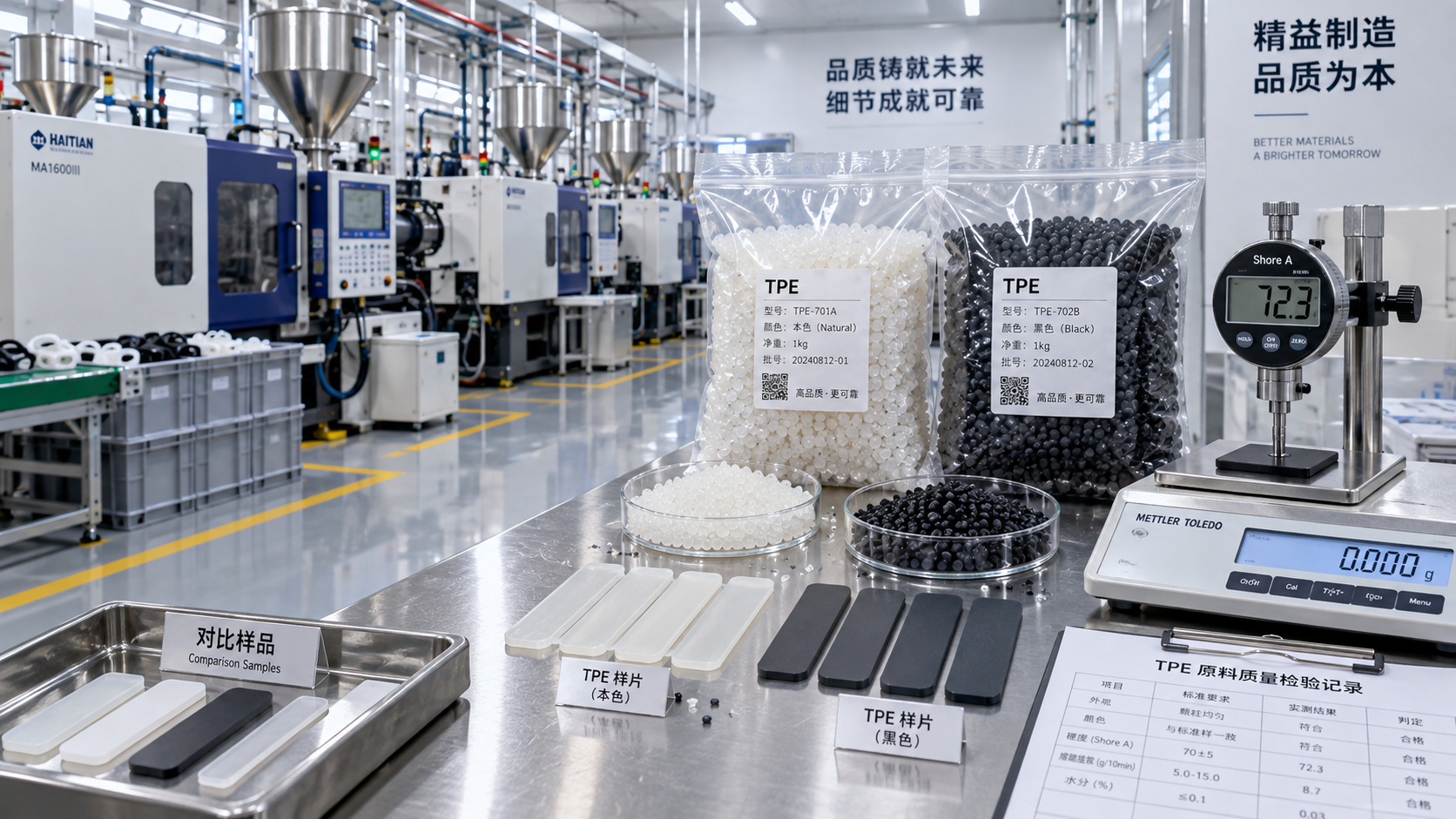
A production line is running smoothly with a familiar thermoplastic elastomer (TPE) grade. Then a new delivery arrives: parts feel slightly softer, the molding window narrows, surface appearance changes, or scrap rates begin to climb. The invoice may show the same grade name, but the material behavior says otherwise.
What should I do if TPE material quality changes between batches? Treat it as a controlled quality incident, not merely a purchasing inconvenience. Confirm the change with comparable test data, quarantine the affected lot, assess the impact on production and finished products, and require a documented explanation from the supplier before unrestricted use resumes. Fast action matters because batch variation can quickly become a molding, compliance, delivery, and customer-claim problem.
TPE is not one single material. It is a broad family that may include styrenic block copolymer compounds, thermoplastic vulcanizates, thermoplastic polyurethanes, copolyester elastomers, and other engineered blends. Small shifts in polymer source, filler loading, oil content, color masterbatch, additives, moisture exposure, or compounding conditions can affect real-world performance. Buyers need a repeatable response that separates normal process variation from a material change that puts the application at risk.
Do not send a suspicious batch straight to production
The most expensive mistake is often made in the first few hours: assuming that operators simply need to adjust temperatures or pressures. Process settings should be reviewed, but they should not be used to hide an unexplained material difference.
When a shipment appears inconsistent, identify the lot clearly and place it in a temporary hold area. Record the supplier’s batch number, receiving date, packaging condition, quantity, resin grade, color, and purchase order reference. If partial quantities have already entered production, trace which machines, shifts, and product codes used the material.
This containment step protects more than the current run. It creates a traceable boundary if finished goods later need to be inspected, reworked, or recalled. For importers and distributors handling multiple warehouses or contract manufacturers, that traceability is particularly important. A mixed pallet, unmarked opened bag, or undocumented regrind stream can make a manageable issue much harder to investigate.
Start with a practical “same-grade” comparison
Compare the questioned batch with a retained sample from a previously approved lot whenever possible. A supplier’s certificate of analysis is useful, but it should not be the only reference. Certificates may show that both lots fall within a broad specification range while still behaving differently in your process.
A receiving or quality team can begin with basic observations:
- Pellet appearance, size consistency, dust level, clumping, and unusual odor
- Bag weight, labeling, seal condition, and evidence of moisture or storage damage
- Color tone, gloss, flow marks, surface tack, and hardness of molded comparison plaques
- Melt behavior during molding or extrusion, including pressure, torque, cycle time, and venting needs
- Dimensional stability, shrinkage, warpage, adhesion, and mechanical feel in the finished part
These checks do not replace laboratory testing, but they can quickly show whether the concern is isolated to a process condition or likely rooted in the raw material.
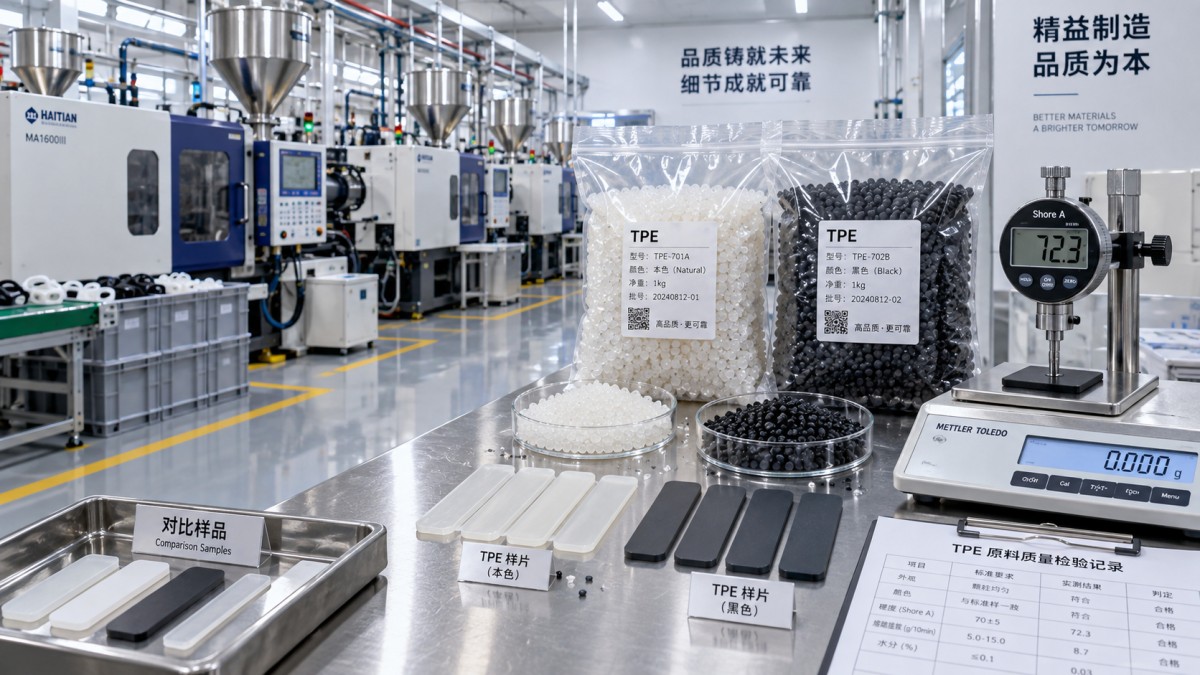
Which TPE properties should buyers test when batches differ?
The right test plan depends on the end use. A soft-touch consumer grip, an automotive weather seal, a medical device component, and an overmolded cable accessory do not fail in the same way. Still, a focused comparison usually begins with the properties most likely to alter processing and functionality.
Do not automatically test every conceivable property. Choose tests tied to the actual failure risk. For example, an overmolding application may require peel or bond testing against the substrate, while a flexible seal may need compression set and fluid-resistance checks. A TPE used near heat sources may require thermal aging or odor/VOC evaluation under the relevant conditions.
Testing must also be comparable. Use the same conditioning time, specimen thickness, test method, equipment settings, and laboratory procedure for both lots. Comparing one supplier certificate with an internally molded part test can produce misleading conclusions because the samples and conditions are not equivalent.
A result can be “within specification” and still be unacceptable
This is one of the most frustrating realities in polymer purchasing. Supplier specifications are often designed to define a grade broadly enough for normal manufacturing variation. A hardness tolerance, for instance, may be acceptable on paper while still creating a noticeable difference in a component that interfaces with another part.
Buyers should distinguish between three levels of control:
- Supplier specification: the published range that defines the commercial grade.
- Agreed purchase specification: the limits, test methods, documents, and change-notification terms written into the commercial relationship.
- Application acceptance criteria: the narrower conditions required for the buyer’s tooling, process, product performance, regulatory obligations, and customer expectations.
If a batch meets the first level but fails the third, it should not be accepted simply because the certificate looks compliant. The evidence should instead be used to refine the second level: the purchasing agreement needs stronger application-relevant controls.
How to speak with the supplier without losing time
A vague complaint such as “the TPE is bad” rarely produces a useful response. Send a concise nonconformance notice supported by facts. Include the lot number, affected quantity, photographs where relevant, comparison results, processing observations, and the specific product or production impact. State whether the batch is on hold, partly consumed, or has entered finished goods.
Ask direct questions:
- Was there any change in raw material source, polymer supplier, oil, filler, additive package, color masterbatch, or recycled-content level?
- Were compounding parameters, production equipment, quality limits, or test methods changed?
- Did the supplier issue a deviation, concession, internal nonconformance, or corrective action record?
- Are other customers or lots potentially affected?
- Can the supplier provide retained-sample results and a lot-specific certificate of analysis?
- What containment, replacement, credit, sorting, or technical support will be provided?
Be careful with an informal assurance that “this is normal variation.” It may be true, but it is not a root-cause analysis. Ask for an explanation of the variation, confirmation of whether future lots are affected, and a corrective action plan with preventive measures. For critical applications, request a joint review involving the supplier’s technical and quality teams rather than relying only on the sales contact.
When process adjustments are reasonable—and when they are not
Some lot-to-lot variation can be managed through normal molding adjustments. A modest change in melt temperature, back pressure, drying practice, or cooling time may restore stable output. That does not necessarily mean the material is defective.
However, process adjustment becomes risky when it causes a meaningful change in part dimensions, bonding performance, appearance, odor, mechanical properties, or compliance status. Do not qualify a new processing window casually if the product is safety-related, customer-specified, regulated, or used in a long-life application. Document any approved adjustment and validate the finished part, not just the ease of molding.
Decide the disposition based on risk, not frustration
Once the data is available, the buyer has several possible paths. The right one depends on the severity of deviation and the application.
Release with controls may be appropriate when the batch meets agreed criteria and trial parts pass all functional checks. In that case, record the conditions under which it was approved and keep the lot segregated in traceability records.
Use in a lower-risk application may be possible when performance is acceptable for a non-critical product, provided contractual terms, product labeling, and customer requirements allow it. This should be a documented decision, not an informal warehouse workaround.
Rework, blend, or return may be considered only with technical approval. Blending inconsistent TPE lots can sometimes reduce variation, but it can also obscure traceability and create a larger volume of questionable inventory. It should never be used as a default fix.
Reject the batch when critical specifications, validated processing behavior, application performance, or required compliance documentation cannot be confirmed. A delayed shipment is painful; a field failure or rejected customer delivery is usually worse.
Prevent the next batch dispute before the next order is placed
Repeated TPE inconsistency is often a procurement-control issue as much as a material issue. A robust sourcing program starts before goods arrive at the dock.
For recurring purchases, maintain an approved material file containing the exact grade, supplier manufacturing site where relevant, color, packaging, target properties, processing guidance, safety documentation, regulatory declarations, and version-controlled technical data sheet. Keep retained samples from approved lots, especially for colors, soft grades, sealing compounds, and overmolding materials where subtle changes can matter.
Your purchase specification should require batch identification and a certificate of analysis for each shipment. It should also define the test standards and units used. “Hardness 70A” alone is incomplete without a tolerance, test method, conditioning requirements, and agreement on whether the stated value applies to pellets, plaques, or finished parts.
For higher-risk programs, add a formal change-control clause. Suppliers should notify the buyer before changing raw material sources, formulation components, production location, manufacturing process, test methods, or packaging that could affect quality. The buyer should retain the right to review samples and approve the change before routine shipment.
Build supplier performance into sourcing decisions
Price and lead time are visible in every quotation. Lot consistency is often discovered only after production begins. When comparing TPE suppliers, ask how they control incoming raw materials, retain production samples, manage formulation changes, investigate nonconformities, and communicate deviations. Request representative lot data rather than relying solely on a single technical data sheet.
For global buyers, logistics conditions deserve attention too. Material exposed to damaged packaging, excessive heat, moisture, or long storage periods may perform differently even if it left the plant in specification. Incoterms, container loading practices, warehouse conditions, and first-in-first-out handling can all influence the consistency experienced by the processor.
The practical takeaway
When TPE quality varies between batches, do not rush to blame the molding machine, accept an unexplained deviation, or mix the lot into general inventory. Isolate it, compare it against an approved reference, test the properties that matter to the application, and demand a documented supplier response.
The immediate goal is to protect current production. The longer-term goal is more valuable: turn a disruptive batch issue into clearer specifications, stronger change control, better receiving inspection, and a supplier relationship based on evidence rather than assumptions. In a material category where small formulation differences can be felt, seen, and measured, that discipline is what keeps a “same grade” purchase genuinely consistent.
Technical Specifications
- Which local safety approvals apply to imported power suppliesAuthor :Electrical Components Editorial Team
- How to choose the right tempered glass panel for safety glazingAuthor :Construction Materials Editorial Team
- When do elastomers outperform thermoplastics in flexible seals?Author :Polymers & Rubber Editorial Team
Expert Insights

Chief Security Architect
Dr. Thorne specializes in the intersection of structural engineering and digital resilience. He has advised three G7 governments on industrial infrastructure security.
Core Sector // 01
Security & Safety
- What Should Buyers Do When TPE Quality Varies Between Batches?Author :Polymers & Rubber Editorial Team

- Which TPE Grade Is Best for Stable Supply?Author :Polymers & Rubber Editorial Team

- What drives the cost of a renewable polydimethylsiloxane production plant?Author :Polymers & Rubber Editorial Team

- What Are Thermoplastic Elastomers and How Do They Compare with Rubber?Author :Polymers & Rubber Editorial Team

- How to Choose Thermoplastic Elastomers for Seals, Grips, and OvermoldingAuthor :Polymers & Rubber Editorial Team