Flat Washers vs Spring Washers: When Should Each Type Be Used?
Author
Date Published
Reading Time
Why the right washer choice changes with the job
Choosing between flat washers and spring washers affects more than a fastener detail. It shapes clamp stability, surface protection, service life, and maintenance frequency.
In real installations, washers work under different loads, materials, and vibration levels. That is why one washer type can perform well in one setting and create problems in another.
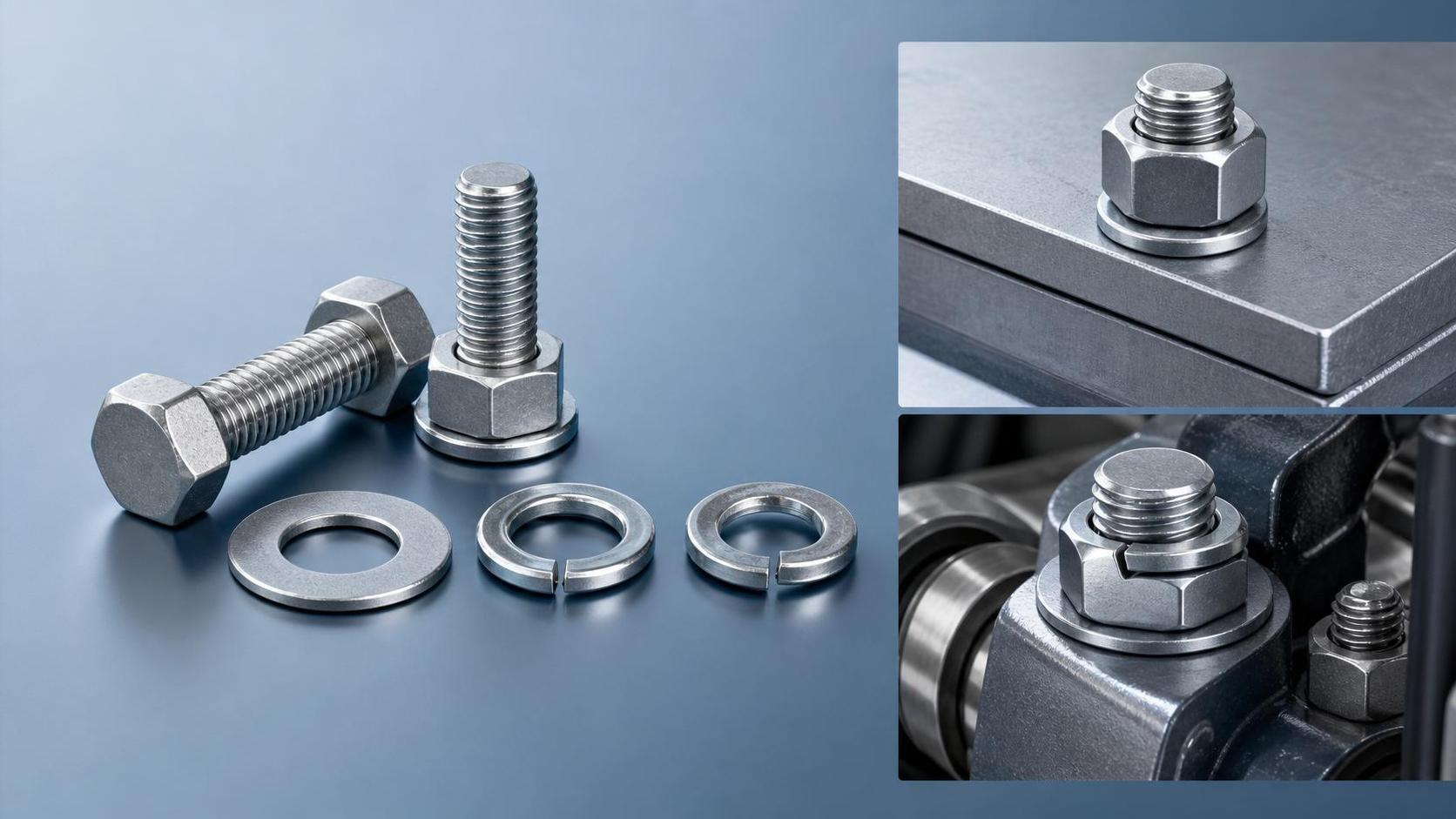
Flat washers mainly spread load and protect contact surfaces. Spring washers mainly add tension resistance in joints where movement or vibration may reduce preload over time.
For anyone tracking product standards, maintenance risk, or sourcing decisions, understanding these differences makes washer selection more reliable and easier to compare across applications.
In practice, the first question is what the joint must resist
Different fastening points fail for different reasons. Some joints damage painted or soft surfaces. Others loosen because of repeated motion, shock, or thermal cycling.
That is why washers should not be selected by habit alone. The better approach is to start with load distribution, vibration exposure, material hardness, and required retention stability.
A flat washer often suits static assemblies, broad bearing surfaces, and softer materials. A spring washer becomes more relevant when the joint faces dynamic conditions and loss of bolt tension.
A quick comparison helps before moving into specific applications
Static structures usually favor flat washers
In steel structures, panels, brackets, and enclosure assemblies, the main need is often even pressure. Here, flat washers support the joint by spreading load under the nut or bolt head.
This matters more when the connected material is aluminum, painted sheet, composite board, or a surface that can deform under concentrated force. Without flat washers, the fastener may sink, scrape, or crack the finish.
A common mistake is assuming thicker washers always solve the issue. In reality, washer diameter, hardness, and fit with the fastener matter more than thickness alone.
Moving equipment often brings spring washers into the decision
On motors, pumps, compressors, agricultural equipment, and transport assemblies, washers face repeated vibration. In those conditions, preload loss becomes a more serious risk than surface marking.
Spring washers are commonly used when the fastening system needs extra resistance to loosening. They help maintain tension by adding elastic force within the joint.
Even so, spring washers are not a universal answer. If vibration is severe, additional locking methods may still be required, such as prevailing torque nuts or thread-locking compounds.
The better judgment is to see spring washers as part of a fastening strategy, not as a complete substitute for proper torque control and joint design.
Where confusion usually starts
- Selecting washers by catalog habit instead of field conditions.
- Treating all vibration environments as identical.
- Focusing on purchase price without considering re-tightening time.
- Ignoring coating compatibility, corrosion exposure, or standards compliance.
Mixed conditions often require a more careful washer setup
Some applications combine soft materials with vibration. Electrical cabinets, HVAC supports, light machinery covers, and modular equipment frames often fall into this middle ground.
In these cases, using only flat washers may protect the surface but do little for loosening resistance. Using only spring washers may hold tension yet damage the contact layer.
The practical answer can be a combined arrangement, depending on standards and assembly rules. But the stack-up must be checked for fit, torque transfer, and available thread engagement.
This is also where sourcing decisions become less straightforward. Similar washers from different suppliers may vary in hardness, finish quality, and dimensional consistency, which changes real performance.
Before final selection, check these application details
A reliable washer choice usually comes from a short technical review rather than a part name alone. The key checks are simple, but they should be done together.
- Confirm whether the joint is static, intermittent, or continuously vibrating.
- Check if the bearing surface is soft, coated, uneven, or appearance-sensitive.
- Review torque level, bolt grade, and available clamping length.
- Match washer material and finish to corrosion and temperature conditions.
- Verify any DIN, ISO, or project-specific fastening requirements.
When these points are documented early, washer selection becomes easier to compare across suppliers, price moves, and substitute options.
The useful rule is simple, but the final check should stay practical
Flat washers are usually the better choice when the priority is load distribution and surface protection. Spring washers are more relevant when vibration and preload retention shape the fastening risk.
Still, the best washer decision comes from the real application, not from a generic label. Similar joints can behave differently once material finish, maintenance access, or movement frequency changes.
Before locking in a washer specification, review the operating condition, fastening method, and replacement cycle together. That small step usually prevents larger problems in service, sourcing, and long-term reliability.
Technical Specifications
- How to test melt flow consistency in batches of recycled plasticsAuthor :Polymers & Rubber Editorial Team
- When does a cast resin transformer need high-altitude derating?Author :Electrical Components Editorial Team
- How to verify Global Industrial Insights sourcing informationAuthor :Industrial Machinery Editorial Team
Expert Insights

Chief Security Architect
Dr. Thorne specializes in the intersection of structural engineering and digital resilience. He has advised three G7 governments on industrial infrastructure security.
Core Sector // 01
Security & Safety
- What to verify before choosing a screw manufacturer in IndiaAuthor :Metals & Fabrication Editorial Team

- How to assess fastener traceability when sourcing in EuropeAuthor :Metals & Fabrication Editorial Team

- What to do when a washer shipment arrives defectiveAuthor :Metals & Fabrication Editorial Team

- Which custom fastener capabilities matter for complex assemblies?Author :Metals & Fabrication Editorial Team

- When do custom fasteners outperform standard parts in equipment design?Author :Metals & Fabrication Editorial Team

- High Tensile Fasteners: Key Grade Checks Before Project ApprovalAuthor :Metals & Fabrication Editorial Team

- Bolts and Nuts Grades Explained for Safer AssemblyAuthor :Metals & Fabrication Editorial Team

- Flat Washers vs Spring Washers: When Should Each Type Be Used?Author :Metals & Fabrication Editorial Team