Which custom fastener capabilities matter for complex assemblies?
Author
Date Published
Reading Time
A complex assembly rarely fails because someone chose the wrong nominal bolt length. More often, trouble begins in the gap between a drawing and production reality: a joint relaxes under vibration, a coating changes thread fit, an unusual head geometry cannot be inspected consistently, or a supplier can make samples but not repeat them at volume.
For technical evaluators, custom fastener capabilities are therefore not a vague supplier-marketing term. They are a practical measure of whether a manufacturer can translate an assembly requirement into a stable, verifiable, scalable fastening solution. The assessment has to go beyond material grade, dimensions, and unit price. It should examine how engineering, forming, machining, thread production, finishing, testing, quality documentation, and supply planning work together.
This matters across industrial equipment, transportation systems, construction hardware, electrical enclosures, energy assets, medical-adjacent devices, and specialized machinery. In each case, the fastener may look like a small line item. Yet it often carries a disproportionate share of the assembly’s reliability risk.
Begin with the assembly, not the fastener drawing
A supplier can quote a custom screw, stud, nut, rivet, pin, or retaining component accurately only when the functional context is understood. Before comparing vendors, technical teams should clarify what the fastener is expected to do once it is installed.
Is the joint structural, sealing-critical, electrically conductive, safety-related, repeatedly serviced, or exposed to corrosive media? Is the load predominantly tensile, shear, cyclic, thermal, or vibrational? Does installation occur on a controlled production line, at a field site, or in a confined service environment? These questions influence the entire specification.
For example, a compact fastener designed for an aluminum housing may need carefully controlled bearing stress and thread engagement to avoid stripping. A fastening point in a high-vibration machine may require a defined locking approach, consistent clamp load, and validated torque-tension behavior. A component installed outdoors may need corrosion resistance that remains compatible with mating materials and local environmental conditions.
When evaluators provide only a legacy part number or a basic dimensional drawing, the supplier is forced to manufacture to incomplete intent. Strong custom fastener capabilities include the ability to ask the uncomfortable but necessary questions before tooling is committed. That is not delay; it is early risk control.
Engineering support should turn requirements into manufacturable geometry
Not every non-standard part needs a long development program. But complex assemblies benefit from a supplier that can distinguish between a truly custom requirement and a familiar design that can be adapted using existing processes. This judgment affects lead time, tooling investment, cost, and repeatability.
Useful engineering support may include drawing review, tolerance-stack discussion, material selection guidance, thread recommendations, head-style evaluation, cold-forming feasibility, machining alternatives, and design-for-manufacture feedback. The important point is not whether a supplier offers every service internally. It is whether the technical response is specific enough to expose trade-offs.
Consider an externally threaded component with an unusual under-head radius and a tight shoulder location. A capable supplier should be able to explain whether cold heading can achieve the intended geometry, where secondary operations are needed, how grain flow may affect strength, and which dimensions are most sensitive during production. If the answer is simply “we can make it,” the evaluator still has little basis for judging risk.
Look for a willingness to challenge dimensions that add cost without improving function. Over-specified corner radii, unnecessarily narrow tolerances, or thread callouts copied from old drawings can make a part harder to produce while delivering no assembly benefit. Good collaboration preserves the function while making the component easier to control.
Tolerance control is a system, not a number on a print
Complex assemblies often contain several interfaces: thread engagement, seating surfaces, clearance holes, washers, mating brackets, coatings, and fixtures. A custom fastener can meet an individual drawing dimension yet still create assembly problems if the supplier does not understand datum strategy and cumulative variation.
Technical evaluators should ask which dimensions are treated as critical-to-function and how they are measured. This is especially relevant for shoulder bolts, captive screws, studs with multiple thread sections, precision pins, special nuts, and fasteners with sealing or alignment features.
- Thread quality: Confirm the relevant thread form, class or tolerance position, gauging method, and treatment of plated or coated threads.
- Length and grip control: Distinguish overall length from effective thread length, unthreaded grip, and usable engagement length.
- Head and bearing geometry: Check seating angle, flange diameter, head height, drive recess depth, and under-head transitions.
- Concentricity and runout: These may be important where a fastener also locates a moving or precision component.
- Coating buildup: A finish can alter dimensions, friction, and fit; it cannot be treated as an afterthought.
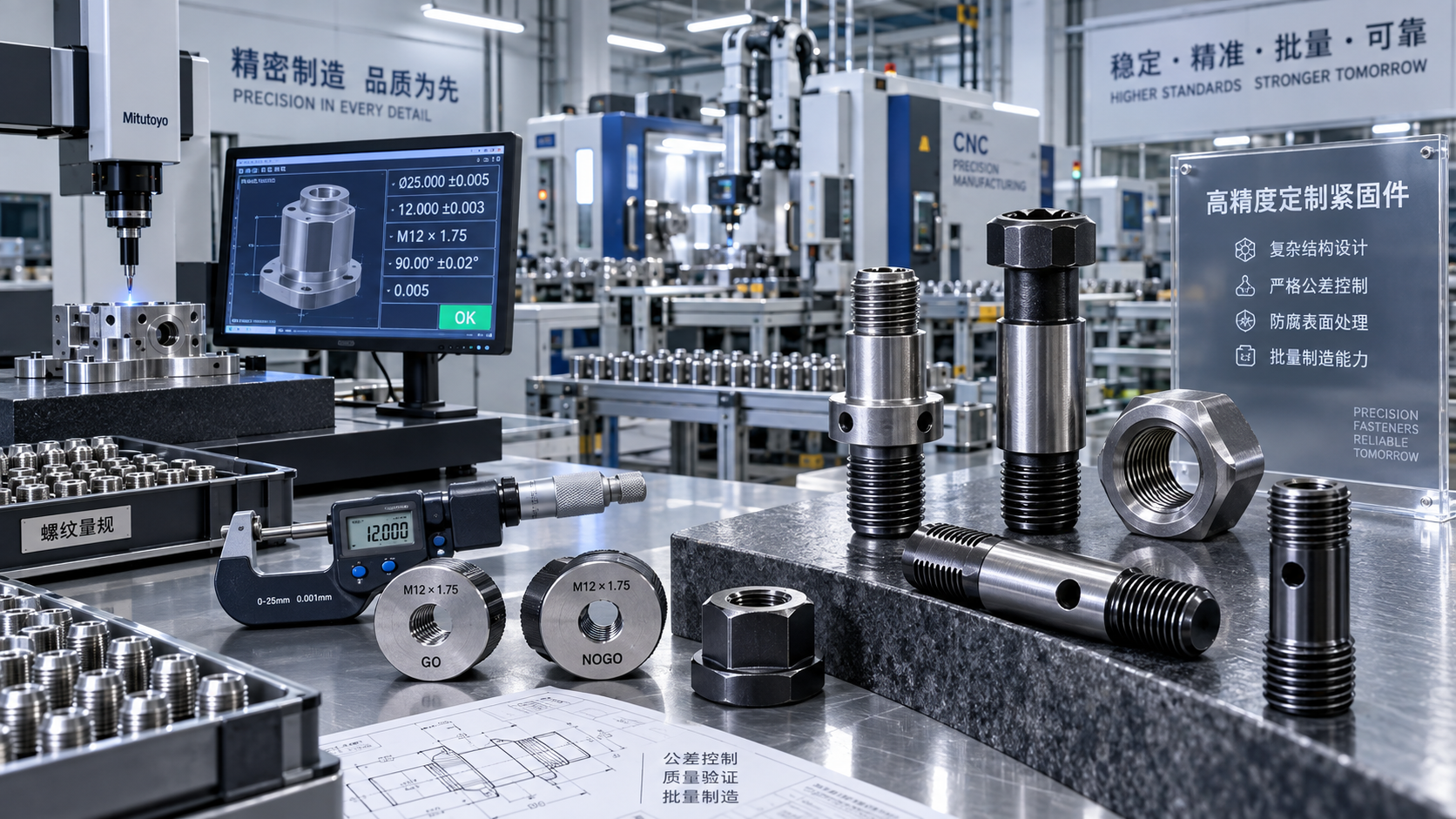
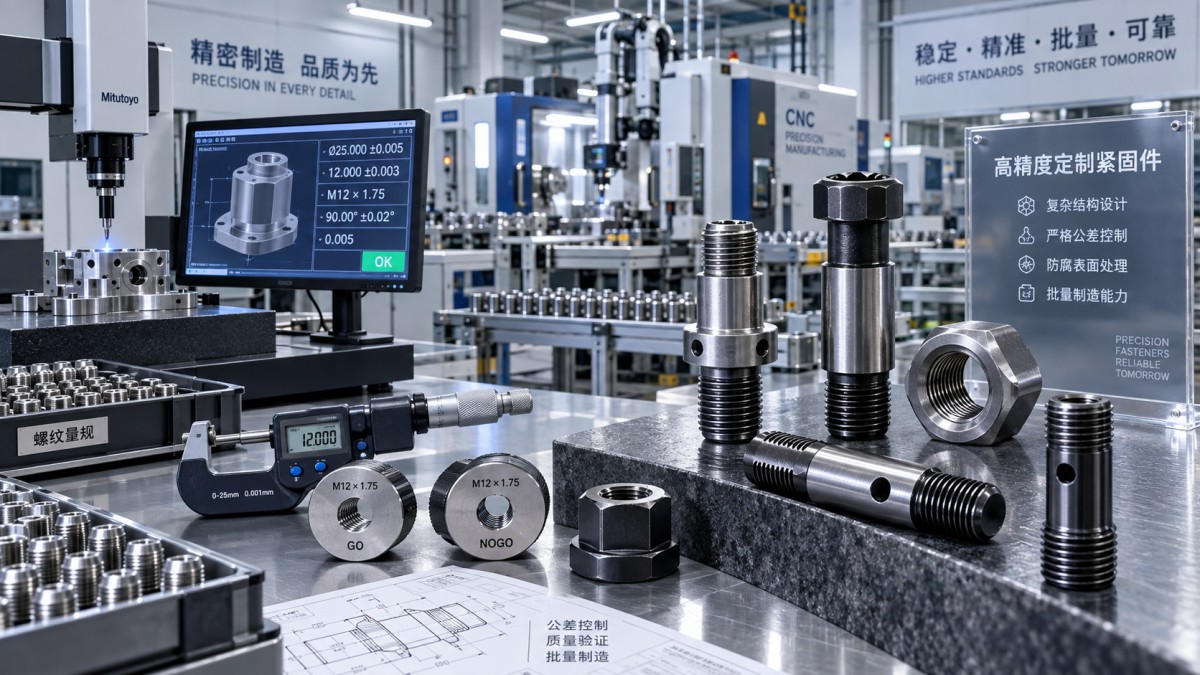
A supplier’s metrology capability should match the risk of the component. Go/no-go thread gauges may be enough for some standard threads, while optical measurement, coordinate measurement, hardness testing, coating-thickness checks, torque testing, or sectioning may be needed for more demanding parts. The goal is not to demand laboratory-level inspection for every item. It is to ensure the inspection plan can detect the failures the assembly cannot tolerate.
Prototype capability matters only when it leads to production learning
Prototype samples are valuable, but they can also create false confidence. A few machined samples may validate fit in a prototype assembly while revealing little about the behavior of a cold-formed, rolled-thread production part. Likewise, a hand-finished sample may look correct but cannot demonstrate that its tolerances will hold through a sustained production run.
When reviewing prototypes, ask what process will be used in serial production and how closely the sample represents it. If production tooling is not yet justified, that is understandable. The supplier should still identify which features may change when the part moves from prototype machining to forming, stamping, heading, thread rolling, or automated secondary operations.
A disciplined development path often includes a drawing review, manufacturability assessment, prototype or first-article samples, inspection reporting, assembly trials, process adjustments, and pilot production before full release. The exact sequence varies by application, but the transition points should be visible. A supplier that treats prototyping and mass production as unrelated activities can leave the buyer with an expensive qualification surprise later.
Material and process choices need to be evaluated together
Material selection is often reduced to a familiar list: carbon steel, alloy steel, stainless steel, aluminum, brass, or a specialty alloy. In reality, the relevant question is whether the material, forming route, heat treatment, and finish collectively deliver the required mechanical and environmental performance.
For high-strength steel fasteners, the route to strength may involve cold forming followed by heat treatment, with careful attention to hardness, ductility, surface condition, and hydrogen-related risks where applicable. Stainless steel may offer corrosion resistance, but grade selection, work hardening, galling behavior, and compatibility with mating threads still need attention. Non-ferrous materials may be selected for conductivity, weight reduction, or corrosion behavior, yet their lower strength or different thermal expansion may shape the joint design.
Manufacturing method also matters. Cold forming can provide efficient high-volume production and favorable grain flow for suitable geometries. CNC machining supports intricate features and lower-volume flexibility, though it may carry different cost and material-use implications. Thread rolling can improve thread surface and strength characteristics in appropriate applications, while cut threads may be necessary for certain materials, dimensions, or special forms. No method is automatically superior; the right process depends on the part’s geometry, performance requirements, and anticipated demand.
Coatings and lubrication deserve their own approval gate
Many sourcing problems appear after a fastener has been “improved” with a corrosion-resistant coating. The assembly then experiences altered torque values, thread interference, inconsistent clamp load, cosmetic variation, or incompatibility with adjacent materials.
Evaluators should treat coating selection as part of joint design. Ask what finish is proposed, why it fits the exposure environment, how thickness is controlled, whether post-treatment affects hardness or dimensions, and how the coating behaves on threads and bearing surfaces. If torque-controlled installation is important, the friction behavior of the coating or added lubricant should be considered alongside the target preload.
There may also be requirements involving salt-spray exposure, chemical contact, electrical conductivity, paint adhesion, appearance, or restrictions on particular substances. These should be defined in the specification and confirmed through applicable documentation rather than assumed from a generic finish name.
Testing capability should reflect failure modes, not a generic checklist
A test report has value when it answers a question that matters to the assembly. Tensile proof, hardness, chemical composition, thread gauge checks, coating thickness, and dimensional inspection are common building blocks, but not every component needs every test at the same frequency.
For a load-bearing fastener, proof load or tensile verification may be central. For a self-locking feature, prevailing torque may deserve attention. For an externally exposed assembly, corrosion testing or coating validation may matter more. Where installation torque is tightly controlled, torque-tension testing can reveal whether the specified tightening procedure produces the intended clamp load. In fatigue-sensitive joints, the design team may require a broader validation approach beyond standard receiving inspection.
The strongest custom fastener capabilities are visible in the connection between identified risks and the proposed control plan. Ask suppliers to explain sampling logic, test methods, acceptance criteria, traceability, and what happens when a result falls outside limits. A vague assurance that parts are “fully tested” is less useful than a clearly defined plan tied to the drawing and application.
Traceability and documentation can determine whether a part is usable
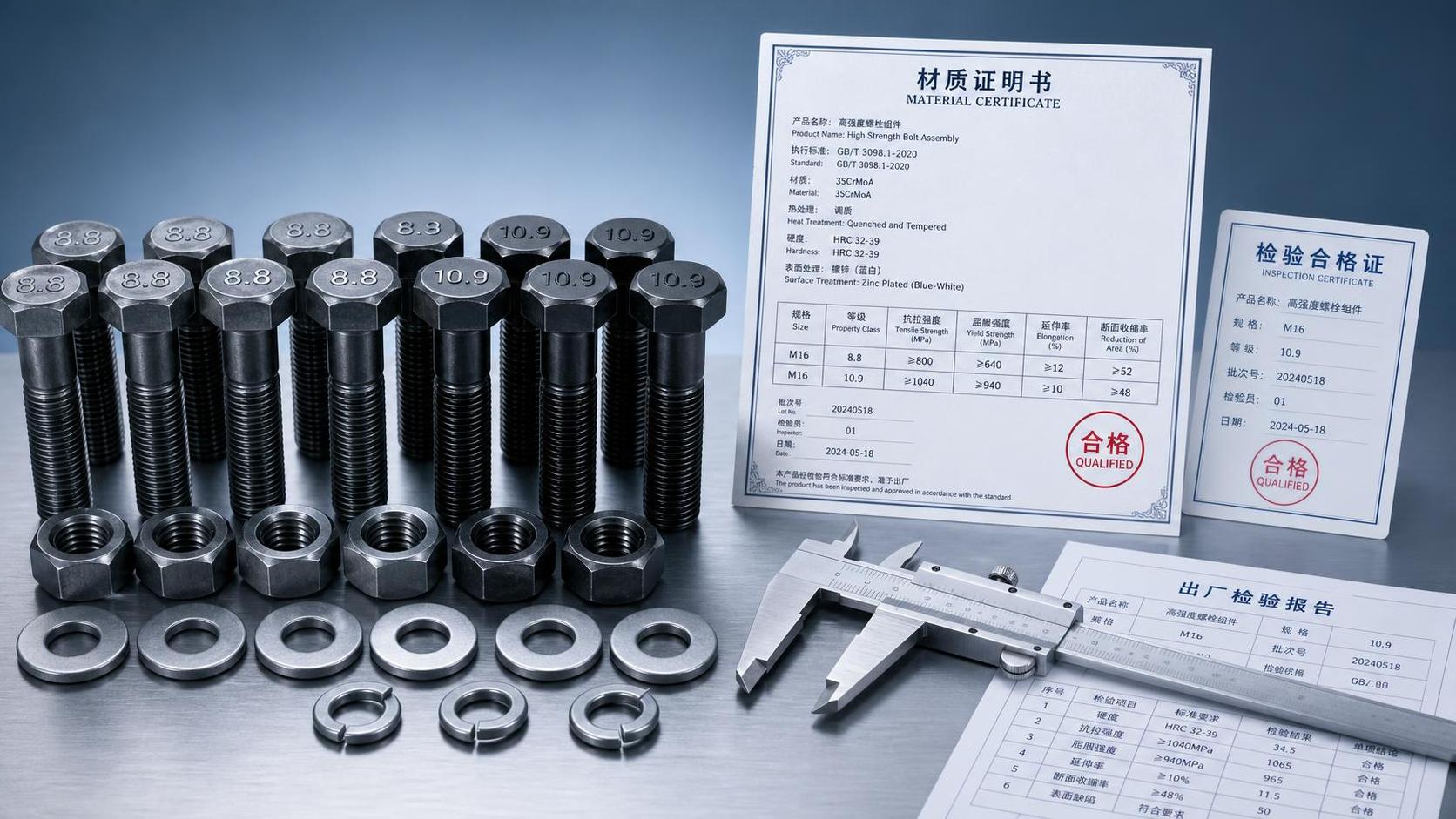
For regulated, safety-sensitive, export-oriented, or quality-managed supply chains, the physical fastener is only part of the deliverable. Material certificates, inspection reports, certificates of conformity, lot identification, process records, and declarations related to material restrictions may all be needed. The exact package depends on the product and destination market.
Technical evaluators should define documentation requirements early rather than asking for them after the first shipment. It is worth confirming whether traceability is maintained by production lot, heat lot, plating batch, or another practical unit of control. For assemblies with multiple operations, the ability to connect raw material, heat treatment, coating, inspection, and final packing records can be especially important.
Standards and certifications should also be interpreted carefully. Compliance with a recognized fastener standard may establish useful baseline requirements, but it does not automatically validate a custom geometry or unique assembly function. Conversely, a custom part may not map neatly to a standard part designation while still requiring disciplined controls and clear customer-specific acceptance criteria.
Compare suppliers through evidence, not capability lists
Supplier websites often present long lists of materials, machines, and industries served. Those lists are a starting point, not a technical qualification. The practical question is whether the supplier can demonstrate experience with a part family of comparable complexity, material behavior, precision, finish, and production scale.
Warning signs are equally revealing. Be cautious when a quotation arrives without technical questions for an unusually complex part; when the proposed material or finish changes without explanation; when critical dimensions are acknowledged but no measurement approach is stated; or when a supplier claims broad certification without clarifying its relevance to the product. These signals do not always mean the supplier is unsuitable, but they justify deeper review.
Scalability includes packaging, lead times, and change control
A fastener program can be technically sound and still cause production disruption if packaging damages threads, mixed lots enter the line, labels are unclear, or replenishment timing is unpredictable. In high-mix assemblies, packaging count and identification can materially affect operator efficiency and error prevention. In automated feeding systems, part cleanliness, orientation, dimensional consistency, and package format may be as important as the basic geometry.
Ask how tooling is managed, what lead-time drivers exist, whether minimum order quantities change after release, and how engineering changes are controlled. A replacement tool, alternate plating source, or revised raw-material availability can affect the finished part. Formal change notification is particularly important where the assembly has been validated around a specific fastening behavior.
For global buyers, logistics visibility adds another layer. Country of origin, shipment consolidation, export documentation, transit risk, and buffer-stock strategy may influence sourcing decisions even when two suppliers offer comparable technical performance. The lowest ex-works price is not always the lowest-risk option for a production-critical component.
A practical decision rule for technical evaluators
When choosing among custom fastener suppliers, prioritize the capabilities that reduce uncertainty at the interfaces: between drawing and manufacturing, coating and thread fit, prototype and production, test report and real application, factory output and assembly line.
The best choice is seldom the supplier with the longest equipment list or the most polished catalog. It is the one that can show how it will control the characteristics that matter to your assembly, document those controls, and maintain them as volumes, finishes, and supply conditions evolve. For complex assemblies, that combination of engineering judgment, process discipline, and transparent communication is what makes custom fastener capabilities genuinely valuable.
Technical Specifications
- What to verify before selecting a transformer manufacturer in the USAAuthor :Electrical Components Editorial Team
- How to choose a cutting machine for stone based on slab thicknessAuthor :Construction Materials Editorial Team
- When are porcelain tiles for outdoor spaces at risk of cracking?Author :Construction Materials Editorial Team
Expert Insights

Chief Security Architect
Dr. Thorne specializes in the intersection of structural engineering and digital resilience. He has advised three G7 governments on industrial infrastructure security.
Core Sector // 01
Security & Safety
- Which custom fastener capabilities matter for complex assemblies?Author :Metals & Fabrication Editorial Team

- When do custom fasteners outperform standard parts in equipment design?Author :Metals & Fabrication Editorial Team

- High Tensile Fasteners: Key Grade Checks Before Project ApprovalAuthor :Metals & Fabrication Editorial Team

- Bolts and Nuts Grades Explained for Safer AssemblyAuthor :Metals & Fabrication Editorial Team

- Flat Washers vs Spring Washers: When Should Each Type Be Used?Author :Metals & Fabrication Editorial Team

- Why Bolted Joints Loosen: Common Washer Selection Mistakes to AvoidAuthor :Metals & Fabrication Editorial Team

- Screw Types Explained for Wood, Metal, and Concrete JobsAuthor :Metals & Fabrication Editorial Team

- How to Avoid Screw Failure in Load-Bearing ApplicationsAuthor :Metals & Fabrication Editorial Team